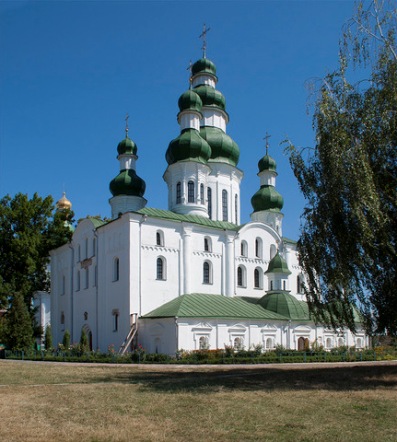
Eletsky Monastery of Chernihiv or Yelets Assumption Monastery is one of the oldest Eastern Orthodox monasteries in Ukraine. It was erected in the middle of the 11th century during reign of prince Svyatoslav Yaroslavich.
Yelets Assumption Monastery (Ukrainian: Yelets
Assumption Monastery) is an Orthodox convent of the Chernihiv
diocese of the Ukrainian Orthodox Church, located in the city of
Chernigov. Historically, it was a male monastery; after the
resumption (since 1992) - female.
One of the first and
richest monasteries of Kievan Rus. The construction of the Cathedral
Cathedral of the Dormition is associated with the name of the
founder of the Olgovichi dynasty, Prince Oleg Svyatoslavich of
Chernigov (d. 1115). This monument has almost completely survived to
our time, although with later layers in the Ukrainian Baroque style.
Foundation and Kievan Rus' Era (Mid-11th to Early
13th Centuries)
According to a well-documented church legend
first recorded in the 17th century by Archimandrite Ioanikiy
Galyatovsky in his book Klyuch Razuminiya (and based on a now-lost
Yeletsky Paterik), the monastery was founded in 1060 by Prince
Sviatoslav II Yaroslavych (fourth son of Yaroslav the Wise), who
ruled Chernihiv at the time and later became Grand Prince of Kyiv.
While hunting on Yelets Hill, the prince and his wife reportedly saw
a miraculous icon of the Mother of God (the Yeletskyi Icon of the
Theotokos, or Bogomater Yeletskaya) glowing on a tall fir tree
(yalyna or spruce). Attempts to remove the icon failed—it repeatedly
returned to the tree—prompting the prince to establish a monastery
dedicated to the Dormition (Assumption) of the Mother of God on the
site. This gave the monastery its name (“Yeletskyi,” from the fir
trees). An alternative tradition links the early monastic presence
to St. Anthony of the Caves (founder of the Kyiv Pechersk Lavra),
who is said to have visited or stayed briefly in Chernihiv around
1069 and possibly inspired cave-dwelling monks here.
The main
church, the Assumption (Uspensky) Cathedral, was likely begun in the
late 11th century and completed in the mid-12th century (scholarly
consensus dates the stone structure to around the 1160s, though
legend claims 1060). It was a monumental three-nave, three-apse,
cross-domed structure about 25 meters high, originally crowned by a
single massive dome and featuring early Romanesque decorative
elements in its brickwork. It dominated the landscape and was
visible from afar. Monks are believed to have initially settled in
nearby caves, some of which may predate those at the Kyiv Pechersk
Lavra. By 1177, the monastery had an abbot named Efrem, indicating
it was already an established spiritual center.
The monastery
served as a princely necropolis and spiritual stronghold during the
Kievan Rus' period.
Mongol Invasion and Long Decline
(1239–Late 15th Century)
In 1239, during the Mongol-Tatar
invasion of Rus', Batu Khan’s forces stormed and burned Chernihiv.
The Yeletskyi Monastery was looted, destroyed, and left in ruins.
The original Yeletskyi Icon was reportedly hidden in the cathedral
wall for safekeeping during the attack. The entire region fell into
deep decline; Chernihiv remained largely depopulated and the
monastery abandoned for nearly two centuries. Archaeological
evidence and historical records show little activity until the late
15th century, when Chernihiv came under Lithuanian and later
Muscovite control.
Revival under Muscovite Rule and
Polish-Lithuanian Conflicts (16th–Mid-17th Centuries)
Restoration
began in earnest in the early 16th century after Chernihiv passed to
the Grand Duchy of Moscow (around the late 15th century). Monks from
Russian monasteries resettled the site, and the complex was
fortified and partially rebuilt. However, the 17th century brought
turmoil due to Polish-Muscovite wars. In 1611, during a Polish siege
of Chernihiv led by Voivode Samuel Hornostai (or “the Ermine”), the
monastery was badly damaged: wooden structures burned, and the
cathedral’s domes collapsed (the fall of the main dome was
reportedly audible across the city). The ancient Yeletskyi Icon was
lost or taken away (one tradition says it was moved to Moscow in
1579 by a descendant of Sviatoslav).
From 1618 to 1648, under
Polish-Lithuanian Commonwealth rule, the monastery was transferred
to the Greek Catholic (Uniate) Church. It was repaired somewhat in
1623, but remained neglected. In 1646, under Archimandrite Kyrylo
Tranquilion-Stavrovetsky, a printing press operated here—the first
book printed in Chernihiv, Perlo Mnogotsinnoe (“The Pearl of Great
Price”), emerged from the monastery. After the Khmelnytsky Uprising
(1648–1657) and the liberation of Chernihiv, the monastery returned
to Orthodoxy in 1649 and became a center of Orthodox revival in the
region.
Golden Age of Ukrainian Baroque Reconstruction (Late
17th–18th Centuries)
The most dramatic transformation occurred
between 1669 and 1688 under Archimandrite Ioanikiy Galyatovsky (a
prominent Ukrainian Orthodox writer and theologian), with support
from Archbishop Lazar Baranovych and generous Cossack patrons,
especially Chernihiv Colonel (later General) Vasyl Dunin-Borkovsky,
as well as families like the Lyzohubs and Polubotoks. The complex
was rebuilt in the Ukrainian Baroque style, giving it the appearance
seen today. The Assumption Cathedral received a new Baroque facade,
additional domes (now five total), and extensive interior work. New
structures included:
Brick monastic cells (the oldest
preserved brick residential buildings in Left-Bank Ukraine).
The
Peter and Paul Refectory Church (17th century), built over the
ancient Yeletskyi Caves.
The 36-meter octagonal gate bell tower
(1670–1675), the oldest high-rise structure in Chernihiv.
The
1689 tomb-church of Colonel Yakov Kindratovych Lyzohub (used as a
library and sacristy).
A brick defensive wall and other
outbuildings.
A wooden house built in 1688 for Archimandrite
Feodosii Uhlytsky (later St. Theodosius of Chernihiv) survives as
the oldest wooden building in the Left-Bank region. The monastery
flourished as a cultural and educational hub, with a library and
scriptorium.
In 1786, Empress Catherine the Great’s
secularization reforms stripped the monastery of its extensive
landholdings (including thousands of serfs, mills, distilleries, and
ferries), reducing it to a first-class monastery with a fixed number
of monks. Major construction largely ceased, though 19th-century
restorations and landscaping occurred (e.g., filling ravines and
building roads).
19th–Early 20th Centuries and Soviet Period
The monastery continued as an active Orthodox house, with an
icon-painting school, library, and school established in the late
19th/early 20th centuries. The Yeletskyi Icon (or copies) was
venerated for recorded miracles.
After the Bolshevik Revolution
and the establishment of Soviet power in Chernihiv (1919–1921), the
monastery was closed in 1921. Buildings were repurposed: cells and
other structures housed Soviet institutions, a philharmonic
(1944–1964), a kindergarten, workshops, and even a military unit.
Parts of the 17th-century wall were demolished for materials in the
1930s. During World War II, German occupation used the site as
warehouses and workshops; the cathedral and cells were burned during
the 1943 retreat. Post-war Soviet restoration was limited and
secular; the complex became part of the Chernihiv
Historical-Cultural Reserve in 1929 and served as a filming location
(e.g., for the 1967 Soviet film Viy).
Post-Independence
Revival and Recent History (1990s–Present)
Ukraine’s independence
in 1991 brought the return of the monastery to the Church. In
1991–1992 it reopened as a women’s convent (Holy Dormition Yeletskyi
Convent). From 1992 until at least the early 2020s it operated under
the Ukrainian Orthodox Church of the Moscow Patriarchate (UOC-MP).
The Assumption Cathedral received a new wooden iconostasis, and the
site was gradually restored as a pilgrimage and tourist destination,
forming part of the Ancient Chernihiv National Architecture and
Historical Reserve (a UNESCO tentative World Heritage site).
In
March 2022, during the Russian invasion of Ukraine, Russian
artillery shelled Chernihiv and directly damaged the monastery:
facades, the 17th-century gate and bell tower, and 11th–17th-century
dome drums were hit. It remains an active convent and national
architectural monument despite the damage.
Dormition Cathedral (Uspensky Sobor / Assumption
Cathedral)
The cathedral, the monastery’s katholikon and dominant
centerpiece, is the oldest and most architecturally significant
building. Construction began at the end of the 11th century and was
largely completed in the first half or mid-12th century. It exemplifies
the Chernihiv school of Kievan Rus’ architecture: a three-nave
(trinefny), three-apsidal, six-pillar (shestystovpny) cross-domed
basilica approximately 25 meters high.
Originally crowned by a single
massive central dome (creating a pyramidal silhouette with lower side
apses), it featured:
A low narthex with choirs (khory) above.
An unusual small baptistery (khreshchalnya) with a semi-circular apse in
the south-western corner of the narthex.
Recessed (perspective)
portals.
Window outlines.
Romanesque-style blind arcature
(arkatura) and monumental semi-columns (pivkolony) on the facades.
The original exterior was covered with a thin layer of plaster
divided into regular quadrangles (squares), emphasizing the rhythmic,
geometric masonry typical of Rus’ churches. Fragments of original fresco
decoration survive inside.
In the 17th century (primarily 1671–1679
under Archimandrite Ioanikii Galiatovsky), the cathedral underwent a
thorough Baroque reconstruction. Three smaller cupolas were added
(resulting in five domes total today), the façades received ornate
Ukrainian Baroque detailing, and a side altar/tomb chapel was attached
on the south side. This chapel, built in 1689 as the burial place of
Chernihiv colonel Yakov Kindratovich Lyzohub (at the order of his son
Yeukhim), consists of two rooms separated by a vestibule (tambour) and
later served as a library and sacristy.
The cathedral’s scale made it
visible across Chernihiv and surrounding villages, serving as a landmark
of Rus’ ecclesiastical power.
Gate Bell Tower (Nadbramna
Dzvinytsya)
Erected in 1670–1675 during the same Baroque revival (on
the site of an earlier wooden tower), this is the oldest high-rise
structure in Chernihiv at 36 meters tall. Its lower tiers originally
served a defensive gate function, while the upper levels house bells
(including one weighing about 160 kg commissioned by the monastery).
Sources describe it as multi-tiered—often four-tiered or hexagonal in
three layers topped by a single dome—with a compact, vertical emphasis
characteristic of Ukrainian Baroque fortifications. It anchors the
western entrance and contributes to the ensemble’s skyline dominance.
Other Structures in the Ensemble
Peter and Paul Refectory Church
(Petropavlivska Trapeza Church): Built in the 1670s, this compact
17th-century church with attached refectory sits above the monastery’s
underground caves and exemplifies Baroque practicality for monastic
daily life.
Monks’ Cells (Keliyi): Three low, one-story brick
buildings (northern, eastern, and south-western ranges) from the 17th
century—the oldest preserved brick residential structures in Left-Bank
Ukraine. They are modest and functional, framing the central courtyard.
Wooden House of Archimandrite Feodosii Uhlytskyi (Theodosius of
Chernihiv): Constructed in 1688 between the cathedral and bell tower,
this single-story wooden residential building is a rare survivor of
Cossack-era timber architecture in the region and the only such
structure preserved in Chernihiv oblast.
Brick Defensive Walls and
Fence: Late 17th-century stone perimeter walls (about 1 km long and
4–4.5 m high) with a western gate emphasize the monastery’s fortified
character during turbulent times.
Ruins of the Abbot’s (Igumen’s)
House: 18th-century remnants that complete the later monastic
infrastructure.
Underground Caves (Yeletskyi Pechery)
Beneath
the complex, in the chalk cliffs of Yeletska Hill, lies a multi-tiered
network of brick chambers, passages, and galleries (some dating to the
12th–17th centuries). A roughly 70-meter underground corridor connects
the cathedral and Peter-Paul Church. Early monks likely settled here
before surface construction, linking the site to broader Rus’
cave-monastery traditions (though claims of pre-dating Kyiv Pechersk
Lavra are debated).
Overall Architectural Character and
Significance
The Yeletskyi Monastery’s architecture illustrates the
continuity and adaptation of Ukrainian sacred building traditions: the
robust, geometrically precise Rus’ forms of the cathedral contrast with
the vertical dynamism, ornate detailing, and integrated defensive
elements of the Baroque additions. The ensemble’s hilltop setting
enhances its monumental presence, creating a unified skyline of domes
and towers visible from the Desna River valley.