Location: Kurortny park Dendrary
Tel. 8622 975 117
Open: 8am- dusk, cable car 8am- 1pm and 2- 7pm daily
Entrance Fee: Adults R200, children R100, cable car: adults R250, children R125
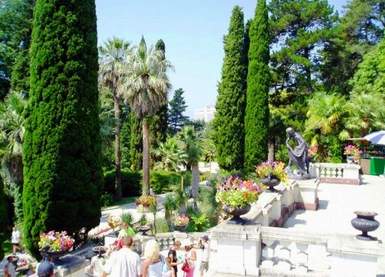
The Sochi Dendrarium, also known as the Sochi Arboretum or Park "Dendrariy," is a renowned botanical garden and protected area in Sochi, Russia. Spanning over 46.4 hectares (approximately 90 football fields), it serves as a living museum of subtropical flora, featuring more than 2,000 species and forms of rare trees, shrubs, and plants from regions like South and North America, Australia, Southeast Asia, and beyond. This park is not only a monument to landscape architecture but also a symbol of Sochi's natural wealth, often referred to as the city's "green heart." It combines exotic greenery with elegant architectural elements, fountains, sculptures, and panoramic views of the Black Sea and Caucasus Mountains, making it an ideal spot for leisurely walks, relaxation, and educational exploration. The subtropical climate of Sochi allows plants from colder climates to thrive here, creating a unique ecosystem that represents "all the forests of the world in one place." As part of the Sochi National Park, it emphasizes conservation, with strict rules prohibiting activities like picking flowers, breaking branches, or walking dogs to preserve its delicate balance.
The origins of the Dendrarium trace back to 1889, when Sergei
Nikolaevich Khudekov—a prominent Russian publisher, playwright, art
collector, and ballet enthusiast—purchased a plot of land on the slope
of Bald Mountain, which was then on the outskirts of what would become
modern Sochi. By 1892, he had established a terraced park and orchard
inspired by 19th-century European designs, importing over 400 species of
plants from nurseries in the Caucasus, Crimea, and Europe. The central
feature was the villa "Nadezhda," named after his wife, Nadezhda
Alekseyevna. Khudekov personally oversaw the park's development,
commissioning cast-iron sculptures and vases from France and designing
elements like the "Cupids" fountain. The park quickly gained fame for
its biodiversity and artistic landscaping.
Following the Russian
Revolution, the property was nationalized in 1922 and placed under the
management of the Sochi Research Station. In 1944, it evolved into the
Sochi Scientific and Research Experimental Station of Forestry and
Forestry Economy. The mid-20th century saw expansions, including new
landscape-geographic zones showcasing plants from various global
regions. A cable car was introduced in 1977 for easier navigation and
later reconstructed. In 2012, the Dendrarium was integrated into the
Sochi National Park under the Russian Ministry of Natural Resources and
Ecology, solidifying its role as a protected scientific and recreational
site.
The Dendrarium is divided into two main sections: the Upper Arboretum
and the Lower Arboretum, separated by Kurortny Prospekt (a major avenue)
and connected by an underground tunnel for seamless access. The Upper
part is larger and more expansive, situated on the hillside, offering
terraced pathways, groves, and elevated viewpoints. It includes 76
species of pines, 80 species of oaks, and 24 (or more, up to 54 in some
counts) species of palms, alongside sequoias over 30 meters tall,
eucalyptus groves, and a "garden of continuous flowering" that ensures
blooms year-round. The Lower part is more compact and water-focused,
with streams, cascades, and reservoirs.
The park's design blends
natural beauty with human artistry: winding alleys lined with snow-white
magnolias, bamboo groves, and sakura trees create a serene atmosphere.
Wildlife adds to the charm, with free-roaming peacocks, ostriches,
squirrels, rabbits, turtles, and beavers, plus aviaries and aquariums.
Architectural highlights include gazebos, fountains, and sculptures that
evoke classical European gardens, all set against the backdrop of the
Black Sea.
The Dendrarium boasts a wide array of attractions that cater to
nature lovers, history buffs, and families:
Flora Highlights:
Explore the sequoia grove, palm alleys, Colchis forest (replicating
ancient Caucasian woodlands), eucalyptus grove (acting as a natural
"inhaler" for respiratory health), bamboo grove, and marmalade tree.
Seasonal blooms include magnolias in spring, roses in summer, sakura in
autumn, and mimosa as early as January.
Villa "Nadezhda": This
historic mansion now houses a museum dedicated to Khudekov, featuring
exhibits on his life, art collection, and contributions to Russian
ballet. It offers guided tours, creative evenings, and displays of
period furnishings.
Water Features and Wildlife: In the Lower part,
enjoy the Maly stream with cascades, ponds with swans, pelicans, and
decorative ducks, and an aquarium showcasing Red Sea marine life like
moray eels, stingrays, and piranhas. An ostrich farm and ornitharium
provide close encounters with birds.
Architectural and Sculptural
Elements: Standout pieces include the Moorish gazebo, gazebo with
eagles, Pueraria gazebo, sculptures of Hippomenes and Atalanta (inspired
by Greek mythology), the "Cupids" fountain (symbolizing love), "Fairy
Tale" fountain with a Swan Princess statue, and the Literary Bench
honoring Russian writers like Pushkin, Tolstoy, Dostoevsky, and Gogol. A
snow-white rotunda marks the main entrance.
Cable Car and Observation
Deck: The 900-meter cable car ascends in about 7 minutes, accommodating
up to 15 people, and provides stunning views of the park, city, sea, and
mountains. At the top, an observation deck for 80 people offers paid
binoculars for enhanced panoramas.
Japanese Garden: A serene area
with sakura trees, a pond with goldfish, and autumn foliage that turns
vibrant shades of red and gold.
A full exploration of both parts
typically takes 3-4 hours, with recommended walking routes starting from
the Upper Arboretum.
Located in the Khostinsky District of Sochi, the Dendrarium's main entrance is at 74 Kurortny Prospekt, easily identifiable by a rotunda with the "Dendrarium" sign and near the "Circus" public transport stop. It's about a 40-50 minute walk from Sochi's central railway station. Public transport is convenient: Numerous buses and minibuses (routes including 2, 3, 12, 19, 22, 23, 41, 50, 86, 87, 88, 94, 95, 103, 120, 121, 37, 38, 43, 45, 48, 83, 98, 113) stop at "Circus" from the city center. From Adler, Khosta, Matsesta, or Krasnaya Polyana, take routes 105, 105s, 125s, or 125p to "Sanatorium Yana Fabritsiusa." Parking is available nearby on Festivalny Square, Deputatskaya Street, or Pushkin Avenue. Taxis or rideshares are also straightforward options.
The park operates year-round, with seasonal variations: Summer hours
are daily from 8:00 AM to 9:00 PM; off-season from 9:00 AM to 6:00 PM;
and winter until 5:00 PM. Ticket offices close one hour before the park.
Always check the official website for updates.
Ticket prices (as of
the latest available data) include:
Standard entrance: Adults 320
RUB, children (7-14) 150 RUB, under 7 free.
Combined with cable car:
Adults 700 RUB, children (7-14) 400 RUB.
Lower Arboretum only: Adults
150 RUB, children 70 RUB.
Guided tours: Additional 200 RUB.
Free entry for certain groups, including children under 7, disabled
persons (groups I and II with one companion), WWII veterans, radiation
disaster victims, Heroes of the Soviet Union/Russia, and large families.
Confirm prices at the box office, as they may fluctuate.
To make the most of your visit, start in the Upper Arboretum (use the cable car for ascent—tickets are valid both ways) and descend through the tunnel to the Lower part. Bring water and light snacks, as there are no on-site cafes, and prepare for warm weather with sun protection. The park has limited benches, so expect an active walk—comfortable shoes are essential. Best times to visit are summer and early autumn for peak blooms, though it's enchanting year-round (e.g., spring sakura or winter mimosa). For a deeper experience, join a guided tour or combine with nearby Sochi attractions like the seaport. If interested in broader sightseeing, consider packages that include boat trips. Respect the rules to help maintain this botanical treasure.