Location: Blida Province Map
Area: 260 km2
Tel. (213.025) 41 64 61
Fax (213.025) 41 63 63
Email: chrea-parc@ifrance.com
UNESCO site
Chréa National Park (Parc National de Chréa, الحديقة الوطنية
الشريعة) occupies a compact but rugged slice of the Blidean Atlas,
the central sector of Algeria’s Tell Atlas. It sits about 50 km
southwest of Algiers and immediately south of Blida, straddling the
wilayas of Blida (about two-thirds of the park) and Médéa.
The
national park itself covers roughly 26,500–26,587 hectares (about
265 km²). The larger UNESCO biosphere reserve (designated 2002)
includes buffer and transition zones and is often cited at
36,985–38,000 ha. Geographic bounds run approximately 36°19'–36°30'
N and 2°38'–3°02' E. The massif stretches about 39–40 km east–west
and 7–14 km north–south.
Location and landscape
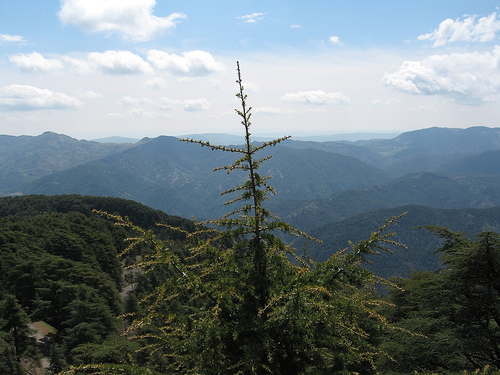
The park sits in the Blidean massif. From
the higher ridges you look north over the Mitidja plain toward the
Mediterranean and, on clear days, Chenoua and the coast. South, the view
drops toward the Titteri high plains. The Chiffa River cuts a dramatic
sandstone gorge that is the classic approach from Blida.
Vegetation
changes with altitude: Aleppo pine and holm oak lower down, then the
signature Atlas cedar stands (plus holly, yew, cork oak, and kermes
oak). Official park data list about 1,152 plant species and 658 animal
species. Emblematic fauna is the Barbary macaque (Macaca sylvanus), plus
wild boar, jackal, fox, genet, and raptors such as golden eagle and
Bonelli’s eagle. The park is also an Important Bird Area.
A smaller
protected area existed from 1925. The modern national park dates from
presidential decree in July 1983. UNESCO biosphere status followed in
2002.
Best time to go
Spring (late March-June): Best overall
for hiking. Mild temperatures, greener slopes, fewer weekend bottlenecks
than midsummer. Wildflowers and active macaques.
Summer: Cool refuge
from the Mitidja heat. Families picnic under cedars. Trails can be dry;
fire risk rises. Weekends and holidays are very busy.
Autumn
(September-early November): Excellent hiking weather, thinner crowds
than summer, still-open roads.
Winter (December-February, sometimes
into March): Snow on the Chréa plateau (~1,500-1,600 m). Sledding and
informal skiing on a tiny slope (about 0.5 km of marked runs). Road ice
is real. Snow years vary.
Weekdays are quieter than Friday-Saturday.
Arrive early on weekends if you want parking and a picnic table.
How to get there
By car (most reliable): Algiers to Blida on the A1,
then the winding RN37 (Route de Chréa), about 18-19 km of hairpins from
Blida up to the station at ~1,550 m. Total from central Algiers is often
1.25-2 hours depending on traffic. In winter, carry chains or use a
vehicle with decent tires. The Chiffa-Médéa road (RN11) also gives
access to the gorge and the classic “Ruisseau des Singes” stop.
Public transport: Train or bus Algiers-Blida, then shared taxi or local
bus toward Chréa. Service is irregular compared with a private car.
Budget extra time.
Télécabine Blida-Chréa: A ~7.1-7.2 km two-section
gondola (Blida - Beni Ali - Chréa), historically one of the longer
urban-to-mountain cableways in the region. It has been closed for long
periods after fires and mechanical problems. A full replacement with
larger cabins has been discussed. Do not plan your day around it unless
you confirm it is running the same week. The road is the backup.
Fees: Many sources report no official park gate fee, or only a token
charge. Ski-lift or refuge fees, if any, are separate. Bring cash for
food stalls and taxis.
What to see and do
Chiffa Gorges and
Ruisseau des Singes. The classic first stop. Red cliffs, the river, a
small cascade, and habituated macaque troops along the road. Do not feed
them. Vehicle strikes on macaques have been a documented problem.
Rangers regularly remind visitors of the ban.
Cedar forests above
Chréa village. The heart of the park. Cool shade, old trunks, picnic
clearings. Good for short family walks and photography.
Named walks
mentioned in local writing (marking quality varies; ask at the visitor
point in Chréa):
Col des Fougères / Chemin des Fougères
Parcours
des Quatre-bancs
Aïn Tirailleur
Areas around Sidi Abdelkader,
Belle-crête, Kerrach, Pic des Trois-moineaux
Higher viewpoints toward
Lalla Khedidja on a clear day
Carry water (2 liters per person is
a safe minimum on longer walks). Trails mix forest soil and rock. Sturdy
shoes matter.
Chréa village and former climate station. Wooden
chalets from the colonial ski-resort era, restaurants, basic refuges,
picnic infrastructure. Summer “forest bathing”; winter snow play. The
old sanatorium has been converted. Views from the plateau over Mitidja
are the payoff.
Winter slope. Tiny compared with the High Atlas or
the Alps. Think sleds, short runs, and the novelty of snow an hour from
Algiers, not a destination ski holiday. Check snow reports; some winters
are thin.
Lac de Dhaya (Tamesguida) is sometimes listed with the
park’s wider circuit if you continue toward Médéa.
Practical
visiting tips
Start early, leave late if you want light and parking.
Sunset from the plateau is worth the wait on a clear day.
Dress in
layers. Mountain air drops fast after mid-afternoon even in summer.
Cash for kiosks. Stock picnic food in Blida markets before the climb.
Pack out all trash. Litter on popular paths (plastic, cans, barbecue
waste) is a recurring complaint.
Do not feed macaques or leave snacks
unattended. Keep dogs under control.
Wildfire is a summer threat.
Obey any access restrictions and never leave a fire unattended.
Winter: ice on RN37, below-freezing nights, limited services if the
cable car is down.
Camping is generally limited to designated or
authorized spots. Check with rangers; do not assume wild camping is
allowed.
Local guides can be arranged in Chréa village for macaque
sites and longer ridges.
Facilities inside the forest are basic.
Bring water, snacks, and a first-aid kit.
Safety and etiquette
The park is a family outing for Algerians from Algiers and Blida, not a
remote wilderness. Still treat it as real mountain terrain: sudden
weather, steep drop-offs in the gorge, and wildlife. Stay on known paths
if you are not with a guide. On weekends the road can clog; drive
patiently on the hairpins.
Respect the biosphere rules. The cedar
stands and macaque population are the reason the site has international
status. Feeding monkeys and leaving waste undermine both.
Ancient and Pre-Colonial Roots
The rugged mountainous terrain of
the Blidean Atlas has been inhabited by Berber (Amazigh) communities for
millennia. These indigenous groups left traces through traditional
pastoral practices, rock carvings, and settlements adapted to the
cedar-covered ridges and gorges (such as the Chiffa gorges and Lake
Dhaya at Tamesguida). The area’s forests provided resources like timber,
game, and medicinal plants long before modern boundaries existed.
During the Roman era (roughly 1st–5th centuries CE), North
Africa—including the Blida region—was part of the Roman provinces of
Mauretania and Numidia. While no major Roman cities lie directly inside
today’s park boundaries, the broader Chréa Valley and surrounding Atlas
foothills feature remnants of Roman roads, fortifications, and influence
tied to agricultural and military networks. Nearby sites (e.g., in the
Mitidja plain or toward Tipaza/Cherchell) reflect this era’s impact,
with the mountains serving as natural barriers and resource zones.
By
the 19th century (pre-French conquest), the cedar forests had already
suffered significant deforestation due to local needs and early colonial
pressures, setting the stage for later protection efforts.
Colonial Era (French Algeria): Early Protection and Tourism Development
(Late 19th–1950s)
French colonial authorities began systematic
interest in the Blidean forests in the late 19th century amid widespread
deforestation. Proposals in 1882 and 1893 to repurchase and reforest
land were initially rejected, but the 1903 forest law and 1910
reforestation service led to expropriations and planting programs.
The modern conservation story starts in 1911–1913:
In 1911,
Blida’s municipal council pushed for a planned summer resort (estivage)
in the Atlas to curb unplanned building and further deforestation.
1912 saw the construction of the first forest house (Hakou Feraoune) and
reforestation of hundreds of hectares.
In 1913, the forest was
officially declared the “Parc National de Chréa” under the impetus of
the Société d’histoire naturelle de l’Afrique du Nord. This was one of
Algeria’s earliest protected areas, initially focused on the cedar
groves (over 3,000 ha on the crest).
A gubernatorial decree on 3
September 1925 formally confirmed and expanded the designation.
Throughout the 1920s–1930s, colonial authorities built infrastructure:
roads (completed to the Col de Chréa by 1924), multiple forest houses,
refuges, and the Hôtel des Cèdres (originally a 1916 skier shelter).
Skiing began in the 1910s–1920s, with lifts and pistes developed by the
1940s–1950s. The area was marketed as the “Algerian Alps” for European
settlers (Pieds-Noirs), attracting thousands for winter sports, summer
escapes, and motor races. By the 1950s, hundreds of chalets existed, and
the station saw record crowds (e.g., 100 buses and 1,000 cars in one
1953 weekend).
Reforestation countered erosion (e.g., major works in
the 1940s via the D.R.S. service, planting thousands of trees and fruit
orchards). However, the park was largely oriented toward settler
recreation, restricting traditional Berber pastoral access. Heavy
snowfall events (1935–1936, 1944) and floods highlighted the area’s
climate variability.
Algerian War of Independence (1954–1962): A
Hidden Revolutionary Role
During the war against French rule, Chréa’s
remote ski station and cedar forests provided cover for the Front de
Libération Nationale (FLN). A secret FLN base operated there, used for
clandestine meetings and logistics. Frantz Fanon—the influential
Martinican psychiatrist and revolutionary theorist who worked in
Blida—frequently visited the Chréa area under the guise of leisure or
medical trips; these excursions facilitated covert FLN activities. His
experiences in the region contributed to his writings on decolonization
(e.g., The Wretched of the Earth). The 1956 creation of a new Chréa
commune and military presence reflected the escalating conflict; by
1962, many European residents and chalets were abandoned as Algeria
gained independence.
Post-Independence: Formal National Park
Status and Modern Protection (1962–Present)
After 1962, the Algerian
state inherited the colonial protected zones but faced immediate
challenges: depopulation of the resort, infrastructure decay, and
pressure on natural resources. In the 1970s–early 1980s, conservation
efforts intensified amid growing awareness of biodiversity loss.
On
23 July 1983, Decree No. 83/461 officially established the Chréa
National Park as a public administrative institution under the Ministry
of Agriculture and Rural Development (Direction Générale des Forêts).
This expanded the protected area significantly to 26,587 ha, overlapping
multiple wilayas and shifting focus from tourism-centric to biodiversity
conservation. (Some English sources cite 1985, likely referring to
operational implementation.) The park’s mandate emphasized protecting
cedar forests, endemic flora, and fauna while allowing sustainable uses
like regulated hiking and limited local resource collection.
Key
milestones:
2002 (or 2003 per some official records): Designated a
UNESCO Man and the Biosphere (MAB) Reserve. This international
recognition highlighted its role as a “poumon” (green lung) for the
Algiers region, buffering the Mitidja plain from steppe climates and
supporting ecosystem services like water purification and recreation.
The park now hosts over 1,150 plant species (including Atlas cedar, holm
oak, cork oak, Aleppo pine) and 658 animal species (notably the
endangered Barbary macaque Macaca sylvanus in the cedar groves, plus
lynx, hyenas, eagles, and vultures). It represents ~34–36% of Algeria’s
flora and 23–25% of its fauna.
Contemporary History and
Challenges
Since the 1980s, Chréa has evolved into a major ecotourism
and winter sports destination (skiing remains popular during rare snowy
winters). Annual visitors reach into the millions, supporting local
economies but creating pressures (overcrowding, waste, fire risks). The
1990s civil war (“Black Decade”) limited access and impacted
conservation, though the park largely retained its core forests. Today,
management balances protection with sustainable tourism, scientific
research, and community involvement (e.g., arbutus berry picking, guided
hikes).
Position in the Atlas system
The Blidean Atlas forms a distinct,
arched barrier between the fertile Mitidja plain to the north and the
drier high plateaus (Titteri) to the south. It is an Alpine-folded range
produced by the collision of the African and Eurasian plates. The park
occupies both the steep northern (Mediterranean-facing) and southern
slopes of this anticline.
Relief and principal summits
The
landscape is highly accidented: steep slopes, deep ravines, sharp
ridges, and hanging valleys. The main crest line oscillates between
1,400 and 1,600 m over a stretch of about 8 km.
Highest point inside
the park is Koudiat (or Pic) Sidi Abdelkader, also called Djebel
Gueroumane, at 1,627–1,629 m. Other notable peaks include:
Djebel
Mouzaia – 1,603 m
Djebel Ferroukha – 1,498 m
Djebel Djamâa Drâa –
1,448 m
Djebel Tamesguida – around 1,200–1,386 m
The mountain
town and ski station of Chréa itself sits near 1,524–1,550 m. Lowest
elevations in the park drop to about 174–217 m in the northern foothills
near the Chiffa gorge and the edge of the Mitidja. The resulting
vertical drop of more than 1,400 m over a short distance creates strong
climatic and vegetation zoning.
From the high ridges one looks north
across the Mitidja toward the sea and Mount Chenoua; on clear days the
view reaches the Tombeau de la Chrétienne. Southward the horizon opens
onto the ochre high plateaus.
Geology
The range consists
mainly of folded and faulted Mesozoic–Cenozoic sedimentary rocks:
Cretaceous limestones and marls, Jurassic sandstones, Lower Cretaceous
shales, and marly limestones. Characteristic black schist outcrops
appear in places. Soils on the forested slopes are typically brown
leached soils developed on schists and quartzite bands.
Hydrography
The park is a major water tower for Algiers, Blida, and
Médéa. The principal drainage is the Oued Chiffa and its tributaries,
which have cut the well-known Gorges de la Chiffa (Monkey Gorge) through
red sandstone and limestone cliffs on the western side of the park.
Numerous springs and seasonal streams feed the system. A small lake, Lac
Dhaya, lies at Tamesguida. Annual precipitation on the higher slopes
historically reached 1,200–1,400 mm, though recent decades have shown
more variability.
Climate and altitudinal belts
The climate is
humid Mediterranean with a strong mountain imprint: wet, relatively mild
winters and a pronounced summer drought. Mean annual temperatures fall
between roughly 8 °C and 11 °C; the summits are cooler. Snow regularly
accumulates above 1,400–1,500 m from December to March, supporting one
of the few natural-snow ski stations in Africa.
Vegetation follows
classic Mediterranean altitudinal zoning:
Lower slopes and foothills:
thermo- and meso-Mediterranean maquis, Aleppo pine, cork oak, holm oak,
and thuja.
Mid-elevations: mixed oak forests.
Highest zone
(supra-Mediterranean, above ~1,300–1,400 m): the iconic Atlas cedar
(Cedrus atlantica) forests that give the park its character.
The
northern slope is generally moister and more forested; the southern
slope is drier and more open.