Location: Bihar State Map
Temple office (0631) 240 2445
Open: daily
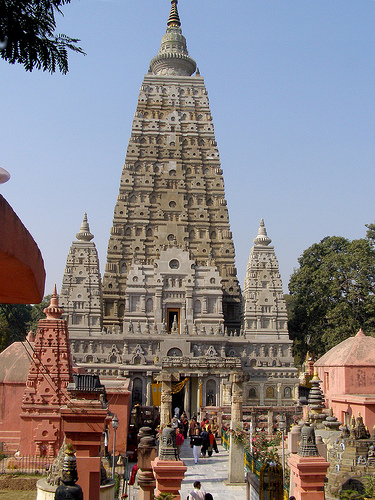
Mahabodhi Temple is a medieval Buddhist temple located in Bihar State in India. The name of this religious complex is translated as the Great Enlightenment or Great Awakening. Buddhist tradition claims that it was here that prince Siddhārtha Gautama achieved enlightenment while sitting under a Bodhi tree. He subsequently received a respectful name Buddha or the Enlightened One. There is little evidence for an existence of this historical figure, but later documents claim that he lived either in the 6th or 5th century BC. Buddhist mythology also claims that this site will be the last to disappear with destruction of the World and will be the first to be recreated when the World will be reborn. The first attempt to mark this spot happened in 250 BC by Buddhist Emperor Asoka. He constructed a diamond throne here and named it Vajrasana. Stupa was constructed in the 5th century AD. During Medieval age religious complex was largely abandoned. Local dynasties that supplied this important religious complex with resources and cheap labor were defeated. It was visited by individuals, but complex was overgrown by a jungle. Only in the late 19th centuries it was re- discovered. Cleaning of the site began under British government and supervision of Sir Alexander Cunningham.
Overall Layout and Complex
The complex covers approximately 4.86
hectares (core zone) within a larger ~12-hectare area, enclosed by
multiple layers of boundaries and circulating passages at different
levels. The site is slightly below surrounding ground level. It features
the main temple in a large open courtyard filled with numerous ancient
votive stupas of varying sizes and shapes, smaller shrines, chaityas,
and monastic remains. Circulation paths allow pradakshina
(circumambulation).
The Bodhi Tree (a direct descendant of the
original) stands adjacent to the rear (west side) of the main temple,
with the Vajrasana positioned under its branches in an integrated space.
Six additional sacred sites mark the seven weeks post-enlightenment:
Animeshlochan Chaitya (gazing at the tree), Ratnachakrama (jewel walkway
marked by stone lotuses), Ratnaghar Chaitya, Ajapala Nigrodh tree/pillar
site, Lotus Pond, and Rajyatana tree site.
Main Temple Structure:
Exterior Design
The Mahabodhi Temple is a towering pyramidal
structure (truncated pyramid or stepped base) with a prominent
curvilinear shikhara (tower) rising approximately 50–55 meters (164–180
feet) high. The base is square, with the tower ascending in diminishing
tiers or recessed levels, creating a rhythmic, soaring profile that
became influential in later North Indian (Nagara-style) temple
architecture, including the use of amalaka (fluted disc) and kalasha
(pot finial) crowning elements.
The surface features:
Receding
tiers/levels with niches housing Buddha images (often in bhumisparsha
mudra).
Alternating circular "cow's eye" windows (gavaksha) or
chaitya arches.
Decorative mouldings with honeysuckle, geese, and
floral motifs.
Four smaller corner towers/shikharas of similar style
atop the parapet, each with Buddha statues in miniature shrine chambers.
The temple faces east, with entrances from the east and north. A low
basement and forecourt lead to the main doorway. The facade includes a
small hall before the sanctum.
Materials and Construction
The
temple is constructed primarily of brick (core, walls, tower), covered
with stucco/plaster for smoothness and detailing—one of the earliest and
finest examples of large-scale brick architecture in India that
survives. Stone elements include the Vajrasana (polished sandstone),
railings (sandstone and granite), and some mouldings/balustrades. Lime
mortar, laterite, and other local materials were also used in various
phases.
Interior and Key Features
The interior sequence
includes:
A forecourt with niches and Buddha statues.
A small
hall.
The sanctum sanctorum housing a large gilded seated Buddha
statue (Pala period, over 5 feet/1.5+ meters high, in earth-touching
mudra witnessing enlightenment).
An upper chamber/shrine for
meditation.
The Vajrasana (Ashokan Diamond Throne) is integrated
near the Bodhi Tree, often considered the symbolic focal point.
Stone Railings and Sculptural Elements
The complex is enclosed by two
sets of stone railings (originally ~2 meters high):
Older
sandstone railings (Sunga period, c. 150 BCE): Intricately carved with
medallions, narrative panels depicting Jataka stories (e.g., Jetavana,
Sibi, Padakusalamanava), animal motifs (elephants, horses, winged lions,
centaurs), devotees, apsaras, Indra, Lakshmi (bathed by elephants),
Surya on chariot, and floral/geometric designs. These resemble carvings
at Bharhut and Sanchi.
Later Gupta-period granite railings: More
decorative with foliate ornaments, small figures, stupas, garudas, and
lotus motifs.
Many originals have been preserved in museums;
replicas stand in situ. These railings represent outstanding early stone
sculptural reliefs.
Architectural Influences and Significance
The design bridges early stupa architecture (stepped base, hemispherical
elements) with the iconic temple form, influencing Buddhist pagoda
traditions abroad and Hindu Nagara shikhara styles. Its brick
construction excellence, layered historical development (Mauryan to
modern), sculptural richness, and direct association with the Buddha's
enlightenment make it architecturally and culturally exceptional (UNESCO
criteria i, ii, iii, iv, vi).
The Mahabodhi Temple (Great Awakening Temple) in Bodh Gaya, Bihar,
India, is the holiest Buddhist pilgrimage site, marking where Siddhartha
Gautama attained enlightenment as the Buddha around the 5th–6th century
BCE (traditionally dated to circa 589 or 528 BCE, though exact
chronology varies).
The site lies along the Phalgu (ancient
Niranjana) River. Siddhartha meditated under a peepul tree (Ficus
religiosa, the Bodhi Tree) for 49 days across seven weeks at specific
spots, achieving bodhi (awakening). These include the first week under
the tree, the second staring at it (Animeshlocha Stupa), the third
walking (Ratnachakrama), and others near shrines, a lotus pond, and
additional trees.
The current Bodhi Tree is a descendant of the
original (propagated from Sri Lanka's Anuradhapura tree, itself from the
original); the site holds deep mythic status as the "navel of the
earth."
Early constructions began in the Mauryan period. Emperor
Ashoka (r. c. 268–232 BCE), after converting to Buddhism post-Kalinga
War, visited circa 250–260 BCE, built the first shrine/monastery,
erected the Diamond Throne (Vajrasana, a polished sandstone slab) at the
exact enlightenment spot, and possibly a memorial pillar (inscription
mentions "bodho" for the Bodhi tree structure). The Vajrasana dates to
the 3rd century BCE and remains in situ under the tree.
During
the Shunga (Sunga) period (c. 185–73 BCE), sandstone railings with
carved panels (Jatakas, Bodhi Tree worship, animals, mythical beings)
were added around the shrine and throne (c. 150–100 BCE); some appear in
reliefs at Sanchi and Bharhut.
The Gupta Empire (5th–6th centuries
CE) produced the main surviving pyramidal brick temple (about 55 m / 180
ft tall, with shikhara tower, niches for Buddha images, and Greco-Roman
influences). It is one of India's oldest surviving brick temples,
evolving from stupa forms to iconic structures. A 150–200 CE plaque from
Kumrahar depicts an early version of this form. Faxian (5th century) and
other pilgrims noted flourishing monasteries.
Pala Empire
patronage (8th–12th centuries) supported Mahayana Buddhism with votive
stupas, sculptures (e.g., Tara, Avalokiteshvara), and international
ties: Burmese kings (e.g., Kyansittha), Sri Lankans, Chinese
(11th-century inscriptions from Song Emperor gifts), and Tibetans.
Decline set in with invasions. Huna raids, early Islamic incursions
(e.g., Muhammad bin Qasim), and especially the 12th–13th-century Turkic
invasions under Bakhtiyar Khilji (c. 1193–1200 CE, sacking Bihar
monasteries) and Delhi Sultanate forces caused destruction and
abandonment. Tibetan pilgrim Dharmasvamin (1234 CE) saw damaged images
hidden for protection; the last known abbot, Sariputra, repaired and
departed in the 15th century. Buddhism nearly vanished in India.
A
Burmese replica exists in Bagan (13th century); Burmese Buddhists
restored parts of the original complex in the 13th and later centuries.
Modern restoration began in the 19th century. The site lay neglected
(used partly as a Shaivite site by local mahants). British archaeologist
Alexander Cunningham and J.D. Beglar led major excavations and
reconstruction in the 1880s, reinstating a large Pala Buddha image,
moving sculptures to a museum, and using replicas for railings. Edwin
Arnold's writings and Sri Lankan monk Weligama Sri Sumangala aided
revival efforts.
Today, the Mahabodhi Temple Complex (4.86 ha) is
a UNESCO World Heritage Site (inscribed 2002 under criteria i, ii, iii,
iv, vi) for its architectural innovation, influence on Buddhist/Hindu
temple design, and direct link to Buddha's life. It remains a vibrant
pilgrimage center managed by the Bodhgaya Temple Management Committee
(Bihar government with international Buddhist representation),
attracting millions. Ongoing maintenance preserves authenticity despite
historical layers.
Debates persist on exact dating (e.g., some
elements possibly 2nd–3rd century CE with Gupta restoration; railing
extensions into Gupta era) based on inscriptions, styles, and
excavations.