Location: Rajasthan State Map
Occupied: 1573- 1783
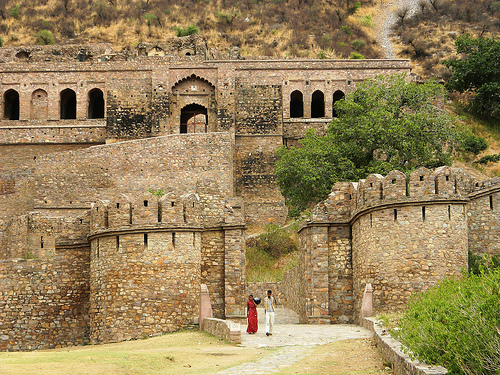
Bhangarg is an abandoned archeological site near modern city of Dausa in Alwar District, Rajasthan State of India. Bhangarg was found in 1573 during rule of Maharaja Bhagawant Das, one of the generals of Mughal Emperor Jalal-ud-Din Muhammad Akbar. Bhangarg was granted by a famous Emperor to the youngest son of one of his generals, Man Singh I. The city grew and prospered until 1783. The legend claims that local Guru Balu Nath had a quarrel with a prince that ruled Bhangarg. He cursed young ruler and all the residents of the city. It was abandoned by its citizens shortly thereafter and never returned. In reality this strange move was forced by famine that struck the region. Descendents of survivors didn't return to Bhangarg, assuming that the city was cursed and evil. Many locals still claim that they see ghosts and strange sounds on the empty streets of the city. Archeological site of Bhangarh is open to the tourists, but it is closed at night. Apparently local security enforced it very strictly.
Construction and Establishment
The fort and town were established
in 1573 AD (Vikram Samvat 1631) by Raja Bhagwant Das, the Kachwaha
Rajput ruler of Amber (part of the later Jaipur state). It was built
specifically as the residence and secondary capital for his second son,
Madho Singh (younger brother of the renowned Mughal general Raja Man
Singh I, one of Akbar's Navratnas).
Some popular accounts attribute
construction or completion to Madho Singh himself or link it loosely to
Man Singh I in the early 17th century (e.g., 1613 or broader
17th-century references), but primary historical consensus and sources
like Wikipedia, ASI references, and Rajputana records point to 1573
under Bhagwant Das for Madho Singh.
The site was chosen strategically
in the Aravalli range to guard trade routes between Jaipur/Amber and
central India, featuring defensive ramparts, inner fortifications, and
multiple gates. Construction used stone and brick, reflecting a blend of
traditional Rajput defensive design with elements influenced by the
Mughal era due to the dynasty's alliances.
Rulers and Peak Period
Madho Singh, who participated in military campaigns alongside his father
Bhagwant Das and brother Man Singh I, established Bhangarh as a
functioning township. His son Chhatra Singh succeeded him but died
around 1630, after which the settlement began a gradual decline.
During its peak in the late 16th and early 17th centuries, Bhangarh
supported a vibrant community with bazaars, havelis (mansions), temples,
and palaces, serving as a prosperous regional center under Kachwaha
Rajput rule aligned with the Mughal Empire.
Decline and
Abandonment
Bhangarh's decline accelerated after the death of Chhatra
Singh. In 1720, as Mughal central authority weakened following
Aurangzeb's death, Sawai Jai Singh II of Jaipur annexed Bhangarh by
force, incorporating it into his state.
The town saw diminishing
population over the 18th century. It became fully uninhabited after the
severe famine of 1783 (Chalisa famine, Vikram Samvat 1840), which
devastated much of North India, including Rajasthan. Additional factors
in some accounts include repeated invasions or raids (e.g., by Marathas
in the late 18th century) and possible earthquake damage, though the
famine is the primary cited trigger for abandonment and relocation of
residents.
By the late 18th century, the site was deserted. During
the British colonial period, it was noted in gazetteers as an abandoned
historical site. Post-1947 independence, the Archaeological Survey of
India (ASI) took over as a protected monument, recognizing its
archaeological and architectural value. No major resettlement occurred,
partly due to entrenched local superstitions.
Architecture and
Key Structures
Bhangarh is one of Rajasthan's best-preserved examples
of a medieval fortified township. It features:
Gates/Entrances:
Multiple gates including the main (often Lahori or Delhi Gate), Ajmeri
Gate, Phulbari Gate, and others, evoking Mughal urban planning
influences. The entrance is marked by an ASI board prohibiting entry
after sunset/before sunrise.
Temples: Several prominent Hindu
temples, including the Gopinath Temple (on a 14-ft raised plinth with
intricate yellow stone carvings), Keshav Rai Temple, Someshwar Temple
(Shiva), Mangla Devi Temple, Ganesh Temple, Hanuman Temple, and others.
Some use Jhiri marble and are styled like cenotaphs.
Royal Palace and
Havelis: The king's palace at the far end on the slope; notable havelis
such as Purohitji Ki Haveli and Nachan Ki Haveli; Jauhari Bazar
(jeweler's market).
Other Features: Fort walls, water reservoirs, a
reported Muslim tomb/maqbara (possibly of a royal son's), and overall
layout showing residential, commercial, and religious zones.
Legends and Curses
Bhangarh's global fame stems from folklore rather
than verified history:
Guru/Baba Balu Nath (or Balnath) curse:
The ascetic permitted construction on the condition that no building's
shadow (especially the palace) fall on his hermitage/retreat. A later
ruler or successor violated this by adding height/columns, prompting the
curse that the fort and town would be destroyed, roofs collapse, and the
site deserted forever. Variations emphasize roofless houses persisting
symbolically.
Tantrik/Sorcerer (Singhia or similar) curse: A black
magician fell in love with Princess Ratnavati (daughter of the ruler).
He enchanted oil/fragrance to make her reciprocate; she discovered the
plot, threw it onto a boulder that rolled and crushed him. In his dying
breath, he cursed the entire kingdom/town to destruction and eternal
desolation, with no one ever living there again. His ghost (and
sometimes the princess's reincarnated spirit) is said to haunt the site.
These tales explain the abandonment in popular imagination, though
historical records attribute it to political, economic (famine), and
military factors. Locals and visitors report eerie experiences, voices,
or apparitions, but these remain anecdotal. The ASI's sunset restriction
(for safety: wildlife in the reserve, structural hazards, poor
visibility) has reinforced the mystique.
Modern Status and
Significance
Bhangarh is a protected ASI monument and popular
tourist/dark tourism site, attracting visitors for its ruins, history,
and legends. It is officially vacant/uninhabited. While pre-historic
traces are occasionally mentioned, the documented history begins in the
16th century. No large-scale excavations have dramatically altered the
understanding of its Rajput-Mughal transitional architecture.
Bhangarh Fort (also known as Bhangarh Fort Complex or ancient
township of Bhangarh) is a 16th–17th century ruined fortified settlement
in the Alwar district of Rajasthan, India, nestled in the Aravalli Hills
at the edge of Sariska Tiger Reserve. It was established around 1573 CE
by Raja Bhagwant Das of the Kachwaha Rajput dynasty (ruler of
Amber/Jaipur) as a residence and capital for his son Madho Singh
(brother of Man Singh I). The site represents a planned medieval Rajput
township that once thrived with palaces, temples, markets, and
residences before being abandoned in the 17th–18th centuries, partly due
to invasions, decline, and local legends of a curse by the ascetic Guru
Balu Nath (who objected to the fort's height overshadowing his
dwelling).
It is now an Archaeological Survey of India (ASI)
protected monument, valued for its architectural and town-planning
insights. Entry is strictly prohibited after sunset (typically 6 PM) due
to safety regulations and its notoriety as one of India's most "haunted"
sites.
Materials and Architectural Style
The complex primarily
uses local sandstone and Alwar quartzite, with Jhiri marble employed in
temples and finer elements for durability and carving detail. The
architecture blends Rajput (Hindu) defensive and residential forms with
Mughal/Islamic influences, reflecting the era's cultural synthesis under
Amber's alliances with the Mughals. Temples follow the Nagara style
(North Indian) with curvilinear shikhara towers, ornate mandapas, and
intricate figurative carvings of deities, dancers, animals, floral
motifs, and mythical figures. Most secular structures lack roofs
(collapsed or never completed in surviving form), exposing walls,
arches, and multi-storied remnants. Passive defense and climate
adaptation include thick walls, strategic hill placement, and water
management via stepwells (baolis) and tanks.
Layout and Defensive
Architecture
Bhangarh is a planned fortified township enclosed by
massive boundary walls with bastions and multiple entry points for
controlled access and defense. The layout follows a linear axial plan:
the main bazaar/market street runs from the primary entrance toward the
elevated royal palace at the far (highest) end, overlooking the entire
settlement for surveillance. The complex includes defensive walls, gates
with anti-elephant iron spikes, havelis lining the streets, temples
clustered near the entrance, water reservoirs, and open courtyards. It
once supported a population of thousands in a prosperous trading and
administrative center.
Gates
Access is through several
fortified gates:
Main entrance (often referred to as Lahiri Gate
or primary Delhi Gate direction) — Imposing structure with spikes for
elephant deterrence, flanked by temples.
Additional gates: Lahori
Gate, Ajmeri Gate, Phulbari Gate, Delhi Gate.
These create
layered defense and direct movement along the main axis. Near the main
gate are clusters of Hindu temples.
Royal Palace
At the
highest point, built into the hillside, stands the royal palace (once
reportedly seven stories tall, now reduced to about four levels due to
ruin). It includes chambers, open courtyards, balconies, and remnants of
residential quarters designed for oversight of the town below. The
palace reflects Rajput grandeur with arched openings, thick sandstone
walls, and strategic elevation.
Religious Structures (Temples)
The temples are among the best-preserved structures and exemplify
Nagara-style architecture with elaborate carvings. Key examples:
Gopinath Temple — Built on a raised 14-ft plinth; highly ornate with
exquisite sandstone carvings, mandapa, and shikhara. Dedicated to
Krishna (Gopinath).
Someshwar Temple (Shiva) — Nagara style enclosing
a Shiv lingam sanctum; adjacent water tank; intricate detailing.
Keshav Rai Temple, Hanuman Temple, Mangla Devi Temple, Ganesh Temple,
and others (including some in cenotaph-like style using Jhiri marble).
Residential Areas, Havelis, and Bazaar
The main street functions
as a deserted bazaar/marketplace lined with ruins of merchant havelis
(mansions) featuring carved doorways, jharokhas (projecting balconies),
arches, and latticework. These grand houses indicate prosperity, with
remnants of two-storied structures, stone pathways, and courtyards.
Stepwells (baolis) and reservoirs supported the community.
Unique
and Engineering Highlights
Water management — Multiple baolis, tanks,
and reservoirs for arid conditions.
Town planning — Grid-like bazaar
axis, separation of palace, religious, and commercial zones.
Conservation challenges — Ruins due to historical decline; ASI maintains
the site with signage, but roofs are largely absent except on temples;
seismic activity and weathering affect sandstone.