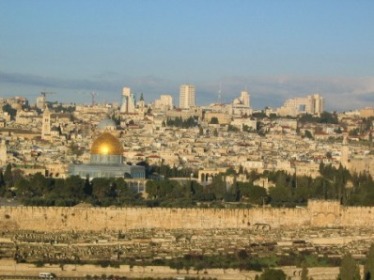
The Dome of the Rock (Arabic: قبة الصخرة, Qubbat as-Sakhrah; Hebrew: כיפת הסלע, Kippat HaSela) is an iconic Islamic shrine located on the Temple Mount (Haram al-Sharif) in the Old City of Jerusalem. Completed in 691–692 CE under the Umayyad Caliph Abd al-Malik, it is one of the oldest extant Islamic monuments and a masterpiece of early Islamic architecture. Its golden dome and vibrant mosaics make it a symbol of Jerusalem’s religious and cultural heritage, revered by Muslims, Jews, and Christians alike due to the site’s multilayered significance.
Umayyad Construction:
The Dome of the Rock was commissioned
by Caliph Abd al-Malik and completed in 691–692 CE, with
inscriptions inside the building confirming the date. It was
built during the Umayyad dynasty (661–750 CE), a period of rapid
Islamic expansion and consolidation. The choice of Jerusalem,
recently captured from the Byzantine Empire in 638 CE, reflected
its spiritual importance as the third holiest city in Islam
after Mecca and Medina.
The shrine was constructed over
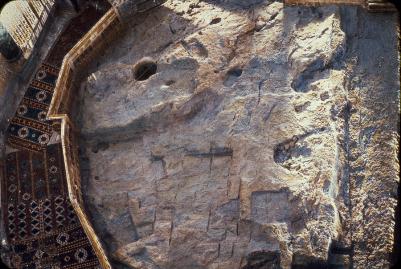
the Foundation Stone (Arabic: الصخرة, as-Sakhrah; Hebrew: אבן
השתייה, Even HaShtiya), a rock believed to hold profound
religious significance. The reasons for its construction are
debated:
Religious Purpose: To commemorate the Prophet
Muhammad’s Night Journey (Isra) and Ascension (Mi’raj), during
which he was transported from Mecca to Jerusalem and ascended to
heaven, as described in the Quran (Surah Al-Isra, 17:1) and
hadiths.
Political Statement: To assert Islamic dominance in
a city sacred to Jews and Christians, possibly as a counterpoint
to Christian churches like the Holy Sepulchre and to rival the
Kaaba in Mecca, controlled by a rebellious faction under Ibn
al-Zubayr.
Architectural Innovation: To showcase Umayyad
wealth and sophistication, drawing on Byzantine and Persian
architectural traditions.
Subsequent History:
Ayyubid
and Mamluk Periods: After Saladin recaptured Jerusalem in 1187,
the Dome was restored and maintained. The Mamluks (13th–16th
centuries) added external mosaics and inscriptions.
Ottoman
Period: Sultan Suleiman the Magnificent (r. 1520–1566) replaced
the original mosaics on the exterior with intricate Iznik
ceramic tiles, many of which remain today. The crescent moon
finial atop the dome was also added during this period.
Modern Era: The Dome has been renovated multiple times, notably
in the 20th century under Jordanian and Saudi funding. The gold
leaf covering the dome was replaced in 1993 with a donation from
King Hussein of Jordan. The site remains a focal point of
religious and political tensions due to its significance to
multiple faiths.
The Dome of the Rock is renowned for its harmonious design,
blending Byzantine, Persian, and early Islamic architectural
elements. Its octagonal plan, centralized layout, and lavish
decoration set a precedent for later Islamic shrines and
mosques.
Overall Structure:
Shape: The building is
octagonal, with a diameter of approximately 20.2 meters (66
feet) and a height of about 35 meters (115 feet) including the
dome. The octagon symbolizes the transition between earth
(square base) and heaven (circular dome), a common motif in
sacred architecture.
Dome: The wooden dome, originally
covered with lead and later gilded with gold leaf, spans 20
meters in diameter. It rests on a circular drum supported by 16
columns and piers, creating a double ambulatory (circular
walkway) around the central rock.
Foundation Stone: The focal
point is the exposed rock, roughly 18 x 13 meters and 1.5–2
meters high, enclosed by a low balustrade. A small cave beneath
the rock, known as the Well of Souls (Bir al-Arwah), is
accessible via a staircase.
Exterior:
Walls: The
octagonal walls are clad in white marble at the lower level and
vibrant ceramic tiles above, added during the Ottoman period.
The tiles feature floral, geometric, and calligraphic patterns
in turquoise, blue, and green, with Quranic verses in Kufic and
Thuluth scripts.
Arches and Windows: Each of the eight sides
has a doorway and seven arched windows, some with stained glass
that filters light into the interior. The arches are supported
by porphyry and marble columns, likely reused from Roman or
Byzantine structures.
Inscriptions: A 240-meter-long Kufic
inscription in blue and gold tiles runs along the upper
exterior, quoting Quranic verses and praising Abd al-Malik
(though later altered to credit the Abbasid Caliph al-Ma’mun).
Interior:
Mosaics: The interior is adorned with intricate
glass mosaics, covering over 1,200 square meters, primarily from
the Umayyad period. These mosaics, executed by Byzantine
artisans, feature vegetal motifs (acanthus leaves, vines,
palmettes), jeweled crowns, and no human or animal figures,
reflecting early Islamic aniconism. The colors—green, gold,
blue—evoke paradise.
Columns and Piers: The central rock is
encircled by 12 columns (four at each cardinal point) and four
piers, supporting the drum and dome. An outer ring of 24 columns
and eight piers forms the ambulatory. The columns are marble,
with gilded capitals.
Inscriptions: A 240-meter Umayyad
inscription in gold Kufic script on a blue background runs along
the inner arcade, containing Quranic verses (e.g., Surah
Al-Ikhlas, 112) and references to Jesus as a prophet, possibly
addressing Christian audiences.
Ceiling and Dome: The inner
dome is decorated with ornate stucco and painted motifs,
restored in later periods. The cave beneath the rock has a
mihrab and simple carvings, possibly predating the shrine.
Engineering:
The structure is built on a raised platform,
with a deep foundation to stabilize it on the uneven terrain of
the Temple Mount. The wooden dome, lightweight yet durable, is
supported by a complex system of beams and braces.
The use of
precise geometry (octagon, circle, and square) reflects advanced
mathematical knowledge, likely influenced by Byzantine
architects familiar with structures like the Church of the Holy
Sepulchre.
Religious Significance
The Dome of the Rock holds profound religious importance,
primarily for Muslims, but also for Jews and Christians due to
the sanctity of the Temple Mount.
Islamic Significance:
Night Journey and Ascension (Isra and Mi’raj): The Foundation
Stone is traditionally associated with Muhammad’s ascension to
heaven during his Night Journey (circa 621 CE). While the Quran
does not explicitly mention Jerusalem, hadiths identify the
“farthest mosque” (Al-Masjid al-Aqsa) with this site. The Dome
commemorates this miracle, though the nearby Al-Aqsa Mosque
later became the primary prayer site.
Sacred Rock: The rock
is believed to be the point from which Muhammad ascended, guided
by the angel Jibril (Gabriel). The cave beneath, the Well of
Souls, is said to house the spirits of the dead or mark a
primordial site of creation.
Third Holiest Site: Alongside
Al-Aqsa Mosque, the Dome makes the Haram al-Sharif the third
holiest site in Islam, a destination for pilgrims, though less
central than Mecca or Medina.
Jewish Significance:
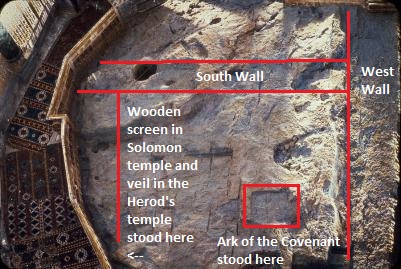
Foundation Stone: In Jewish tradition, the rock is the Even
HaShtiya, the “foundation of the world,” where creation began
(Mishnah Yoma 5:2). It is also identified as the site of the
Holy of Holies in the First and Second Temples, where the Ark of
the Covenant rested.
Temple Mount: The Temple Mount is the
holiest site in Judaism, and the Dome’s location over the rock
makes it a focal point of Jewish longing for the rebuilding of
the Third Temple. However, most rabbinical authorities prohibit
Jews from entering the area to avoid inadvertently stepping on
the Holy of Holies.
Tensions: The Dome’s presence on the site
of the former temples fuels religious and political debates, as
some Jewish groups advocate for access or control, while others
respect the status quo.
Christian Significance:
Historical Context: Early Christians viewed the Temple Mount as
a site of Jesus’ activities, including his teachings and the
cleansing of the Temple (Matthew 21:12–17). The rock was less
central but associated with biblical events.
Byzantine
Influence: The Dome’s design drew on Christian architecture, and
its inscriptions engage with Christian theology, emphasizing
Islam’s view of Jesus as a prophet, not divine.
Crusader
Period: During the Crusader occupation (1099–1187), the Dome was
converted into a church, the Templum Domini, with a cross placed
atop the dome. Saladin restored its Islamic function in 1187.
Cultural and Political Context
The Dome of the Rock is not only a religious monument but also a
cultural and political symbol:
Architectural Influence:
The Dome set a template for Islamic architecture, influencing
structures like the Great Mosque of Damascus and later Ottoman
mosques. Its octagonal plan inspired shrines such as the Dome of
the Chain and mausoleums across the Islamic world.
Its
mosaics and aniconic decoration shaped early Islamic art,
emphasizing calligraphy and vegetal motifs over figurative
imagery.
Symbol of Jerusalem:
The Dome’s golden
silhouette is synonymous with Jerusalem, appearing in art,
photography, and media. It represents the city’s role as a
crossroads of faiths and cultures.
Its image is central to
Palestinian identity, often featured in flags, posters, and
literature, symbolizing resistance and heritage.
Political Sensitivities:
The Temple Mount/Haram al-Sharif is
one of the most contested religious sites in the world.
Administered by the Jordanian Waqf since 1967, it is subject to
a delicate status quo: Muslims pray at the site, while
non-Muslims can visit but not worship.
Incidents, such as
Ariel Sharon’s visit in 2000, have sparked violence (e.g., the
Second Intifada), highlighting the site’s volatility.
Restrictions on Jewish access fuel debates, with some groups
advocating for prayer rights or temple reconstruction.
Archaeological excavations near the Temple Mount, such as in the
City of David, are controversial, with critics arguing they
prioritize Jewish narratives over Islamic ones.
Modern Status
Preservation and Renovations:
The Dome is maintained by the
Jordanian Waqf, with funding from Jordan, Saudi Arabia, and
other Muslim countries. Major renovations occurred in 1959–1964
(dome regilding), 1993 (gold leaf replacement), and 2016–2018
(mosaic and tile restoration).
Seismic risks pose a
challenge, as Jerusalem lies on fault lines. A 2008 earthquake
caused minor ground shifts nearby, prompting studies to
reinforce the structure.
Access and Visiting:
Muslims:
Have unrestricted access for prayer, entering through multiple
gates (e.g., Bab al-Maghariba, Bab al-Qattanin). The Dome is
open during prayer times, especially on Fridays.
Non-Muslims:
Can visit the Temple Mount as tourists, entering only via the
Mughrabi Gate near the Western Wall. Visiting hours are limited:
Sunday–Thursday, 7:30–11:00 AM and 1:30–2:30 PM (summer) or
7:30–10:30 AM and 12:30–1:30 PM (winter). Non-Muslims cannot
enter the Dome’s interior or pray on the Mount, and security
checks are strict.
Restrictions: Religious items (e.g.,
Bibles, prayer books) and visible religious acts are prohibited
for non-Muslims. Modest dress is required (no shorts, sleeveless
tops, or headscarves for non-Muslims unless requested).
Current Challenges:
The Dome remains a flashpoint in
Israeli-Palestinian relations. Proposals to alter access, such
as allowing Jewish prayer, are met with protests from Muslim
authorities and international concern.
UNESCO recognizes the
Old City of Jerusalem, including the Dome, as a World Heritage
Site, but political disputes have led to resolutions criticizing
Israel’s management of the site, sparking diplomatic tensions.
Interesting Facts
Oldest Islamic Monument: The Dome of the Rock is the earliest
surviving Islamic structure, predating most mosques and setting
architectural standards for the Islamic world.
Gold Dome
Origins: The dome was not originally gold but lead-covered. The
gold leaf, first added in the 20th century, was funded by Jordan
and symbolizes divine radiance.
Byzantine Influence: The
Umayyads employed Byzantine craftsmen, evident in the mosaics’
similarity to those in Ravenna or Constantinople, though adapted
to Islamic theology.
Footprint Relic: A slab near the rock,
now in Istanbul’s Topkapi Palace, is said to bear Muhammad’s
footprint from his ascension, though its authenticity is
debated.
Crusader Cross: During the Crusader period, a gilded
cross topped the dome, removed by Saladin in 1187 and replaced
with an Islamic crescent.
Mathematical Precision: The
octagonal plan is based on a circle with a radius equal to the
dome’s diameter, reflecting sophisticated geometric planning.