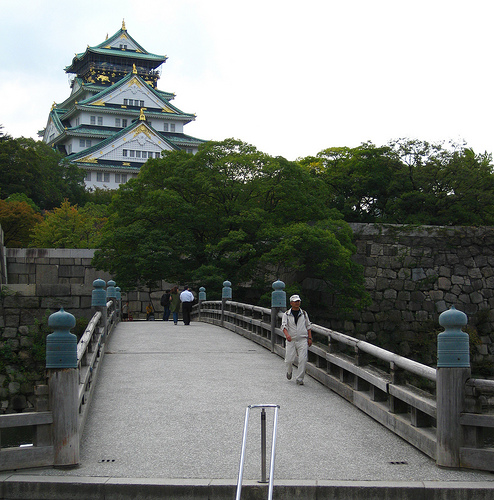
Location: Osaka, Osaka prefecture Map
Osaka Castle (jap. 大坂城) is a five-story samurai castle in the city of
Osaka, Japan, which played a key role in Japanese history in the late
16th and early 17th centuries.
The castle was built in 1585-98 by
General Toyotomi Hideyoshi on the model of Azuchi Castle, which Oda
Nobunaga had built for himself ten years earlier. Hideyoshi tied to
Osaka the most important trade routes of Japan, divided by many years of
civil strife. During his reign, the territory adjacent to the castle
(now the city of Osaka, the second largest in Japan) became the center
of the entire economic life of the country.
The castle with an
area of one square kilometer rises on top of a stone embankment,
designed to protect against attacks by warriors of the sword. Huge
boulders are laid at its base, the largest of which reach six meters in
height and fourteen meters in width. The castle has five floors; three
more underground levels go deep into the embankment. From 20 to 30
thousand people were simultaneously employed in the construction.
In 1614, during the war between Hideyori (son of Hideyoshi) and the
powerful shogun Tokugawa Ieyasu, the castle withstood the siege of
200,000 troops. Tokugawa was unable to take the fortress, but he managed
to fill in the ditches surrounding it, a key element of the Osaka
fortification system. The following year, Hideyori made an attempt to
restore the outer moat and fill it with water. Enraged, Tokugawa sent a
detachment of his warriors to Osaka, who captured the enemy castle.
Hideyori and his mother committed suicide; the place of their death is
marked with a memorial sign.
In 1620, Tokugawa ordered the
rebuilding and expansion of Osaka Castle. In 1665 lightning struck the
main tower and caused a devastating fire. In subsequent years, the
castle was restored, but burned down again in 1868, during the dramatic
events of the Meiji Restoration. The Encyclopedic Dictionary of
Brockhaus and Efron notes that by the beginning of the 20th century,
only ruins remained of the castle, and the remaining premises were
turned into barracks. The main tower (tenshukaku) rose from the ruins
and acquired its modern appearance only in 1931, when the local
authorities carried out a major reconstruction of it using reinforced
concrete.
At the end of World War II, the castle buildings were
damaged by American air raids, but were restored in 1995-97. The
facility is currently open to tourists; the interiors of the main tower
are modern. Adjacent to the castle garden is a stadium where world-class
musicians touring Japan perform.
Osaka Castle (Ōsaka-jō) is one of Japan's most iconic landmarks,
symbolizing the transition from the Sengoku (Warring States) period to
unification under the Toyotomi and later Tokugawa shogunate. Its history
involves multiple constructions, destructions, sieges, reconstructions,
and adaptations from a feudal fortress to a modern museum and park.
Precursor: Ishiyama Hongan-ji (1496–1580)
The site of modern
Osaka Castle was originally occupied by Ishiyama Hongan-ji, established
in 1496 by Rennyo, a key revivalist abbot of the Jōdo Shinshū (Ikkō
sect) Buddhist school, at the mouth of the Yodo River near the Seto
Inland Sea coast in Settsu Province (modern Osaka area), atop ruins of
the ancient imperial Naniwa palace.
It evolved into the primary
temple and fortress for the Ikkō-ikki, leagues of warrior monks,
priests, and commoner devotees who opposed samurai rule and feudal
authority. The complex grew rapidly with devotee settlements, becoming a
heavily defended "temple town" with earthen mounds, fences, moats, and
natural coastal advantages. It featured patrols by priests and the
ability to summon thousands of supporters, bolstered by alliances (e.g.,
Mōri clan supplies) and distractions from warlords like Uesugi Kenshin
and Takeda Shingen against Oda Nobunaga.
Oda Nobunaga's forces
besieged Ishiyama Hongan-ji starting in 1570, enduring for 11 years—the
longest siege in Japanese history—until Abbot Kōsa (Kennyo) surrendered
in August 1580. The complex was then burned (possibly set aflame from
within to deny spoils to Nobunaga), effectively ending the Ikkō-ikki as
a major militant force. Three years later, Toyotomi Hideyoshi built
Osaka Castle on the exact site.
Construction by Toyotomi
Hideyoshi (1583–1597)
Toyotomi Hideyoshi, one of the three great
unifiers of Japan (alongside Oda Nobunaga and Tokugawa Ieyasu), began
construction of Osaka Castle in 1583 as his primary base and a symbol of
power after Nobunaga's death. It was modeled after (and intended to
surpass) Nobunaga's Azuchi Castle, featuring a massive five-story main
keep (tenshu) with three underground levels, gold leaf decorations, and
an expansive layout on a one-square-kilometer inner precinct with raised
stone platforms, burdock piling (cut rock walls), multiple moats (inner
wet/dry sections and a larger outer moat system), gates, turrets
(yagura), and daimyo residences.
The inner donjon was largely
completed by 1585, with full construction finishing around 1597 (some
sources note major completion by 1586 or 1597). Hideyoshi amassed
resources and labor from across Japan, using massive granite boulders
(some bearing daimyo crests) quarried near the Seto Inland Sea and
transported by sea. The castle became the de facto political and
military center during the late Azuchi–Momoyama period, overseeing
Japan's unification campaigns, including invasions of Korea (1592–1598).
Fall of the Toyotomi: Sieges of Osaka (1614–1615)
After
Hideyoshi's death in 1598, the castle passed to his young son Toyotomi
Hideyori (with Yodo-dono as influential mother/regent). Tensions with
the rising Tokugawa Ieyasu (who became shogun in 1603) culminated in the
Sieges of Osaka.
Winter Campaign (1614): Ieyasu's ~200,000 troops
besieged the castle; Toyotomi defenders (~100,000 or fewer) repelled
initial assaults, but Ieyasu negotiated a truce and filled in parts of
the outer moat, weakening defenses.
Summer Campaign (1615): Hideyori
restored some moats, provoking renewed attack. On June 4, 1615, Tokugawa
forces broke through, routing defenders inside the walls. The castle
complex burned, Hideyori and Yodo-dono committed seppuku, extinguishing
the Toyotomi line.
Tokugawa Reconstruction (1619–1630s)
The
Tokugawa shogunate took direct control after briefly considering (then
abandoning) Osaka as capital. Reconstruction began around 1619–1620, led
by engineers like Tōdō Takatora and Kobori Enshū. Old structures were
dismantled; new massive interlocked granite walls (no mortar) were built
using boulders from various daimyo clans. The new tenshu (five stories
exterior, eight interior) was erected starting 1628 and completed 1630,
slightly relocated within the Honmaru (main bailey) since the original
foundation was buried. Reconstruction finished around 1628–1630s.
Many original Toyotomi-era stone walls were concealed or incorporated;
some were rediscovered in the 1950s and are now exhibited (e.g., in the
2025 Toyotomi Stone Wall Museum).
Later Edo Period Events and
Decline
1660: Lightning struck a gunpowder warehouse, causing an
explosion and fire.
1665: Lightning destroyed the tenshu, which was
not rebuilt during the feudal era.
1740: A notable theft of gold from
the castle led to the culprit's execution; it inspired legends linking
to Hideyoshi's era (e.g., Kinmeisui Well).
Mid-19th century neglect;
1843 repairs funded by bakufu with regional donations rebuilt some
turrets.
Meiji Restoration and Modern Era (1868–Present)
In
1868, during the Boshin War and Meiji Restoration, imperial loyalists
captured the castle; many buildings (including Honmaru Palace) burned.
The former Kishū Palace from Wakayama was relocated as an imperial guest
house (later Tenrinkaku).
Under the Meiji government, it became the
Osaka Army Arsenal, producing modern weaponry and expanding
significantly. During WWII, it employed up to 60,000 workers but
suffered heavy damage from U.S. bombing raids (90% of arsenal destroyed
in 1945, killing hundreds).
A ferroconcrete reproduction of the
tenshu was built in 1931 (surviving wartime raids). Major post-war
repairs and restoration in 1997 (approved 1995) recreated Edo-period
external appearance as a museum with elevators and exhibits on Hideyoshi
and castle history. The surrounding Osaka Castle Park (~2 km²) includes
gardens (e.g., Nishinomaru with 600 cherry trees), Osakajo Hall, a
Hideyoshi shrine, and is famous for hanami (cherry blossom viewing).
Today, 13 structures (gates, turrets, walls) are designated Important
Cultural Properties. The castle features prominently in Japanese
culture, media (e.g., films, games like Assassin's Creed Shadows,
literature), and tourism. Its repeated rises from destruction embody
resilience in Japanese history.
Osaka Castle (Ōsaka-jō) is a prime example of Azuchi-Momoyama period
Japanese castle architecture, originally constructed in 1583 by Toyotomi
Hideyoshi on the site of the former Ishiyama Hongan-ji temple in Osaka.
It served as a symbol of power during Japan's unification era, modeled
after (but intended to surpass) Azuchi Castle. The castle complex spans
about 1 km² on the Uemachi Plateau, divided into baileys (kuruwa) like
the Honmaru (inner bailey containing the main keep) and others such as
Yamazato-Maru, with extensive defensive layers of moats, massive stone
walls, gates, and turrets (yagura).
The layout emphasizes defense
through elevation, water barriers, and multi-level stone fortifications.
The castle sits on two raised landfill platforms supported by sheer
cut-rock walls via "burdock piling" (a interlocking technique creating
stable, vertical faces resistant to erosion and attack). It features an
outer moat (partly surviving, originally encircling the site with
sections oriented to cardinal directions) and inner moats (including wet
northern/eastern and dry southwestern portions). The inner grounds,
including the Honmaru, are elevated three levels above the moat water
level, forcing attackers to scale multiple high stone walls and pass
through defended gates and turrets. A dry moat (karabori) surrounds the
Honmaru bailey. The overall park area today covers roughly 2 km²,
incorporating surviving fortifications amid gardens and modern
facilities.
The stone walls (ishigaki) are among the most impressive
and best-preserved features, primarily dating to the Tokugawa
shogunate's reconstruction (1620s onward after the 1615 Siege of Osaka
destroyed much of the Toyotomi-era structures). These walls total about
12 km in length, built without mortar from massive interlocked granite
boulders transported from distant quarries (e.g., Mount Rokko, Seto
Inland Sea islands, Kyushu—up to 420 km away). Around 64 daimyo
contributed, often inscribing their family crests (kokuin) on stones.
The technique achieves near-perfect fitting with minimal gaps,
showcasing advanced 17th-century engineering. Heights vary, reaching up
to 34 meters from the base (24–25 meters above moat water level) on the
east side of the central core—the tallest in Japan. The foundation
employs burdock piling for sheer, stable walls.
Notable megaliths
include the Tako-ishi (Octopus Stone) near Sakuramon Gate: Japan's
largest single castle stone at ~5.5 m high, 11.7 m wide, and ~108 tons
(named for an octopus-like pattern when wet). Near Otemon Gate stand
three giant sheet-like stones, each ~5 m high and 8–11 m wide, carved
from single boulders. Some original Toyotomi-era stones survive
(excavated in the 1950s/1980s and now exhibited, e.g., in the Toyotomi
Stone Wall Museum opened 2025), often buried or overlaid by Tokugawa
reinforcements.
The main keep (tenshu or tenshukaku) dominates the
Honmaru. The current structure is a 1931 ferroconcrete reconstruction
(restored 1995–1997 after WWII damage, registered tangible cultural
property), designed to replicate the Tokugawa-era appearance as a museum
(with elevator). It stands 55 meters tall, with 5 stories visible
externally but 8 floors internally (including functional spaces). It
features white plastered walls with extensive gold leaf decorations—most
notably gilded shachihoko (mythical dolphin-like roof finials) on the
uppermost roof tiers, crouching tiger motifs under railings/balustrades,
and other glittering gold accents. The multi-tiered roofs use
traditional curved eaves (possibly with green-glazed or dark tiles and
copper elements in gables). Originally, the Toyotomi tenshu (completed
~1585) was planned as five stories with three underground levels and
gold-leafed sides; the Tokugawa version (1620s–1630) followed a similar
layout but in a different Honmaru spot and burned in 1665 after
lightning. The keep served dual purposes: peacetime storehouse/residence
support and wartime fortified tower.
Gates and yagura (turrets)
provide layered defense. Key gates include Otemon (southwest main
entrance, Kōraimon style with watari-yagura connecting corridor, loop
holes for firearms, and Important Cultural Property status), Sakuramon
(south inner crossing), and Aoyamon (northeast). Many use masugata
(square courtyard) design to trap attackers. Surviving or reconstructed
original yagura include Sengan-yagura (robust corner turret guarding the
northwest moat area), Tamon-yagura, Inui-yagura, Ichiban-yagura,
Rokuban-yagura, and remnants like Fushimi-yagura and Taiko-yagura. These
multi-story wooden/plastered structures with loopholes and overhanging
eaves enabled surveillance, archery, and gunfire. Other surviving
elements: Enshō-gura (gunpowder storehouse), Kinmeisui Well, and
mud-plaster walls (dob ei).