Location: Saranda
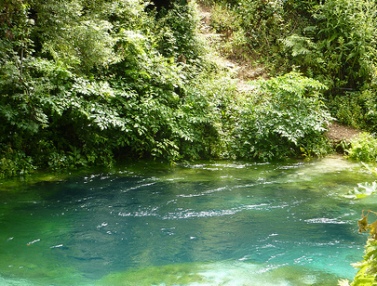
The Blue Eye Spring, known locally as Syri i Kaltër, is a mesmerizing karst spring and natural phenomenon located in southern Albania, near the village of Muzinë in the Finiq municipality of Vlorë County. Situated approximately 22 kilometers (13.5 miles) from the coastal city of Sarandë, this enchanting site resembles a giant human eye when viewed from above, with its deep blue pupil surrounded by lighter turquoise iris-like hues. The spring emerges from an underground cave system, bubbling up with crystal-clear water at a constant temperature of around 10-13°C (50-55°F), creating a hypnotic visual effect that draws thousands of visitors annually. Spanning a protected area of about 293 hectares, it is designated as a Monument of Nature and serves as the source of the Bistricë River, which flows 25 kilometers to the Ionian Sea. Renowned for its striking colors and mysterious depths exceeding 50 meters (165 feet)—with the true bottom yet unexplored—The Blue Eye symbolizes Albania's rich natural heritage and is a must-visit for eco-tourists and adventure seekers.
Geography and Geology
Geologically, The Blue Eye is a Vauclusian spring, formed through karst processes where rainwater percolates through limestone bedrock, dissolving it over millennia to create subterranean channels. The water surges from a vertical shaft at a rate of 6-18 cubic meters per second, depending on seasonal rainfall, maintaining exceptional clarity due to natural filtration. Its vivid blue coloration results from high concentrations of calcium carbonate and other minerals that reflect sunlight, with the darkest shades in the center where the depth absorbs more light. The surrounding landscape features lush Mediterranean vegetation, including oak and sycamore forests, set against the backdrop of the Mali i Gjerë mountains at an elevation of about 152 meters above sea level. The site's hydrology connects to a vast aquifer system, potentially linked to nearby Butrint Lake and the Ionian coast, contributing to its perennial flow even in dry summers.
The Blue Eye Spring, or Syri i Kaltër, has a historical footprint
that intertwines with Albania's ancient past, though it lacks prominent
archaeological ruins directly at the site. Evidence suggests human
activity in the surrounding area dates back to Neolithic times, with the
spring's underground channels potentially supplying freshwater to
ancient Greek and Roman settlements along the Ionian coast—many of which
are now submerged due to rising sea levels. The region's karst
landscape, part of the broader Albanian Riviera, has long supported
human habitation, and the spring's location near the UNESCO-listed
Butrint Archaeological Park underscores its proximity to significant
historical sites, including remnants of Illyrian, Greek, and Roman
civilizations. During antiquity, the area around Delvinë and Sarandë was
influenced by Illyrian tribes, for whom serpents held symbolic
importance in mythology, often representing protection, fertility, or
the underworld—motifs that echo in local folklore tied to the spring.
Engravings of dragons, eagles, and other mythic creatures from this era
are preserved in nearby structures like the Mesopotam Monastery, built
over a pagan temple, highlighting the site's embedded cultural heritage.
In the Ottoman period (15th to early 20th century), the spring was
likely known to local communities as a natural water source, but it
gained no formal historical documentation until modern times. Its
folklore persisted orally among Albanian villagers, featuring in
regional songs and tales passed down through generations. The most
transformative era came during Albania's communist regime under Enver
Hoxha (1945–1991), when the country isolated itself under one of Eastern
Europe's strictest dictatorships. The Blue Eye was designated a
restricted area, accessible only to high-ranking party officials and
elites, including Hoxha himself, who reportedly used it as a private
retreat. This exclusivity inadvertently preserved the site's pristine
condition, shielding it from public exploitation or development during a
time when Albania built over 170,000 bunkers nationwide as part of
Hoxha's paranoid defense strategy—though none are directly at the
spring. The communist era's isolation also meant limited international
awareness, with the site symbolizing the regime's control over natural
treasures.
Post-communism, following the regime's collapse in
1991, the Blue Eye opened to the public in the 1990s, sparking a tourism
boom that revitalized local economies in southern Albania. In 2004, it
was officially declared a Monument of Nature by the Albanian government,
encompassing a protected area of 293 hectares to safeguard its
ecological and cultural value. This status aligns with broader
conservation efforts, including considerations for UNESCO recognition as
part of the Albanian Riviera's natural heritage. Recent advancements, as
of 2025, include archaeological surveys revealing potential prehistoric
ties and modern explorations using robotic drones and 3D mapping to
probe the spring's unexplored depths and subaquatic cave networks. These
efforts highlight ongoing interest in uncovering the site's hydrological
connections to ancient civilizations, while balancing tourism with
sustainability amid growing visitor numbers exceeding 100,000 annually.
Legends of The Blue Eye Spring
The Blue Eye Spring is steeped in
Albanian folklore, with legends that blend mythic creatures, heroism,
and natural explanations, reflecting the region's rich oral traditions.
The most prominent tale is the Legend of the Giant Snake (or Dragon),
which varies slightly across versions but consistently portrays the
spring as the remnant of a monstrous entity's demise. According to the
story, a colossal snake emerged from the Ionian Sea amid a fierce
windstorm, slithering ashore near modern-day Sarandë. It terrorized the
Delvinë area, devouring women and children at a local water source
called Vrisi, then ascending Sopoti Mountain (Mali i Gjerë) to consume
entire herds of sheep and goats, along with shepherds, and ravage crops.
Villagers lived in fear until a wise, brave old man devised a cunning
plan. He loaded a donkey with sacks of dry straw and positioned it near
the snake's cave lair. As the beast approached to devour the donkey, the
man ignited the straw, causing the animal to burn from within the
snake's belly. In excruciating pain, the snake cried out for its mother
(the sea) and sisters (the rivers) to aid it, but they arrived too late.
Writhing in agony, the creature traversed the mountain, carving unusual
parallel lines of trees along the snowline—still visible today as its
"trace." Upon reaching the spring's current location, the snake's
enormous blue eye fell out, overflowing with water that formed the
eternal, bubbling pool. To this day, the spring is said to "cry," its
ceaseless flow symbolizing the beast's unending torment.
Variations of this legend sometimes replace the snake with a dragon or a
hybrid serpent-dragon, emphasizing its child-eating habits and
amplifying the heroic old man's role. These motifs draw from ancient
Illyrian beliefs, where serpents symbolized guardianship and the
chthonic world, as noted by Albanologist Robert Elsie in his work on
Albanian mythology. The tale also connects to broader Balkan folklore,
where dragons often represent natural forces or chaos subdued by human
ingenuity.
Other legends add layers of romance and mysticism. One
recounts that the spring was named by a lovesick engineer who, upon
discovering it, was reminded of his beloved's piercing blue eyes. More
obscure stories speak of the site as a forbidden rendezvous for
star-crossed lovers escaping societal constraints, or as the domain of
scorned fairies and nature goddesses who cursed or blessed the waters.
Some narratives involve slain dragons or doomed monsters whose bodies
provided the bottomless flows, while others portray the spring as a
portal to the underworld, guarding hidden treasures—a notion fueled by
unsuccessful diving attempts, including by Jacques Cousteau, to reach
its depths. The Blue Eye's eye-like appearance also evokes the "Evil
Eye" (Syri i Keq) in Albanian culture, a widespread amulet used to ward
off misfortune, with its blue hues mirroring protective charms worn as
jewelry. These legends, embedded in songs and oral histories for
centuries, underscore the spring's role as a cultural emblem of mystery,
resilience, and the interplay between nature and myth in Albanian
identity.
Biodiversity
The Blue Eye's ecosystem thrives due to its pristine waters and surrounding habitat, supporting a variety of flora and fauna. Aquatic life includes endemic Albanian water frogs, freshwater mussels, and schools of trout that dart through the clear depths, while the river hosts otters and various fish species. Terrestrial biodiversity features Mediterranean shrubs, wildflowers, and trees like plane trees and figs, providing habitat for birds such as kingfishers, herons, and eagles. Insects, including dragonflies and butterflies, abound in the humid environment, and the area's isolation preserves rare plants adapted to karst soils. Conservation measures protect against pollution and over-tourism, ensuring the site's ecological balance.
Attractions and Activities
Visitors access the spring via a short 1.8-kilometer hike from the parking area along a scenic path lined with fig trees and wildflowers. A wooden viewing platform overlooks the eye-shaped pool, offering ideal photo opportunities, while brave souls can jump into the frigid waters from a small cliff—though swimming is challenging due to the cold and strong currents. Nearby, a restaurant serves traditional Albanian dishes like grilled trout and byrek, enhancing the experience. Activities include picnicking, birdwatching, and guided tours exploring the folklore. For adventurers, combining visits with nearby sites like Butrint Archaeological Park or Ksamil beaches creates a full-day itinerary.
Current Status and Tourism
As of 2025, The Blue Eye remains one of Albania's top attractions, welcoming over 100,000 visitors annually, with peak crowds in July and August. Entrance fees are around 300 lek (about €2.50), supporting maintenance, and the site is open year-round, though best visited in spring or early summer for milder weather and fewer people. Challenges include overtourism leading to litter and path erosion, addressed through eco-friendly initiatives like waste management and visitor limits. Accessibility is straightforward by car from Sarandë (30-40 minutes) or bus tours, with electric shuttles introduced in 2024 for sustainability. Overall, The Blue Eye exemplifies Albania's push toward responsible tourism, blending natural beauty with cultural immersion.