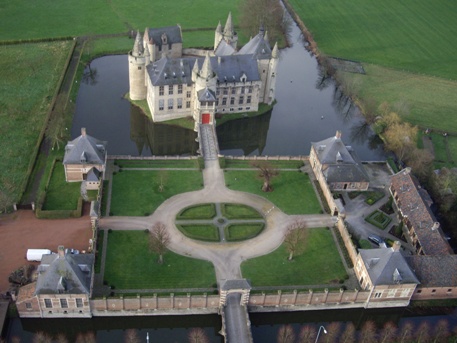
Location: Cortewalle Castle
Zwarte dreef 1
9129 Beveren, East Flanders Map
Constructed: 15th century
Open: Jan 1- Dec 31 by appointment only
Tel. +32 3 750 15 80
Email: toerisme@beveren.be
Cortewalle Castle (Dutch Kasteel Cortewalle) is a palace complex
in the center of the Flemish municipality of Beveren in Belgium.
Built in the 15th century by the Trieste family, ownership passed to
the Counts of Brouchoven de Bergeyck in the 18th century via the
Goubau family, who lived in the moated castle until 1960. In 1966
they sold it to the municipality of Beveren, which now uses the main
building as a venue. The castle also houses a local history museum
and the archives of the Brouchoven de Bergeyck family. The former
depot building including the orangery now serves as a restaurant.
The mansion of the complex has been a listed building since
September 8, 1971.
Origins and Name
The site was originally called Ten Wallen (or Hof
ter Walle), which evolved into the French Cour-ten Walle, hence
Cortewalle. Construction likely dates to the early 15th century, making
it a late medieval structure that transitioned into Renaissance styles.
It is built primarily of white sandstone.
Early History: Triest
Family and Connections to Flemish Masters
The castle was associated
with the Triest family, who were Lords of Walle. It was expanded by Joos
Vijd (also spelled Joos Vijdt), a prominent figure who bequeathed it to
his nephew Joos Triest. Joos Vijd and his wife Elisabeth Borluut are
famous as the commissioners of the iconic Ghent Altarpiece (Het Lam
Gods), painted by Hubert and Jan van Eyck in the early 15th century.
This link ties the castle to one of the most significant works in
Northern Renaissance art.
The Triest family held the property
successively through much of its early history.
17th–18th
Centuries: Goubau Family
In 1671, the castle was sold to Joannes
Francis (Jan-Frans) Goubau, shortly after his marriage to Margaretha
Catharina Gerardi. He was knighted in 1679. The Goubau family maintained
ownership for over a century. Their descendants, particularly in the
18th century, included notable women like the sisters Isabella Maria,
Barbara Francisca, and Joanna Theresia Goubau, who left a mark through
correspondence and management of affairs.
In 1787, the property
passed through marriage to Pieter-Xavier van Brouckhoven (or de
Brouchoven), Count of Bergeyck.
19th–20th Centuries: de
Brouchoven de Bergeyck Era
The de Brouchoven de Bergeyck family
became the most prominent long-term residents, living there until the
mid-20th century. Key figures include:
Count Charles de Brouchoven de
Bergeyck (1801–1875)
Count Florimond de Brouchoven de Bergeyck
(1839–1908)
These owners oversaw major 19th- and early
20th-century modifications that gave the castle much of its current
appearance, including a hanging bridge, a coach house (replacing a
medieval bailey), interior updates (e.g., Verlatzaal and Blauwe Kamer),
and stylistic elements blending Neo-Renaissance and French Empire
influences. The last major pre-sale renovation occurred around 1909
under Count Charles René de Brouchoven de Bergeyck, which expanded the
ground floor.
The castle served as a repository for the extensive and
historically important De Bergeyck family archives. After the death of
the last resident, Countess Joséphine Cornet d’Elzius de Peissant (widow
of a family member) in 1960, the archives were at risk of dispersal but
were later largely reassembled.
Modern Era: Municipal Ownership
The family sold the castle to the municipality of Beveren in 1965 (some
sources note 1966). It was protected as a monument in 1971. The park
(about 10 hectares) is open to the public, while the castle itself is
accessible by appointment or for events.
Restorations continued,
notably from 1979 to 2008, restoring its appearance to that of the final
noble occupancy period. It now functions as office space, a venue for
weddings, cultural events, and guided tours that highlight Beveren's
history. It even served as a filming location for the nostalgic Belgian
TV series Kapitein Zeppos.
Cultural and Historical Significance
Cortewalle stands as a testament to Flemish nobility, art patronage (via
the Vijd/Triest link), and evolving tastes from the 15th to 20th
centuries. The preserved De Bergeyck archives provide valuable insights
into local and noble history. It remains a peaceful landmark in Beveren,
blending heritage with community use.
Overall Layout and Structure
The castle follows a quadrangular
(four-winged) plan surrounding a rectangular inner courtyard. This
layout is typical of late medieval to Renaissance noble residences in
the Low Countries, balancing defense with comfortable living.
Two
main parallel wings (southeast and northwest) are two stories high and
feature prominent stepped gables (also called crow-stepped or Flemish
gables), a hallmark of Flemish Renaissance style.
These are connected
by lower wings on the southwest and northeast sides, creating the
enclosed courtyard.
The entire structure sits directly on a water
moat, emphasizing its original defensive character as a moated castle
(water castle).
The oldest section is the south wing, dating to
around 1416. It includes an octagonal stair tower and remnants of two
small turrets on the upper floor, hinting at its medieval defensive
origins.
Key Architectural Features
Materials: Primarily white
sandstone for the main structure, with slate-shingled roofs throughout.
Later additions include brick elements in ancillary buildings.
Main
Entrance (Northeast Wing): A striking pointed-arch portal flanked by
slender octagonal turrets topped with pointed slate roofs. This creates
a picturesque, somewhat fairy-tale entrance.
Stepped Gables: Elegant
and decorative, typical of Flemish Renaissance, adding vertical emphasis
and visual rhythm to the facades.
Turrets and Towers: The octagonal
stair tower and various conical or pointed-roofed turrets contribute to
the castle's vertical silhouette and defensive aesthetic.
Windows:
Original Renaissance elements were modified over time. The northwest
wing features neo-Gothic pointed-arch windows marking the location of
the castle chapel, added during 19th-century renovations.
Roofs:
Uniform slate shingles with multiple chimneys and decorative elements.
The castle has undergone several restorations and modifications,
particularly in the 19th century and more recently (2007–2008), adapting
it to changing tastes while preserving its core Renaissance character.
Interior Architecture
The interiors largely reflect 19th- and
early 20th-century modifications, overlaying the original structure with
richer decorative elements:
Entrance Areas: Vestibule with a
black-and-white marble checkerboard floor and a stained-glass dome for
natural light.
Notable Rooms:
Verlatzaal (named after artist
Charles Verlat): Features hunting scene paintings and a white marble
fireplace.
Blauwe Kamer ("Blue Room"): Distinguished by blue damask
wall coverings.
Vlaamse Kamer ("Flemish Room"): Includes
stained-glass windows with heraldic designs.
Other features include
extensive wood paneling, intricate carpentry, and detailed stucco work.
The castle also houses the important De Bergeyck family archives.
Ancillary Buildings and Grounds
Originally included a moated
bailey with agricultural buildings (now gone).
Coach House (Remise)
and Orangery on a nearby island, accessible via an early 20th-century
iron suspension bridge. The coach house has brick construction on a
bluestone base with a hipped slate roof.
Set in a beautiful
~10-hectare public landscape park with native and exotic trees,
flowerbeds, and gardens. The castle serves as the centerpiece of this
park today.
Architectural Style Context
Flemish Renaissance
(late 15th–17th centuries) blends medieval Gothic survivals (like
stepped gables, pointed arches, and moats) with Renaissance influences
from Italy and the Low Countries—emphasizing symmetry, decorative
brick/stone work, and comfortable manor-house living over pure
fortification. Cortewalle is a classic example, evolving from a more
defensive medieval structure into an elegant noble residence.
Visiting Tips: Practical Information
Park Access: The park is
public and free, open daily for walking, picnics, and relaxation. You
can circle the castle exterior anytime.
Interior Access:
Individual visitors: Limited. From May to September, free guided tours
on the first and third Sundays (typically starting around 14:00 or
15:00). Check the exact schedule on the official Beveren tourism site
(gemeentebkz.be) as dates can vary.
Groups: Available year-round by
reservation through the tourism office. This is the most reliable way to
see the interior.
The castle is not open for unguided individual
interior visits outside scheduled times.
Duration: Allow 1–2
hours for the park and exterior. A guided interior tour typically lasts
1–2 hours. Combine with nearby Hof Ter Saksen castle/park for a full
day.
Best Time to Visit:
Spring/Summer (May–September) for
gardens in bloom and Sunday tours.
Weekdays or early mornings for
fewer people in the park.
Avoid heavy rain (moat and paths can get
muddy).
How to Get There
Address: Zwarte Dreef 2, 9120
Beveren, Belgium.
By Car: Large parking lot available (Essendreef,
across the street). Easy access from Antwerp or Ghent via major roads.
By Bike: Via nodes 7 and 50 through the park. Belgium’s cycle network
makes this pleasant.
Public Transport: Check local buses/trains to
Beveren; the castle is central but a short walk/taxi from the station
may be needed.
On-Site Facilities
Restaurant/Taverne: In the
historic coach house with orangery. Nice terrace overlooking the castle
— great for Belgian beer, meals, or coffee. Reviews note variable food
quality but excellent location.
Picnics: Allowed in the park (watch
for bird droppings near the moat!).
Events: Check for exhibitions,
concerts, or cultural activities at the castle.
Visitor Tips for
a Great Experience
Guided Tours: Highly recommended. Local guides
share stories of the noble families, Rubens connections (via Hélène
Fourment), and Beveren history. Tours are engaging and informative.
Photography: Excellent opportunities around the moat, bridge, and from
the park. Golden hour (sunrise/sunset) enhances the romantic, fairy-tale
vibe.
Comfort: Wear comfortable shoes for park walking and any stairs
in the castle (attic visit requires good mobility). No specific
accessibility details widely noted, so inquire if needed.
Wildlife &
Nature: Bring binoculars for birds; the park feels peaceful and
immersive.
Combine Visits: Pair with Hof Ter Saksen (nearby) or other
Waasland sites.
Weather Prep: Belgium can be rainy — bring layers and
an umbrella.
Crowds: Generally low-key compared to major tourist
castles. Sundays during tour season are busier.
Dogs: Likely allowed
in the park on leash (confirm locally); not inside the castle.
Nearby
Amenities: Beveren has restaurants and shops; Antwerp (about 20–30 min
drive) offers more options.