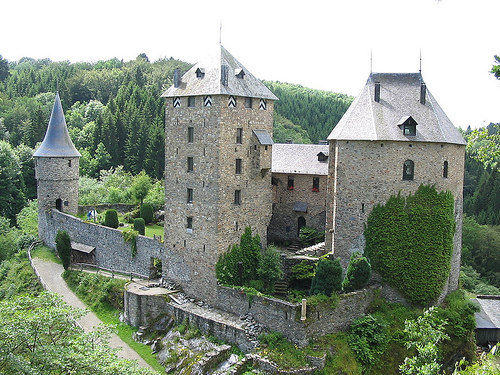
Location: Ovifat Map
Constructed: 1354 by Wenceslaus I, Duke of Luxembourg
Official site
Ticket Cost:
Adult- 6.5 Euro
Children (6- 16 years)- 5 Euro
Reinhardstein Castle is a well preserved fortress in the valley of the Warche bear a town of Ovifat in the municipality of Waimes (Weismes) in the provinve of Liege. Reinhardstein Castle is located in Warche valley in the village of Ovifat in the Ardennes. Medieval fortification was constructed near the strategic river Warche in 1354 by Reinhard of Weismes for his lord, Count Wenceslaus of Luxerbourg. This strategic location with a 60 meter decline makes Reinhardstein Castle the highest in the country. Reinhardstein Castle was inherited by a family Nesselrode, Nassau, Schwartzenberg. Finally it was owned by the counts of Metternich between 1550 and 1812. It was briefly seized in 1795- 98 by the French revolutionary troops. After 1812 Franz Georg Karl Count Metternich- Winnenburg- Beilstein sold Reinhardstein Castle to the state of Prussia. Much of its stones were quarried by the locals in the nineteenth century. Prussian government tried to put an end to this illegal destruction of the citadel. In 1969 reconstruction of Reinhardstein Castle has begun returning the citadel to its original condition.
Position
Reinhardstein is located in the eastern cantons of Belgium in the
vicinity of Malmedy on the soil of the municipality of Waimes below the
town of Ovifat, which belongs to Waimes. Not far away is the High Fens
with the highest point in Belgium and the Signal de Botrange at 694
meters.
Next to Reinhardstein Castle, Belgium's highest waterfall
at 60 meters falls down into the Warchetal.
Origins and Construction (14th Century)
The castle was built in
1354 by Reinhard (or Renaud/Renuwar) of Weismes (Waimes), a vassal of
Wenceslaus of Luxembourg (who was Count of Luxembourg at the time and
later became Duke). The duke granted permission for construction on this
strategic, nearly impregnable rocky spur, which dominated a narrow
valley serving as a key passage toward the Eifel region.
It was
constructed primarily with red brick and white sandstone. Some sources
suggest it may have incorporated or been built near much older
Gallo-Celtic foundations, though this is not definitively confirmed. The
site’s natural defenses made it a formidable fortress from the start.
Ownership Changes and Medieval Period (15th–16th Centuries)
The
Weismes family line ended with the death of John of Reinhardstein
(grandson of the builder) around 1430. The castle then passed through
inheritance and marriages to several noble families:
John of
Zievel (Zivelle): He established the seigneury and court of justice of
Reinhardstein.
Brandscheid (Brandschei) and Nesselrode: Through Agnes
of Zievel’s marriages.
Nassau: Via Catherine (Agnes’s daughter), who
married Adrian of Nassau (Grand Bailiff of Vianden and Burgrave of
Bütgenbach). Adrian played a role in regional conflicts, notably helping
the Prince-Abbot of Stavelot escape threats from the Prince-Bishop of
Liège.
In 1550, the castle entered the hands of the prominent
Metternich family through the marriage of Anne of Nassau to William
(Guillaume) of Metternich. It remained with branches of this Rhineland
noble family until the early 19th century (with a brief interruption).
Metternich Era and Decline (16th–19th Centuries)
The Metternichs,
a powerful family in the Holy Roman Empire, held the castle for over 250
years. Notable figures include:
Various counts such as
Philip-Emerich, Francis-Ferdinand, and others.
Francis-George-Charles, Count of Metternich-Ochsenhausen (father of the
famous Austrian Chancellor Klemens von Metternich, key figure at the
Congress of Vienna).
During the French Revolution, the castle was
confiscated by revolutionary authorities (1795–1798) but later returned.
In 1812, Francis-George-Charles sold it to a building materials dealer,
intending for it to be quarried for stone.
From 1815 to 1919, the
area was under Prussian control. Prussian authorities halted the
demolition and made early efforts to protect the monument. After the
Treaty of Versailles (1919), the region became part of Belgium (as part
of the "redeemed cantons" around Eupen-Malmedy). In the 19th century,
quarrying and neglect reduced the castle to ruins, with treasure hunters
further damaging it after rumors of hidden gold and silver.
20th
Century Restoration
The castle’s fortunes turned in the mid-20th
century. In 1965, the Conseil de Défense du Château de Reinhardstein
acquired it. Professor Jean Overloop (a university professor) led a
meticulous reconstruction starting around 1969, using rare 14th-century
documents to restore towers, parapet walks, and other features as
authentically as possible. The work was largely completed by 1971.
Overloop lived in the restored castle until his death in 1994. His wife
and daughter later donated it to a non-profit organization, ensuring its
preservation as a cultural site.
Modern Day
Today,
Reinhardstein Castle is open to the public with guided tours (typically
1 hour), featuring furnished rooms, armor, tapestries, a knights’ hall,
guards’ room, chapel, and apartments. It hosts medieval animations,
events, and activities like archery. The site blends history with
tourism in the Ardennes landscape.
Location and Regional Context
The castle is located in the village
of Ovifat (part of the municipality of Waimes), in the Liège Province of
Wallonia, eastern Belgium, near the German border. Its coordinates are
approximately 50.452°N 6.102°E.
It sits at the heart of the Hautes
Fagnes (High Fens or Hohes Venn) region — Belgium’s largest nature
reserve and a plateau area transitional between the Ardennes highlands
and the Eifel. This upland zone features raised bogs, heathlands, and is
part of the larger Hautes Fagnes-Eifel Nature Park. The area is known
for its cool, humid microclimate, high rainfall, and peat bogs that
serve as sources for several rivers, including the Warche.
The castle
is situated just south of Ovifat and is closely associated with the
nearby Robertville Reservoir (Barrage de Robertville) on the Warche
River.
Topography and Immediate Setting
Reinhardstein Castle
is built atop a prominent rocky outcrop or spur, rising dramatically
above the narrow Warche River valley (Vallée de la Warche). This
position elevates it significantly — with parts of the structure perched
more than 60 meters (about 200 feet) above the river below, creating a
highly defensible and visually commanding site.
The site consists
of a rugged, rocky promontory carved by the Warche River, which has
incised deep gorges and ravines through the landscape over time.
The
castle overlooks a small, steep-sided valley with cascading sections of
the river.
It is now fully surrounded by dense forest, primarily
mixed deciduous and coniferous woodland typical of the Ardennes,
blending the stone structure into the natural environment.
The
terrain around the castle is hilly and undulating, with steep slopes,
rocky paths, and elevation changes that make hiking popular but
sometimes demanding (sturdy footwear recommended). Viewpoints in the
area, such as those near the Nez de Napoléon rock formation, sit around
500 meters elevation and offer panoramic views of the castle nestled in
the forested valley.
The Warche River and Hydrological Features
The Warche River is central to the castle’s geography. It flows through
a narrow, scenic valley directly beneath the fortress, creating a
dramatic vertical contrast between the rocky heights and the water
below.
Nearby, the Cascade de Reinhardstein (one of Belgium’s notable
waterfalls, sometimes described in the context of the highest drops in
the country) adds to the area’s wild character, with water tumbling
through moss-covered gorges and rocky chasms.
The Warche is one of
several rivers originating in the High Fens plateau, contributing to the
region’s lush, water-rich environment. Reservoirs like Robertville help
manage water flow and provide additional scenic and recreational value.
Climate and Environment
The High Fens/Ardennes location gives the
area a cool, oceanic highland climate with:
Higher precipitation than
much of Belgium.
Frequent mist or fog.
Cooler temperatures,
especially in winter.
Potential for snow in colder months.
The
environment supports rich biodiversity, including unique bog flora,
forests, and wildlife. The combination of rocky outcrops, deep valleys,
ancient woodlands, and water features creates a highly atmospheric,
"fairy-tale" landscape that enhances the castle’s romantic appeal.
Human and Visual Impact
The castle’s strategic placement on an
"impregnable" rocky spur was deliberate for defense in the 14th century.
Today, this same geography makes it one of Belgium’s most picturesque
sites — often appearing suspended between the sky, rock, and forest.
Hiking trails wind through the valley, offering multiple vantage points:
from below (emphasizing the height and drama), from across the valley
(showing the full silhouette against the wooded backdrop), and from
higher ridges. The surrounding area is popular for outdoor activities,
with loops combining the castle, waterfalls, and viewpoints like Nez
Napoléon.
In summary, Reinhardstein Castle occupies one of the most
geologically and scenically compelling spots in the Belgian Ardennes: a
rocky promontory high above a forested river gorge in the High Fens
transition zone. Its geography — steep relief, river incision, dense
woodland, and upland plateau influences — not only defined its medieval
defensibility but continues to make it a standout natural and cultural
landmark.
Location & Getting There
Address: Chemin du Chêneux 50, 4950
Waimes (Ovifat), Belgium.
Coordinates: Approx. 50.452°N, 6.102°E.
By Car (recommended): From Brussels ~1.5–2 hours, from Liège ~45–60
minutes, near the German border. The final approach road is narrow and
winding—drive carefully.
Parking: Limited on-site parking near the
castle. The road to it is narrow; aim for the second parking area on the
left for more shade. Arrive early on busy days (weekends, holidays) as
spaces fill quickly.
Alternative: Park at the larger Robertville Dam
(Barrage de Robertville) parking lot and hike up (1.5–2 km, scenic but
involves a steep section).
By Public Transport: Bus 845 stops at
Robertville Barrage (then ~20-minute walk uphill to the castle).
Pro Tip: Combine with a hike for the best experience—views of the castle
from the valley trails or viewpoints are stunning, especially in autumn
foliage or winter snow.
Opening Hours & Guided Tours
Tours are
the only way inside and run in French or Dutch (German on some Saturday
slots). No reservations needed for standard visits, but arrive 15–20
minutes early.
Standard Schedule (no reservation):
Weekends,
Belgian/Dutch school holidays, public holidays: Tours at 11:00, 12:00,
13:00, 14:00, 15:00, 16:00.
Wednesdays (year-round, outside normal
days): One tour at 14:30.
Tour Duration: About 60–75 minutes.
Check the Calendar: Always verify on the official site
(reinhardstein.net) for exact open days, as it’s not open daily outside
peak periods.
Special Experiences:
Candlelit night tours
(July/August, Thursdays) — very atmospheric.
Events like flower
festivals (July) or Christmas markets.
Ticket Prices (as of
recent data)
Adults: €12
Seniors (65+), students, children (6–17):
€10
Children under 6: Free
Dogs: Allowed on a lead.
Tickets
are purchased on-site. Groups (10+) or schools need reservations.
What to Expect on the Visit
Exterior: Impressive towers and stone
walls on a dramatic rocky outcrop. Great photo ops from below or during
the approach walk.
Interior: Rooms furnished in medieval/Renaissance
style with armor, fireplaces, tapestries, paintings, and period
furniture. Guides (sometimes in costume) share history engagingly.
Zamek Reinhardstein - BELGIA
The castle is relatively compact
compared to massive châteaux, so the tour feels personal but can feel
brisk.
Accessibility Note: The path to the entrance is steep and
uneven in places. Lower courtyard and some areas may be
wheelchair-accessible, but the full tour is not recommended for those
with significant mobility issues.
Practical Visiting Tips
Best
Time to Visit:
Weekdays (especially Wednesdays) for fewer crowds.
Spring for flowers, autumn for foliage colors, winter for a fairy-tale
snowy look (but check weather/road conditions).
Avoid peak summer
weekends if you dislike crowds.
What to Wear/Bring:
Sturdy
walking shoes — paths and the approach can be muddy, steep, or rocky.
Layers: Ardennes weather changes quickly.
Water, snacks (small
on-site restaurant/café available but limited).
Binoculars for valley
views.
Photography: Excellent opportunities outside. Inside,
check rules (flash often prohibited).
Combine with Nearby
Attractions:
Hike the Panorama de la Warche or “In the Footsteps of
Napoleon” trail (starts near the dam).
Robertville Lake/Dam for
picnics.
High Fens Nature Reserve (Signal de Botrange) nearby.
Other Ardennes castles or towns like Malmedy.
With Kids: Engaging
for history-loving children due to armor and stories. Short tour length
helps. Free for under 6s.
Weather & Seasons: The site is
exposed—check forecasts. In rain, paths get slippery. Winter visits can
be magical but tours may be affected by conditions.
Food &
Facilities: Small restaurant on-site for drinks/meals. Limited
facilities overall—use restrooms before/after the tour.