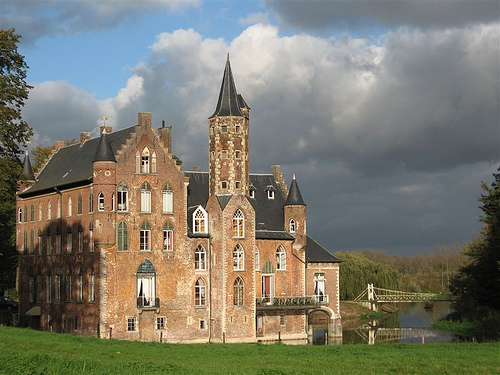
Location: Koningin Astridplein 17, Bazel, East Flanders Map
Constructed: 15th century
Open: May- June, Sept- Oct
Thurs:
10am- 4:30pm
Sun: 2- 5pm
July- Aug
Tue- Thur: 10am- 4:30 pm
Sun: 2- 5pm
Tel. +32 3 740 0400
Wissekerke Castle (Dutch: Kasteel Wissekerke) is a historic water castle located in the village of Bazel, within the municipality of Kruibeke in East Flanders, Belgium (coordinates: 51°08′42″N 4°18′04″E). Situated on a site with fortifications dating back to the 10th century, the current structure primarily reflects 15th-century construction with extensive 19th-century neo-Gothic renovations, transforming it from a defensive stronghold into a luxurious residence. Surrounded by a moat, an expansive English-style park exceeding 33 hectares, and featuring one of Europe's oldest wrought iron suspension bridges (built in 1824), the castle exemplifies the evolution of Belgian aristocratic architecture. Once the seat of influential families like the Vilain XIIII, who served as local mayors for 139 years, it now functions as a cultural heritage site, museum, and venue for events, offering visitors insights into medieval history, 19th-century opulence, and industrial archaeology.
Early Origins (10th–13th Centuries)
The site's history dates back
to at least the 10th century, when an early fortification—likely a
moated earthen motte-and-bailey structure—was built as part of a
defensive belt along the Scheldt River. This was a strategic location to
protect the region (and the County of Flanders) from threats such as
Viking raids and other incursions. Other similar fortifications existed
nearby in places like Kruibeke, Rupelmonde, and Temse.
By the
mid-12th or 13th century, a more substantial stone castle was
constructed. In 1238, Raas van Basele (or a similar figure associated
with the lordship) laid the foundations for a strengthened castle. The
lordship of Wissekerke was one of the most important feudal domains in
the County of Flanders during this era. The castle served primarily as a
defensive stronghold guarding the riverbanks.
Medieval and Early
Modern Period (14th–17th Centuries)
Ownership changed hands among
various noble families. Key documented transitions include:
In 1510,
the castle was purchased by Lieven van Pottelsberghe, Lord of
Vinderhoute and a counselor to Emperor Charles V.
It later passed to
his son Frans (who died childless), then to relatives including Servaas
van Steelant.
In 1562, a chapel was added inside the castle.
During the turbulent religious and political conflicts of the late 16th
century, the castle suffered damage. In 1583, troops under Philip of
Marnix, Lord of Saint-Aldegonde, partially destroyed the left wing and
drawbridge. Reconstruction occurred around 1590 under Servaas van
Steelant: the left wing was rebuilt higher with larger windows, a hipped
roof, and dormers; the tower lost its battlements for an octagonal
spire; and the drawbridge was replaced with a wooden bridge on piles.
The 16th-century tower and some 15th-century cellars (with brick ribbed
vaults) represent some of the oldest surviving physical elements, though
heavily modified later.
Vilain XIIII Era (18th–20th Centuries)
The most significant and longest-lasting chapter began when the
influential Vilain XIIII family (one of the oldest and most prominent
noble houses in the region) acquired the castle. They resided there for
over 200 years and shaped much of its current character. Family members
served as mayors (burgemeesters) of Bazel for 139 consecutive years,
underscoring their local political power.
Major transformations
occurred in the 19th century under Viscount Philippe Vilain XIIII and
his wife, Sophie-Louise-Zoé de Feltz (a notable figure with connections
to Napoleon and Empire-style tastes):
The castle was extensively
renovated in a rich neo-Gothic style, one of the earliest and finest
examples in Belgium. This included unifying the wings, adding
pointed-arch windows, gables, pinnacles, and a prominent façade.
An
English landscape park was created around the castle, with ponds, exotic
fruit gardens, and an ice cellar under the dovecote (a cutting-edge
feature at the time).
In 1824, engineer Jean-Baptiste Vifquain
designed the iconic wrought-iron suspension bridge (one of the oldest
surviving chain suspension footbridges in Europe, with a span of about
20.5–23 meters). It was an innovative engineering feat using bolted
connections instead of traditional carpentry.
Interiors were updated
with Empire, Directoire, Flemish Renaissance, and other period styles,
including ornate salons, a chapel, and family heraldry.
Further
modifications continued into the early 20th century (e.g., 1906
restorations restoring some medieval-inspired elements).
20th
Century to Present
The Vilain XIIII family gradually left the castle
in the second half of the 20th century. In 1989, the last ancestral
occupant, Jean Vilain XIIII, sold it to the municipality of Kruibeke.
The castle, gatehouse, suspension bridge, and pigeon tower were
protected as monuments in 1981.
The municipality has managed
restorations and opened the site to the public as a cultural center. It
hosts exhibitions, events, tours, and seminars. A major renovation
(announced in 2022) led to its reopening in 2023 with an interactive
visitor experience: projections, audio guides narrated by the character
of Viscountess Zoé de Feltz, soundscapes, objects, and quizzes exploring
family history, Belgian independence, Catholic-Liberal tensions, and
international politics.
Today, the castle and its ~8-hectare park
(with centuries-old trees) are accessible to visitors. The surrounding
Polders of Kruibeke add to the scenic appeal.
Overall Layout and Setting
The castle stands on a roughly square
ground plan and was originally entirely surrounded by water. Since 1803,
an earthen dam connects the north side to the mainland. It features a
large English landscape park (about 8 hectares, with some sources noting
broader estate elements up to 33 hectares), ponds, a kitchen garden, and
a notable 600-meter beech-lined avenue.
Key protected elements
(listed as monuments in 1981) include:
The main castle
The
Neo-Tudor gatehouse
The wrought-iron suspension bridge
The pigeon
tower (duiventoren) with an ice cellar beneath
Materials:
Primarily red brick with sandstone for plinths, corner blocks, and
detailing. Windows have largely been replaced over time, now dominated
by elongated pointed-arch (lancet) forms with shutters.
Exterior
Architecture
The current appearance is heavily shaped by 19th-century
Neo-Gothic interventions, particularly under architects like François
Verly (1811) and others, transforming it into one of Belgium’s early
Neo-Gothic castles while incorporating Empire-style elements.
North façade: Features a prominent semi-circular vestibule (porch)
flanked by two stepped gables (trapgevels). This creates a symmetrical,
imposing entrance.
West façade: A long, unbroken flank with three
stories plus a basement level, cornered by round turrets with pointed
roofs.
South façade: More varied, with emphasis on a central tower
that has a square base transitioning to an octagonal upper section.
East façade: Includes a projecting oriel (erker) resting on a round-arch
arcade over the water, plus a three-sided chapel apse with pointed-arch
twin windows (tweelichten) and sandstone mullions.
Towers and
turrets: Round corner turrets (hoektorentjes) were added or modified for
symmetry. A 16th-century tower survives in modified form. The overall
roofscape includes stepped gables, saddle roofs, and decorative elements
like crockets (hogels) and finials (kruisbloem).
Gatehouse
(Poortgebouw): Built in the 1830s in Neo-Tudor style with two square
brick towers (two stories), battlements, a pointed-arch frieze, and a
Tudor-arched gateway with sandstone detailing. It features the coats of
arms of the Vilain XIIII and de Feltz families.
Suspension Bridge:
One of the castle’s most iconic features — a wrought-iron chain
suspension footbridge designed in 1824 by engineer Jean-Baptiste
Vifquain. It is among the oldest surviving examples of its kind in
Europe (span around 20–28 meters). It uses innovative bolted connections
and integrates with brick abutments and Neo-Gothic iron columns. Wooden
decking (later replaced) and original railings remain largely intact.
Interior and Medieval Remnants
The oldest surviving parts are the
15th-century cellars and parts of a 16th-century tower. The cellars
extend under much of the old structure and feature:
Brick
cross-rib vaults (kruisribgewelven)
Low round columns with simple
bases and capitals
Heavy sandstone ribs on large corbels
(kraagstenen)
19th-century interiors largely reflect the taste of
Viscount Philippe Vilain XIIII and his wife Zoé de Feltz, blending
Neo-Gothic exteriors with Empire, Directoire, and Flemish Renaissance
revival styles inside.
Notable rooms include:
Vestibule:
Directoire style with white-and-red marble flooring, white marble
monolithic columns with Corinthian capitals, stucco friezes, and a
gently curved ceiling.
Octagonal dining room (Eetzaal): Empire style
with white walls/ceiling and mahogany cabinets with mirrors.
Salle de
compagnie: Door surrounds featuring sphinxes (Egyptian-inspired motifs).
Salon: Simpler rectangular room with a mantelpiece flanked by slender
columns and pilasters.
Flemish Renaissance Hall: High natural-stone
fireplace with garlands and festoons, oak wainscoting, and a notable
coffered ceiling (cassettenplafond) with round and square heraldic
shields of the Vilain XIIII family.
Chapel: Cross-rib vaults and a
flat ceiling with a lantern tower.
The interiors preserve much of
the early 19th-century grandeur and are presented today with an
interactive focus on the Vilain XIIII family’s lifestyle.
Evolution of the Architecture
Medieval period (10th–15th centuries):
Defensive moated fortress with cellars and basic fortifications.
16th
century: Reconstructions after damage (e.g., 1583 fire); addition of
tower elements.
Early 19th century: Major Neo-Gothic overhaul
(Pisson, Verly) emphasizing picturesque Gothic revival while filling in
parts of the moat and adding the dam.
Later 19th/early 20th century:
Further symmetrization, height adjustments, and park enhancements
(including the bridge and ice cellar under the dovecote).
Practical Visiting Information
Address: Koningin Astridplein 17,
9150 Bazel (Kruibeke), Belgium.
Opening Hours: Wednesday to Sunday
(and public holidays), 1 PM to 5 PM. Closed on 1, 2, and 11 November,
and from 24 December to 2 January.
Tickets: €8 adults (includes audio
guide). Reduced rates (€5) for ages 12-18, 60+, students, teachers,
groups of 10+, etc. Free for under 12 and certain locals/schools.
Audio Guides: Included. Choose from:
Standard: “A tour with Zoé de
Feltz” (adult-focused).
Kids: “Serafina the sphinx shares the secrets
of the castle.”
Youth: “19th century splendour meets the latest hits”
(hip soundtrack).
Guided Tours: Available for groups (reservation
required). 2-hour tour €75 (max 20 people); from 15 people, a guide is
often obligatory.
Duration: Allow 1–2 hours for the castle interior +
30–60+ minutes for the park and bridge.
No advance booking needed for
individuals. Tickets can be bought on-site or via the municipality’s
ticket shop.
Getting There & Parking
By Car: Easy drive from
Antwerp (~20–30 min). Free parking at Sporthal De Dulpop (Beekdam 2,
Bazel). Disabled parking on Koningin Astridplein.
Public
Transport/Bike: Take DeWaterbus (water bus) from Antwerp (Steenplein) to
Kruibeke, then cycle ~15 minutes. Bike rentals available in Antwerp.
Scenic cycling routes in the area.
Nearby: Combine with the Polders
of Kruibeke nature area or other regional castles.
Accessibility
The castle grounds and main park areas are largely wheelchair
accessible. Inside, the primary trail is on the ground floor. A lift
exists but may not accommodate all wheelchairs — inaccessible upper
rooms have digital displays downstairs. Call ahead with questions.
In-Depth Visiting Tips
Best Time to Visit:
Weekdays (Wed–Fri)
for quieter crowds.
Spring/summer for lush park greenery and better
light for photos.
Autumn for golden foliage reflections in the moat.
Avoid peak weekends if you prefer solitude.
What to Bring & Wear:
Comfortable walking shoes (cobblestones and park paths).
Weather-appropriate layers (Belgium can be changeable).
Picnic
supplies — the park is ideal for one.
Camera/phone for the bridge,
moat views, and interiors.
Enhance Your Experience:
Use the
audio guide fully — the interactive projections, soundscapes, and quiz
make it engaging for all ages.
Spend extra time in the park: Walk
among centuries-old trees, cross the suspension bridge, and enjoy moat
reflections.
Look for seasonal events or temporary exhibitions (check
the official site).
With Kids/Families:
Highly recommended —
the Serafina kids’ trail is interactive and fun. Family-friendly
overall.
Photography & Practical Notes:
Golden hour (late
afternoon) is magical for exterior shots with the moat and bridge.
Interiors have atmospheric lighting; respect no-flash rules if posted.
Toilets and basic facilities are available.
Combine with a meal in
Bazel or nearby Antwerp/Ghent.
Nearby Attractions:
Polders of
Kruibeke (beautiful wetlands).
Other Flemish castles (e.g., along
cycling routes).
Antwerp city center for a full day.