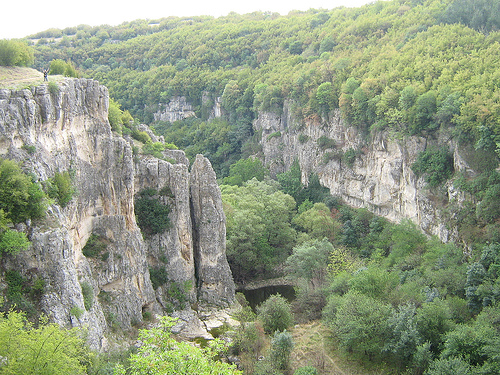
Emen Gorge, also known as Emen Canyon or the Canyon of the Negovanka River, is a stunning natural landmark in northern Bulgaria, renowned for its dramatic limestone cliffs, cascading waterfalls, deep caves, and lush vegetation. Formed by the erosive action of the Negovanka River, the gorge stretches approximately 5 km and features vertical rock walls exceeding 120 meters in height, creating a picturesque and somewhat isolated wilderness area. Key attractions include the Momin Skok waterfall—a 10-meter-high cascade with a crystal-clear pool—and the Emen Cave, one of Bulgaria's longest at 3,113 meters. Often dubbed the "Bulgarian Grand Canyon" due to its scenic depth and rock formations, it hosts Bulgaria's first eco-trail, established in 1997, which draws hikers, nature enthusiasts, and tourists seeking an immersive outdoor experience. The site's name ties into local folklore, particularly the waterfall's moniker "Momin Skok" (Girl's Leap), evoking tragic legends of love and resistance. As a protected natural landmark since 1980, Emen Gorge exemplifies Bulgaria's diverse karst landscapes, blending geological wonders with opportunities for eco-tourism, while also serving as a habitat for unique wildlife like rare bat species.
Location
Emen Gorge is situated in the Veliko Tarnovo Province of northern Bulgaria, approximately 20 km west of the historic city of Veliko Tirnovo and 8 km from the main road connecting Veliko Tarnovo to Pavlikeni. It lies near the small village of Emen, which has a year-round population of about 100 residents, swelling to around 300 in summer due to tourism. The gorge extends from the village of Novo Selo in the east to the Mihaltsi dam in the west, along the Negovanka River—a tributary of the Rositsa River. Geographic coordinates place it roughly at 43°08′N 25°22′E, nestled in the foothills of the Balkan Mountains (Stara Planina) within a forested, karst-rich region. Access is primarily by car: from Veliko Tarnovo, drive west toward Pavlikeni, turning off at signs for Emen village. Parking is available in the village square or near a narrow bridge over the river. Public transport is limited, but taxis or organized tours from Veliko Tarnovo (about 30 minutes) are common. The site's remote feel is enhanced by its position in a verdant valley, though the approach involves narrow roads and a short hike to the trailhead, making it less accessible for those with mobility limitations.
Geologically, Emen Gorge is a classic karst formation, sculpted over
millennia by the Negovanka River's erosive forces on soft limestone
bedrock, resulting in steep cliffs, narrow canyons, and subterranean
features like caves and sinkholes. The river's constant flow has carved
out two main sections: the Upper Boaz (Goren Boaz) with broader,
forested plateaus, and the Lower Boaz (Dolen Boaz) characterized by
tighter gorges and waterfalls. This process, influenced by tectonic
activity in the Balkan region, has created dramatic rock phenomena,
humid microclimates with lush, jungle-like vegetation, and habitats for
diverse flora and fauna. The Emen Cave, at the gorge's entrance,
exemplifies this with its 3,113-meter length, constant 9°C temperature,
and high humidity, formed through dissolution and collapse of limestone
layers.
Historically, the gorge has limited human records, primarily
tied to natural and folkloric elements rather than ancient settlements.
It was declared a natural landmark in 1980 to protect its ecological
value. The eco-trail was pioneered in 1997, marking it as Bulgaria's
first such path. The Emen Cave has seen varied uses: in the 20th
century, it served for mushroom cultivation, cheese maturation, and even
as a military base during conflicts. Folklore dominates, with the Momin
Skok waterfall named after legends of young women leaping to their
deaths—either from unrequited love or to escape Ottoman captors during
the centuries of Turkish rule (14th–19th centuries). No prehistoric
artifacts are noted, but the area's isolation likely provided refuge
during turbulent periods. Nearby sites like the Bacho Kiro Cave (a few
km away) contain Paleolithic remains, suggesting regional human activity
dating back 40,000 years, though not directly linked to Emen.
Emen Gorge boasts a range of natural features that highlight its
karst geology and biodiversity. The centerpiece is the Momin Skok
waterfall, a 10-meter plunge where the Negovanka River drops between two
towering rocks, forming a serene, emerald pool ideal for swimming and
picnics. Surrounding cliffs rise over 120 meters, adorned with rock
niches, overhangs, and verdant foliage that create a tropical ambiance
in humid sections. The Emen Cave, at the trail's start, is a multi-level
labyrinth with stalactites, stalagmites, and bat colonies (six species,
including two unique to Europe like the greater horseshoe bat). Its
entrance is wide and accessible, but deeper sections are unlit and
require caution.
Other structures include man-made elements along the
eco-trail: wooden bridges (some elevated and rickety, crossing the river
for panoramic views), handrails in steep areas, and informational signs
(though inconsistent). The trail winds through forested paths with
exposed cliff edges, offering vistas of the river's cascades and small
waterfalls upstream. Beyond the main waterfall, the path leads to the
Negovanka dam and a fishing lake, expanding the explorable area.
Biodiversity is rich, with lush vegetation, birds, and insects thriving
in the cool, moist environment, though rubbish accumulation in some
spots detracts from the pristine feel.
The primary usage of Emen Gorge is for hiking and eco-tourism, with
the eco-trail serving as the main activity. This 1.5–3 km loop (round
trip 2–4 hours) is rated easy to moderate, suitable for all ages but
requiring fitness for steep ascents/descents and cliffside paths. It
begins at the Emen Cave, follows the river's edge through Upper and
Lower Boaz, crosses wooden bridges (one notably high for an adrenaline
rush), and culminates at the Momin Skok waterfall. Multiple routes
exist: starting from Emen village square for a scenic, river-adjacent
path with more clambering; a road-side start outside the village; or a
higher path along the canyon top, easier for those avoiding heights or
with limited mobility (though it skips the cave).
Visitors use the
site for picnics, swimming in the waterfall pool, fishing at the dam,
and photography amid breathtaking views. Cave exploration is popular but
advised against during bat breeding season (May–June). Key events are
minimal, but it's integrated into full-day tours from Veliko Tarnovo,
combining with nearby waterfalls and caves like Krushuna Falls or
Dryanovo Monastery. Usage peaks in summer for its cooling microclimate,
with folklore adding cultural depth—visitors often reflect on the
waterfall's tragic legends. Safety tips include bringing a map due to
poor signposting, watching for slippery rocks, and avoiding collapsed
bridges (some optional detours exist).
As of August 2025, Emen Gorge remains a popular, well-preserved
natural attraction, open year-round with no entrance fee, though it's
best visited in spring/summer for milder weather and fuller river flow
(avoid winter due to ice/slips). Maintenance is generally good for the
eco-trail—marked and accessible—but issues persist: inconsistent
signage, accumulated rubbish along paths, and deteriorated wooden
bridges (one at the waterfall reportedly collapsed, requiring detours or
caution). Recent visitor reviews (2024–2025) rate it 4/5 on platforms
like Tripadvisor, praising the peaceful setting, stunning views, and
family-friendly swims, but noting challenges for non-hikers, those
afraid of heights, or families with young children (e.g., a July 2024
family review described it as "tough" but rewarding). Crowds are low,
with only a few people encountered even in peak season, enhancing the
serene experience.
Conservation efforts focus on its status as a
natural landmark, protecting bat habitats and vegetation, though litter
remains a concern. Nearby accommodations like The Willow House (200m
from Emen center, ~$39/night) or Eco Hotel Imenieto offer convenient
stays with trail access. Dining options include traditional Bulgarian
meals at nearby sites like Dryanovo Monastery. For 2025, no major
changes or closures are reported, but visitors are urged to prepare with
maps, sturdy shoes, and early starts. It's family-oriented but not fully
accessible—stairs and uneven terrain limit wheelchair use. Overall, Emen
Gorge continues to attract eco-tourists, symbolizing Bulgaria's untamed
beauty amid calls for better upkeep.