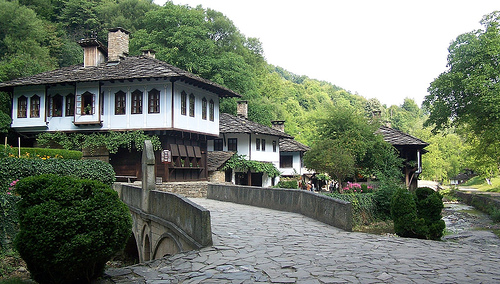
Location: 8 km (6 mi) South of Gabrovo Map
The Etar Architectural-Ethnographic Complex, commonly known as Etar or Etara (Bulgarian: Етър or Етъра), is Bulgaria's first open-air ethnographic museum, dedicated to preserving and showcasing the architecture, customs, culture, craftsmanship, and economy of the Gabrovo region during the Bulgarian National Revival period (late 18th to 19th centuries). Spanning 7 hectares, it functions as a living museum where visitors can witness traditional Bulgarian life through authentic reconstructions, live demonstrations of crafts, and interactive experiences. Founded in 1964, it incorporates historical elements like water-powered machinery and Revival-era buildings, making it a unique cultural landmark that blends education, heritage preservation, and tourism. Often described as a "time capsule" or "living village," Etar attracts families, history enthusiasts, and international tourists, emphasizing Bulgaria's rich ethnographic heritage.
Location
Etar is situated 8 km south of the city of Gabrovo in northern Bulgaria, on the northern edge of the Bulgarka Nature Park, nestled in the foothills of the Balkan Mountains (Stara Planina). Its geographic coordinates are approximately 42°48′34″N 25°20′54″E, overlooking the Sivek River (also known as Yantra River tributary), which powers many of its installations. The site is accessible by car (about 1-2 hours from Sofia or Veliko Tarnovo), bus from Gabrovo, or taxi, with parking available on-site (around 3 leva or free along nearby roads if arriving early). Surrounded by lush forests and natural scenery, the location enhances its immersive, village-like atmosphere, though the terrain involves uneven paths and stairs, making it moderately challenging for those with mobility issues. It's part of a broader tourist route including nearby attractions like the Sokolski Monastery (several km away) and the House of Humor and Satire in Gabrovo.
Founding and Vision
The complex was the brainchild of Lazar Donkov
(1908–1976), a Gabrovian ethnographer and visionary. He aimed to
preserve and showcase the architecture, daily life, crafts, and economy
of the Gabrovo region during the Bulgarian National Revival period
(roughly the late 18th to 19th centuries).
Construction began in
1963. The team started by restoring existing historic structures along
the river, particularly the Karadzheyka water mill (built around 1780).
They also relocated and reconstructed authentic elements like a
valyavitsa (fulling mill) and tepavitsa (another type of fulling mill)
from nearby villages.
The museum officially opened on September 7,
1964, as an Ethnographic Museum Park. Donkov became its first director
(appointed in 1966) and remained deeply involved until his death.
Historical and Cultural Context
Etar recreates the atmosphere of
a typical Balkan mountain (Balkandzhi) settlement and craft town from
the Revival era. Gabrovo and the central Balkan Range were known for
their entrepreneurial spirit, water-powered industry, and craftsmanship
under Ottoman rule. Economic and political changes in the 19th century
allowed the area to flourish as a center for trade, education, and
manufacturing.
The name "Etar" is the ancient name for the Yantra
River, highlighting the crucial role of water power in the region's
development.
Development and Expansion
Initial phase
(1963–1964): Focused on water-powered installations and basic
structures.
Subsequent years: Additional houses, workshops, and
facilities were added, using three main methods: on-site restoration,
preservation in place, and transportation/restoration of originals from
surrounding areas.
The complex grew over more than a decade (some
sources say it took about 12 years to fully develop the core).
By the
late 1960s–1970s, it included a full Craftsman Street with replicas of
19th-century buildings.
Key recognitions:
Proclaimed a
national park in 1967.
Declared a monument of culture in 1971 (State
Gazette issue 101).
Awarded the Order of Saints Cyril and Methodius,
First Class, in 1989 for its contribution to Bulgarian heritage.
Features and Layout
The museum spans about 7 hectares and contains
around 50 objects. It is divided into zones that illustrate different
aspects of Revival-era life.
Water-powered installations (the
museum’s highlight and emblem):
Bulgaria’s only collection of
still-operational historic hydropower machinery.
Includes water mills
(for grinding grain), fulling mills (for processing woolen cloth), a
sawmill, lathes for wooden bowls and flasks, a braid-making workshop,
grindstone, and more.
Water is diverted via a restored mill-race
system from the Sivek River. Many machines are functional and
demonstrated to visitors.
Craftsman Street:
Replicates a
19th-century urban commercial street.
Features two-story Revival
houses with characteristic bay windows, decorative elements, and
workshops on the ground floor.
Active artisans demonstrate and sell
traditional crafts (e.g., pottery, coppersmithing, woodcarving,
furriery, cutlery, needlework, bell-making, and more) using original
techniques and tools.
Other elements:
Residential houses
(including notable replicas like the Sakov House with many windows).
Churches, clock tower, bridges, and other architectural samples.
Exhibitions on occupations, spiritual culture, and daily life of the
Balkandzhi people.
Post-Opening Evolution
After Donkov, the
museum had several directors, including Stancho Stanchev, Ivan Nikolov,
and others, with Prof. Svetla Dimitrova, PhD, serving as director since
2014. The staff grew to include researchers, guides, and specialists. It
developed archives, a library, photography studio, and educational
programs.
Today, it functions as a research center for traditional
Balkandzhi culture from the pre-industrial era onward. It hosts events,
festivals, workshops, educational programs, and volunteer activities. It
remains open year-round and attracts tourists interested in living
history.
Significance
Etar is more than a static museum — it
is a living reconstruction that keeps Bulgarian traditions alive. It
preserves endangered crafts, demonstrates authentic technologies
(especially hydropower), and educates visitors about the ingenuity and
resilience of 18th–19th century Bulgarians in the Balkan region. As
Bulgaria’s pioneering open-air ethnographic museum, it set a model for
cultural heritage preservation in the country.
Overall Layout and Concept
The complex functions as a living
reconstruction of a Balkan mountain town/village from the Revival era.
It includes about 50 sites: houses with integrated workshops,
water-powered technical installations, bridges, a clock tower, a church,
school, and social buildings.
Construction began in 1963 under Lazar
Donkov (an artist, architect, and ethnographer from Gabrovo), with the
museum opening on September 7, 1964. Many structures are exact replicas
of original buildings from Gabrovo and nearby villages, built using
traditional methods, materials, and based on sketches, photos, and
memory. Some original water-powered structures (like the Karadzheyka
water mill from ~1780) were restored on-site, while others were
relocated.
The site is organized around a central Craftsman Street
(Charshiya)—a recreated urban commercial street—and separate zones for
water installations and rural-style houses.
Key Architectural
Characteristics (Bulgarian Revival Style in the Balkans)
Etar
showcases the distinctive Balkan Revival (Vazrazhdane) architecture
adapted to the mountainous Gabrovo region. Features include:
Two-story houses — Ground floor typically for workshops, shops, or
storage (often stone or mixed construction for durability and fire
resistance). Upper floor for living quarters, more ornate and
residential.
Bay windows (erker) and projecting wooden loggias —
These provide extra space, light, and aesthetic appeal. They are often
richly wood-carved.
Broad eaves and stone or tile roofing — Practical
for heavy Balkan snowfall and rain.
Colorful facades — Painted white,
blue, or copper tones. Wooden elements (doors, windows, consoles)
frequently feature intricate carving.
Functional integration — Houses
combine living, working, and commercial spaces, reflecting the era’s
craft-based economy.
Adaptation to terrain — Built along the river
with careful site engineering (props, drainage, canals) due to unstable
soil and landslides.
The style is purely Bulgarian with minimal
foreign influence, emphasizing symmetry, harmony, comfort, and
craftsmanship.
Notable Structures
Sakov (Saakov) House — One
of the most striking examples. It features 21 windows on the upper
floor, which was uncommon and demonstrates wealth and a desire for light
and openness. It exemplifies elaborate Revival decoration.
House of
Trifon Kanev (1872 replica) — Coppersmith workshop on the ground floor
with an angled entrance. Upper floor has bay windows. Large size and
beautiful exteriors signal the owner’s prosperity.
House of Kolyo
Dragolov (1874 replica) — Pottery workshop with traditional kilns.
Represents Gabrovo’s historic pottery center.
Twin (semi-detached)
House from Lesicharka Village — Mid-19th century. Features beautiful bay
windows and wooden grating. Ground floor has workshops (goat’s hair
processing, saddle-making); upper floor has icon-painting atelier.
House from Batoshevo Village (1865) — A masterpiece with wood-carved
consoles and doors, two loggias, elegant staircase, and courtyard.
Houses furriery workshop.
Other houses — Replicas from villages like
Tumbalovo, Gachevtsi, Nova Mahala, etc., showing variations between
urban merchant/craftsman homes and more modest rural artisan dwellings.
Clock Tower — A prominent landmark in the complex.
Water-Powered
Installations — Unique in Bulgaria (10+ active objects). Includes water
mills, fulling mills (tepavitsa), felting mills (valyavitsa), sawmill,
braid-making machine, lathes for wooden bowls/flasks, and grindstone.
These are powered by a reconstructed mill-race system using the river’s
flow. The water wheel is the museum’s emblem.
Materials and
Construction Techniques
Builders used local stone, wood (for upper
stories, eaves, carvings), clay, and traditional tiles. Wood carving is
prominent in decorative elements. Many replicas were constructed between
1967–1976, faithfully copying originals while adapting orientations to
face the street.
Atmosphere and Living Heritage
The
architecture is not static—workshops are active, with craftsmen
demonstrating traditional techniques (pottery, wood-carving,
coppersmithing, furriery, weaving, etc.) using original or period tools.
Visitors can buy items made on-site. This makes Etar a “living museum”
where the buildings serve their original functional purpose.
Etar has primarily served as an educational and cultural hub,
illustrating Revival-era life through live craft demonstrations using
original tools and methods. Visitors can observe or participate in
activities like baking, weaving, and metalworking, purchasing handmade
souvenirs. It has hosted international initiatives, national contests,
and thematic tours. Key events include:
Opening (1964): Marked
the establishment as Bulgaria's first open-air museum.
Symposiums and
Festivals: Events like the "KEVIS" land art and kinetic art symposium
(e.g., 2020 edition), folk festivals, and craft fairs.
Diplomatic and
Cultural Visits: Notable visits, such as by the Georgian Embassy in
2021, fostering collaborations.
Renovations and Modern Programs:
Post-2020 updates enhanced interactivity, with educational programs for
schools and creative workshops.
During its history, it has been
used for filming, photography, and as a venue for preserving intangible
heritage like folklore and cuisine.
As of August 2025, Etar remains a thriving open-air museum, open daily year-round: 9 a.m. to 7 p.m. in summer (April–September) and 9 a.m. to 5 p.m. in winter (October–April), with no days off. Admission is affordable at about 5 leva (€2.50), and it attracts visitors for 1-3 hour visits, extendable for families. Recent renovations (noted in 2024-2025 reviews) have improved facilities, making it more interactive and well-maintained, though some critiques mention limited English-speaking staff and fewer live demonstrations than expected. It offers on-site eateries serving traditional Bulgarian dishes like banitsa, kachamak, sarma, and sweets at low prices, plus souvenir shops. Educational programs, thematic tours, and events continue, with collaborations for exhibitions. Rated 4.5/5 on platforms like Tripadvisor based on 261+ reviews, it's praised for its authenticity and family-friendliness but noted as smaller than similar European sites. Accessibility includes paths but involves stairs; contact via +359 66 810 560 or info@etar.bg for details. Social media highlights its scenic beauty and cultural value, with no major changes reported in 2025.