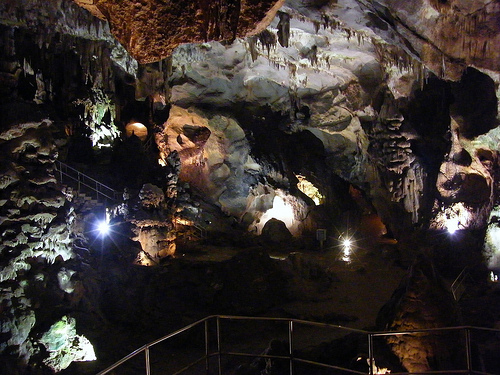
Location: 6 km away from Vratsa Map
Open: Summer: 8:30am- 12:30am and 1:30pm- 6:00pm
Winter: 8:30am- 4:00pm
Ledenika Cave (Леденика in Bulgarian, meaning "icy" or "glacial") is a renowned karst cave located in the northwestern Balkan Mountains, approximately 16 km from the city of Vratsa in Vratsa Province, Bulgaria. Situated within the Vrachanski Balkan Nature Park, the cave's entrance is at an elevation of about 830–850 m above sea level, nestled in the Stresherski section of Vratsa Mountain. The cave spans roughly 300 m in length with a vertical range of 37 m and features 10 distinct halls adorned with impressive speleothems such as stalactites, stalagmites, curtains, and waterfalls. Its name derives from the striking ice formations—icicles, stalagmites, and columns—that appear near the entrance during winter and sometimes persist into late summer, creating a glacial-like atmosphere. Ledenika is one of Bulgaria's most visited show caves, attracting tourists for its natural beauty, geological wonders, and cultural events, and it is part of the country's 100 National Tourist Sites. The coordinates are approximately 43°12′16″N 23°29′28″E.
Geological Formation and Age
The cave formed in Upper Jurassic to
Lower Cretaceous carbonate sediments of the Gintsi Formation. Its
limestone formations date back to the Pliocene era (over 2.5 million
years ago). Karst processes—dissolution of soluble rocks by
water—created its galleries, stalactites, stalagmites, columns, and
other speleothems.
The name "Ledenika" derives from dramatic ice
formations (icicles, frozen stalactites, and stalagmites) that appear in
the first two halls during winter and early spring due to the cave’s
cold microclimate. Temperatures inside range from about –7°C to +16°C
depending on the season and section, with the entrance area being the
coldest.
Pre-Modern and Early History
Ledenika has likely been
known to local people for centuries, primarily as a source of ice during
warmer months. There is limited evidence of significant prehistoric
habitation compared to other Bulgarian caves (like Magura or Devetaki),
but locals used it practically long before formal exploration.
The
earliest documented modern explorations occurred in the early 20th
century. Systematic speleological work began between 1922 and 1925 by
Bulgarian explorer Nenko Radev, who conducted the first surveys.
In
1927, landowner Hr. Chomakov donated 100 decares (about 10 hectares) of
meadows and forests around the cave to the tourist company "Veslets" in
Vratsa, supporting its development for tourism.
Development as a
Tourist Site
1960: Declared a natural landmark and added to
Bulgaria’s protected territories.
1961: Officially opened to the
public, becoming one of Bulgaria’s premier show caves with guided tours.
Late 1980s: Peaked in popularity with up to 100,000 visitors annually.
2005: Major infrastructure renovation improved paths, lighting, and
safety.
2010: Management transferred to Vratsa Municipality.
The cave is part of Bulgaria’s 100 Tourist Sites program by the
Bulgarian Tourist Union. Today, it features guided tours (typically
30–45 minutes) with lighting and occasional sound-and-light shows. A
small underground lake called the "Lake of Wishes" has a local legend:
dipping your hand in its icy water and making a wish brings it true.
Key Features and Halls
The cave includes:
Antechamber
(entrance area with seasonal ice).
Concert Hall (acoustically
resonant, with rich stalactite/stalagmite formations; one of the
highlights).
Great Temple (largest gallery, with a 15 m high
ceiling).
White Hall and smaller passages.
Notable formations
named after figures like Santa Claus, the Head of the Giant, or Baba
Yaga (a witch from Slavic folklore).
It hosts about 53 species,
including bats and the troglobitic (cave-adapted) insect Light-hater
(Troglophilus), which cannot survive outside the dark.
Cultural
and Scientific Significance
Ledenika symbolizes Bulgaria’s rich karst
landscape and speleological heritage. Its cultural importance led to
Ledenika Peak in Antarctica’s Graham Land being named after it. The cave
contributes to regional tourism alongside nearby sites like Saeva Dupka.
While not as archaeologically rich as some Bulgarian caves with
Paleolithic or Neolithic evidence, its accessibility and beauty have
made it a key educational and recreational site since the mid-20th
century.
Host Rock and Stratigraphic Context
The cave developed in Upper
Jurassic to Lower Cretaceous carbonate rocks of the Gintsi Formation
(sometimes referred to with a Ledenika Member). This formation consists
of gray to pink, thin- to medium-bedded nodular limestones, micritic
limestones, intraclastic, peloidal, and peloidal-lithoclastic varieties.
These rocks are part of the broader West Balkan Carbonate Group and
represent pelagic to hemipelagic marine depositional environments from
the Late Jurassic (Kimmeridgian–Tithonian) into the earliest Cretaceous.
The Gintsi Formation is fossil-rich, containing ammonites (often
corroded), aptychi, belemnites, bivalves, brachiopods, and other marine
fauna. It overlies other Jurassic units (such as the Yavorets Formation)
and relates to the regional tectonic framework of the Balkan Zone (part
of the Alpine orogenic system). The limestones are soluble and
fractured, ideal for karst development.
The broader Vratsa karst
massif features multiple cave systems formed in Mesozoic (primarily
Jurassic-Cretaceous) carbonates, influenced by the complex Alpine
tectonic history of folding, thrusting, and uplift in the region.
Cave Formation (Speleogenesis)
Ledenika is a karst cave formed
primarily by dissolution of the limestone by infiltrating meteoric
(rain/snowmelt) groundwater. Rainwater absorbs CO₂ from the atmosphere
and soil, forming weak carbonic acid (H₂CO₃) that reacts with calcium
carbonate (CaCO₃) in the limestone:
CaCO₃ + H₂CO₃ → Ca(HCO₃)₂
(dissolved form).
This acidic water enlarges fractures, joints, and
bedding planes over time, creating passages, chambers, and galleries.
The process occurs both above and (historically) below the water table,
with phreatic (submerged) and vadose (air-filled) phases.
The cave is
relatively short (~300–350 m long) with about 10 halls and galleries. It
includes multi-level passages, indicating changes in base level or water
table over time. Some sources suggest it was once more water-filled,
with only a small remnant lake (Lake of Wishes) remaining today.
Key chambers include:
Antechamber/Anteroom — lowest part near the
entrance, prone to ice formations.
Concert Hall (one of the larger
ones, excellent acoustics).
Great Temple (ceiling up to 15 m high).
White Hall.
Smaller passages like the "Passage of Sinners."
Speleothems and Secondary Deposits
Ledenika is renowned for its rich
speleothems (secondary mineral deposits), formed by the re-precipitation
of calcium carbonate as water degasses CO₂ in the cave air:
Ca(HCO₃)₂
→ CaCO₃ (calcite) + H₂O + CO₂.
Common types include:
Stalactites (hanging from ceiling).
Stalagmites (rising from floor).
Columns (where they join).
Flowstones and draperies.
Curtains and
other varieties.
These formed over thousands to millions of years
under varying climatic conditions (warmer/wetter periods favored more
deposition). Some formations in the Concert Hall are estimated as old as
~2.5 million years (Pleistocene), while host rock limestones trace back
further (Mesozoic, with some references noting Pliocene-era influences
in dating contexts).
Ice formations (seasonal speleothems) give the
cave its name. In winter, cold dense air sinks into the entrance
depression, freezing seepage water into icicles, ice
stalactites/stalagmites, and flowstones. These can persist into
spring/summer in some years due to the microclimate (entrance traps cold
air; deeper cave stays ~8–16°C, more stable around 6–8°C).
Other
features include sinter (flowstone) pools and small lakes.
Age
and Paleoclimatic Significance
Host rock: Primarily Late Jurassic
(~157–145 Ma), extending into Early Cretaceous.
Cave passages: Likely
developed during the Pleistocene or earlier, linked to regional uplift
and karstification phases.
Speleothems: Record Quaternary climate
fluctuations; growth rates and isotopes can serve as paleoclimate
proxies (though specific studies on Ledenika are limited in general
sources).
The cave's microclimate and ice phenomena are sensitive
to broader climate trends.
The cave's ecosystem is limited due to its cold, dark conditions.
Flora consists mainly of lichen and moss. Fauna includes 53 species,
such as bats, cave beetles, wood lice, and small spiders. Notably, it is
home to the endemic insect "Ledenikus" or "Light-hater" (Svetlomrazets),
which cannot survive in light and is unique to this cave. Rules prohibit
collecting fauna to preserve this delicate biodiversity.
Cultural
and Historical Significance
Ledenika holds cultural importance as a
symbol of Bulgaria's natural heritage, included in the 100 National
Tourist Sites and inspiring the naming of Ledenika Peak in Antarctica.
It commemorates historical events through annual concerts in the Concert
Hall during the Days of Botev (May 24–June 2), honoring poet and
revolutionary Hristo Botev and his fight against Ottoman rule. The
cave's formations inspire folklore, with named shapes evoking mythical
figures like Baba Yaga. It has been a site of human activity since
Neolithic times and reflects Bulgaria's karst landscapes, comparable to
other regional caves. In popular culture, it lends its name to a beer
brand and features in tourism promotions.
Location and How to Get There
Position: About 16 km southwest
of Vratsa town, at ~830 m elevation in the Stresherski section of
the Balkan Mountains.
From Vratsa: Well-signposted asphalt road
with many hairpin turns (30–45 minutes drive). There’s a parking lot
right at the entrance.
From Sofia: ~120–150 km away (2–2.5 hours
by car via E79 highway). Many people do it as a day trip.
By car
— Easiest and most flexible.
Public transport — Bus or train to
Vratsa, then taxi (~15–20 BGN) or arrange pickup. No direct public
bus to the cave.
Organized tours — Popular from Sofia (often
combined with Saeva Dupka Cave). These include transport, guide, and
entrances.
Tip: The mountain road is steep and winding—drive
carefully, especially in bad weather. GPS works fine if you follow
signs to “Ledenika.”
Opening Hours and Tickets (as of recent
info)
Summer (April–September): 9:00–17:00 (last entry ~16:00).
Winter (October–March): 9:00–16:00 (last entry ~15:00).
Open
daily, year-round, but guided tours only (no self-guided).
Tours
run hourly or when a group forms (min ~5–15 people). Expect possible
short waits.
Ticket price: Around 10 BGN (~5 EUR) per adult in
recent years—cash only in many cases. Check on-site or call for
current rates (+359 889 616 614 or similar municipal numbers).
Discounts for students/seniors likely.
What to Expect Inside:
The Tour
The guided tour lasts about 45–60 minutes and covers
~350 m of galleries with 10 halls. It’s a developed show cave with
paths, stairs, and iron bridges.
Key highlights:
Anteroom
(Entrance Hall): Lowest part—famous for winter ice
stalactites/stalagmites (hence “Ledenika” = Ice Cave). Best
Dec–March/April.
Low passages (e.g., “Plaznyata” — crawling-like)
and bottlenecks.
Concert Hall: Largest/most impressive with
excellent acoustics. Features named formations like Santa Claus,
Giant’s Head, Baba Yaga’s House, Crocodile, etc. Occasional concerts
(e.g., during Botev Days in late May/early June).
Passage of
Sinners → Lake of Wishes (small shallow sinter lake ~50 cm deep).
Legend says dipping your hand grants a wish.
White Hall,
curtains, abysses, and more stalactites/stalagmites.
There
may be a light/sound or 3D laser show in some tours. The cave hosts
~53 species, including the unique “light-hater” insect.
Cave
climate: Constant ~7–8°C inside (colder near entrance in winter,
down to -7°C or lower with ice). Humidity ~92%. Even in summer, it
feels chilly.
In-Depth Visiting Tips
Clothing & Footwear:
Warm jacket/fleece mandatory year-round.
Comfortable, sturdy
closed shoes with good grip (stairs can be slippery or uneven).
Not suitable for flip-flops or heels.
Physical Demands:
Many stairs (long descent at start), narrow/low passages, and iron
bridges.
Not recommended for people with mobility issues, severe
back/heart problems, claustrophobia, or pregnancy. Less-able
visitors may only see the main area.
Moderate fitness needed for
the full tour.
Photography: Guides often take photos for you
in scenic spots. Flash photography is usually restricted to protect
formations—follow rules.
Best Time to Visit:
Winter/early
spring for spectacular ice formations.
Summer for easier access
and warmer outside weather.
Avoid peak Bulgarian holidays if you
dislike crowds.
Rules & Etiquette:
No touching formations,
no writing/painting, no torches/smoking.
Stay with the guide.
No food/drink inside.
Nearby Amenities:
Souvenirs and info
at the entrance.
Small amusement/eco-park nearby.
Combine with
Vratsa Canyon (great views, rock climbing), hiking trails (e.g., to
Borov Kamak waterfall), or Saeva Dupka Cave.
Practical Advice
Bring water, snacks, and cash.
Toilets available at the site.
English may be limited—guides often speak Bulgarian primarily, but
you can still enjoy the visuals.
For families: Great for kids 6+
who are active, but watch younger ones on stairs.
Road
conditions: The access road is paved but can have potholes; drive
cautiously after rain/snow.