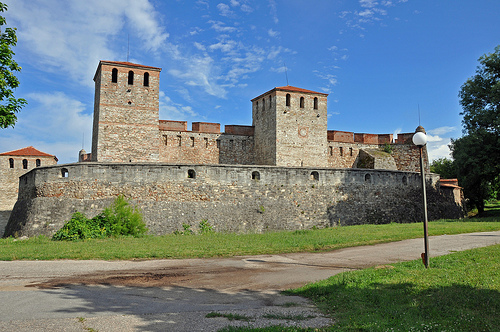
Location: Vidin Map
Constructed: 10th century
Baba Vida, also known as Vidin Castle or Baba Vida's Towers, is a medieval fortress located in the town of Vidin in northwestern Bulgaria. Situated on the banks of the Danube River at an elevation of 39 meters (128 feet) above sea level, it serves as the primary landmark of Vidin and is positioned at the northern end of a riverside park. The fortress covers an area of approximately 9,500 square meters and is renowned as the only entirely preserved medieval castle in Bulgaria, making it a significant historical and cultural site.
Pre-Medieval Foundations
The site has deep roots. It stands atop
the ruins of the ancient Roman castellum (fort) Bononia, built in the
1st century AD as part of the Roman Danube limes (defensive frontier).
Bononia itself was constructed on earlier Thracian settlement remains.
This strategic location at a bend in the Danube made it vital for
controlling river trade, crossings, and defense against invasions from
the north.
Construction and Early Medieval Period (10th Century)
Medieval construction of Baba Vida began in the second half of the 10th
century during the First Bulgarian Empire (681–1018). The core structure
was built on Roman foundations as part of Vidin's (then called Bdin or
Badin) defensive system.
Legend of the Name ("Granny Vida"):
A
popular Bulgarian legend ties the fortress to a Danubian Bulgarian king
with three daughters: Vida (eldest), Kula, and Gamza. Before his death,
he divided his realm: Vida received Vidin and lands north to the
Carpathians; Kula got Zaječar and the Timok Valley; Gamza ruled lands
west to the Morava. Kula and Gamza married poorly (to a drunkard and a
warlike noble, respectively) and squandered their inheritances. Vida
remained unmarried, built the castle in her city, and lived there. The
name "Baba Vida" means "Granny Vida" or "Old Woman Vida," reflecting her
long life and enduring legacy.
Role in the Second Bulgarian
Empire (12th–14th Centuries)
Baba Vida served as the citadel of
Vidin's main fortress and the key defensive installation in northwestern
Bulgaria. Major enlargement and modernization occurred under Tsar Ivan
Sratsimir (r. 1356–1396), the last Bulgarian ruler of the independent
Tsardom of Vidin. It functioned as his capital and royal residence.
Key Events:
It withstood an eight-month siege by Byzantine
Emperor Basil II's forces (during the Byzantine-Bulgarian wars around
the turn of the 11th century).
In 1365–1369, Hungarian King Louis I
suddenly attacked and captured Vidin after a months-long effort to take
the heavily defended Baba Vida. Ivan Sratsimir regained control in 1369
but remained under Hungarian overlordship.
The fortress featured
two concentric rectangular curtain walls, about nine towers (three
preserved to full medieval height with original battlements), a moat
(fed by the Danube), and a drawbridge (now a stone bridge). Its area is
roughly 5 decares (about 1.25 acres).
Ottoman Conquest and Rule
(Late 14th–19th Centuries)
In 1388, Ottoman forces invaded
Sratsimir’s lands, forcing him into vassalage. Sratsimir joined a 1396
anti-Ottoman crusade with Hungarian King Sigismund, but the crusade
failed disastrously at the Battle of Nicopolis. The Ottomans captured
most of his domains by 1397 (some sources cite 1422 for full control of
Vidin).
The Ottomans called it a “virgin” fortress because it was not
taken by storm but surrendered or captured through other means. Under
Ottoman rule, Baba Vida lost its primary defensive role but served as:
A weapons and ammunition warehouse (armory).
A prison.
A
residence (e.g., for the semi-independent Ottoman ruler Osman
Pazvantoğlu in the late 18th/early 19th century).
It saw some
modifications, including an Austrian-built tower from the 17th century
during periods of Habsburg-Ottoman conflict. It ceased defensive use by
the end of the 18th century.
Modern Era
After Bulgaria's
liberation from Ottoman rule (1878), the fortress fell into disuse but
was preserved. It opened to the public as a museum in 1958. Today, it is
a popular tourist attraction, maintained for visitors, with exhibits on
its history inside. The main courtyard, inner/outer walls, and towers
remain visible, offering views of the Danube.
Summary Timeline
1st century AD: Roman Bononia fort.
10th century: Bulgarian medieval
construction begins.
Late 10th–11th centuries: Withstands Byzantine
sieges.
14th century: Expanded under Ivan Sratsimir; Hungarian
occupation 1365–1369.
1396/1397–1878: Ottoman control; used as
armory/prison.
1958–present: Museum and cultural heritage site.
Overall Layout and Structure
The fortress features two concentric
curtain walls (an inner and outer defensive ring) enclosing a main
courtyard, along with approximately nine towers (of which three survive
to their full medieval height with original battlements). It sits at
about 39 meters (128 ft) above sea level.
Inner Fortress: Roughly
an irregular quadrilateral (sometimes described as roughly rectangular
or square in core sections), measuring around 40m x 40m in its earliest
fortified core. This forms the primary citadel with 9 middle and corner
towers. The walls and towers feature embrasures (arrow slits) for
defense.
Outer Fortress: Added later, providing an additional layer
of protection with its own entrance features. The entire complex covers
roughly 2.4 acres (about 9,500–10,000 square meters), including a
surrounding moat/ditch that could be flooded from the nearby Danube.
The design is a classic concentric castle layout, typical of
medieval fortifications seeking layered defense: attackers breaching the
outer wall would face a second, stronger inner barrier and enfilading
fire from towers. The fortress was built atop and incorporated elements
of the ancient Roman castellum Bononia (1st century AD), with visible
Roman foundations in places.
Construction Materials and
Techniques
Builders primarily used local stone (scarce in the river
delta region), creating robust, thick walls that have endured remarkably
well. Later phases incorporated brick elements, especially in
Ottoman/Austrian modifications (e.g., parapets and firing positions).
Medieval Bulgarian core: Stone masonry with battlements,
machicolations (openings for dropping projectiles), and integrated
towers.
Adaptations for artillery: In later centuries (especially
post-medieval), outer walls were modified for cannon use, including
ramps for moving artillery and adjusted embrasures.
Towers: Varied in
shape (circular, rectangular, or polygonal). Three main towers retain
full height, allowing visitors to climb for views. Interiors include
staircases, chambers, and access points.
The structure blends
Roman, Byzantine, Bulgarian medieval, Hungarian, Ottoman, and Austrian
influences due to successive occupations and renovations.
Key
Architectural Features
Towers: About nine in total. Prominent
surviving ones include a high tower associated with Tsar Ivan Sratsimir
(14th century). Towers served as observation posts, living quarters, and
defensive strongpoints. Some have stubby appearances internally due to
artillery adaptations.
Curtain Walls: Thick stone walls with
crenellations (battlements) for archers. The inner walls are taller and
more robust.
Courtyard: Central open area with cobblestone or earthen
surfaces, used for gatherings, storage, and movement. Modern visitors
see displays like stone cannonballs here.
Entrance and Gates:
Protected by towers and the outer wall system. Steep staircases and
uneven cobblestone paths are common throughout.
Defensive Elements:
Embrasures, arrow slits, possible drawbridges or moat systems tied to
the Danube, and later gunpowder-era modifications like slitted brick
parapets.
Interior Spaces: Ground-floor rooms now house museum
exhibits (medieval arms, clothing, artifacts). Upper levels offer
walkways along walls and into towers.
Historical Construction
Phases
10th Century: Initial construction on Roman ruins during the
First Bulgarian Empire or shortly after.
12th–14th Centuries (Second
Bulgarian Empire): Major expansion, especially under Tsar Ivan Sratsimir
(r. 1356–1396), who made Vidin his capital and enlarged/modernized the
fortress. This period defines much of the visible medieval architecture.
Hungarian Interlude (1365–1369): Temporary occupation with possible
modifications.
Ottoman Era (late 14th–19th centuries): Used as a
weapons depot, prison, and residence (e.g., for Osman Pazvantoğlu).
Further adaptations for gunpowder warfare; ceased defensive use by late
18th century.
Later Modifications: Austrian and 19th-century
additions (e.g., brick elements).
Current State and Visitor
Experience
Today, Baba Vida operates as a museum (opened to the
public in 1958) and tourist site. It is well-preserved but retains a
rugged, authentic feel with steep stairs, uneven paths, and some areas
under restoration. Visitors can explore the courtyard, climb towers,
walk the walls, and view exhibits. Its location right on the Danube adds
scenic value.
Legends and Cultural Significance
The name "Baba Vida," meaning "Granny Vida" in Bulgarian, originates
from a popular legend tied to the fortress's construction. According to
the tale, a Danubian Bulgarian king divided his realm among his three
daughters: Vida, Kula, and Gamza. Vida, the eldest and unmarried,
received Vidin and the lands north to the Carpathians. She built an
inaccessible castle there, where she lived alone, leading to its naming
in her honor. Kula was given Zaječar and the Timok Valley (where she
built Kula Tower), while Gamza received lands west to the Morava River.
The sisters who married poorly squandered their inheritances, but Vida's
legacy endured through the fortress. This story reflects medieval themes
of independence and fortitude, sometimes likened to concepts like the
Iron Maiden in folklore.
Culturally, Baba Vida holds immense
significance as a symbol of Bulgarian resilience and medieval heritage.
It is one of the best-preserved fortifications in the country and
attracts tourists interested in history and architecture. The site also
functions as Vidin's summer theater, hosting traditional theatrical
events with performers from across Bulgaria, blending its historical
role with modern cultural activities.
Current Status and Visitor Information
In its current state, Baba Vida operates as a museum, showcasing artifacts and exhibits related to its history, from Roman times through the Ottoman period. It is accessible to the public, with the nearest train station in Vidin just a 20-minute walk away, and clear signage guiding visitors. The fortress is about 200 km from Sofia, Bulgaria's capital, making it a feasible day trip for those exploring the region. Efforts to restore and maintain the site continue, as it has faced wear over centuries, ensuring its legacy as a top attraction in Bulgaria.