Location: Plovdiv Province
Plovdiv (in Bulgarian, Пловдив; in Greek Philippopolis, "Φιλιππούπολις"; in Turkish, "Filibe") is a city in Bulgaria and the capital of the province of Plovdiv. With a population of 341,567 inhabitants (2015) and an urban agglomeration of 544,628 inhabitants, it is the second most populated city in the country, after the capital, Sofia. It is located in the lowlands of Thrace, on the banks of the Maritsa river and the seven hills. The population is, predominantly, Bulgarian although minorities of Gypsies, Turks, Jews and Armenians also inhabit the city. Plovdiv is the second largest city in Bulgaria and one of the oldest cities in the country with a history of settlement dating back to 6000 BC.
The climate of Plovdiv is humid subtropical with the four seasons are well defined. The summers are long and dry with maximum temperatures that exceed 30 ° C. The winters are cold with snowfall. In the city it snows an average of 33 days, although this number can vary a lot between years, with 2-5 cm of depth. The average winter temperature is 2 ° C.
Outside of the sea and ski resorts, Plovdiv is the only place in
Bulgaria where international tourism prevails over domestic tourism.
Many travelers make a stop here on their way to the sea or Istanbul,
while others go to the city on purpose. So far, he has managed to
maintain a balance between tourism development and authenticity, even in
summer it is quite free here, and at other times there is a chance to
explore the old town alone. You can get an idea of Plovdiv in half a
day, but it is better to stay in the city for at least a day or,
together with the surroundings, for one and a half to two days, since
much does not lie on the surface. In addition to Roman ruins and houses
in the national style, there is, for example, a very interesting
archaeological collection or Byzantine mosaics, and the views from the
Plovdiv hills are worth a walk outside the old town.
Plovdiv is
one of the warmest cities in Bulgaria. In winter, snow may fall here,
but the sun shines more often, and the temperature only rarely drops
below zero. Summer, accordingly, is hot with a stable temperature of +30
degrees Celsius. Most museums don't have air conditioning, or they can't
handle it. Keep this in mind when planning.
Information Center,
Tsentralnaya Square, 1. Mon–Fri 9:00 – 18:00, Sat–Sun 10:00 – 17:00.
Brochures, maps, transport tickets and posters of cultural events.
The Roman name Trimontium reflects the geography of the city well: it
really stands on three hills, which are located in the middle of a flat
plain, breaking the smooth grid of streets. Some sources report seven
hills at once (seven hills are depicted on the coat of arms of the
city), but it is absolutely impossible to see some of them, as in
Moscow. To the west of the center stands Bunardzhik, aka Khlm on the
Liberator with a monument to a Soviet soldier. To the east of it is
Sahat tepe (Clock Tower) with a Turkish clock tower. Finally, the main
hill — the one on which the old town is located — is itself called
Tricholmie, because it once consisted of three different hills, but now
it has merged into one: the largest and filled with sights.
All
the hills are located on the southern bank of the Maritsa River flowing
through Plovdiv. The northern shore is built up with boring houses of
the socialist era. In other parts of the city, they also exist,
especially on the outskirts, but closer to the center, a fairly large
area between the river (in the north) and the railway (in the south) is
occupied mainly by old buildings. It is pleasant to walk everywhere, the
city perfectly combines the European (mainly Austrian) style of
architecture with southern elements like grapes in courtyards and plane
trees growing along the streets. If you don't have much time, limit
yourself to the old town and the pedestrian streets at its foot. On each
hill you will find observation decks, and in good weather you need to
visit at least one of them for a great view of the Thracian plain and
the Rhodope Mountains.
Many National Revival style houses function as museums and are open to the public. If you want to see several such houses, it makes sense to contact the Association of the Old Town (Stoilova str., 50; tel. 63-33-80), where for a small fee you can purchase a single ticket that gives you the right to visit several sites (Roman theater, Roman stadium, Roman forum, historical pharmacy, small basilica, Zlatyu Boyadzhiev collection, houses of Balabanov, Nedkovich, Hindliyan, Stambolyan and Kilanti). All of them have the same opening hours: in winter (from November to March) 9:00 – 17:30, in summer until 18:00.
The old part of Plovdiv is located on the slopes of a
hill. The main entrance to it is Osborne Street, which rises uphill from
the Jumaya Mosque, although you can also enter through narrow streets
from the east. The congress, turning into the street "Dr. Stoyan
Chomakov", leads to the top of the hill, where the ruins of the Thracian
settlement are located. This is one of the best viewpoints of the city,
the second is the Roman theater on the opposite (southern) slope. Two
thirds of Plovdiv's attractions are located in the old town, and almost
every house is an architectural monument. The houses are marked with
signs indicating the name and date of construction. Take enough time to
just wander around the local back streets, and the museums of the old
town deserve attention.
1 Ancient Roman Theatre
(Antique Theatre) , Tsar Ivaylo street (the southern quarter of the old
city; the search requires some accuracy, there are not enough signs; the
entrance is from above). 9:00 – 17:30, in summer until 18:00. BGN 5. The
theater was built at the beginning of the II century during the time of
Emperor Trajan, in the IV century it was destroyed by an earthquake and
covered with earth. It was discovered during archaeological excavations
in 1960 and completely restored in 1981. This is one of the best
preserved ancient amphitheatres. In addition to the actual marble seats
forming a semicircle, the ruins of some structures at the scene site
have been preserved. The diameter of the circle is 82 meters, the
amphitheater could accommodate from 5,000 to 7,000 spectators.
Currently, open-air festivals are held here, feature films are shown,
plays and operas are played. In addition, from the upper tiers there is
an excellent view south towards the Rhodope Mountains, and you can enjoy
it through the fence outside official opening hours.
2 Nebet tepe (at
the top of the hill). The oldest known settlement on the site of modern
Plovdiv was founded on this hill around 4000 BC. In the historical era,
there was a Thracian settlement here, from which, in fact, Philippopolis
originated. There are many archaeological structures of all kinds left
from this and other eras, including walls, towers and just the
foundations of something incomprehensible, so it's not easy to figure it
out. The most notable ruins, a wall with a tower on top of a hill, date
back to the Hellenistic era — the period between the collapse of the
empire of Alexander the Great and the emergence of the Roman Empire.
From the hill there are good views of the northern part of the city, and
it is worth coming here both in daylight and in the dark: the ruins are
not illuminated (be careful), but the city is flooded with lights from
all sides. Where you go out to the settlement, there is a whole cluster
of houses in the national Revival style, used as an open-air museum
(craft workshops, admission is free).
3 The Church of Saints
Constantine and Elena (Tserkvata sveti Konstantin and Elena). It was
built in 1832. The walls are decorated with magnificent frescoes by a
whole team of artists, including the founder of secular Bulgarian
painting, Zachary Zograf. The church itself is unmistakably defined as
built in the National Revival style, the bell tower standing next to it
was built later, in the 1860s
4 Church of the Holy Week (Tserkvata
sveta Nedelya) , Slaveykov, 40. This church was built in 1830, and also
in the national Revival style. Before her, there was another church
here, known since the end of the XVI century, from which the iconostasis
of 1766 comes. The bell tower in this complex is the latest (1905). The
church has icons of famous Bulgarian artists Zacharias Zograf and
Stanislav Dospevsky — if, of course, you can find them.
5 The Church
of St. Dimitar (Tserkvata sveti Dimitar Solunsky). The church was built
from 1830 to 1838, and from 1922 to 1964 it belonged to the Russian
Orthodox Church abroad. The building is a three—nave basilica, inside
the paintings and icons are mostly of the XIX century (some icons are
older than the church itself).
6 Church of the Most Holy Theotokos
(Tserkvata Sveta Bogoroditsa), 6 Szborna St.. The church was built in
1844 and is remarkable for its location on the hillside, so you need to
climb stairs to it from different sides. Here, in 1859 and 1860, the
Plovdiv Bishop Paisii held a service in Bulgarian and announced a break
with the Patriarchate of Constantinople, to which Bulgaria was
subordinate at that time. Paisius was removed from office and exiled
somewhere, but the modern Bulgarian Orthodox Church somehow grew out of
this event — first as an exarchate, and then as an independent one. The
bell tower was built in 1881, already in independent Bulgaria, according
to the design of architect Josef Schnitter.
7 Nedkovich House
("Nedkovich" School) , 3 Tsanko Lavrenova str., 62-52-16. This house,
built in 1863, belonged to a wealthy city merchant. Now the building
houses an exhibition telling about the life of citizens in the era of
national renaissance.
8 House-Museum of Atanas Krastev (House-Museum
on Atanas Krastev), Dr. Stoyan Chomakov str. 5. This is almost the only
building in Plovdiv in the national Revival style that can be
photographed from the street (which is what everyone is doing, since the
house is located at one of the most popular intersections of the old
city). It was built at the end of the XVIII century and rebuilt many
times, and in the XX century it belonged to the artist Atanas Krastev,
who popularized old Plovdiv as a tourist center. Inside there is an art
collection assembled by Krastev and consisting mainly of abstract works
by Bulgarian artists.
9 Balabanov's House (Balabanov's house) , 57
Stoilova str., 62-70-82. The house was built in the early 19th century
and is now named after the owner of the early 20th century, trader Luka
Balabanov. In the 1930s, the house was demolished, and in 1971 it was
restored according to drawings and measurements. Now the works of
Bulgarian and foreign artists are on display on the ground floor,
although the house is quite interesting from the outside — it stands in
the middle of a whole cluster of buildings in the national Revival
style.
10 Hindliyan House (Khindliyan School), 4 Artina Kidikova
str., 62-89-98. The building was built in 1835-1840 for the famous
Armenian Hindliyan family. Renovated in 1974. This is actually a fairly
large complex, consisting not only of a building, but also of an inner
courtyard, which has some other buildings, galleries, stairs and
something else. If you can get into the building itself only during the
museum's opening hours, then the courtyard is open around the clock. Be
sure to come in if you find yourself nearby. Hindlian's house is also
interesting, mainly for its frescoes with landscapes of cities including
Constantinople, Venice and Alexandria.
11 Birdas House (Dr. Birdas
House), 45 Szborna Street. Mon–Fri 9:00 – 17:30. Built between 1820 and
1830, an example of the so-called symmetrical style in Plovdiv. On the
one hand, the house looks like a one—storey building, on the other -
like a three-storey one. There is no basement in the house, the first
floor was used as a warehouse, the second as an auxiliary room, and the
third was inhabited. The first owner of the house, Dimitar Birdas, was
the first certified doctor in Plovdiv. Currently, it is the mayor's
office.
12 The house of Artin Gidikov (House on Artin Gidikov), 4
januari Street 15. It was built in 1848 and belonged to the merchant
Artin Gidikov, currently it is an administrative building. It is
characterized by its loggia, inscribed in a curved roof, and, as it
should be in national Revival style houses, by an ornament on the
outside.
13 House of George Mavridi (Lamartine House) (Lamartine
Church) , Knyaz Tseretelev str., 19. ☎ 63-17-79, 62-66-61. The French
poet Alphonse de Lamartine stayed in this house in July 1833, on his way
from Istanbul to Paris. Currently, the building belongs to the Union of
Bulgarian Writers. In one of the rooms there is a small exhibition
dedicated to Lamartine and his family.
14 Klianti House (Klianti
Museum), Knyaz Tseretelev str., 16. This is the oldest of the houses in
the national Revival style in Plovdiv and was originally built in the
middle of the XVIII century (when there was no national revival yet),
and then it gradually acquired its current appearance as a result of
several alterations of the XIX century. The house is remarkable for its
murals on the walls and ceilings, which can be seen since the Clianti
house functions as a museum.
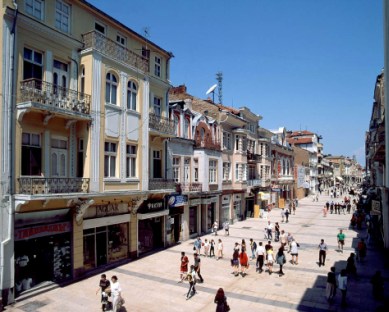
The center of Plovdiv consists of several pedestrian blocks located
on a flat area between the hill of the old town and the neighboring
Sahat Tepe with a clock tower. There is a nice building from the
beginning of the XX century, there are always a lot of people, as well
as shops, cafes and restaurants.
15 Roman Stadium (Antique
Stadium) , Jumaya Square. If the Roman theater is now located in the
backyards, and during the reconstruction the goal was to reproduce the
structure of Roman times as accurately as possible, then the stadium, on
the contrary, is located right on the central square of Plovdiv, near
the mosque, and is maximally integrated into the square, so we had to
build all sorts of observation decks and glass passages, however,
architecturally looking quite good. This stadium once held 30,000
spectators, but only a few fragments have survived to this day. The
stadium was built in the II century under Emperor Hadrian, at some point
it ceased to be used and disappeared into the cultural layer, and was
rediscovered only in 1923, when all the buildings now standing on the
square had already been built. The restoration was carried out several
times, the last one in 2012-13.
16 Jumaya Mosque (Jumaya Jamiya),
Jumaya Square. It is considered to be the first mosque built on the
Balkan Peninsula, sometimes dating back to the XIV and sometimes XV
century. The height of the minaret is 23m, it is covered with absolutely
wonderful stone carvings. A wooden extension has been made on the north
side of the mosque, which looks good, but completely foreign — this is
the 1880s. Unlike later typical Turkish mosques, which usually have only
one dome, the Jumaya Mosque has nine domes covered with sheet lead. Open
to the public (be dressed so that your shoulders and legs are covered).
Services are held on Fridays.
17 Roman Forum (south end of Knyaz
Alexander I street). The former center of Philippopolis has been
preserved, of course, in a ruined state, but the ruins cover an area of
20 hectares, of which half is available for inspection. The forum
appeared here under Emperor Vespasian, in the 70s of the first century,
when the city received a new rectangular plan. The territory is divided
into two parts by a modern street. What exactly has been preserved is
not very easy for a layman to understand, but in general the forum had
three entrances and two streets; there was a market on its territory, so
most of it was occupied by warehouses and shops. In the northern part
there was an odeon (actually a cultural center), a library and a
treasury. They should be looked for where the columns stand.
18 The
Church of St. Marina of Antioch (Tserkvata sveta Marina), Dr. Georgi
Valkovich St. 5 (in the alleys near the Roman amphitheater). The church
was built in 1851-1856 and is a three-nave basilica with an extension
(colonnade), which is remarkable for being painted both inside and
outside. The iconostasis is carved in wood. The wooden six-tiered bell
tower dates back to 1870.
19 Clock Tower (Kula Chapel) (on the hill
of Sahat Tepe, visible from the city center). The 17 m high tower was
built in 1809, but there were others on this site before it, starting at
least from the XVII century.
20 Danov House (Christo G. Danov
Museum), Metropolitan Paisii str., 2. In winter Mon–Fri 9:00 – 17:00, in
summer Mon–Fri 9:30 – 18:00. The very first books and newspapers in
Bulgarian were printed in this building. Currently, it houses a small
museum (part of the Historical Museum of Plovdiv) dedicated to book
publishing in Bulgaria in the 19th and early 20th centuries. The museum
itself is interesting mainly to specialists, but the building (in the
style, again, of the national renaissance) is also very good.
The blocks in the north, between 6 Septemvri Street and the river,
are very close to the center, 5-10 minutes on foot, but they have a very
unusual view. There is a historical museum and a couple of interesting
monuments of the Turkish time.
21 Imaret Mosque (Shahbedinova
Imaret jamiya) , Khan Kubrat. One of the most important mosques in
Bulgaria, built in 1444 or 1445 by Shehabeddin Pasha, beylerbey
(governor) of Rumelia. Shehabeddin Pasha was a rather bad military
commander and an incompetent administrator, and was quickly removed from
this position, but he became famous for the improvement of the cities
under his jurisdiction — primarily Adrianople, now Edirne, and Plovdiv.
(In 1445 Constantinople had not yet been taken, and Edirne was the
capital of the Ottoman Empire). It is a stone building of typical Balkan
architecture, the minaret is covered with twisted ornaments. The walls
are decorated with magnificent oriental frescoes.
22 Turkish baths
(Old bath, Chiefte bath), 6 Septemvri blvd., 179. There are enough
mosques in Bulgaria, but medieval baths are much less common. Plovdiv is
an exception in this sense, since the baths in the city are not only
preserved, but also very favorably located — their domes are clearly
visible from the observation deck of Nebet Tepe. The building was built
in the XVI century, the Turkish name Cifte (couple) is associated with
the fact that there were two departments here from the very beginning —
male and female. The building is now occupied by the Center for
Contemporary Art.
23 Monument to the Unification of Bulgaria
(Pametnik "Unity on Bulgaria 1885"), 6 Septemvri blvd. The modernist
monument was erected in 1985 to mark the centenary of the unification of
Bulgaria, i.e. the reunification of the province of Eastern Rumelia,
formed after the Russian-Turkish war, with the main part of the country.
A woman with a wreath symbolizes Bulgaria, and the two wings behind her
are two parts of the country striving for each other. The acquaintance
with Bulgarian history can be continued on the other side of the street,
where monuments to several famous people are installed in a cozy square
(Dondukova Gradina), including Zakhariy Stoyanov, who organized the
Bulgarian uprising in Eastern Rumelia in 1885, as well as Ivan Vazov,
the patriarch of Bulgarian literature.
24 Small Basilica (Malka Basilica) , blvd. "Maria Luisa", 31A
(south-east of the old town). 9:00 – 18:00. The ruins of an early
Christian basilica in the second half of the 5th century are a good
example of what values are hidden in the vast cultural layer of ancient
Plovdiv. They found the basilica in 1988 during the construction of an
apartment building. They did not move the ruins, instead they organized
a small and very modern museum right at the excavation site. The
basilica was built in honor of the local military commander who defended
the city from the Goths, but it is interesting not for this, but for the
magnificent mosaic with peaceful images of deer and birds. Next to the
ruins there is an exposition telling about the history of the building
and the symbolism of what you will see here. The basilica is located
near the center, but in the middle of an ugly modern building, 10-15
minutes walk from the Roman forum and just a few hundred meters from the
Church of the Holy Week on the eastern border of the old town.
25
Monument to the Soviet soldier (Alyosha) (on Bunardzhi hill). A cult
monument, famous in Bulgaria and abroad. It is dedicated to the "Soviet
soldier-liberator" and, as often happens in such cases, is perceived
ambiguously by modern Bulgarian society. In August 1944, Bulgaria, which
had been Hitler's ally until that moment, announced its withdrawal from
the war, demanded that German soldiers leave the country and even
declared war on Germany, but the Soviet army decided to enhance the
effect by launching an offensive on Bulgarian territory. It all ended
with the communist coup on September 9, 1944, as a result of which
liberation from Nazism turned out to be at the same time the onset of
communism — an event that is now perceived without much enthusiasm. In
the post-war years, monuments to Soviet soldiers were erected all over
the country. Due to its size and location (11.5-meter sculpture on a
6-meter pedestal), the Plovdiv Alyosha, installed in 1954, became the
largest and most recognizable among them. The song "Alyosha" (Standing
over Alyosha Mountain // Bulgaria Russian soldier), written in the
1960s, brought him even greater fame. Soviet authors and gained
considerable popularity in Bulgaria, until 1989 it was even the anthem
of Plovdiv. After the fall of the communist regime, the city authorities
made attempts to demolish or at least move the monument, but so far it
stands in its place, confirming that, unlike other Eastern European
countries, Bulgaria still treats Russia and everything connected with it
kindly. The prototype of "Alyosha" was made by a Soviet soldier, but the
Bulgarians did the project, so that the bas-reliefs at the base of the
monument are entirely local subjects and faces.
1 Ethnographic Museum, Dr. Chomakov
str., 2 (Old Town). ☎ +359 (32) 62-56-54. In winter, Tue–Sun 9:00 –
17:00, in summer Tue–Sun 9:00 – 18:00. BGN 5. The museum is located in
the house of the Greek merchant Kuyumjioglu. The exposition consists of
40,000 exhibits and is dedicated to the folk crafts of the Rhodope
Mountains; folk costumes, musical instruments, ceramics, carpets and
jewelry are presented. Photo and video shooting in the museum is paid.
The Kuyumjioglu house was built in the 1840s and is remarkable as one of
the most striking examples of so-called "symmetrical houses" — it
consists of three parts with curved roofs. When you're inside, don't
miss the wooden ceilings: each room has a different one.
2
Archaeological Museum , Saedinenie Square, 1. ☎ +359 (32) 26-99-33. In
winter (from November to March) Tue–Sat 9:30 – 17:00, in summer Tue–Sun
10:00 – 18:00. 5 lev. The museum has a good collection of Neolithic
objects (mainly idols and ceramics from excavations near the village of
Dolnoslav), Thracian, Greek, Byzantine periods and the Middle Ages. The
Panagyur treasure, the most famous monument of Thracian civilization in
Bulgaria, is also kept here — nine golden vessels of amazing beauty. The
treasure dates back to the IV century BC, its total weight is more than
6 kg of pure gold.
✦ Historical Museum. The museum unites four
independent exhibitions in different parts of the city. Two of them are
of interest, dedicated to the events of the second half of the XIX
century.
3 National Renaissance Museum (Museum at the entrance
to the city), 11 Tsanko Lavrenov str. In winter: 9:00 – 17:00, in
summer: 9:30 – 18:00. 3 Leva. It is located in the House of Dimitar
Georgiadi (1848). A high-quality exposition telling about the
anti-Turkish uprising of 1876.
4 The Museum of the Unification of
Bulgaria (the museum "Unity on Bulgaria"), 1 Saedinenie Square (next to
the archaeological one). In winter: Mon–Fri 9:00 – 17:00, in summer:
Mon–Fri 9:30 – 18:00. 3 lev. The exposition is a logical continuation of
the previous one, telling about the events of 1878-85 and ended with the
Bulgarian uprising and the unification of the country (see History). The
museum building was built in 1883-85 for the regional council of Eastern
Rumelia, but it actually did not have a chance to work for its intended
purpose.
5 Museum Pharmacy (Hippocrates Pharmacy), Congress 16.
Mon–Fri 9:00 – 17:30. The pharmacy is located in the house of Sotir
Antoniadi built in 1872, in the style, of course, of the national
renaissance. The interior of the pharmacy of the XIX century has been
recreated.
6 City Art Gallery (Gradska khudzhestva galeria), 14 Szborna str.
Mon–Fri 9:00 – 17:30, Sat–Sun 10:00 – 17:30. 4 lev. One of the country's
best collections of Bulgarian paintings and sculptures of the XIX-XX
centuries, from the national renaissance to the 1990s. Most of the main
names are represented, so it's easy to get an idea of Bulgarian painting
in an hour. Free admission on Thursdays. Most of the halls are not
air-conditioned, and it can be hot in summer.
7 Philippopolis Gallery
and Museum, 29 Szborna Street. In winter 10:00 – 18:00, in summer 10:00
– 19:00. 5 lev. This first private gallery in Bulgaria was opened in
2003. The works of Bulgarian artists of the XIX-XX centuries are
exhibited.
8 Zlatyu Boyadzhiev Gallery, 18 Sborna (Chomakov House).
9:00 – 17:30. The Zlatyu Boyadzhiev Gallery has been housed in the
Chomakov House since 1984 (the building was built in 1860 and belonged
to the famous Doctor Chomakov at the time). Boyadzhiev, a neoclassical
artist and one of the most famous Bulgarian painters, studied and then
lived in Plovdiv.
9 National Opera (Rustavna Opera) , 15 Gladstone Street. ✉ Classical
and modern European productions. The Plovdiv Opera has two venues — the
Boris Hristov Recreation Center on Gladstone Street and the Roman
Theater, where performances are staged mainly in summer. Feb 2018 edit
10 Drama Theatre (Drama Theatre) Wikidata Element , 38 Knyaz
Alexander I str., Performances almost every day.
11 Puppet Theater
(Drzhaven Puppet Theater) , blvd. Hristo G. Danova, 14. Mostly
children's productions, although there are also performances for adults.
12th International Fair (International Panair Plovdiv) , "Tsar Boris
III United" blvd. (north shore of Maritsa). The history of the Plovdiv
fairs dates back to 1892, when a huge "exhibition of achievements of the
national economy" was organized in the city to stimulate the Bulgarian
economy. Since the 1930s, fairs have become regular. Now Plovdiv has a
large and modern exhibition complex, on the basis of which international
exhibitions of a wide profile are held twice a year, in March and
September. At other times, themed events are organized — for example,
for winemakers and beekeepers (fortunately, not at the same time).
In late May and early June, Plovdiv hosts the Opera Festival in the Amphitheater, in June — the International Chamber Music Festival, in late June — the Days of Verdi Operas (at the Roman Theater), in early August — the International Folklore Festival, in September — the National Art Exhibition "Old Plovdiv" and the International Puppet Theater Festival.
By plane
S7 flies from Moscow to Plovdiv three times a week (only
in winter). Plovdiv Airport also accepts infrequent Ryanair flights from
the UK and Central Europe and charters that take tourists to ski resorts
in the Rila Mountains. If you are unable to find a suitable flight to
Plovdiv (which is very likely), take a ticket to Sofia, which is only
2.5-3 hours away by bus or train.
1 Plovdiv International Airport
(IATA: PDV). The new terminal building easily accommodates a few
passengers; there is a cafe, Wi-Fi, a duty-free shop and even a business
lounge. The airport is located 14 km south of the city on the road to
Asenovgrad. There is no public transport to the airport, and the highway
runs 3 km from the terminal, so it is inconvenient to go to it — as,
indeed, to Mavrudovo station on the railway passing by the airfield
(there, however, there is an interesting aviation museum). Taxis should
be collected by the arrival of flights, a trip to the center costs 10-15
lev.
By train
Trains from Sofia run every 2 hours: at first
they slowly cross the mountains, and then they literally rush across the
Thracian plain — the road takes 2.5 hours if you travel by fast train,
and 3-3.5 hours by suburban. The line is very beautiful, try to drive
along it during the day.
To the east, trains leave in the
direction of Burgas (4 times a day, 4-5 hours) via Stara Zagora and
Yambol, as well as to Dimitrovgrad (every 2 hours, 1 hour on the way) -
some then reach Svilengrad on the Turkish border, however, only the
daily Sofia—Istanbul night train goes to Turkey itself, stopping in
Plovdiv, late in the evening on the way to the east and early in the
morning on the way to the west.
There is a regular commuter
service to Karlovo in the northern direction (6 times a day, 1.5 hours).
You can leave for Veliko Tarnovo via Stara Zagora, but it's not fast.
2 Railway station , blvd. Independence Street, 29 (south of the
central square). ☎ 62-27-32. The beautiful building was built in 1908,
like many other buildings in Plovdiv, under the influence of European
architecture. In the winter of 2018, the station is under
reconstruction, in its far corner there are ticket offices and a
kiosk-cafe with a meager assortment and several high tables. If you want
to wait for the train in a comfortable environment, go to the Rhodope
bus station, connected to the railway platforms by an underground
tunnel, or visit the Trakia restaurant on the opposite side of the
forecourt. The train station is located in the southern part of the
city, 15-20 minutes walk to the center.
3 Filipovo. The station is on
the northern outskirts of Plovdiv, an intermediate stop for trains to
Karlovo and Panagyurishte. Near the bus station "North".
By bus
Contrary to the Bulgarian tradition, there are already three bus
stations in Plovdiv and a rather confusing configuration of bus routes,
but there are no normal schedules. In most cases, you will need the Yug
and Rhodope bus stations, located on opposite sides of the railway next
to the railway station, and serving all routes except infrequent flights
through the Balkan Mountains. Information about the distribution of
routes by bus stations is available on the city website. The only source
of the schedules themselves remains the website of some enthusiasts who
publish photos of what is posted at bus stations.
Buses from
Sofia every half hour, on the way for about 2 hours — a little faster
than by train. Please note that the Plovdiv–Sofia buses depart from the
Yug bus station, and those passing to Sofia — from any (i.e. the bus
station that serves the departure point).
To the east, buses
slightly reduce the travel time to Burgas (4 hours) and serve as almost
the only way to get to Turkey, where there is only one train (night),
but buses run at least 7-8 times a day and most often during the day.
The main destination is Istanbul (7-8 hours) with a stop in Edirne (4
hours). Apparently, there is only one direct bus to Greece, but
immediately to Athens via Kavala and Thessaloniki.
From Varna,
Ruse, Veliko Tarnovo, it takes half a day to go to Plovdiv by bus, and
it makes a lot of sense to make stops on the way.
4 Yug bus
station (Avtogara Yug) (next to the station: from the center). Around
the clock. A cramped, chaotic and uncomfortable bus station serving all
international flights, as well as buses to Sofia and some other cities,
united, apparently, only by the fact that they are located from Plovdiv
not to the south. The bus station is located north of the railway, a
3-minute walk from the railway station; it contains a closed (but
possibly functioning) storage room and a shabby cafe on the second
floor. Several more cafes are located on the street right next to the
platform, there is nothing decent.
5 Rodopi Bus Station (Rodopi
Autogara) (next to the station: from the side opposite the center).
4:00 – 22:45. A brand-new bus station south of the railway, connected to
the city by a long tunnel. Inside there is a storage room (7:00 – 18:00)
and several pleasant cafes, at least one of which offers simple hot
food. There is a Billa supermarket nearby. All buses depart from this
bus station to the cities of the Rhodope Mountains (Smolyan, Kardali)
and towards the Turkish border (Haskovo, Dimitrovgrad), but not to
Turkey itself.
6 Sever Bus Station (Avtogara Sever), Pobeda Blvd.
(on the northern outskirts of the city, 2.5 km from the center). Buses
to Karlovo and cities on the other side of the Balkan Mountains (Veliko
Tarnovo, Pleven, Ruse). Near the bus station there is a Lidl supermarket
and Filipovo railway station.
By car
The motorway from Sofia
(145 km) comes to Plovdiv, which then forks, going to Burgas (250 km)
and Istanbul (420 km). The pass between Sofia and Plovdiv is not very
high, but in winter there may be delays and difficulties during
snowfall. If you are coming from the north, the optimal road is through
Stara Zagora, 210 km from Veliko Tarnovo. There are high Rhodope
Mountains towards Greece and there are no main roads. The nearest border
crossing is on the road going through Kardzhali.
There are narrow
cobblestone streets in the center of Plovdiv, and entry to the old town
is generally only by pass. If you have a car, look for a hotel near the
center (there are enough options) and leave the car there.
If you have settled in the center of Plovdiv, you will not need
transportation. In and around the old town, the streets are narrow,
there are few cars, and it's nice to walk, although be prepared for
cobblestone pavements and small ascents.
Public transport is
represented by buses. Trolleybus traffic has been stopped; if you see
wires somewhere, it's only because they didn't have time to remove them.
Buses can be ordinary (bus lines) and minibuses (additional buses on the
same line): there is no difference between them except that the routes
may have the same numbers, but go in completely different ways. All the
schemes and schedules are on the website (apparently unofficial), there
is also a route planner. In addition to this site, there is a virtual
scoreboard showing (at least in theory) the current departures from each
stop and synchronized with electronic displays hung around the city.
Tickets: for one trip — 1 lev, for a day — 4 lev, for 24 hours — 5
lev (2018). At least a single ticket can be purchased from the driver.
1 Billa, Raiko Daskalov str., 8. Mon–Fri 7:30 – 22:00, Sat 8:00 –
22:00, Sun 8:30 – 21:00. There is a grocery supermarket in the very
center of the city next to the Juma Mosque. It is located in the
basement, not very noticeable from the street.
2 Markovo Tepe Pier,
blvd. "Ruski", 54. 10:00 – 21:00, Triumph supermarket: 7:00 – 22:00. The
nearest shopping center to the Plovdiv attractions and the train
station, where you can sit in the food court, walk through boutiques or
find a shop with electronics. On the top floor there is an expensive
pastry shop with very attractive cakes and a good view of the city.
Most establishments tend to the pedestrian zone along Knyaz Alexander
Batenberg Street. The Kapan quarter north of the Jumia Mosque has become
a hub of bars — beautiful, cozy, but hardly distinguishable from similar
establishments in Riga, Krakow and any other city in Eastern Europe.
Restaurants of national cuisine in Plovdiv can be counted on one hand,
but something local usually happens in those that focus on average
European cuisine.
Cheaply
1 Sofra, Zhelezarsk str.", 13. 9:00
– 23:00. A simple but authentic Turkish restaurant with a full range of
kebabs, dolmas and sweets.
Average cost
2 Cafe-aperitif
"Arena", Father Paisii, 2 (near the Roman stadium). A large selection of
both traditional Bulgarian and international cuisine, good quality. In
summer, the places are outside, but in the shade. You can easily have
lunch for BGN 15-30.
3 Restaurant "Civic Club" , 1 Stoyan Chalkov
str. (Old Town). Mon–Fri 9:00 – 24:00, Sat–Sun 10:00 – 24:00. Hot: 10-15
lev. A somewhat strange name hides a restaurant of national cuisine
without any signs of national style. Traditional restaurants in Bulgaria
usually have an elusive rural spirit, but this one looks completely
urban and more like a pub somewhere in the northern part of Europe. The
cuisine, however, is good and local — it is practically the only
restaurant in the old part of Plovdiv and one of the best places in the
city with national food.
4 Restaurant "Yerevan" , "Father Paisii"
street", 15. 9:00 – 23:00. Suddenly, an Armenian cuisine restaurant in
the very center of Plovdiv. Lunch menu in the afternoon.
Expensive
5 Sol and Piper Restaurant (Salt and pepper) , Khan
Kubrat str., 1 (next to the historical museum). Mon–Sat 11:30 –
23:30. Hot: 15-25 lev. A cozy country setting and a large fish menu.
European cuisine.
6 Paldin Restaurant (Paldin, Mevlevi Khan) An
element of Wikidata, Prince Tseretelev 3. This rather expensive
restaurant is interesting because it occupies the building of a former
dervish monastery, the only one of its kind in Plovdiv (if not in the
whole of Bulgaria). The building was built in the early 19th century.
From the outside you will see only a stone fence, to look at the
courtyard, you will have to go to a restaurant.
Cafe
7 Sezoni, Khan Kubrat 8 (at the Khan Kubrat Mosque). A cafe, a
convenient place to drink coffee if you want to visit the Khan Kubrat
Mosque. From the terrace of the cafe there is a direct view of the
mosque.
8 Sweetcart Djumaia, "Jumayata" square. 8:00 – 23:00. The
Turkish pastry shop in the building of the Jumaya Mosque is perhaps the
best institution in the whole of Bulgaria of this plan. An excellent
selection of traditional sweets, including cakes and very tasty
custard-based desserts. The prices are slightly above average (1.5 leva
for tea, almost 3 leva for coffee in Turkey), but it's worth it.
9
Pasticceria Dolce Mela, 34 Preslav Street. Mon–Fri 8:00 – 20:00, Sat
9:00 – 20:00, Sun 11:00 – 19:00. A pastry shop with several tables and
delicious Austrian-style cakes. You can have breakfast with a banitsa,
and you should also try the local apple pie.
1 Absinthe House, Petko S. Slaveykov str., 8. Tue–Thu 16:00 – 23:00, Fri–Sat 16:00 – 1:00, Sun 16:00 – 22:00. Absinthe does not belong to the traditional Bulgarian drink, but it makes sense to try it here, since bartenders know all the subtleties of serving a drink, and it costs less than in other European countries. Pay attention to the glasses and a special "siphon", from which water flows in a thin stream, which ensures proper dilution of absinthe. If the diluted absinthe is too strong for you, the bar has beer and pleasant music in the assortment.
There are plenty of hotels in Plovdiv, for 70-80 lev you can easily
find a good double room, especially in low season.
Cheaply
1
Hiker's hostel, St. Osborne, 53. ☎ +359 (896) 76-48-54. From 14
lev/person. It is located in the central part of the city. There are
places in the garden for tents. Positive feedback.
Average cost
2 Dafi Hotel, G. Benkovski street", 23. ☎ +359 (876) 62-00-41. Double
room: 90 lev. A good-quality three-star hotel, lost in the streets of
the Kopona quarter. There is a free underground garage, but it is not
very convenient to get to the hotel by car.
3. "Noviz", bul. "Ruski",
55. ☎ +359 (876) 95-99-68. Double room: 70-80 lev. The case when a hotel
draws itself four stars without any reason, however, the local level of
comfort is quite attractive for 2.5-3 stars, and there is something
elusively Balkan in the atmosphere. It is located a 10-minute walk from
the center at the foot of the hill with Alyosha. The car can be
delivered for an additional fee, but it is quite inexpensive.
Expensive
4 Ramada Plovdiv Trimontium, 2 Kapitan Raycho str. (on the
central square). Double room: from 250 leva, in case of pre-booking it
is much cheaper. A four-star hotel with all imaginable amenities,
including a casino, a restaurant with panoramic views, a fitness center
and a sauna. The level of service is high, but the rooms are not very
large. Mostly good reviews.
5 Hebros Hotel, Konstantin Stoilov
street", 51. ☎ +359 (32) 26-01-80. Double room: 155 lev. A small hotel
with 6 double rooms in Old Plovdiv. The interior decoration is stylized
as a 19th-century mansion.
Connection
Central Post Office, 1 Tsentralnaya Square. ☎ 23-63-33.
The date of foundation of Plovdiv is unknown. What is certain is that
from the first years of its existence, the city was on the main land
route from Europe to Asia, countless armies and conquerors passed
through it, and the rest of the time trade was active. The documented
period of the history of Plovdiv begins in 342 BC, when the city,
already quite large and inhabited by Thracians, was conquered by the
Macedonian king Philip II, the father of Alexander the Great, and
renamed Philippopolis (in Greece this name is still used today). Soon,
however, the Thracians regained control of the city and began to call it
Pulpudeva, which many historians interpret as "Philippi's city", a
direct translation of the Greek name.
From 72 BC to the middle of
the III century AD, Plovdiv was part of the Roman Empire, for some time
it was the capital of the Roman province of Thrace. The Romans called it
Trimontium ("the city of three hills"). After the collapse of the Roman
Empire, Plovdiv fell into the sphere of influence of Byzantium, where it
was again called Philipoppol, and spent quite a lot of time in its
composition, although sometimes the Bulgarian kingdom also got: one of
these periods is precisely connected with the capture of Plovdiv in 970
by the Kievan Prince Svyatoslav Igorevich, sent by the Byzantines, who
unsuccessfully defended their interests, clashing among themselves, the
Bulgarians, Khazars, Pechenegs and Russian principalities. The national
composition of the city was very diverse, it was during that period that
the old Thracian name was revived, changed to Plovdiv in the Slavic
manner.
Since the middle of the XIV century, Plovdiv, like the
whole of Bulgaria, has been part of the Ottoman Empire. The Turkish name
Filibe comes from the same Filipoppol. For a long time, the city was
predominantly Turkish, Bulgarians and Greeks were a minority in it. The
situation began to change in the XVIII century, when more and more
Bulgarians moved from villages to the city, which was facilitated by two
circumstances: the development of the textile industry and the turbulent
situation in the country, where armed Turkish gangs robbed civilians of
non-Muslim faith with impunity (the so-called Kurjali). In the 19th
century, Plovdiv became the center of the Bulgarian national
Renaissance, which is easy to see today by the abundance of
characteristic buildings of this style in the old part of the city.
After the defeat of Turkey in the war of 1877-78, the Bulgarians
expected the creation of an independent state in the territory conquered
by the Russian army (which included Plovdiv), but the British Empire and
Austria-Hungary saw the situation completely differently and pushed
through a "compromise" solution, according to which Bulgaria turned out
to be a vassal principality, receiving only territory north of the
Balkan Mountains, and Plovdiv and the entire Thracian Plain became the
autonomous province of Eastern Rumelia within the Ottoman Empire. As a
result of these political games, Sofia, and not Plovdiv, became the
Bulgarian capital. Plovdiv became part of Bulgaria 7 years later, when
in 1885 the Bulgarians raised an uprising in the city. Turkey could not
oppose him, Austria-Hungary tried to "solve the issue" by pricking
Serbia against Bulgaria, but the short intra-Balkan war ended with the
victory of the Bulgarians, after which the country acquired borders
close to modern ones.
Plovdiv immediately became the second most
important city in Bulgaria. The railway from Istanbul came here under
the Turks (1874), and the line to Sofia was opened in 1888. Since 1892,
an international fair has been held in the city, and light and food
industries have appeared. The industrialization of the socialist era
also did not bypass the city: here, in particular, a non-ferrous metal
production plant was opened, and now Plovdiv is surrounded by industrial
zones on almost all sides, although it looks like a clean city, and
nothing inside it reminds of industry.