Location: Espoo, Kirkkonummi and Vihti Regions Map
Area: 45 km2 (17 mi2)
Tel. +358 205 644 790
Official site
Nuuksio National Park is one of Finland's 40 national parks, established in 1994 and managed by Metsähallitus, the Finnish state enterprise responsible for national parks and wildlife. It spans approximately 53 square kilometers (20 square miles) across the municipalities of Espoo, Kirkkonummi, and Vihti in the Uusimaa region, about 30-35 kilometers northwest of Helsinki, making it the second-closest national park to the capital after Sipoonkorpi National Park. The park's name derives from the Nuuksio district in Espoo, and it serves as a vital green oasis in the densely populated Helsinki metropolitan area, attracting over 312,600 visitors in 2024. Its proximity to urban life—reachable in under an hour by public transport, such as bus 245A from Espoon keskus to entrances like Nuuksionpää or Kattila—makes it an accessible escape into nature for city dwellers and tourists alike.
Geological Formation (Prehistory ~1.9 Billion Years Ago to ~10,000
Years Ago)
The bedrock of Nuuksio belongs to the Svecofennian orogeny
(roughly 1,900–1,820 million years ago), part of the ancient geological
processes that formed much of southern Finland’s crust.
The modern
landscape was profoundly shaped by the last Ice Age (Weichselian
glaciation). Glaciers scoured the terrain, creating rugged rocky hills,
valleys, ravines, and exposed granite bedrock. As the ice retreated
around 10,000–9,000 years ago, post-glacial land uplift raised the area
from the sea. The first parts of Nuuksio emerged as dry land over 9,000
years ago.
This resulted in the characteristic Nuuksio Lake Upland
(or lake highlands): a mosaic of lakes (over 40 in the park), ponds,
bogs, spruce and pine forests, lichen-covered rocks, and old-growth
patches. The highest point is only about 110 meters above sea level, but
the terrain feels wild due to its ruggedness and poor suitability for
large-scale farming.
Early Human Presence (Mesolithic/Stone Age
Onward)
Nuuksio is among the earliest settled areas in Finland.
Archaeological traces nearby (outside the current park boundaries) date
back approximately 9,000 years, to the early post-Ice Age period when
hunter-gatherers moved into the region as land became habitable.
Evidence includes ancient rock paintings, such as an elk figure by Lake
Pitkäjärvi, indicating cultural and spiritual significance. The area’s
name likely derives from Sámi (Lappish) roots: “njukča” or similar,
meaning “swan,” reflecting the presence of swans on long lakes and
possible prehistoric Sámi travel through the region. The Swedish name
Noux for the central village dates to the 1500s.
For millennia, the
area supported small-scale hunting, fishing, and gathering rather than
permanent dense settlement, due to its rocky, swampy, and forested
character.
Historical Period (Medieval to 19th Century)
Settlement remained sparse. The central village of Nuuksio has roots
going back about 500 years. The first manor in Pitkäjärvi was built at
the end of the 18th century. The terrain was traditionally viewed as
unsuitable for intensive farming, so forests remained largely intact
compared to surrounding cleared agricultural lands.
Some summer
cabins for Helsinki’s elite appeared later, but the core area stayed
wooded and difficult to penetrate.
20th Century: Recreation,
Forestry, and Path to Protection
In the early-to-mid 20th century:
Limited forestry occurred in the 1940s–1950s, with a few loggers’ cabins
built (some, like Oravankolo and Tikankolo, still exist and are used for
accommodation).
The City of Helsinki acquired lands in the 1960s,
including the Nuuksionpää and parts of Salmi outdoor recreation areas,
for public use.
Scout organizations (partiolaiset) used the area
extensively for camps and trips for decades, valuing its proximity to
the capital while retaining wilderness qualities.
Proposals for
national park status emerged as early as the 1950s, driven by concerns
over growing development pressure around Helsinki. The rocky, wet
terrain had spared it from heavy building, but rapid urbanization in the
late 20th century threatened it.
Nuuksio National Park was officially
established on March 1, 1994. It combined the former Tervalampi manor
forest area (state-owned hiking land), Nuuksionpää, and southern Salmi
areas. The initiative had strong support from local scouts, who feared
the land would otherwise be developed.
Since Establishment
(1994–Present)
Management falls under Metsähallitus (Parks & Wildlife
Finland). The park protects old-growth forests, heritage biotopes,
flying squirrel habitats (one of Finland’s densest populations, with
nearly 200 groves identified), and other species like grouse, owls,
woodpeckers, and rare beetles. It is a key conservation area for
southern Finland’s forest nature.
Visitor numbers have grown steadily
(e.g., ~307,000 in 2022, ~312,600 in 2024), making it highly accessible
via public transport and car. It offers hiking, swimming, skiing,
fatbiking, and nature tourism. Infrastructure includes trails from
entrances like Haukkalampi (most popular), Haltia Nature Centre, and
others.
In 2024, the park celebrated its 30th anniversary with events
like Lux Nuuksio (light festival), sauna weekends, wilderness cooking
championships, and more, emphasizing considerate use, collaboration, and
nature connection.
The park’s management plans have been updated to
balance conservation, recreation, and stakeholder input. Its proximity
to over a million people in the Helsinki area makes it unique in
Europe—offering genuine wilderness feel despite urban closeness, thanks
to its challenging terrain.
Location and Accessibility
The park sits roughly 30–37 km (18–23
miles) from central Helsinki, making it one of the most accessible
national parks in Finland. Its proximity to a major urban area is
notable because the rocky, wet terrain historically resisted agriculture
and intensive development, preserving its natural character.
Topography and Landforms
Nuuksio exemplifies the Fennoscandian Shield
landscape shaped by the last Ice Age (Weichselian glaciation). Key
features include:
Rugged rocky hills and granite outcrops: The
terrain consists of low, rolling hills with exposed granite bedrock.
Glacial action scraped surfaces clean in places, leaving lichen-covered
rocks and sparse vegetation. Rectangular jointing in the bedrock often
creates stepped or terraced appearances.
Valleys and ravines: Ice Age
meltwater and glacial movement carved valleys and ravines between the
hills.
Elevation: The park has modest relief typical of southern
Finland. The highest point reaches about 110–112 m (360–367 ft) above
sea level, with an average elevation around 67 m. The minimum is near 22
m. This creates gentle but noticeable slopes with some steep sections,
especially on rocky hills and cliffs.
Glacial legacy: Erratics
(boulders left by retreating ice), polished bedrock, and thin soils are
common. The landscape feels intimate rather than dramatic—no high
mountains or deep gorges, but a mosaic of intimate, varied scenery.
Hydrology: Lakes, Ponds, and Wetlands
Water is a defining
element. The park and surrounding highlands contain dozens of lakes and
ponds (estimates range from 30–40+ in the core park to over 100 in the
broader upland).
Prominent water bodies include Haukkalampi (a
central pond with nature hut), Mustalampi, Nuuksion Pitkäjärvi
(bordering southeast), Tervalampi (west), and others like Kurjolampi,
Saarilampi, Ruuhilampi, and Saarijärvi.
Lakes are typically clear,
oligotrophic (nutrient-poor), and surrounded by forest. Many connect via
small streams or wetlands.
Bogs and swamps (including sphagnum moss
mats) fill low-lying areas between hills, adding to habitat diversity.
Some swamps and overgrown ponds evoke a sense of deeper northern
wilderness.
Vegetation and Forests
The park features a rich
mosaic of forest types:
Pine-dominated forests on drier, rocky hills
and ridges — often sparse with lichen carpets.
Spruce and mixed
forests in more sheltered, moister valleys.
Old-growth forests —
especially in central areas like Haukkalampi — with mature trees,
deadwood, and high biodiversity.
Birch and broadleaf groves —
including maple, oak, and hazel in fertile spots.
Heritage biotopes
like meadows and open areas maintained historically.
Forests are
among the most significant in the Helsinki metropolitan region,
supporting species that need mature woodland.
Geological Context
The underlying rocks belong to the Svecofennian orogeny
(Paleoproterozoic, ~2–1.8 billion years old), making them among Europe's
oldest despite low elevation. Granite and associated metamorphic rocks
dominate.
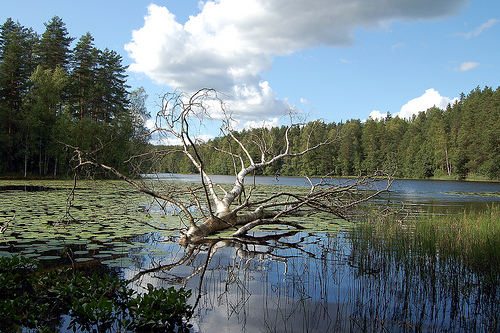
Overall Landscape Character
Nuuksio offers an
"archetypically Finnish" landscape: conifer and birch forests, rocky
outcrops with exposed granite, numerous small lakes/ponds, mossy or
lichen-covered ground, and intervening bogs. It feels wild and peaceful
despite its location near a capital city. The terrain is hilly and
varied enough for interesting hikes (with stairs and boardwalks on
trails) but remains accessible.
The park is not one contiguous block
but includes a main area plus smaller detached sections around certain
lakes.
The park's biodiversity is rich, hosting dozens of endangered or near-threatened species of animals, plants, and fungi across its old-growth forests, meadows, mires, and lakes. Flora includes ancient coniferous forests dominated by pines and spruces, with undergrowth of bilberry, lingonberry, and various mosses and lichens on rocky surfaces. Fauna highlights include the Siberian flying squirrel (Pteromys volans), the park's emblematic species with one of the densest populations in Finland, as well as birds like the European nightjar, woodlark, and various migratory waterfowl at sites like Matalajärvi. Other wildlife encompasses common forest mammals such as elk, foxes, and hares, alongside a variety of insects and amphibians thriving in the wetlands. The park also features the southernmost reindeer enclosure in Finland, adding a unique Arctic touch to its ecosystems. Its mixed habitats—dense forests, rocky hills, lakes, and wetlands—support a wide range of bird species, making it a prime spot for birdwatching.
Nuuksio offers extensive recreational opportunities, with hiking as the primary activity on dozens of kilometers of marked trails, best suited for exploring its diverse landscapes. There are eight marked hiking trails ranging from 1.5 km to 17 km, including four nature trails (2–7.5 km) starting from the Haukkalampi nature hut, equipped with duckboards and stairways in challenging sections to aid navigation and prevent erosion. Popular routes wind through quiet forested hillsides, valleys, and around lakes, with options for day hikes or multi-day treks. Biking is permitted on 30 km of connecting trails (with restrictions for conservation), and there are 22 km of horse-riding paths. Other activities include canoeing on lakes, birdwatching (especially at Matalajärvi), skiing in winter, and guided adventures like wilderness safaris or sauna experiences. The Finnish Nature Centre Haltia provides indoor exhibits, a restaurant, shop, and sauna facilities for a more structured experience.
Services include the Haukkalampi nature hut (with a water tap), covered grilling shelters, reservable campfire sites, a smoke sauna, and meeting facilities. Camping is available at 12 free tent sites, nine of which have campfire rings, woodsheds with axes, and dry toilets, located at spots like Mustalampi, Haukanholma, Holma-Saarijärvi, Isoholma, and Saarilampi. Two rental cabins and the Kattila lean-to shelter offer more sheltered options. Recycling points are at Kattila and Haukkalampi. For broader planning, the Nuuksio Lakeland pages detail additional services for day trips or overnight stays in the surrounding area.
The park features accessible trails and structures for a range of visitors, though specific details vary by section. As a nature reserve, Everyman's Rights are restricted: camping and campfires are only allowed at designated sites, and during wildfire warnings, fires are limited to cooking shelters with chimneys. Pets must be leashed, and visitors should pack out trash (or use recycling points), avoid littering, and not wash in water bodies. Stick to marked routes to minimize erosion and respect nature. Always check current rules and fire warnings before visiting.
For beginners, start at popular entrances like Haukkalampi, which can get crowded, especially on weekends. Public transport is convenient, but driving offers flexibility for exploring remote areas. Dress for variable weather, bring insect repellent in summer, and pack water and snacks, as facilities are limited. Visitor reviews often highlight the park's clean air, serene lakes, and green forests as a refreshing contrast to Helsinki's urban vibe, with experiences like hiking, canoeing, and sauna sessions praised for immersing in Finnish wilderness. It's ideal for short visits from the city or longer nature retreats.