Location: Bad Arolsen, Hesse Map
Built: early 18th century
Tel. +49 5691 895526
Official site
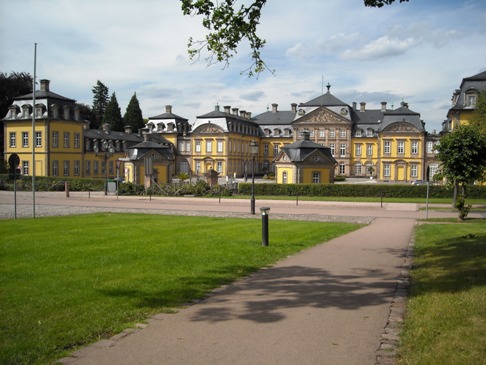
Arolsen Castle was constructed in the 18th century as a private residence of Waldeck and Pyrmont family. The lands of Arolsen Castle were originally home to a medieval Catholic monastery, but after it was secularized it was abandoned by its former residents. Arolsen Castle was finally removed in 1710 to make room to a family house. Arolson Castle was home to several generations of this noble family. Also it was a birth place of Queen consort Emma of Netherlands (2 August 1858 – 20 March 1934). Today the mansion is open to the public. It is notable for its huge library that is known as "Prince Waldecksche Court Library" that was completed in 1840. It is famous for its extended collection of 18th century literature.
Arolsen Castle (Residenzschloss Arolsen) is a grand Baroque palace in
Bad Arolsen, northern Hesse, Germany. It served as the principal
residence of the Princes of Waldeck and Pyrmont from the early 18th
century until the monarchy's end in 1918. Today, it remains a private
residence for descendants of the princely family (currently Carl-Anton,
Prince of Waldeck and Pyrmont, and his family) while functioning as a
public museum with guided tours, exhibitions, concerts, and cultural
events.
The three-winged complex exemplifies early 18th-century
princely ambition, modeled loosely after Versailles but scaled to the
modest resources of the small principality. Its history spans a medieval
convent, Renaissance adaptations, lavish Baroque construction,
19th-century royal connections, 20th-century political upheavals
(including Nazi-era involvement by family members), and modern
preservation.
Medieval Origins: From Augustinian Convent to Early
Residence (1131–1655)
The site’s roots trace to 1131, when an
Augustinian nuns’ convent (Kloster Aroldessen) was founded in the
village of Aroldessen. This religious house formed the foundation for
later secular structures.
In 1526–1530, Count Philipp III of
Waldeck-Eisenberg secularized the convent during the Reformation,
demolishing much of it and converting the remnants into a
Renaissance-style castle. This early residence became part of the
Waldeck family’s holdings. By 1655, Arolsen (then simply Arolsen) was
designated the official residence town of the Counts (later Princes) of
Waldeck, shifting the family’s seat from other locations like Waldeck or
Korbach.
An initial attempt to build a new Baroque palace in Korbach
failed due to local landowners’ refusal to sell property, prompting the
focus on Arolsen.
Baroque Construction and Princely Splendor
(1706–1810)
The current palace was commissioned by Prince Friedrich
Anton Ulrich of Waldeck and Pyrmont (1676–1728). Elevated to hereditary
princely rank in January 1712 (formalized around 1711–1712), he sought a
magnificent residence to match his new status. In 1706, he began
planning a Versailles-inspired complex and town expansion.
Construction started in 1710 on the cleared site of the old Renaissance
castle and convent. Master builder Julius Ludwig Rothweil (the Elder)
designed the three-winged Baroque structure. Key phases included:
Main building work intensified after 1712, peaking 1713–1722.
Exterior largely finished by 1719–1720 (court and garden façades).
Prince and his wife, Countess Palatine Christiane of
Zweibrücken-Birkenfeld, moved into the completed eastern wing on 13
September 1720.
Outer courtyards, enclosures, and guard houses added
by 1725.
Overall completion in 1728, though interior furnishings,
stucco, and décor continued for decades due to financial constraints.
The exterior is classic Baroque with yellow-and-stone façades,
mansard roofs, and ornate gables. Interiors feature:
Splendid stucco
by Italian artist Andrea Gallasini.
Ceiling frescoes by Carlo
Ludovici Castelli (1721–1722).
Supraporte paintings by Magnus de
Quitter.
Later Rococo touches (e.g., princess’s audience chamber
post-1746).
Subsequent additions under later rulers included:
Marstall (stables, 1749–1758).
Government building (1755–1761, by
Friedrich Franz Rothweil the Younger).
Neues Schloss (New Palace, a
widow’s residence, 1763–1778).
Großer Saal (Great Hall, 1809–1811, by
Theodor Escher).
The palace reached full completion around 1810
under Prince Friedrich Karl August. The ambitious scale strained the
principality’s finances, contributing to long-term debt.
The
surrounding French formal garden was later replaced by an English
landscape park with a pond; remnants include an old avenue and a boxwood
rondel at the main portal.
19th Century: Royal Ties, Library, and
Political Shifts
The court library (Fürstlich Waldecksche
Hofbibliothek) has deep roots, with early acquisitions from a 1576
secularization of another canonry, but it was formally organized and
expanded in the 18th–19th centuries. By 1840 it housed thousands of
volumes focused on geography, history, literature, and militaria
(including rare “Klebebände” or paste-in engraving albums). It now
comprises about 35,000 volumes and remains a cultural highlight.
A
notable resident was Princess Emma of Waldeck and Pyrmont (born 2 August
1858 in the palace). She married King William III of the Netherlands in
1879, becoming queen consort and later regent; she is an ancestress of
the current Dutch royal family.
In 1867, financial woes and the
German Confederation’s demands led Waldeck-Pyrmont to sign an accession
treaty with Prussia, ceding much autonomy while retaining nominal
sovereignty until 1918.
20th Century: Monarchy’s End, Nazi Era,
and Post-War Recovery
World War I and the German Revolution ended the
principality. The last reigning prince, Friedrich, was deposed on 13
November 1918. Asset negotiations lasted until 1929: the Waldeck
Domanial Administration (now under the district) took forests and some
properties, but the family retained lifelong usufruct rights to the
palace, outbuildings, and lands. A princely foundation was created to
preserve the inventory, library, and art.
Nazi-era connections
involved the family directly. Hereditary Prince Josias of Waldeck and
Pyrmont (born 1896 in the castle) joined the NSDAP in 1929 and the SS in
1930, rising to SS-Obergruppenführer. He used the New Palace (Neues
Schloss) as his official headquarters for SS recruitment and training.
High-ranking Nazis, including Heinrich Himmler (who became godfather to
Josias’s son in 1936) and Rudolf Hess, visited the Old Palace
(Residenzschloss) for ceremonies. Josias oversaw SS activities linked to
Buchenwald and local sub-camps; he was later convicted as a war criminal
but released in 1950. The Old Palace itself hosted state events
welcoming SS guests.
Post-1945, American troops occupied both
palaces; the New Palace briefly housed UNRRA headquarters for tracing
Nazi victims. Extensive restorations occurred 1987–2009, preserving the
structure.
Present Day: Museum and Living Residence
The palace
is open to visitors year-round (guided tours of state rooms, military
history exhibits, municipal museum). Highlights include the Baroque
staircase, White Hall, Garden Hall, Alhambra Room (an oriental-style
gift), Queen Emma’s room, and sculptures by artists like Christian
Daniel Rauch. The Marstall houses a Rauch Museum. Summer events feature
the Arolser Barockfestspiele and concerts in the Stone Hall.
Historical Context and Construction
The castle stands on the site
of a former Augustinian convent (first documented 1131), which was
secularized and converted into a Renaissance castle between 1526 and
1530. In 1710, Prince Friedrich Anton Ulrich zu Waldeck und Pyrmont
(elevated to hereditary prince in 1711/1712) ordered the old structure
demolished to make way for a new Baroque palace.
Architect Julius
Ludwig Rothweil (the Elder, from Alsace) created the plans, drawing
direct inspiration from Versailles after the prince’s Grand Tour of
France. Construction ran primarily from 1710 to 1728, with the exterior
largely finished by 1719–1720 (court-yard-side gables in 1719,
garden-side gables in 1720). The prince and his wife, Christiane of
Palatinate-Zweibrücken-Birkenfeld, moved into the habitable east wing on
13 September 1720. Inner and outer courtyards with guardhouses and wings
were added by 1725. Interiors were fitted out over decades, and some
elements (parts of the staircase and the Weißer Saal/White Hall) were
only completed in the 19th century due to funding constraints.
Later
additions under subsequent princes and architects (e.g., Friedrich Franz
Rothweil the Younger and Theodor Escher) included stables (Marstall,
1749–1758), a government building (1755–1761), a riding hall
(1819–1824), and a separate Neues Schloss (widow’s residence,
1763–1778). A major restoration in the late 20th/early 21st century
(completed c. 2007) returned the palace to its historic splendor.
Overall Layout and Architectural Style
The palace is a classic
three-winged (Dreiflügelanlage) Baroque complex arranged in a
symmetrical U-shape around a central cour d’honneur (Ehrenhof). This
French-inspired axial layout creates a grand approach, spatial
hierarchy, and sense of princely authority. The main corps de logis
faces the garden, with symmetrical side wings enclosing the courtyard;
the east wing was built first. The design emphasizes balance,
proportion, and theatrical grandeur typical of Baroque palace
architecture, scaled to the resources of a small principality.
An
adjacent formal French garden (later largely replaced by an English
landscape park in the 18th/19th century) originally featured parterres;
a preserved circular rondell (boxwood or central feature) and an ancient
alley along the Schlossteich (palace pond) remain. Outbuildings include
an orangery, greenhouse, and later neoclassical structures.
The
façade is richly ornamented with Baroque detailing: rusticated stonework
on the lower levels, pilasters, arched windows with keystones, and
prominent triangular or segmental pediments (especially the central
gables on both courtyard and garden sides). The color scheme is
striking—warm yellow stucco walls contrasted with light sandstone trim
and dark slate roofs—creating a bright, imposing presence.
Exterior Architecture
Symmetry and hierarchy: Strict axial alignment;
the central pavilion of the main wing projects slightly with elaborate
sculptural decoration (cartouches, coats of arms, allegorical figures)
in the pediment.
Roofscape: Mansard-style roofs with dormer windows,
chimneys, and decorative finials or lanterns.
Courtyard: Paved
Ehrenhof with formal plantings (circular beds visible today), flanked by
the side wings and guardhouses. The entrance sequence builds
anticipation through gates, bridges, and forecourts.
Garden façade:
More open and palatial, originally overlooking parterres leading to the
pond and park.
The overall effect is one of restrained
opulence—Baroque but not overly flamboyant—suited to the Waldeck court’s
status.
Interior Architecture and Decoration
Interiors shift
from pure Baroque to early Rococo influences, reflecting evolving tastes
during the long construction period. Most rooms feature:
Elaborate Baroque stucco by Andrea Gallasini (a frequent collaborator of
Rothweil): intricate ceiling and wall moldings with scrolls, foliage,
putti, and mythological motifs.
Ceiling frescoes by Italian painter
Carlo Ludovico Castelli (1721–1722): large-scale mythological and
allegorical scenes glorifying the prince (e.g., references to ancient
gods symbolizing princely virtues and court protocol).
Key spaces
include:
Baroque Treppenhaus (staircase hall): A grand, light-filled
central feature with sweeping stairs, stucco, and frescoes; some upper
elements completed in the 19th century.
Gartensaal (Garden Hall):
Ground-floor reception room directly beneath the Weißer Saal, opening
toward the garden.
Weißer Saal (White Hall): The principal state room
on the piano nobile, with a surrounding gallery (umlaufende Galerie),
white stucco, monumental frescoed ceiling, and chandeliers. It served
for balls, audiences, and ceremonies.
Red Drawing Room (Roter Salon):
Notable for early Rococo elements—lighter, curvilinear ornamentation
contrasting the heavier Baroque elsewhere.
Alhambra Room: A
19th-century Orientalist fantasy room (Moorish/Islamic-inspired
decoration) gifted to Princess Helene of Nassau on her marriage;
features intricate geometric and arabesque patterns.
Other
apartments: Prince’s and princess’s suites (Pfälzisches Zimmer,
Kronprinzenzimmer) with overdoor paintings by Magnus de Quitter (1721),
Dutch tapestries, period furniture, and portraits. A five-room library,
music room (1751), and Stone Hall (used for concerts and the palace
chapel) complete the enfilade of state rooms.
Floors often
feature elaborate parquet or geometric inlays; walls combine painted
panels, silk damasks, and wood paneling. Later neoclassical and
Biedermeier touches appear in some areas.
Later Modifications and
Artistic Collections
19th-century changes under Theodor Escher
introduced neoclassical elements (e.g., the Großer Saal/Great Hall,
1809–1811). The palace houses significant collections: paintings
(Tischbein family, Aldegrever, etc.), sculptures (Rauch, Rietschel),
historical graphics, and cast-iron art, reflecting the family’s cultural
patronage.
Current Status and Significance
Today the palace
functions as a museum with guided tours of the state apartments, armory,
and Alhambra room, while parts remain privately inhabited by the Waldeck
family. Its architecture exemplifies the “Versailles of Waldecker
Land”—a compact yet magnificent Baroque residence that successfully
translated French absolutist ideals into a German princely context. The
combination of symmetrical planning, rich sculptural ornament, and
lavish interiors makes it one of Hesse’s finest Baroque monuments.