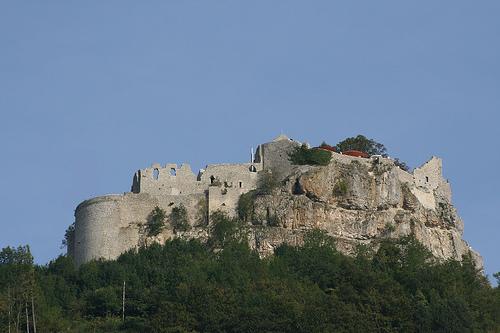
Location: Neuffen, Baden- Württemberg Map
Constructed: 1100- 1120 by Mangold von Sulmetingen
Hohenneuffen Castle (Burg Hohenneuffen) is one of the most impressive ruined hilltop fortresses in southern Germany, perched dramatically at 743 m (2,437 ft) on a late Jurassic rock outcrop in the northern foothills of the Swabian Alb (Schwäbische Alb). It overlooks the town of Neuffen in the Esslingen district of Baden-Württemberg and commands sweeping views across the surrounding cultural landscape. Today, the site is a popular tourist attraction with freely accessible ruins, open casemates, a restaurant, beer garden, and events like medieval markets and a fell-running race—yet its history spans from prehistoric times through medieval nobility, Württemberg state fortress, prison, near-total demolition, and 20th-century symbolism.
Prehistoric and Early Origins
The site was not
virgin territory when the medieval castle rose. Archaeological
evidence shows it served as a fortified settlement and outpost
during the late Iron Age La Tène period (roughly 450–1 BCE), linked
to the large Celtic oppidum at Heidengraben on the Swabian Alb
plateau. The name Neuffen (first recorded as Niffen around 1206)
likely derives from pre-Germanic or Celtic roots—possibly
proto-Celtic nobos ("holy/sacred") or Nîpen ("dispute
castle")—suggesting the mountain once held religious rather than
purely military significance.
Construction and the Lords of
Neuffen (c. 1100–1301)
The medieval castle was founded between
1100 and 1120 by Mangold (or Manegold) von Sulmetingen, a
ministerial of the Zähringen family, who soon adopted the name "von
Neuffen" after the site. His son Egino is recorded using the name in
1122. The castle first appears in documents in 1198, firmly in the
hands of the free nobles (Edelfreien) of Neuffen. This family rose
to prominence in the Staufer (Hohenstaufen) era, with ties to kings
Philip of Swabia and Frederick II; they acted as regents of Swabia
and tutors to Henry VII. Their influence extended across Swabia,
founding towns and villages. However, when Henry VII rebelled
against his father around 1235, the Neuffen lords supported him,
leading to their economic decline after the rebellion's suppression
in 1235. The Swabian branch of the family died out in 1290.
A
notable family member was the Minnesänger (minstrel poet) Gottfried
von Neifen, active in the early 13th century. By the end of the 13th
century, the castle passed briefly to the Lords of Weinsberg before
they sold it in 1301 to Count Eberhard I of Württemberg,
significantly expanding Württemberg's territory.
Württemberg
Takeover and Early Fortifications (1301–Mid-16th Century)
Under
Württemberg rule, the castle proved its strategic value almost
immediately. In 1312, during the Reichskrieg—an internal Holy Roman
Empire conflict following Henry VII's election as emperor—it
withstood attack and could not be conquered. Initial expansions into
a regional (Landesfestung) fortress began in the 14th–15th
centuries. It even served temporarily as a Württemberg residence in
the mid-15th century.
The most transformative phase came in the
first half of the 16th century under Duke Ulrich of Württemberg.
Major works (c. 1543 onward) added forward works (Vorwerke), round
towers for artillery, bastions, a commandant's building
(Kommandantur), casemates, stables, an armoury (Zeughaus), and two
cisterns. These created a powerful, artillery-resistant complex that
remained largely unchanged for the next 200 years.
Sieges and
Military Tests (16th–17th Centuries)
Hohenneuffen was besieged
four times but never taken by storm—only surrendered twice due to
external pressure or morale collapse:
1519: Surrendered to
troops of the Swabian League during conflicts involving Duke
Ulrich's expulsion.
1524/25: Withstood an assault by insurgent
peasants during the German Peasants' War.
1635 (Thirty Years'
War): The longest and most grueling siege—over 14–15 months by
Imperial forces. On 22 November 1635, commander Captain Johann
Philipp Schnurm negotiated surrender, allowing the garrison to leave
with weapons and possessions. The terms were violated: troops were
pressed into Imperial service, and Schnurm lost his property.
A popular (but historically inaccurate) 19th-century legend
claims defenders once fooled besiegers by feeding their last grain
to a donkey, slaughtering it, and hurling its full stomach over the
walls—convincing enemies of abundant supplies and prompting
withdrawal. The "Esel vom Hohenneuffen" (Donkey of Hohenneuffen)
became Neuffen's mascot anyway.
State Prison and 18th-Century
Modernization Plans
Throughout its Württemberg era, the castle
doubled as a state prison for political opponents, criminals, and
high-profile detainees—often involving torture. Notable prisoners
included:
1502: Young Count Friedrich von Helfenstein, who
died falling during an escape attempt.
1512: Abbot Georg Fischer
of Zwiefalten.
1517: Tübingen reeve Konrad Breuning, tortured
then beheaded in Stuttgart.
Early 17th century: Chancellor
Matthäus Enzlin (under Duke Friedrich).
1737: Court Jew Joseph
Süß Oppenheimer (financial advisor to Duke Karl Alexander), held
briefly before transfer to Hohenasperg and execution in 1738 in a
notorious show trial.
In the 18th century, Duke Karl
Alexander planned a major upgrade to a modern French-style fortress,
but he died in 1737 before completion. His successor, Duke Karl
Eugen, abandoned the costly project due to questionable military
value. The castle gradually lost strategic importance.
Decline, Demolition, and Preservation (Late 18th–19th Centuries)
In 1793, authorities decided to raze the fortress and sell its
materials. It ceased military/prison use in 1795 and was officially
released for demolition in 1801 (work began around 1803). Locals
quarried stone cheaply for building projects, reducing much of the
complex to ruins. Protection of the remains started in 1830; the
ruins opened to the public in the 1860s, and an inn was established
in the upper bailey in 1862.
20th Century and Symbolic Role
During World War II, the ruins served as an air watch post
(Fliegerwache). Post-war, on 2 August 1948, it hosted the historic
Dreiländerkonferenz (Three-States Conference). Württemberg-Baden's
Prime Minister Reinhold Maier convened delegations from
Württemberg-Baden (American zone), Württemberg-Hohenzollern, and
Baden (French zone) to discuss merging into a single southwest
German state. Though no immediate agreement was reached, the
secluded, symbolically elevated site (overlooking former
occupation-zone borders) helped initiate the process leading to
Baden-Württemberg's formation in 1952. A memorial plaque was added
in 2008.
Renovations occurred in the 1960s and later; lighting
was added and maintained by local groups from the 1950s onward. A
Staufer stele was inaugurated in 2014 to commemorate the Neuffen
lords' Hohenstaufen ties.
Today
The ruins remain a
breathtaking landmark, blending medieval, Renaissance, and early
modern fortifications. Key surviving features include massive
bastions, round towers, casemates, and the inner courtyard with
modern restaurant facilities. It attracts hikers, history
enthusiasts, and falconry shows, offering panoramic views of the
Swabian landscape.
Site and Natural Integration
The castle exploits the dramatic
geology of a steep-sided limestone spur. Steep cliffs on the west and
south sides made direct assaults nearly impossible without massive siege
works, turning the natural rock into the castle’s strongest “wall.”
Builders hewed sections directly into the bedrock and quarried local
White Jurassic limestone for construction, giving the walls exceptional
durability and a seamless blend with the terrain. The elevated position
commands panoramic views over the Neckar Valley and toward Stuttgart,
enhancing both defensive oversight and symbolic dominance.
Architectural Evolution by Construction Phases
Early Medieval Core
(c. 1100–1120)
Founded by Mangold von Sulmetingen (later von
Neuffen), the original hill castle featured classic high-medieval
defensive elements:
A robust inner shield wall (Schildmauer) up
to 3 m thick enclosing the core bailey (Hauptburg).
An outer
encircling ring wall (Ringmauer).
A prominent gate tower
(Allewindeturm) controlling the single viable approach.
Likely a
central keep (Bergfried) and basic residential quarters.
These early
walls, built of massive limestone blocks, prioritized mass and height
for resistance to battering rams, scaling ladders, and early siege
engines.
14th–15th Century Fortress Expansion
Under
Württemberg ownership (from 1301), the castle grew into a regional
stronghold. Minor upgrades addressed emerging artillery threats, but the
core medieval layout remained. It proved its worth in sieges (e.g., 1312
Reichskrieg and 1524–25 Peasants’ War).
16th-Century Renaissance
Military Upgrades (under Duke Ulrich of Württemberg)
The most
transformative phase introduced gunpowder-era defenses, shifting from
pure mass to enfilading fire and trace italienne principles:
Barbicans (outer defensive enclosures) protected the main gate,
funneling attackers into kill zones.
Round and half-round towers
(some adapted for cannon) provided elevated, 360° fields of fire for
archers and artillery.
Bastions (projecting polygonal or rounded
structures, including named examples like Ludwig and Friedrich bastions)
allowed overlapping cannon fire along curtain walls.
Casemates —
vaulted, bomb-proof chambers built into or behind walls (>3 m high in
places) — housed protected gun emplacements.
Additional functional
buildings: commanding officer’s quarters, stables, armoury, and two
large cisterns for water self-sufficiency during prolonged sieges.
These changes made Hohenneuffen one of the most advanced fortresses in
Württemberg, emphasizing artillery defense while retaining medieval
curtain walls.
18th-Century French-Style Modernization
(incomplete)
Duke Karl Alexander planned a full Vauban-inspired
redesign with more sophisticated bastion rings and outworks, but his
death in 1737 and successor Karl Eugen’s cost concerns halted the
project. The castle was partially dismantled after 1793–1801 and
repurposed briefly as a prison before preservation began in the 1830s.
Layout and Key Defensive Features
The castle follows a classic
multi-layered hill-fortress plan divided into outer ward (Vorburg) and
inner ward (Hauptburg/upper bailey), with the natural rock forming much
of the perimeter.
Entrance and Outer Defenses: Access is via a
single approach road leading through the barbican and Black Gate (one of
the labeled entrances). The gate tower and barbican create a narrow,
easily defended corridor.
Curtain Walls and Towers: Thick limestone
walls (original Schildmauer and later casemated sections) feature
battlements, shooting slits, and integrated round/half-round towers.
Bastions project outward for crossfire.
Inner Courtyard and Upper
Bailey: The heart of the complex includes residential and administrative
buildings (now mostly ruined), with an open inner courtyard. A modern
restaurant/inn (established 1862) occupies restored structures here.
Support Infrastructure: Stables, armoury, and cisterns ensured
logistical independence. Some casemates remain accessible today.
A simplified floor-plan diagram (available on sites like
great-castles.com) highlights the Black Gate, Shield Wall, and
restaurant area, showing the elongated layout hugging the crag’s
contours.
Current State and Visitor Experience
The ruins
preserve impressive stretches of 12th–16th-century masonry, with
bastions, round towers, and vaulted casemates still visible. The
integration of rock and wall is especially striking in places where the
fortress seems to grow directly from the cliff. While much is ruined,
the site feels vast and impregnable, offering a tangible sense of
medieval-to-early-modern defensive evolution. Public access is free;
guided tours and the on-site restaurant enhance visits.