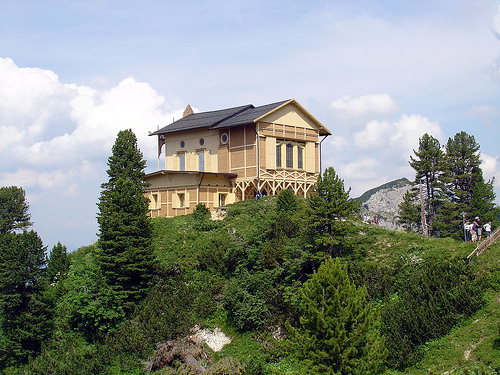
Location: 10 km (6 mi) South of Garmisch-Partenkirchen Map
Constructed: 1869- 1872 by King Ludwig II of Bavaria
Open: June-
Oct
Entrance Fee: 4.50 Euro
Tel. (0 88 22) 92 03 0
The King's House on Schachen (German: Königshaus am Schachen), also known as the Schachen Royal Lodge or King's House, is a small, remote two-storey wooden villa (Schlösschen) perched at an altitude of 1,866 meters (6,122 feet) on the Schachen Alp in the Wetterstein Mountains of the Bavarian Alps. Located about 10 km south of Garmisch-Partenkirchen, Germany, at the foot of the dramatic Wetterstein massif (with panoramic views including the Zugspitze), it was commissioned by the eccentric "Fairy Tale King" Ludwig II of Bavaria (1845–1886) as a personal mountain refuge. Unlike his more famous palaces (Neuschwanstein, Linderhof, and Herrenchiemsee), it is the least known of his creations and was never intended as a hunting lodge—Ludwig II strongly disliked hunting.
Planning and Construction (1869–1872)
In 1869, Ludwig II began
planning a mountain house in the Werdenfelser Land region, seeking a
place where he could enjoy the high Alps in complete comfort and
solitude, away from court life and royal duties. He personally selected
the Schachen site for its unparalleled high-mountain vistas—one of the
most impressive in the Bavarian Alps.
Architect Georg von Dollmann
(who also worked on other Ludwig projects, including Linderhof) designed
the building. Construction ran from 1869 to 1872. The remote,
high-altitude location posed significant logistical challenges: every
material, including heavy items like chandeliers and furnishings, had to
be hauled up the mountain by men, mules, or carts along steep forest
paths. Fresh running water was sourced directly from mountain streams.
The total cost and exact labor details are not extensively documented in
public sources, but the project reflected Ludwig's willingness to spare
no expense for his romantic visions, even in such an inaccessible spot.
The house was completed in time for Ludwig's use by around 1872. It
stands as a modest timber-framed structure in the popular 19th-century
"Swiss chalet" style—wooden post-and-infill construction with a simple,
inviting alpine façade that belied its opulent interior surprises.
Architecture and Interiors: Contrast of Modesty and Oriental
Splendor
The exterior and ground floor deliberately evoke a cozy
Alpine holiday home, aligning with the era's fashion for Swiss-style
chalets among the nobility and wealthy. The floor plan features a
central salon, reminiscent of mid-19th-century French upper-class
villas. The five ground-floor living rooms are paneled in warm cembra
pine (Swiss stone pine), with comfortable, practical furnishings that
create an unpretentious, nature-oriented atmosphere.
The upper floor,
however, delivers a stunning contrast: the entire level is occupied by
the Turkish Hall (also called the Moorish Room or Türkischer Saal), an
extravagant Oriental fantasy that occupies roughly 100 square meters.
This room was modeled after an 18th-century hall in the Palace of Eyüp
in Istanbul, built by Ottoman Sultan Selim III (r. 1789–1807). Ludwig
had encountered a depiction of it (an engraving by Englishman Thomas
Allom) in an architectural publication on Constantinople, fueling his
fascination with Eastern cultures amid the broader 19th-century European
Orientalism craze.
The hall features:
Gilded, richly ornamented
walls in a lavish mix of styles (gold, blue, and red color scheme).
A
central fountain.
Elaborately embroidered divans, stools, and
textiles (including peacock feathers).
A luxurious carpet.
Incense
burners, candelabra, and other accessories.
Large stained-glass
windows with colorful ornamentation that bathe the space in ethereal
light.
The overall effect is one of fairy-tale exoticism—opulent,
theatrical, and deliberately otherworldly—perfectly embodying Ludwig's
eclectic tastes. As one source notes, "this hall—in the midst of the
high mountains—is unique and conceivable only with King Ludwig II."
Usage During Ludwig II's Lifetime
Ludwig II used the King's House
exclusively as a private mountain retreat, not for hunting or official
functions. He visited regularly to immerse himself in the Alps' grandeur
while enjoying every comfort. Most notably, he celebrated his birthday
and name day (both falling on August 25) here annually. These events
were elaborate and theatrical: servants dressed in Oriental costumes
would serve tea and smoke hookahs in the Turkish Hall, evoking tableaux
vivants (living pictures), a popular 19th-century entertainment. The
room was illuminated with numerous candles (sometimes reportedly 100 or
more) to heighten the magical atmosphere.
These visits allowed Ludwig
to stage his romantic ideals of escape and illusion, blending nature
with fantasy in a way that foreshadowed (and contrasted with) his
grander palace projects. A notable early visitor was the writer Felix
Dahn in 1873, shortly after completion, who documented the experience.
After Ludwig II: From Royal Property to Public Site
Ludwig II
died in 1886 under mysterious circumstances. The house remained in royal
hands until the abolition of the Bavarian monarchy in 1918, after which
the Free State of Bavaria assumed ownership. It has since been
administered by the Bavarian Palace Administration (Bayerische
Verwaltung der staatlichen Schlösser, Gärten und Seen), with oversight
from the Schloss- und Gartenverwaltung Linderhof.
The property is
open to the public seasonally (typically late May to early October,
weather permitting), as the high altitude and steep access trail (a
3-hour hike ascending about 1,000 meters from points like Schloss Elmau
or Garmisch-Partenkirchen) make it inaccessible in winter. Guided tours
highlight the interiors, and visitors often combine it with the adjacent
Alpengarten auf dem Schachen (alpine botanical garden), established
later at around 2,000 meters and featuring over 1,000 plant species from
various global mountain regions.
In July 2025, the King's House on
Schachen was inscribed as a UNESCO World Heritage Site, alongside
Neuschwanstein, Linderhof, and Herrenchiemsee, under the collective
title "The Palaces of King Ludwig II of Bavaria." It meets cultural
criterion (iv) as an outstanding example of 19th-century royal
architectural ensembles. The core area is tiny (0.025 ha), but it is
protected by a vast 3,773 ha buffer zone encompassing the surrounding
alpine landscape.
Historical Significance
The King's House on
Schachen encapsulates Ludwig II's visionary, eccentric personality: a
romantic idealist who blended simplicity with extravagance, nature with
fantasy, and isolation with theatricality. Far less grandiose than his
other works, it remains a hidden gem that reveals his personal tastes
more intimately. Its survival as a preserved historic site offers
visitors a tangible link to the "Fairy Tale King" and the cultural
currents of 19th-century Bavaria and Europe. Today, it stands not only
as a architectural curiosity but as part of Bavaria's rich royal
heritage, drawing hikers and history enthusiasts alike for its unique
blend of alpine wilderness and Oriental opulence.
The King's House on Schachen (German: Königshaus am Schachen or
Schachenhaus), also known as the Schachen Lodge, is a small two-storey
wooden villa built between 1869 and 1872 for King Ludwig II of Bavaria
at an elevation of approximately 1,866 meters (about 6,120 feet) on the
Schachen alp in the Wetterstein Mountains, roughly 10 km south of
Garmisch-Partenkirchen in Bavaria, Germany.
Designed by court
architect Georg von Dollmann (who also worked on other Ludwig II
projects like Linderhof), it was conceived not primarily as a hunting
lodge—Ludwig reportedly disliked hunting—but as a remote mountain refuge
for personal solitude, birthday celebrations, and immersion in nature
combined with fantasy. It is the least-known and smallest of Ludwig’s
palaces and was inscribed in 2025 as part of the UNESCO World Heritage
Site “The Palaces of King Ludwig II of Bavaria” (alongside
Neuschwanstein, Linderhof, and Herrenchiemsee) under cultural criterion
(iv) for its exemplary historicist and eclectic 19th-century
architecture.
The structure exemplifies Ludwig’s characteristic
duality: a deliberately modest, nature-integrated exterior and lower
floor contrasting with extravagant, theatrical interior fantasy spaces.
Access is only on foot (a 3–4 hour hike ascending ~1,000 m), enhancing
its sense of isolation amid alpine meadows with panoramic views of the
Zugspitze and surrounding peaks.
Exterior Architecture and
Construction
The building is a timber-framed (post-and-infill or
Ständerbau) wooden structure in the style of a traditional 19th-century
Swiss chalet (Schweizerhaus), a type popular among European nobility and
wealthy citizens for mountain holiday homes or excursion restaurants.
The exterior appears unpretentious and cosy: light-colored wooden
cladding, wooden shutters, artfully sawn balcony railings, and
projecting eaves. Some details subtly echo Ottoman wooden architecture,
though the overall impression is that of a simple alpine lodge rather
than a royal palace.
It sits on a slight rise with a gabled roof and
a modest footprint, blending into the high-alpine landscape. No grand
stone façade or towers here—unlike Neuschwanstein or
Herrenchiemsee—emphasizing humility and harmony with nature.
Spatial Organization and Ground Floor
The interior layout on the
ground floor follows a central salon plan typical of mid-19th-century
French upper-class villas, providing a logical, symmetrical flow with
rooms arranged around a main living space.
There are five residential
rooms (living/dining room, study, bedroom, guest room, and a
toilet/bathroom area), all modestly appointed to evoke a comfortable
Alpine holiday home. Walls and ceilings are paneled in aromatic cembra
pine (Swiss stone pine or Zirbelholz), which gives a warm, resinous
scent and a rustic yet refined texture. Furniture in the study and
bedroom is oak, emphasizing simple elegance with comfortable upholstered
pieces.
Stylistic elements are a restrained mix—Bavarian folk
influences blended with subtle historicist touches—but nothing
extravagant. The overall effect is cozy, practical, and in keeping with
the chalet exterior: no gilded excess, just functional retreat spaces
suited to mountain life.
Upper Floor: The Turkish (or Moorish)
Hall
The entire upper floor is occupied by a single, spectacular
Turkish Hall (Türkisches Zimmer or Moorish Room), creating the
building’s most dramatic architectural and experiential contrast. This
space transforms the modest chalet into an opulent Orientalist fantasy,
reflecting 19th-century European fascination with the “exotic” East.
It was modeled on a historic hall in the Palace of Eyüp (Eyoub) in
Istanbul, built by Sultan Selim III at the end of the 18th century.
Ludwig discovered it via engravings (notably by Thomas Allom) and had
the initial design redone to his exacting standards; the final version
was completed around 1872.
The hall features:
Central fountain
— a gurgling marble or gilded basin that adds sound, movement, and cool
humidity to the alpine air.
Walls and ceiling — richly gilded,
carved, and ornamented with intricate Moorish/Turkish motifs,
arabesques, and panels in a vibrant palette of gold, deep blue, and red.
Windows — large stained-glass or colored-glass panes that cast rainbow
light effects across the room.
Furnishings — low, lavishly
embroidered divans, stools, and cushions arranged around the fountain;
precious carpets on the floor; and stands of peacock feathers (a
practical substitute for fresh flowers, which were hard to transport
uphill).
Lighting and accessories — ornate chandeliers, candelabras,
incense burners, enameled vases, and other luxurious details creating a
“One Thousand and One Nights” atmosphere.
A tight wooden spiral
staircase at the rear of the ground floor leads up to this hall,
heightening the surprise. The overloaded eclectic mix of styles
(Turkish, Moorish, and broader Orientalist) is typical of 19th-century
historicism but executed with Ludwig’s signature theatricality.
Architectural Significance
The King’s House on Schachen perfectly
encapsulates Ludwig II’s architectural philosophy: blending romantic
historicism, eclecticism, and personal fantasy with advanced
19th-century construction techniques (light timber framing suited to the
remote, high-altitude site). The deliberate contrast between the humble
Swiss-chalet exterior/ground floor and the lavish Turkish Hall upstairs
mirrors the king’s desire for both rustic solitude and fairy-tale
escapism. It is a “staged visual architecture” for imagined worlds,
using the alpine setting as a dramatic backdrop.