Location: Wunsiedel, Bavaria Map
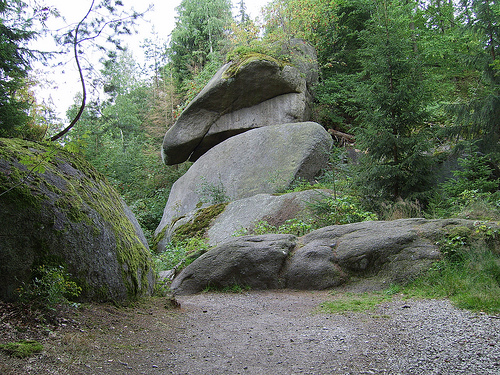
The Luisenburg Rock Labyrinth (German: Luisenburg-Felsenlabyrinth) is a stunning natural geological formation located in the Fichtelgebirge mountains of Upper Franconia, Bavaria, Germany. Recognized as Europe's largest felsenmeer (a "sea of rocks"), it consists of massive granite boulders, some up to several meters in diameter, scattered across a hilly landscape, creating a maze-like network of narrow passages, steep stairways, and climbable rock piles. Covering approximately 5.8 hectares, the site offers an adventurous hiking experience that combines natural beauty with historical and cultural elements, attracting families, hikers, and nature enthusiasts. It is part of the Großes Labyrinth Nature Reserve and has been designated a national geotope since 2006, highlighting its scientific significance. Visitors often describe it as a "magical" or "breathtaking" playground of rocks, with paths that evoke a sense of exploration and wonder, though it requires physical agility due to its rugged terrain. The labyrinth is also home to the Luisenburg-Festspiele, an annual open-air theater festival held in a natural amphitheater amid the boulders.
Geological Origins
The formation dates back roughly 240–300
million years. Granite formed when magma intruded into the Earth's crust
during the Variscan orogeny (late Paleozoic era). Over time,
particularly in the warm, humid tropical climate of the Cenozoic
(Tertiary) era, spheroidal weathering (Wollsackverwitterung) rounded the
granite blocks along joints and fractures.
Subsequent erosion,
especially during the Quaternary Ice Ages, removed surrounding softer
material and soil. This left massive, unstable boulders that shifted
into a chaotic jumble of narrow clefts, caves, steep drops, and piled
rocks. For centuries, people attributed the dramatic landscape to
catastrophic events like earthquakes, floods, or volcanoes. Johann
Wolfgang von Goethe, who visited in 1785 and 1820, rejected this in
favor of gradual natural processes—his observations on granite
weathering remain insightful today.
The site spans about 20 acres
(part of the Großes Labyrinth Nature Reserve) at around 693 meters
elevation, featuring moss-covered boulders, luminous moss in caves, and
features like narrow passages and metal stairs for modern safety.
Early Human History and Mentions
The area appears in records as
early as 1352, referred to variably as Los-, Lux-, Luchs-, or Lugsburg
(referencing a nearby medieval motte or ruined castle site, not an
actual fortress on the rocks). It was a place of fear and
superstition—locals viewed the wild, inaccessible boulders as eerie or
dangerous, sometimes associated with robbers or the supernatural.
By
the 18th century, the first minor human interventions occurred, such as
blasting in 1740 (purpose unclear—possibly for access or geological
interest).
Development as a Romantic Landscape Garden (Late
18th–Early 19th Century)
The transformation into a tourist site and
bürgerlicher Landschaftsgarten (civic landscape garden) aligned with the
early Romantic movement's fascination with sublime nature, inspired by
English landscape gardens.
1784: The Society for the
Enlightenment of Patriotic History, Customs, and Rights formed in
Wunsiedel, promoting local heritage and development.
Around 1790:
Citizens, led by figures like Dr. Johann Georg Schmidt (mayor,
physician) and Baron von Carlowitz (a frequent spa visitor from
Regensburg who funded much of the work and added inscriptions), began
draining swamps, laying paths, carving stairs, and planting. The area
shifted from boggy wilderness to accessible romantic wonderland.
Initial name: Luxburg, referencing the old castle remnants.
1794:
Used for the singspiel Die kleine Ährenleserin.
1805 marked a
pivotal royal visit by Prussian King Frederick William III and Queen
Louise (Luise). The queen was enchanted; Dr. Schmidt renamed the site
Luisenburg in her honor. This boosted its fame. Further enhancements
occurred, though Napoleonic wars (1806–1810) caused a pause.
Post-1810, Schmidt's sons (especially Florentin Theodor Schmidt, who
profited from sugar smuggling via Heligoland during the Continental
Blockade) resumed and expanded the project. Key features added: poetic
inscriptions on rocks, benches, viewpoints, and an open-air theater in a
natural amphitheater. Notable named formations include the Three
Brothers, Napoleon's Hat, Sugar Loaf, Devil's Staircase, and Insel
Helgoland (with a pagoda, referencing sugar trade).
The garden
reached completion around 1820, embodying Romantic ideals of wild yet
cultivated nature. It became a jewel of civic culture, with phases
continuing into the 1820s under Bavarian influence (after the region
shifted from Prussian to Bavarian control).
19th–20th Centuries:
Theater, Tourism, and Cultural Role
The natural stage hosted
performances from the late 18th century onward. The
Luisenburg-Festspiele (open-air theater festival) evolved into one of
Germany's oldest and most significant, with summer musicals, plays, and
events drawing crowds. It symbolizes German Romanticism and has
nationalist undertones in its history.
The site saw periods of
neglect and reclamation by nature but remained a tourist draw. In the
20th century, Wunsiedel (birthplace of poet Jean Paul and later
associated with Rudolf Hess) added layers of cultural and controversial
history, though the labyrinth itself stayed focused on natural beauty.
Modern Era and Protection
2002: Named one of Bavaria's most
beautiful geotopes.
2006: Designated a National Geotope.
2026:
Officially established as a Naturschutzgebiet (nature reserve) and
Nationales Naturmonument.
Location
Coordinates: Approximately 50°00′43″N 11°59′32″E
(50.01208°N, 11.99209°E).
Position: It sits on the northeastern slope
of the Kösseine massif, near the town of Wunsiedel (address: Luisenburg
2a, 95632 Wunsiedel). The site reaches an elevation of about 693 meters
(2,274 feet).
Regional Context: The Fichtelgebirge is a low mountain
range in northeastern Bavaria, known for its granite geology, forests,
and hiking trails. It lies near the Czech border and is roughly 45
minutes north of Grafenwoehr or 2.5 hours north of Munich by car (via
A93 motorway, then B303).
The labyrinth forms part of the Großes
Labyrinth Nature Reserve. It is embedded in a forested, hilly landscape
with a mix of woodland paths, steep steps, narrow clefts, moss-covered
boulders, and scenic viewpoints. It was developed in the late 18th–early
19th century as a romantic landscape garden, with paths, stairs,
benches, poetic inscriptions, and an open-air theater, inspired by
English gardens and named after Prussian Queen Louise (Luise).
Accessibility: There is parking nearby (day ticket around €3 for cars).
A circular hiking route through the labyrinth typically takes 1.5–2
hours (about 4–5 km / 2.5–3 miles with some elevation gain). It features
steep stairs, slippery sections when wet, and fun squeezes between
rocks. Guided tours and apps (e.g., Hyronimus) are available for deeper
insights.
Geology
The site is a classic felsenmeer (rock sea
or boulder field) composed of massive granite blocks, many several
meters across, piled chaotically in a maze-like arrangement.
Rock
Type and Age
The primary rock is Kösseine granite, an intrusive
(plutonic) rock formed during the Variscan orogeny (late Paleozoic,
roughly 300 million years ago, Permian period).
This resulted from
continental collisions that caused magma to rise and solidify
underground. The granite body includes Kösseine core granite (eastern
parts, often bluish due to cordierite crystals) and marginal granites
(western parts). It contains inclusions of older rocks and partially
assimilated sedimentary remnants, visible in nearby quarries.
Formation Processes
Initial Intrusion and Jointing: Magma intruded
and cooled, creating a granite pluton with systematic horizontal and
vertical joints (fractures) from cooling contraction.
Spheroidal
Weathering (Wollsackverwitterung or "wool sack" weathering): During the
warmer, humid tropical/subtropical climate of the Cenozoic era (Tertiary
period), chemical weathering penetrated deeply along joints. This
rounded the granite blocks into characteristic "wool sack" or
mattress-like shapes.
Erosion and Exposure: Over millions of years,
overlying material eroded away. Physical weathering intensified during
the Quaternary (Ice Ages), with freeze-thaw cycles, ice wedging, and
temperature fluctuations breaking down weaker zones. Solifluction (slow
downslope flow of saturated soil) during warmer interglacial periods
removed finer material, leaving the resistant blocks unstable and
allowing them to shift gradually into their current chaotic positions.
Historical Misconceptions: Earlier observers, including during the
Romantic era, attributed the jumble to catastrophic events like
earthquakes, floods, or volcanoes. Johann Wolfgang von Goethe visited in
1785 and correctly advocated for gradual, patient natural processes
(weathering and erosion) in his writings.
The blocks are often moss-
and lichen-covered, creating a wild, fairy-tale atmosphere with features
like narrow passages, caves, grottoes, and named formations (e.g., Three
Brothers, Napoleon’s Hat, Sugar Loaf, Devil’s Staircase).
Summary
of Key Features
Scale: Europe's largest such labyrinth, with giant,
rounded granite boulders strewn across a forested hillside.
Ongoing
Process: The rocks continue to shift very slowly today.
Scientific
Value: Recognized as a national geotop, it exemplifies long-term
granitic weathering and erosion in a temperate European setting.
The labyrinth's main attraction is its maze of granite boulders,
offering a variety of trails that wind through tight passages, up steep
stone steps, and over climbable rocks. Key features include:
Goethe Rocks: A cluster of massive boulders named after the poet's
visit, featuring inscriptions and viewpoints.
Natural Amphitheater: A
rock-encircled space used for the Luisenburg-Festspiele, hosting
theater, music, and cultural events from May to September, with seating
for thousands amid the natural setting.
Narrow Clefts and Tunnels:
Some passages require squeezing through, adding an adventurous element;
these "rock tunnels" are highlighted as fun but potentially challenging
for larger individuals.
Prinzenplatz and False Ruins: Historical
landscaping elements, including a plaza with panoramic views and
artificial ruins evoking romanticism.
Hiking Paths: The primary trail
is a 1.5–2 hour loop marked by blue arrows (uphill/ascent) and red
arrows (downhill/descent), covering about 2–3 km with moderate
difficulty. It includes steep stairs, low overhangs, and opportunities
for scrambling. Side paths lead to viewpoints over Wunsiedel and the
Fichtelgebirge. The terrain is family-friendly for active children, who
enjoy climbing, but it's not fully accessible for those with mobility
issues.
The site integrates nature with culture, where the rocks
serve as both a playground and a stage. Biodiversity adds to the appeal,
with forests providing shade and a mystical atmosphere, especially in
misty conditions.
Practical Information (2026)
Opening Hours: Daily 8:30 AM – 6:00
PM (extends to 7:00 PM in June–August during the Luisenburg Festival).
Season runs roughly from Easter/early April to mid-November. Closed in
winter for safety (snow/ice).
Admission Fees (approximate, confirm
on-site or official site):
Adults: €6
Children/youth (6–17): €2
Under 6: Free
Family ticket (2 adults + up to 3 kids): €14
Groups
(20+): €5/person
Guided tours: Extra fee (book ahead).
Parking:
Paid lot near the entrance (around €2–3/day). Follow signs; avoid
unofficial spots as they may be restricted.
Address: Luisenburg 2,
95632 Wunsiedel.
Getting There
By Car (recommended): From A93,
take Marktredwitz exit and follow B303 toward Wunsiedel.
Well-signposted. Drive times: ~1.5–2 hours from Nuremberg, ~2.5–3 hours
from Munich, ~4.5 hours from Berlin.
Public Transport: Train to
Marktredwitz or Wunsiedel, then taxi or limited bus (fichtelBAXI
on-demand). Not ideal for a quick visit.
Bike/Walk: Possible from
Wunsiedel (~2–3 km), but hilly.
The Hiking Experience
The main
circular route is about 1.4 km long with ~100m elevation gain. It takes
1.5–2.5 hours (longer with kids, photos, or the app). It's a one-way
system in parts for safety: follow blue arrows uphill and red arrows
downhill.
Highlights: 25 numbered stations, including the
Tränengrotte (Tear Grotto), Goethefelsen, Teufelstreppe (Devil's
Staircase — steep and narrow), Drei Brüder, and viewpoints. Some
sections have luminous moss, narrow squeezes, ladders, and grottoes.
Difficulty: Moderately challenging. Involves climbing steps, squeezing
through gaps, and uneven/rocky terrain. Not suitable for strollers,
wheelchairs, or those with mobility issues or fear of heights/confined
spaces. Good for kids 4+ who are agile.
Extensions: Continue to the
Kösseine summit for panoramic views (adds time/elevation; rewarding).
Dogs: Allowed on leash (free entry). Some narrow spots may require
carrying smaller dogs.
In-Depth Visiting Tips
Best Time to
Visit:
Weekdays or early morning/late afternoon for fewer crowds and
better light.
Spring (wildflowers) or autumn (foliage colors) for
beauty. Summer can be busier but has longer hours.
Avoid after heavy
rain — rocks and roots get very slippery.
What to Wear and Bring:
Sturdy hiking boots with good grip (essential — wet rocks, mud, stairs).
Weather-appropriate layers (shaded but can be cool/damp).
Rain
jacket, water, snacks (no food vendors inside).
Headlamp if staying
late; phone for the free Hyronimus app (QR at entrance) for
geology/history info.
Safety and Etiquette:
Stay on marked
paths (one-way in key sections).
Watch kids closely near drops and
narrow spots.
No drones.
Leave no trace; this is a protected
natural monument.
With Families/Kids:
Great adventure
playground feel, but carry toddlers in some spots. No strollers. Family
ticket saves money.
Photography:
Bring a wide-angle lens for
rock formations. Golden hour or overcast light works well. Mossy areas
and viewpoints are highlights.
Nearby Attractions:
Combine
with free spots like Granitlabyrinth Epprechtstein, Weißenstein ruins,
Oberpfalzturm, or Fichtelsee lake.
Luisenburg Open-Air Theatre
(festivals in summer).