Location: Perl, Saarland Map
Constructed: 2nd century
Open: Apr- Oct 11am- 6pm
Nov- Dec
11am- 4pm
Feb- March 11am- 4pm
Closed: Christmas Eve- 1 Feb
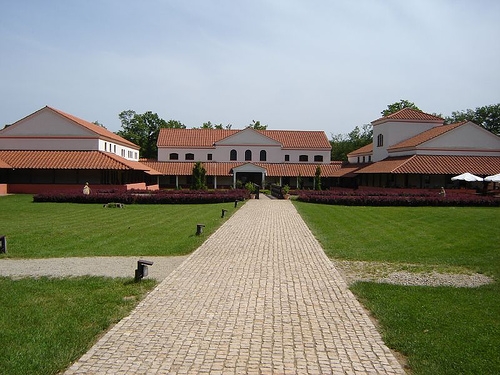
Roman Villa Borg is a reconstruction of an ancient Roman villa that once stood here near modern Perl, Saarland in Germany. In the early 20th century the site was discovered by a local teacher Johann Schneider who started his private digging in the local mounds that stood out from local plains. There was no in depth exploration of the ancient site due to World War One and Two. Only in the 1980's did scientists got a chance to explore the historic settlement. Subsequently archeologists uncovered a private residence of a Roman nobility that date back to the second century AD. Additionally to the antiquity tools from the Beaker culture that date back to the Neolithic and Chalcolithic periods were discovered here. Since that an ancient mansion was reconstructed. This included gardens that once surrounded this prosperous residence. Pollen discovered here gave historians an idea on what type of plants were raised here. Every year a Roman Day is held here in the first week of August. Reenactment of the period, including horsemanship, Roman drill soldiers are held here.
Pre-Roman Settlement
Human activity on the site dates back
thousands of years. Beneath the Roman layers, excavations uncovered
evidence of continuous occupation from the Neolithic period (tools
and settlements), the Beaker culture (including a notable Bell
Beaker grave from the Chalcolithic era), and the Iron Age
(structures and artifacts). This long pre-Roman presence suggests
the location was attractive for settlement long before Roman
influence reached the area.
Roman Occupation (1st–5th
Centuries AD)
The Roman villa emerged in the early 1st century CE
as a modest half-timbered structure with hearths and a portico. By
the Flavian period (late 1st century CE), it expanded into a
substantial stone-built villa rustica—a self-sufficient agricultural
estate typical of Roman Gaul and the Germanic provinces. It reached
its peak in the 2nd and 3rd centuries CE, covering over 7.5 hectares
(about 18.5 acres) and following a longitudinal axial plan oriented
around a central axis.
The villa was divided into two main zones
separated by a wall and impressive gatehouse:
Pars urbana
(residential/prestige area): This included the main manor house (a
palatial building perpendicular to the axis, serving as the elite
family’s residence and status symbol), a fully equipped bath complex
with hypocaust heating, frigidarium, tepidarium, caldarium,
latrines, and apodyterium (dressing room), servants’ quarters, a
kitchen (culina), and formal reception rooms. Features included
black-and-white mosaics in the atrium and reception hall, painted
wall plaster (some with Latin inscriptions indicating literacy among
inhabitants), and a household shrine (lararium).
Pars rustica
(economic/farm area): Symmetrical annexes housed food stores,
workshops, stalls, carriage sheds, and living quarters for workers
and administrators. Enclosed spaces likely served as kitchen gardens
and small livestock areas. The estate supported agriculture (crops,
livestock, food processing) and benefited from its proximity to a
major Roman road linking the civitas capitals of Augusta Treverorum
(Trier) and Divodurum Metromatricorum (Metz).
Artifacts
recovered include high-quality Terra Sigillata pottery, Roman glass
vessels, gold jewelry, a cavalry plaque, stamped clay floors, and
evidence of ongoing renovations. No specific owner is known, but it
was likely managed by a wealthy Romanized Gallo-Germanic elite
family. The site shows signs of gradual decline after the 4th
century amid broader Roman withdrawal from the region, with some
rooms reused before final abandonment in the early 5th century. Its
low-lying, flood-prone location discouraged post-Roman settlement or
reuse, which remarkably preserved the foundations (up to 1.8 meters
high in places) in excellent condition with minimal later
disturbance.
Post-Roman Period and Rediscovery (5th–20th
Centuries)
After abandonment, the site saw virtually no
significant activity or building, leaving the Roman remains largely
untouched. Local knowledge of the ruins persisted faintly, but
systematic interest began only in the late 19th/early 20th century.
Around 1900, Johann Schneider, a local schoolteacher, noticed
unnatural mounds in fields between Borg and Oberleuken,
investigated, and uncovered wall remains and Roman pottery.
Small-scale amateur work followed, but the two World Wars and other
priorities halted progress.
Modern Excavations and Protection
(1980s Onward)
Illegal excavations in the mid-1980s threatened
the site, prompting Saarland authorities to fence it off. Systematic
scientific excavations began in 1986/1987 under the Cultural
Foundation for the District of Merzig-Wadern, in partnership with
the State Conservation Office, employment programs, and the
Municipality of Perl. The pars urbana was fully excavated first;
work on the pars rustica continues today across the 7.5-hectare
area. These digs confirmed the villa’s scale, pre-Roman layers, and
excellent preservation.
Reconstruction Project (1994–2008 and
Beyond)
In 1994, authorities decided on an ambitious
reconstruction to create an authentic representation of the villa as
it appeared in the 2nd–3rd centuries CE. Work proceeded in phases:
the bathhouse and tavern first, followed by the manor house (with
integrated museum), inner courtyard, residential/economic wings,
gatehouse, and Roman kitchen (completed 2008). Structures were built
directly atop the original Roman foundation walls using evidence
from the site, comparable regional villas (e.g., Echternach in
Luxembourg), ancient texts like Vitruvius, pollen analysis for
gardens, and modern archaeological research. Materials and
techniques mimic Roman methods (e.g., lime mortar resembling opus
caementicium) while meeting safety standards. The project is unique
worldwide—no other Roman villa has been so completely and
authentically rebuilt on its exact foundations. Ongoing excavations
allow continuous refinement as new finds emerge.
Authentic
Roman-style gardens were planted based on pollen studies: herb and
medicinal plant gardens, kitchen gardens with fruits/vegetables,
rose gardens, and an inner peristyle court with fountains and paths.
The baths are fully functional (visitors can book experiences). A
non-original tavern serves Roman recipes (including bread baked in
the reconstructed culina). The manor house displays original finds
and replicas, including a Chalcolithic Bell Beaker, gold jewelry,
and cavalry plaque.
Current Status and Significance
Today,
the Archaeological Park Römische Villa Borg operates as a living
museum and tourist attraction drawing around 50,000 visitors
annually. It hosts events like the annual “Roman Days” (Römertage)
since 1997, with reenactments, and offers immersive experiences of
Roman rural life—baths, gardens, crafts, and cuisine. As the only
complete reconstruction of its kind (even surpassing examples in
Italy), it provides unparalleled insights into Roman architecture,
daily life, agriculture, and elite culture in the northern
provinces. Excavations and research continue, making the site a
dynamic window into over 2,000 years of history.
Reconstruction work started in the mid-1990s (around 1994) and was
largely completed by late 2008, though excavations continue. The goal
was maximum archaeological authenticity: new structures rise exactly on
the original Roman foundation walls, informed by on-site finds,
comparable villas (such as Echternach in Luxembourg), ancient texts like
Vitruvius’s writings on architecture, and modern research (including
pollen analysis for gardens and studies of wall paintings).
The
result gives a vivid, probable picture of the villa’s appearance at its
height in the 2nd–3rd centuries CE.
Main House (Pars Urbana Manor): The focal prestige building sits
perpendicular to the central axis, forming the heart of the residential
complex around a large inner courtyard. It likely rose two stories, with
a grand reception hall (atrium) featuring a black-and-white mosaic
floor, adjacent rooms for living and display, and upstairs bedrooms.
Interiors include reproduced Roman furniture (beds, stools, tables,
cupboards), colorful fresco-style wall paintings, and geometric mosaics.
A lararium (household shrine) reproduces a Pompeii-style fresco of
Bacchus.
Thermal Baths: One of the highlights is the fully functional
Roman bathhouse (balneum), complete with frigidarium (cold plunge pool),
caldarium (hot bath with vaulted ceiling and underfloor heating),
tepidarium (warm room), laconicum (dry sweat room), latrines, dressing
room (apodyterium), and relaxation areas. Hypocaust heating (hot air
circulated under suspended tile floors supported by pilae pillars) and
authentic wall paintings and statuary bring it to life—visitors can
sometimes experience it during events.
Roman Kitchen (Culina) and
Tavern: The kitchen (finished in 2008) features authentic Roman
earthenware, ovens for baking bread, and spaces for preparing period
dishes. The adjacent tavern (a modern addition for visitors) serves
meals based on ancient Roman recipes using local ingredients.
Gardens
and Courtyards: Beautifully recreated using pollen analysis and Roman
gardening literature, they include a herb garden (spices and medicinal
plants), kitchen garden (fruits and vegetables), rose garden, flower
garden, and an inner courtyard with fountains, geometric box-hedge
parterres, cobblestone paths, and statuary.
Gatehouse and Other
Structures: A splendid reconstructed gatehouse separates the residential
area from the farm zone. Additional buildings include servant quarters
and workrooms.
Archaeological Museum and Exhibits: The main house
displays key finds, such as a solid-gold ring with an engraved carnelian
gemstone portrait, bronze harness ornaments (e.g., a rider with hunting
dog), small god statues (Amor, Mercury), lion-head chest fittings, and
bone carvings (e.g., an eagle-handled knife). Craft workshops
demonstrate Roman arts like metalworking and pottery.
Pars Rustica:
Still under excavation; this farm area included stores, stalls,
workshops, carriage sheds, and housing for workers and administrators.
Parts of it (like annexes used as food stores or simple dwellings) have
been studied.
Today, the park welcomes around 50,000 visitors annually. It
functions as a dynamic open-air museum with interactive elements: tame
animals, multimedia presentations, craft demonstrations, baking
experiences, “cooking like the Romans,” and the popular annual Römertage
(Roman Days) in August, featuring reenactments by legionaries, traders,
and artisans.
The site provides an unparalleled, hands-on window into
Roman provincial life—luxury amid the Germanic frontier, blending
Mediterranean architecture and comforts (heating, baths, gardens) with
local resources. Its exceptional preservation and faithful
reconstruction make it a landmark of international cultural importance
and one of Saarland’s top attractions.