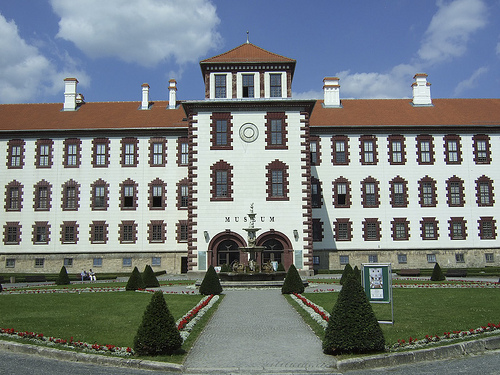
Location: Schlossplatz 1, Meiningen, Thuringia Map
Constructed: 1682- 92
Tel. +49 3693 50
Open: 10am- 6pm
Schloss Elisabethenburg is magnificent palace situated in Meiningen, Thuringia region in Germany. Schloss Elisabethenburg was constructed in 1682- 92 as a government seat of the duchy of Saxe- Meiningen. The first duke of the line Bernard I erected his building on a site of an older 15th century castle. Medieval stronghold was partially demolished and partially incorporated into design of a new building. Many famous people frequented the mansion including composer Johannes Brahms, poet and philosopher Friedrich Schiller and many others. Today it is open to the public and houses a Meiningen Musem dedicated to the history of the town and a residence itself.
Construction and Early History (Late 17th Century)
The palace
was built between 1682 and 1692 by Bernhard I (1649–1706), the first
Duke of Saxe-Meiningen, who founded the ducal line after the
division of the Ernestine Wettin lands. It replaced an earlier
late-Gothic castle (city fortress) from 1511 belonging to the
Prince-Bishops of Würzburg. Parts of this older structure, known as
the Bibrabau (named after Bishop Lorenz von Bibra), were
incorporated into the north wing.
The design is a three-winged
complex with a central tower, forming an "E" shape from above. This
was later romantically linked to Bernhard’s second wife, Elisabeth
Eleonore of Brunswick-Wolfenbüttel (1658–1729), after whom the
palace is named, though the shape primarily resulted from practical
architecture (the tower housed the main staircase). An ideal
symmetric plan with additional towers was envisioned but only
partially realized.
Builders reused stones from the old city
walls, moat fortifications, and even attempted (unsuccessfully) to
demolish parts of the ruined Landeswehre castle. A semi-circular
Rundbau (round building) closed the eastern side toward the town.
The palace originally featured a broad water moat. The southern wing
included the Schlosskirche (Castle Church of the Holy Trinity),
consecrated in 1692, with a crypt beneath for ducal burials.
The
style is characteristically restrained Baroque, reflecting
Protestant ducal tastes (similar to Schloss Friedenstein in Gotha).
Interiors began with Baroque frescoes and evolved through later
periods.
18th and Early 19th Centuries: Ducal Residence and
Cultural Foundations
The palace served as the administrative and
residential heart of the small Duchy of Saxe-Meiningen. It housed
the ducal family, court functions, and early cultural institutions,
including a court orchestra established by Bernhard I—one of
Europe’s oldest still-active ensembles.
Successive dukes expanded
its cultural role. The court library became notable; Friedrich
Schiller used it extensively during his time in nearby Bauerbach,
aided by librarian Wilhelm Reinwald.
Modifications occurred over
time:
Early 19th century: Parts of the moat were filled and
covered (1809–1810); the courtyard was paved.
1835–1837: Roof
rebuilt.
1845: Heavily rusticated (bossed) window surrounds
added, giving the facade its current dominant appearance (originally
simpler sandstone frames).
Mid-to-Late 19th Century: The
"Theater Duke" Era
Under Duke Georg II (1826–1914, reigned
1866–1914), the palace and Meiningen reached their cultural zenith.
Known as the "Theaterherzog" (Theatre Duke), Georg II transformed
the court theatre and orchestra into European-renowned institutions.
He developed the Meiningen Ensemble, emphasizing ensemble acting,
historical accuracy in costumes and sets, realistic staging, and
directorial vision—principles that influenced modern theatre (e.g.,
impacting André Antoine and Konstantin Stanislavsky).
The court
orchestra, under conductors like Hans von Bülow (from 1880),
attracted composers such as Johannes Brahms (frequent guest and
collaborator), Richard Strauss, and Max Reger. Brahms premiered
works there, and the orchestra was praised by Wagner.
Extensive
renovations took place, including work on the Bibrabau (1861) and
other updates. A new Italian marble fountain was added to the
courtyard in 1918.
The palace interiors reflect this era’s
opulence, with rooms in Rococo, Empire, and Historicism styles.
Georg II and his wife Helene von Heldburg were passionate patrons
who hosted artists and intellectuals.
20th Century to
Present: Post-Monarchy and Modern Use
After the German Revolution
in 1918, the duchy became the Free State of Saxe-Meiningen (later
part of Thuringia). The palace lost its role as a royal residence
but retained public functions. The Rundbau housed ministries and
later became the city administration and registry office.
During
and after World War II, some collections were affected (e.g., the
court library taken as war booty to the Soviet Union). The palace
survived relatively intact and was repurposed for cultural and civic
use.
Today, it is a multifaceted site:
Meininger Museen:
Extensive collections on local history, art (paintings, sculptures,
furniture, ceramics), music (Max Reger Archive, historical
instruments), and theater history. About 52 rooms and 3,400 m² of
exhibition space.
Concert hall in the former Schlosskirche
(Johannes Brahms Hall).
Max Reger music school (formerly in
Bibrabau).
Thuringian State Archives (moved in recent years).
Restaurant, tower café (in the central tower/Hessensaal with views),
and civic ceremonial rooms.
Part of the "Thuringian Residences
Landscape" UNESCO tentative listing efforts.
The palace and
park continue to host events, exhibitions, and tours, preserving
over 300 years of history, art, and music.
Overall Layout and Form
The palace features a three-winged
complex arranged around a central courtyard, with a prominent
central tower. When viewed from above, the layout forms an "E"
shape—a common Baroque device for symmetry and grandeur, though
later romanticized as a reference to Duchess Elisabeth Eleonore
(second wife of Duke Bernhard I).
The north wing incorporates
remnants of a late-Gothic castle (Bibrasbau, from 1511), providing a
historical foundation.
The design encloses a courtyard that opens
toward the town, creating a sense of enclosure and display typical
of Baroque residential palaces.
A curved/semi-circular facade
(often described as crescent-like) forms part of the structure
facing the town or courtyard, adding dramatic Baroque curvature.
Aerial views highlight how the palace dominates the northwestern
edge of Meiningen, rising above the historic town with its red-tiled
roofs contrasting against the white facades.
Exterior
Architecture
Style: Primarily Baroque, built 1682–1692 under Duke
Bernhard I, likely influenced by architects like Christian Richter.
Facade: The building has a multi-story elevation with a relatively
restrained early Baroque character, later altered. In 1845, heavily
rusticated (textured) window surrounds were added, giving the facade
a more robust, picturesque quality that dominates today. Original
windows had simpler rectangular sandstone frames.
Roof and
Massing: Red-tiled hipped or mansard-style roofs, multiple chimneys,
and a central tower that adds vertical emphasis.
Moat and
Entrance: A dry moat was added during 19th-century remodeling. The
main entrance leads through a round arch or gateway into the
courtyard.
Courtyard: Features a notable Italian marble fountain
added in 1918, enhancing the formal Baroque garden-court aesthetic.
The overall impression is one of princely dignity rather than
overwhelming opulence—typical of smaller German ducal residences
that balanced functionality with representation.
Interior
Architecture and Decoration
The interiors showcase a rich
layering of styles across centuries, reflecting evolving tastes of
the ducal family:
Baroque origins: Frescoes and stucco work
commissioned by Bernhard I. The Schlosskirche (Castle Church) of the
Holy Trinity features Baroque interior decorations.
Rococo
influences: Lighter, more ornate elements in some rooms.
19th-century Empire/Neoclassical: Prominent in state rooms,
including the Wooden Room (Empire style), Red Room, Yellow Room, and
others with luxurious furnishings, large mirrors, heavy curtains,
and elaborate detailing.
Key spaces:
Marble Hall: A
magnificent banqueting/concert hall, still used for events. It
exemplifies grand Baroque/Rococo proportions with high ceilings,
ornate stucco, and marble elements.
Other rooms feature white
stucco with elaborate decorations, oversized windows, historical
furniture, tiled stoves, paintings of rulers, and musical
instruments (reflecting the palace's strong musical heritage linked
to Brahms, Reger, etc.).
A Baroque-style café on an upper level
with mirrors and red curtains is often praised for its beauty.
The interiors transition from formal public spaces to more intimate
ducal apartments, offering a comprehensive view of courtly life from
the 17th to 19th centuries.
Architectural Significance and
Context
Baroque principles: Symmetry, axial planning, integration
of architecture with landscape/courtyard, and theatrical display
suited to absolutist princely courts.
19th-century
Romantic/Picturesque overlay: Rustication and moat additions reflect
the era's interest in historicism and medievalizing elements.
It
is less grandiose than larger palaces like those in Dresden or
Munich but is notable for its well-preserved multi-period interiors
and cultural role (theater, orchestra, museum).
Visiting Tips: Practical Information
Opening Hours (as of recent
data; always confirm closer to your visit):
April–September:
Tuesday–Sunday & holidays, 10:00 AM – 6:00 PM.
October–March:
Tuesday–Sunday & holidays, 11:00 AM – 5:00 PM.
Closed: December 24,
25, and 31. Monday closures are typical.
Tickets and Pricing:
Tickets are available on-site or potentially via the Meininger Museen
website. Family tickets are a great value if visiting with children—they
often cover multiple Meiningen museums (e.g., theater museum).
Audioguides are available (usually with a deposit, e.g., €20) and are
described as informative.
Combination or multi-museum tickets are
worthwhile since the palace is part of a trio of museums (including the
theater museum in the former riding hall and literature museum).
Duration: Plan 2–4 hours for a thorough visit. Guided tours (often in
German; check for English options) or audioguides are recommended.
Visitors praise passionate guides who cover history, music, and theater
deeply.
Best Time to Visit:
Weekdays for fewer crowds.
Spring/summer for longer hours and pleasant weather to explore the park
afterward.
Check the calendar for concerts in the Marble Hall or
Brahms concert hall, or special exhibitions.
What to See and Do
(In-Depth Highlights)
Ducal Apartments and State Rooms — Explore the
Wooden Room (Empire style), Red Room, Yellow Room, Music Room, and
especially the Blue Salon/Adelaide Room (staff favorite—delicate blue
tones, portraits, elegant furnishings).
Marble Hall — A grand,
opulent space still used for events and concerts.
Musical Instruments
Collection — In the former library; interactive elements where
instruments play as you approach—highly engaging.
Art and Historical
Collections — Paintings, furniture, coins (Meiningen was a mint), and
items linked to Max Reger (desk, piano, personal effects) and Duke Georg
II's theatrical legacy.
Tower Café — Don't miss this Baroque gem on
the central tower. Enjoy cakes (e.g., nut brittle) with panoramic views
over Meiningen. It's often called one of the most beautiful Baroque
cafés.
Palace Park — Adjacent green space with ancient trees,
sculptures, and bridges over the Werra River—perfect for a relaxing
stroll.
Schlosskirche (Castle Church) — Now the Johannes Brahms
concert hall with a modern organ.
Insider Tips from
Visitors/Staff:
Ask staff for favorites (Adelaide Room and Music Room
frequently mentioned).
Combine with the other two Meiningen museums
for a full cultural day.
Wear comfortable shoes—there are stairs and
multiple floors.
Getting There and Accessibility
Location:
Schlossplatz 1, 98617 Meiningen. It's walkable from the town center and
dominates the skyline.
By Car: Parking is available nearby. Meiningen
is reachable via A71 motorway.
Public Transport: Train to Meiningen
station, then a short walk or local bus.
Accessibility: Some
limitations due to historic building (stairs). Check with the museum for
elevators or adapted tours. Family-friendly overall.
Additional
Advice
Photography: Allowed in most areas (no flash); the staircase
and courtyard are photogenic.
Food: Schlossstuben restaurant and
Tower Café on-site. Meiningen has other dining options nearby.
Nearby
Attractions: Meiningen Theater, old town, Goetz Cave, or day trips to
other Thuringian sites like Eisenach.
Language: German primary;
English materials/audioguides likely available. Guided tours may be
German-only unless specified.
Crowds: Generally quiet compared to
major tourist palaces—ideal for a peaceful, immersive experience.
Official Site: Check meiningermuseen.de for the latest hours, prices,
events, and tickets.