Located: Ebringen, Baden-Württemberg Map
Constructed: 1312 by Lords of Hornberg
Destroyed: 1525 during German Peasants' War
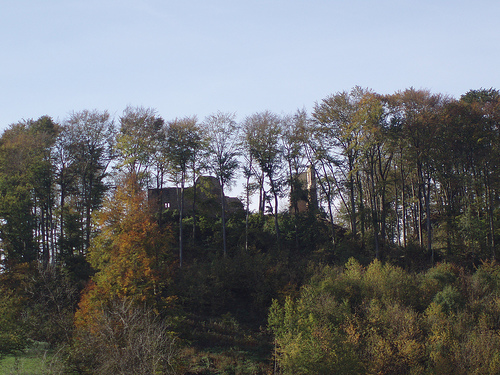
Schneeburg (also known as Ruine Schneeburg) is a medieval castle
ruin located on the western spur of the Schönberg hill near
Ebringen, in the Breisgau region of Baden-Württemberg, southwestern
Germany (coordinates approx. 47°57′38″N 7°47′53″E). It sits at an
elevation of about 516 m (1,693 ft) above sea level, offering
panoramic views over the Rhine Valley, Freiburg im Breisgau, and the
Vosges Mountains.
The ruins are a compact, late-medieval
Höhenburg (hilltop castle) in a spur position, roughly rectangular
in layout (about 37–38 m long and 16–17 m wide), with rounded
corners. It features surviving sections of thick (1.2–1.4 m)
two-shell rubble stone walls, a particularly well-preserved
northwest corner rising to around 13–14 m (suggesting a multi-story
residential tower-like structure), remnants of living quarters, beam
holes, window niches (some with original sandstone surrounds and
plaster), and a courtyard well that remains in good condition.
Construction and Early History (Late 13th–Early 14th Century)
The exact origins are somewhat obscure, as with many smaller noble
castles. The castle was first documented in 1312, already in the
possession of Friedrich von Hornberg (also spelled Hornberg or
Homberg). It was likely built in the late 13th or very early 14th
century—making it one of the later foundations in the Breisgau
region—by or for the Lords of Hornberg, a noble family from the
central Black Forest with holdings in the area.
Earlier
speculation linked the name "Schneeburg" (or variants like
Snewesberg/Schnewesberg) to the prominent Freiburg patrician family
Schnewlin (Snewlin), but this has been largely dismissed for the
construction phase. The name more likely derives from the snowy or
"white" appearance of the hill or local features.
An indirect
reference may exist from 1302, when another site (Wilde Schneeburg
near Oberried) was called the "new and wild" one, implying an older
Schneeburg existed, though this interpretation is debated.
Architectural features (compact layout with integrated residential
buildings against the curtain wall, rounded corners, lack of a
prominent separate keep/bergfried, and masonry style) support a late
13th/early 14th-century date. It resembles other regional "compact
castles" like Neuenfels or Lichteneck.
The castle served as a
noble residence and administrative center for a small lordship,
controlling the surrounding area including Ebringen. Its strategic
yet somewhat isolated hilltop position included defensive elements
like a deep neck ditch (Halsgraben) to the north, additional ditches
and ramparts on other sides, and steep slopes providing natural
protection (especially to the east).
14th–15th Centuries:
Ownership Changes and Feudal Ties
In 1349, Werner von Hornberg
(likely a son or nephew of Friedrich) transferred ownership of the
castle to the Abbey of Saint Gall (Fürstabtei St. Gallen) but
received it back as a fief (Lehen). In exchange, he gained lordship
over Ebringen and nearby settlements. This made Schneeburg the
center of a small feudal territory.
The Hornberg family
maintained ties to the castle amid internal family disputes and
competing claims. For example:
In the 1420s, Konrad von
Hornberg navigated complex inheritance and pledge issues, including
marriage alliances.
By the 1430s, the family began acquiring
properties directly in the village of Ebringen, gradually shifting
the administrative seat downhill.
The castle changed hands
through marriages and inheritances in the later 15th century (e.g.,
to families like Embs, Ebenstein, and Falkenstein), but it remained
tied to the Hornberg lineage and the St. Gallen fief.
Decline
and Abandonment (Late 15th–16th Centuries)
The lords increasingly
preferred a more comfortable residence in Ebringen village itself. A
new manor house (Schloss Ebringen) was built there before 1500, and
the hilltop castle was largely abandoned and left to decay.
References from 1574 already describe it as the "old and departed"
castle.
Claims that it was destroyed during the German Peasants'
War in 1525 appear in some older literature but lack supporting
evidence and are considered unlikely. The castle was probably
already in poor condition or disused by then.
Later History
and Ruins
After abandonment, locals reportedly quarried stone
from the ruins. It survived as a romantic ruin and a marker of
former lordship rights. In the 19th century, interest grew due to
romanticism and local history studies, with early articles
speculating on its builders.
Modern preservation:
Early 20th
century (around 1905): Clearing of vegetation, initial
stabilization, and some reconstruction under figures like Fritz
Geiges.
Further work in the 1970s and around 1999/2000.
Today,
it is a popular hiking destination with secured paths. The ruins are
stabilized but remain authentic rather than heavily restored.
The castle was likely built around 1300 (first documented in 1312) by
the Lords of Hornberg (or possibly associated with the Schnewlin family
of Freiburg). It served as a typical noble residence and defensive
structure in the Breisgau region during the late Middle Ages. Ownership
later passed to the Abbey of Saint Gall in 1349. It was probably
abandoned before 1500 and may have been damaged or partially destroyed
during the German Peasants' War in 1525 (though this is unconfirmed).
Over time, locals quarried stones from the ruins, accelerating its
decay.
As a relatively modest noble castle (a "Burg" rather than a
grand palace), its architecture reflected practical medieval defensive
and residential needs rather than elaborate ornamentation.
Overall Layout and Dimensions
The ruin complex measures roughly 37
meters (121 ft) long by 17 meters (56 ft) wide, forming a compact,
elongated rectangular footprint oriented roughly along the mountain
ridge.
It was a small hilltop castle with:
A central courtyard.
Defensive walls and possible outer enclosures.
A prominent tower on
the north side.
A deep moat (Burggraben) surrounding much of the
site, carved directly into the rock on the north side (absent on the
steep eastern slope for natural defense).
The site takes
advantage of the topography: steep slopes provided natural
fortification, especially to the east, while the moat and walls
reinforced the more accessible approaches.
Key Architectural
Elements (Current Ruins)
What remains today includes substantial wall
fragments, a tower stump, living quarters foundations/walls, and a
well-preserved courtyard well. The ruins have been stabilized in recent
decades for safety and preservation.
The Tower (Bergfried or
Keep): On the north side stands the most prominent remnant—a ruined
four-storey tower. It features two visible windows (or window openings)
in the surviving masonry. This tower likely served defensive purposes
(as a watchtower and last refuge) typical of medieval German castles.
Its height and positioning would have offered commanding views over the
Rhine Valley and surrounding lands.
Living Quarters / Palace (Palas):
The main residential building (or "living quarters") forms the core of
the remaining structure. Surviving walls show the layout of interior
spaces, including what appears to be a main hall or "Hauptraum." These
walls are constructed of local stone rubble masonry, with some smoother
facing stones. Arched openings and doorways are visible in photos of the
ruins.
Courtyard and Well: A central courtyard remains, with the well
in good condition—one of the best-preserved features. This would have
been essential for water supply during sieges. The courtyard is enclosed
by the surviving wall sections.
Walls and Masonry: The ruins feature
typical medieval rubble stone construction using local materials (likely
sandstone or similar from the Black Forest region). Walls are thick for
structural and defensive strength. Some sections retain height
sufficient to show original floor levels and openings. There are arched
entrances or passages in the better-preserved southern or eastern wall
sections.
Architectural Style
Schneeburg exemplifies late
medieval German castle architecture of the 13th–14th centuries in the
Upper Rhine region:
Functional and defensive focus: Compact design,
use of natural topography, moat, and tower.
Rubble masonry: Common
for smaller noble castles, as opposed to the ashlar (finely cut stone)
used in grander imperial or episcopal fortifications.
Minimal
ornamentation: No significant surviving decorative elements (e.g., no
elaborate Gothic tracery or sculptural details), consistent with a
utilitarian noble residence rather than a prestige project.
It was
not a large concentric castle like some Rhineland fortresses but a
typical "Höhenburg" (hill castle) adapted to its ridge-top location.
Setting and Strategic Role
The elevated position on the Schönberg
provided panoramic views over the Rhine Plain, Freiburg, and surrounding
vineyards/forests—ideal for monitoring trade routes and asserting
control over the area. The nearby Schönberghof (an inn) recalls the
former economic courtyard of the castle.
Today, the ruins are
accessible via hiking trails and offer scenic viewpoints, making them a
popular local destination despite their modest size.
For visuals, the
ruins appear as atmospheric stone walls and a tower stump rising from a
grassy, wooded hilltop, with Freiburg visible in the distant valley
below.
Getting There
By Car — Easiest option. Drive to Ebringen or
parking areas near Berghauser Kapelle or along roads connecting Ebringen
and Wittnau. There are small parking spots at trailheads, often about
1.5–2 km from the ruin. Navigation: Search "Ruine Schneeburg" or
"Schönberg Ebringen" on Google Maps.
Public Transport — Take a train
or tram to Freiburg, then a bus to Ebringen or nearby villages. From
there, walk/hike up. It's feasible as a half-day trip from Freiburg.
From Freiburg — About 20-30 minutes by car. Combine with a visit to
Freiburg's old town or Schlossberg.
Hiking Trails and Access
The ruin is reached primarily by foot. Trails are well-marked but can be
steep, narrow, and slippery in wet conditions.
Popular Route from
Ebringen — Moderate uphill hike (1-2 km one way, 30-45 minutes). Starts
through vineyards and forests with scenic views. Good for most fitness
levels.
Loop Trails — Options combining Schneeburg with Schönberg
summit or other viewpoints (e.g., 6-8 km loops, 2-3 hours). Apps like
Komoot or AllTrails have detailed maps.
Difficulty — Easy to
moderate. Some sections are steep and rooty/rocky. Not ideal for
strollers or those with serious mobility issues.
Best Time — Spring
(blooming) or autumn (foliage). Summer for longer days, but can be hot.
Winter possible if no snow/ice, but trails may be muddy or icy.
Tip:
Avoid after heavy rain — paths turn muddy. Wear sturdy hiking shoes with
good grip.
Visiting Tips
No Tickets or Restrictions — Free and
open 24/7, but visit during daylight for safety and views. No facilities
on site.
What to Bring:
Water, snacks, and a picnic (great spot to
sit in the ruins).
Rain jacket/layers — weather changes quickly in
the region.
Trekking poles (optional for steep parts).
Binoculars
or camera for views.
Download offline maps (signal may be spotty).
Time Needed — 2-4 hours round-trip including hike and exploring. Add
more for a longer loop or picnic.
Crowds — Usually quiet, especially
weekdays. Busier on sunny weekends with locals.
Safety — Ruins are
unrestored — watch for uneven ground, drops, and crumbling stone. Stay
on paths. Not suitable for young children unsupervised.
Photography —
Excellent for atmospheric shots of the tower, courtyard, and valley
views. Golden hour (sunrise/sunset) is magical.
Accessibility — Not
wheelchair-friendly due to trails and terrain.
Nearby Attractions
and Combining Visits
Freiburg im Breisgau (main base): Charming old
town, Münster Cathedral, Schlossberg hill with tower and funicular,
Bächle (little streams).
Black Forest — Easy day trips for hiking,
cuckoo clocks, or lakes.
Other Castles/Ruins — Staufen Castle ruin,
Zähringen, or further afield like Burg Eltz.
Vineyards — Ebringen
area has wine trails — great for tastings (Baden region wines).
Hexental Valley — Alternative starting point for hikes to the ruin.
Practical Advice
Best Season — Late spring to early autumn for
dry trails and pleasant weather. Winter visits possible but check
conditions.
Stay — Base in Freiburg for amenities, or quieter
Ebringen/Wittnau for proximity.
Food — No on-site options. Eat in
Ebringen or pack a lunch. Nearby forest restaurants or Freiburg for
Black Forest specialties.
Pets — Leashed dogs usually fine on trails.
Etiquette — Leave no trace. Respect the historic site.