Location: Weinheim, Baden-Württemberg Map
Constructed: 12th century
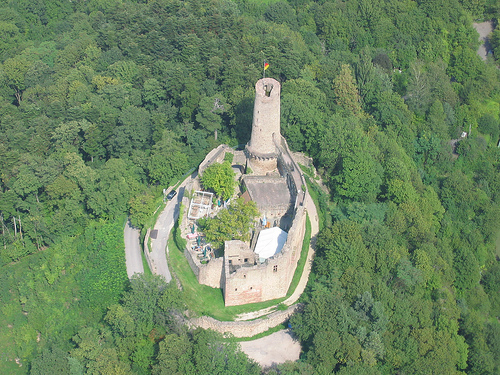
Windeck Castle is located in Weinheim, Baden-Württemberg region of Germany. Windeck Castle was constructed in the 12th century to defend nearby possessions of the Lorsch monastery. In 1674 the French troops of General Turenne captured the citadel, burned and looted it. After devastating campaign of the French king Louis XIV the military fortifications of the Windeck Castle were abandoned. The locals used the site as a quarry for damaged houses, churches and other structures instead. Today the castle is open to the public. Little remains from the original structures of Windeck Castle, but medieval structures including the main donjon from the 14th century is still well preserved and visible.
Origins and Construction (c. 1200)
The lords of Windeck, likely of
Franconian origin and based in the Ortenau region, constructed the
castle around 1200. It served as a residence, defensive stronghold, and
symbol of their power. The family held wealthy allodial estates (land
owned outright, not as fiefs) and various fiefs from powerful entities,
including the Holy Roman Empire, the Prince-Bishopric of Strasbourg
(Straßburg), the counts of Eberstein, and the Vogtei (advocacy) of
Schwarzach Abbey as an after-fief of the burgraves of Nuremberg.
First mentions: A Melchior von Windeck appears in records in 1212. In
1248, the lords are noted as ministeriales (unfree knights in service)
of the Bishop of Strasbourg at Schwarzach Abbey. The castle itself is
first documented in 1335.
Layout: It was a Ganerbenburg (a castle
jointly managed by co-heirs due to inheritance divisions). It likely
featured an outer and inner ward, each with its own bergfried (defensive
tower) and palas (residential hall). The surviving southern bergfried is
about 27.6 meters high with thick walls suitable as a refuge. The
smaller northern tower guarded the gate and downhill approach.
In the
early 13th century, a branch of the family built Neu-Windeck (New
Windeck Castle) nearby near Lauf, visible from the older site. This
created two related strongholds.
Medieval Conflicts and
Challenges (13th–14th Centuries)
The lords of Windeck frequently
clashed with neighboring powers, including territorial lords, the city
of Strasbourg, and the counts of Württemberg (often allied with the
Martinsvögel during the Schlegler Wars). The castle endured multiple
sieges but was never conquered, remaining largely intact through
military threats.
A major setback occurred in the late 14th century:
a devastating fire destroyed stables, domestic buildings, and valuable
archives (key for legal claims and disputes). Reinhard von Windeck
rebuilt the damaged structures.
Transition of Ownership and
Decline (15th–16th Centuries)
In 1466, the castle passed through
marriage when Anna, the last direct heir of Old Windeck (daughter of
Burkhard von Windeck), wed Baron Berthold IV of New Windeck. His
descendants held it into the 16th century.
From 1561 onward, locals
quarried stone from the castle for buildings in Bühl, including the
Kappelwindeck Church. Owners shifted to the more modern Schlosshof
palace in Bühl (today a hotel). The last male heir, Jakob von Windeck,
died in Venice in 1592 while returning from a Junkerfahrt (a young
nobleman's educational tour) through France, Spain, Italy, and
Palestine. The fiefs reverted to the Empire, and allodial lands were
divided between his sisters Ursula (Old Windeck) and Elisabeth (New
Windeck).
Later History and Ruination
The castle gradually
fell into ruin as it lost strategic and residential importance. Today,
only the bergfried, a tower, and parts of the curtain walls remain.
These ruins are accessible for visits in good weather and offer
panoramic views over the Rhine Valley and Black Forest.
At the base
of the ruins are modern amenities: the Burg Windeck hotel and
restaurant, plus a snack bar.
The castle was constructed around 1200 by the Lords (or Counts) of
Windeck, a noble family likely of Franconian origin with significant
allodial (freehold) estates and fiefs in the Ortenau region. They held
lands from various overlords, including the Holy Roman Empire, the
Prince-Bishopric of Strasbourg, the Counts of Eberstein, and others.
Earliest mentions: A family member (Melchior von Windeck) appears in
records in 1212. The family served as ministeriales (unfree knights in
service) to the Bishop of Strasbourg by 1248. The castle itself is first
documented in 1335.
Ganerbenburg (shared inheritance castle): Due to
family divisions, it became a jointly managed castle early on, occupied
by multiple branches of the family. In the early 13th century, a branch
built nearby Neu-Windeck (New Windeck Castle), visible from the older
site.
Conflicts and sieges: The lords frequently clashed with
neighbors like the city of Strasbourg and the Counts of Württemberg
(including during the Schlegler Wars). The castle was besieged multiple
times in the 13th–14th centuries but was never captured, remaining
largely intact.
14th-century fire: A major fire in the late 14th
century destroyed living quarters, stables, and valuable archives (which
had fueled many legal disputes). Reinhard von Windeck rebuilt the
affected parts.
Inheritance and decline: In 1466, the last direct
heir of Old Windeck (Anna) married into the New Windeck line (Berthold
IV). Descendants occupied it into the 16th century. From 1561, locals
quarried stones for buildings like the Kappelwindeck Church. The family
later moved to a more modern palace (Schlosshof) in Bühl. The last male
heir, Jakob von Windeck, died in 1592 in Venice. Holdings passed to his
sisters and eventually the Empire.
Later fate: It fell into ruin like
many castles of the era. Today, it is a preserved ruin open to visitors
(in good weather), with excellent panoramic views over the Rhine Plain,
vineyards, and Black Forest. A hotel and restaurant (Burg Windeck) and
snack bar sit at its foot.
It withstood medieval conflicts but
suffered from fire, quarrying, and natural decay. It was never heavily
damaged in major wars like the Thirty Years' War in the same way some
other regional castles were.
In-Depth Architecture
Windeck
Castle is a classic example of a medieval spur castle (Spornburg)
layout, adapted to its ridge-top position for natural defense on
multiple sides. It likely featured an outer and inner ward (bailey),
each potentially with its own bergfried (defensive tower) and palas
(residential hall).
Key surviving and historical elements:
Bergfried (Main Keep/Tower): The most prominent surviving feature is the
southern bergfried, standing about 27.6 meters high with a base of
roughly 9.6 x 9.8 meters. Walls are exceptionally thick (2.5–3 meters at
the base), making it a strong refuge. The lower level likely served as a
dungeon or storeroom. The entrance was high up (around the 4th story,
~15.5 meters above ground) for security, accessible via a ladder or
removable bridge in medieval times. It has a barrel-vaulted
(tonnengewölbe) interior.
Northern/Smaller Bergfried: An 8.5-meter
square tower that guarded the gate and downhill side. Less preserved.
Curtain Walls and Enclosure: Substantial remnants of the outer walls
(curtain wall) survive, enclosing an oval or irregular layout suited to
the spur. A massive round-arched portal (with Eberstein family coat of
arms in some descriptions) served as the main entrance.
Palas
(Residential Buildings): Largely destroyed. These would have included
reception halls, living quarters, and possibly a great hall on upper
floors of the attached structures. Foundations and wall remnants give an
impression of the scale.
Overall Layout: The castle had defensive
strengths from its elevated spur position (steep drops on sides),
multiple wards for layered defense, and thick masonry typical of
12th–13th century Hohenstaufen-era or regional Romanesque/Gothic
transition fortifications. It combined residential, administrative, and
military functions.
The ruins today consist primarily of the tall
southern tower, wall sections, and foundations—enough to convey its
former imposing presence but open and roofless. The tower can often be
climbed for views.
Architectural Style/Context: Typical of early
13th-century Swabian/Upper Rhine castles—robust, functional stone
construction using local materials, emphasizing defense over
ornamentation (though some heraldic elements existed). It shows
evolution from pure Romanesque to early Gothic influences in details
like arches.
The site offers hiking paths, a children's playground
below, and is popular for panoramas, especially at sunset or night when
illuminated.