Location: Saxony-Anhalt Map
Constructed: 18th century by Leopold III, Duke of Anhalt-Dessau
Area: 142 km2 (54.8 sq mi)
Open: Mar, 6th Nov- 1st Dec: 10am- 4pm
Wed- Sun
Apr and Oct- 3rd Nov: 10am- 4:30pm Tue- Sun
May- Sep:
10am- 5:30pm Tue- Su
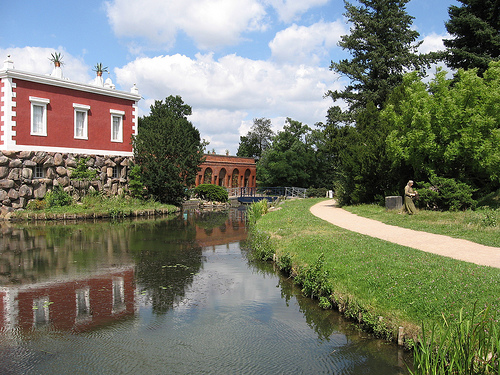
The Dessau-Wörlitz Garden Realm is a cultural
landscape in Saxony-Anhalt that is important throughout Europe,
consisting of several buildings and landscape parks based on the
English model.
The Garden Kingdom now covers an area of 142
km² along the Elbe in the Middle Elbe Biosphere Reserve. It has been
a UNESCO World Heritage Site since November 2000. It was included in
the Blue Book published in 2001. The Blue Book is a list of
nationally significant cultural institutions in East Germany and
currently includes 20 so-called cultural beacons. The cultural sites
were selected on the initiative of the Federal Government
Commissioner for Culture and the Media in coordination with the East
German Ministers of Education. The majority of the funding comes
from the federal government.
The Dessau-Wörlitz Garden Realm (German: Dessau-Wörlitzer
Gartenreich), also known as the Garden Kingdom of Dessau-Wörlitz, is one
of the most exceptional examples of 18th-century landscape design and
Enlightenment-era planning in Europe. Located in Saxony-Anhalt, Germany,
along the floodplains of the Elbe and Mulde rivers, this vast cultural
landscape covers approximately 142 km² (about 14,500 hectares) and
encompasses a network of English-style landscape parks, palaces,
follies, agricultural lands, and architectural features. It was
inscribed as a UNESCO World Heritage Site in 2000 under criteria (ii)
and (iv) for its outstanding application of Enlightenment philosophical
principles—integrating art, education, economy, and nature—and as a
seminal illustration of 18th-century landscape design.
Early
Foundations (17th Century)
The story begins in the 17th century with
Dutch influences on the small Principality of Anhalt-Dessau. In 1659,
Prince John George II married Dutch princess Henriette Catharina
(daughter of Prince Frederick Henry of Orange). This brought Low
Countries engineers and architect Cornelis Ryckwaert to redesign the
area around the former settlement of Nischwitz (renamed Oranienbaum in
1673). They created a Baroque palace, town layout, and formal garden,
establishing a strong Dutch horticultural and architectural tradition
that persisted for decades. Oranienbaum Palace, completed in 1683 as
Henriette Catharina’s summer residence, featured elaborate interiors
like leather wallpapers and Delft tiles. This Baroque foundation later
became a key integrated element of the larger Garden Realm.
The
Visionary Prince and the Enlightenment Turn (1758–1765)
The
transformative phase began with Prince Leopold III Friedrich Franz of
Anhalt-Dessau (1740–1817), often called “Prince Franz” or the
“Enlightened Prince.” He ascended the throne in 1758 at age 18.
Rejecting the rigid Baroque style of his predecessors, Leopold embraced
Enlightenment ideals: the “useful with the beautiful” (das Nützliche mit
dem Schönen verbinden), public education, religious tolerance,
agricultural reform, and harmony with nature. Influenced by philosophers
like Jean-Jacques Rousseau (emphasizing natural landscapes and
agriculture as societal foundations), Johann Joachim Winckelmann
(classical aesthetics), and Johann Georg Sulzer, he sought to create an
idealized, didactic world.
In 1763, Leopold and his close friend and
architect Friedrich Wilhelm von Erdmannsdorff (1736–1800) embarked on
Grand Tours of Europe, visiting England (landscape gardens like
Stourhead, Stowe, and Claremont), Italy (ancient ruins and neoclassical
ideals), and France. These journeys provided the blueprint: English
picturesque landscapes over formal French/Baroque gardens. By 1765,
Leopold began reshaping the countryside, choosing the small town of
Wörlitz (on an Elbe anabranch) as the focal point. This marked the birth
of the first English-style landscape park on the European continent.
The Core: Wörlitz Park and Palace (1765–1770s)
Wörlitz Park,
spanning about 112 hectares around Wörlitz Lake, became the heart and
starting point of the Garden Realm. Landscape architect Johann Friedrich
Eyserbeck executed the design, creating naturalistic meadows, woodlands,
winding paths, water features, and “follies” (architectural surprises)
that blended seamlessly with the floodplain. A dam protected against
Elbe floods while serving as a scenic belt-walk with long vistas.
Key
features included:
Wörlitz Palace (1769–1773): Germany’s first
neoclassical building, designed by Erdmannsdorff as a modest country
house (inspired by English villas). Interiors featured exquisite
furnishings by Abraham and David Roentgen and Wedgwood porcelain. It was
open to the public from the start, embodying Enlightenment
accessibility. Adjacent was the Graues Haus for Leopold’s wife, Louise
of Brandenburg-Schwedt.
Gothic House (from 1773, expanded to 1813):
One of the earliest neoclassical-to-Gothic Revival structures on the
continent, modeled on Horace Walpole’s Strawberry Hill. It symbolized
political sovereignty for smaller German states and housed collections.
Rousseau Island in Neumark’s Garden: A tribute to Rousseau, with a
tomb-like feature.
Artificial volcano on an island in Wörlitz Lake: A
technical marvel simulating Vesuvius eruptions (with internal fireplaces
and chambers), used for educational demonstrations of Pompeii and
natural forces. It remains operational today.
Wörlitz Synagogue
(1790): A rotunda modeled on the Temple of Vesta in Tivoli, promoting
religious tolerance.
Neo-Gothic churches (e.g., St. Peter’s in
Wörlitz, 1804–1809; Riesigk 1800; Vockerode 1810–1811): Early
neoclassical ecclesiastical architecture, with towers as landscape
markers.
The park functioned as a “ferme ornée” (ornamental
farm), demonstrating modern English agricultural techniques while
serving as an open-air educational institution in gardening,
architecture, and farming. Johann Wolfgang von Goethe visited in 1778
and famously described it as “infinitely beautiful” (unendlich schön),
likening it to a divine dream.
Expansion into a “Garden Kingdom”
(1770s–1805)
Over the next 40 years, Leopold and Erdmannsdorff
expanded the vision into a cohesive “Garden Kingdom” through visual
axes, avenues, dykes, and pathways linking sites. Older gardens were
ingeniously incorporated, creating an “architectural encyclopaedia”
spanning antiquity to modernity.
Major additions:
Luisium
Castle and Park (1774–1778): A neoclassical gift to Leopold’s wife
Louise in Dessau’s Waldersee district, with intimate gardens, pastures,
and a stud farm. Leopold died here in 1817 after a riding accident.
Nearby Snake House (neo-Gothic) drew from Kew Gardens.
Georgium
Palace and Park (from 1780): Built for Leopold’s brother John George
north of Dessau in riparian woodland; the second-largest English garden
after Wörlitz, now housing the Anhalt art collection (including Dürer
and Cranach works).
Großkühnau Castle and Park (1780 onward): For
brother Albert, at Kühnau Lake, with orchards, vineyards, and artificial
islands; now the seat of the Kulturstiftung Dessau-Wörlitz.
Oranienbaum: The original Dutch Baroque palace and garden were
reimagined with an Anglo-Chinese garden (one of Europe’s last surviving
pre-1800 examples), pagoda, tea house, bridges, and a massive 1811
orangery.
Mosigkau Palace and Park (pre-existing Rococo, integrated):
Built 1752–1757 for Leopold’s half-sister Anna Wilhelmine; featured
Flemish Baroque paintings (Rubens, van Dyck).
Additional elements:
Sieglitzer Berg woodland park (1777), Leiner Berg forester’s lodge, and
subtle modifications to agricultural lands for economic demonstration.
By around 1810, the realm formed a unique 25-km network of
interrelated landscapes, palaces, and structures—far larger in scale
than contemporary English examples.
Philosophical and Practical
Significance
The Garden Realm was no mere aesthetic project. It
embodied Enlightenment values: public access democratized culture;
agriculture taught progressive farming; follies educated on history,
nature, and technology; and the whole promoted humanization of society.
It influenced Central European architecture (neoclassicism, Gothic
Revival) and landscape design. Contemporary Christoph Martin Wieland
called it the “credit and epitome of the 18th century.”
Later
History and Preservation (19th Century–Present)
After Leopold’s death
in 1817, maintenance continued under his successors, preserving the
vision into the 19th century. The parks largely survived World War II
unscathed. In the 1930s, a railway and the A9 autobahn divided the
landscape into four parts, leading to some deterioration. Post-1945 (in
East Germany) and especially after German reunification in 1990,
scientific restoration programs revived sightlines, vegetation, and
structures according to original plans.
The site is protected within
the Middle Elbe Biosphere Reserve (designated 1979/1988) and under
Saxony-Anhalt conservation laws. The Kulturstiftung Dessau-Wörlitz
manages major houses and parks, while the Forum for the Dessau-Wörlitz
Garden Kingdom (est. 1996) coordinates efforts. A minor boundary
modification was made for UNESCO in 2019. Today, it remains a living
testament to Enlightenment ideals, attracting visitors for its beauty,
history, and educational value—much as Leopold intended.
The Garden Realm features an interconnected network of palaces,
castles, and landscaped parks. According to official sources, the main
highlights include:
Wörlitz Castle and its celebrated Wörlitz
Park — the centerpiece and first major English landscape garden in
continental Europe, complete with artificial lakes, islands, bridges,
temples, grottos, and even a model of Mount Vesuvius that could "erupt."
The Gothic House in Wörlitz Park — one of the earliest Neo-Gothic
buildings in Germany (and Europe), originally serving as a private
retreat and gardener's residence, now housing a notable collection of
historical stained glass.
Oranienbaum Castle and park, which
incorporates rare surviving elements of an Anglo-Chinese garden
alongside its Baroque and Dutch-influenced features.
Mosigkau Castle
— a charming Rococo "little Sanssouci" built as a summer residence.
Luisium Castle and its intimate park, designed as a private refuge.
Großkühnau Castle and the surrounding landscape park.
Georgium Castle
(also known as Georgium Palace), home to the Anhaltische Gemäldegalerie
art gallery, set within extensive grounds that merge formal design with
natural Elbe floodplains.
The park on the Sieglitzer Berg (Sieglitz
Hill).
These sites are linked by meadows, forests, and subtle
agricultural modifications that create a unified "garden kingdom"
spanning about 142 km².
The realm also includes various historical structures scattered
across the landscape, many of which appear on official maps of the
Garden Realm:
The historical cemetery in Dessau
The grave
monument in Drehberg
The Elbe Customs House
The schoolhouse in
Griesen
The obelisk at Ochsenwall
The vineyard house in the Kühnau
landscape park
The Proteus stone
The Sweden House
The Tower of
the Eight Winds (also called Napoleon's Tower)
Several wall guard
houses (around 11 in total)
Wallwitzburg
These elements
enhance the educational and aesthetic character of the cultural
landscape.
During the founding period under Prince Leopold, many churches
were newly built, rebuilt, or expanded to harmonize with the
surrounding gardens and serve as visual landmarks in the flat
floodplain terrain. Notable examples include:
In today's
suburbs of Dessau-Roßlau:
Church in Waldersee (formerly Jonitz,
built 1722–1725)
Church in Mosigkau (1789)
Church in Mildensee
(formerly Pötnitz, 1804–1806)
Church in Großkühnau (1828–1830)
In the eastern part of the garden realm:
Church in
Oranienbaum (1707–1712)
Church in Riesigk (1797–1800) — one of
the earliest Neo-Classical churches in Germany
Church in Wörlitz
(St. Peter's Church, 1804–1809), with its prominent 66-meter steeple
Church in Vockerode (1810–1812)
Church in Horstdorf (1872)
Pre-existing churches that were integrated:
Church in Rehsen
(1680, with later modifications in 1707)
Church in Goltewitz
(13th/14th century), now part of Oranienbaum-Wörlitz. This area
originally lay outside Anhalt territory (Saxon/Prussian) and
belonged to a different parish.
Many of these churches,
particularly the Neo-Classical ones in Riesigk, Wörlitz, and
Vockerode, were pioneering in German ecclesiastical architecture and
helped define the visual identity of the landscape.
With their World Heritage Sites, Dessau and Wörlitz are part of the Anhalt-Dessau-Wittenberg World Heritage Region. The association is dedicated to the tourism marketing of the region and sells the World Heritage Card, a guest card with which many tourist offers in connection with the Garden Kingdom in Dessau and Wörlitz can be used free of charge or at a reduced price. At the same time, the UNESCO World Heritage Garden Kingdom of Dessau-Wörlitz will be sold under the Luther | Bauhaus | Garden Kingdom marketed by the World Heritage Region. The so-called World Heritage Line (bus route 304) connects the World Heritage sites in Dessau and Wörlitz with those in Wittenberg.