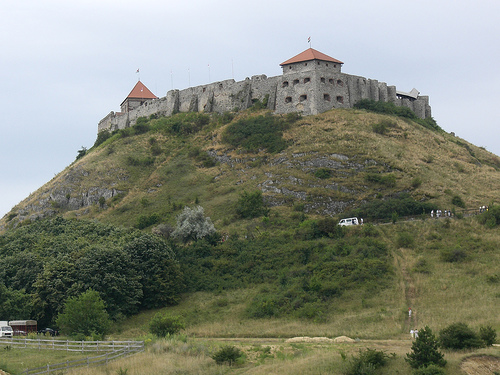
Location: Sumeg, Veszprém county Map
Constructed: 13th century
Tel. (087) 55 02 76
Apr- Sept: 10 am- 6 pm
Sumeg Castle is located in Sumeg, Veszprém county of Hungary. Castle hill that rises at 885 feet (270 meters) has been inhabited since the Roman times. Roman legions first erected wooden fortress here to defend their empire against raiding Germanic tribes. Sumeg Castle was build here in the 13th century and subsequently almost completely reconstructed in the 16th century. Sumeg citadel is also a museum of Medieval life. Re- enactments of battles and jousts are held here in summer months of the year. Besides here you can find restored fortune chambers with authentic weapons of trade, collection of weapons, couches and other exhibitions. Traditional dances are also held here every year. One of the town’s main attractions is the Roman Catholic Church of Ascension build in 1756- 58 on Biro Maron utca (street). Beautiful frescoes of Austrian Franz Anton Maulbertesch adore walls of the church inside Sumeg Castle.
Construction and Early History (13th Century)
The origins of Sümeg
Castle trace back to the aftermath of the devastating Mongol invasion of
Hungary in 1241–1242, during which much of the kingdom was ravaged, and
King Béla IV sought refuge in fortified locations. To prevent future
incursions, Béla IV initiated a nationwide program of castle-building on
elevated, defensible sites. Sümeg Castle was constructed as part of this
initiative in the mid-to-late 13th century, likely beginning around
1262. The king himself is credited with ordering its erection, and
historical accounts suggest he may have resided there briefly during the
invasion.
The earliest structure was the citadel's old tower
(Öregtorony), built on the hill's summit. This initial phase featured a
wooden-floored tower on the lower level of the citadel, designed for
basic defense with thick stone walls. The first documented reference to
the castle appears at the turn of the 13th and 14th centuries,
associated with Bishop Benedek of Veszprém, who may have overseen its
completion or early expansions. At this time, Sümeg was part of the
Veszprém bishopric's estates, establishing a long tradition of
ecclesiastical control that influenced the castle's development.
Medieval Expansions and Administrative Role (14th–15th Centuries)
During the 14th century, under the Anjou kings (particularly Charles I
and Louis I), the castle underwent significant modifications. The
citadel's walls were reinforced, and the upper levels of the old tower
were constructed, enhancing its defensive capabilities. In 1342, Sümeg
became the administrative center of the bishopric's estates, elevating
the castle's importance. This led to further expansions, including the
enlargement of the old tower and the addition of residential and storage
buildings within the inner castle.
The 15th century brought
challenges from Ottoman incursions into Hungary, but Sümeg Castle
remained relatively secure due to its elevated position and robust
fortifications. It served as a refuge for local populations and a base
for the bishops of Veszprém, who used it to manage their vast holdings.
Architectural additions during this period included gatehouses, chapels,
and outer walls, transforming it into a more comprehensive fortress
complex.
Peak and Conflicts (16th–17th Centuries)
The 16th
century saw Hungary divided after the Battle of Mohács in 1526, with
Ottoman forces occupying much of the central plains. Sümeg Castle,
located in the western, Habsburg-controlled part of the kingdom, became
a key defensive outpost against potential Ottoman advances. It was
further fortified with bastions and artillery positions to adapt to
gunpowder warfare.
The castle reached its architectural zenith in the
17th century under the episcopate of Pál Széchenyi, a prominent bishop
who oversaw extensive renovations and expansions. This included the
addition of baroque elements to the residential quarters and improved
water supply systems, such as cisterns. During this era, it functioned
not only as a military site but also as a cultural and religious center,
housing chapels and libraries.
Role in Wars of Independence and
Decline (18th Century)
Sümeg Castle played a notable role in Ferenc
II Rákóczi's War of Independence (1703–1711), a rebellion against
Habsburg rule. The castle was held by Kuruc (anti-Habsburg) forces and
served as a supply base and stronghold. After the war's failure,
Austrian imperial troops besieged and captured it. In 1713, on orders
from the Habsburgs, the castle was deliberately set on fire to prevent
its reuse by rebels, marking the beginning of its decline.
For the
next two and a half centuries, the castle lay in ruins, exposed to the
elements and gradual deterioration. It became a symbol of Hungary's
turbulent past, with locals occasionally using its stones for building
materials. Despite this, its core structures remained intact due to the
quality of the original construction.
Restoration and Modern Era
(20th Century Onward)
Interest in preserving Sümeg Castle revived in
the mid-20th century. Archaeological excavations and restoration efforts
began in earnest in 1957, focusing on stabilizing the walls and
reconstructing key buildings like the old tower and chapel. By the
1980s, under private initiative and government support, the castle was
partially rebuilt and opened to the public as a historical site.
Today, Sümeg Castle is one of Hungary's most visited attractions,
drawing over 200,000 tourists annually. It features a museum with
exhibits on medieval life, weaponry, and the castle's history, as well
as live demonstrations of knightly tournaments and falconry. The site
also hosts cultural events, emphasizing its role in preserving Hungarian
heritage.
The castle's layout is divided into an outer and inner section,
designed for layered defense. The structure is irregular and polygonal,
adapting to the hill's contours, which enhances its defensive
capabilities. The total area spans roughly 125 meters north-south and 80
meters east-west, with walls enclosing a large central courtyard. Access
begins at the outer gate, leading through a walled pathway (known as the
long ward) to the internal gatehouse, which opens into the main
courtyard. This pathway includes defensive features like a wolf pit—a
deep ditch outside the keep gate, originally crossed by a drawbridge.
The southern end houses the oldest parts, while the northern and eastern
sections feature later bastions and fortifications. The interior is
multi-level, with buildings hugging the walls around the courtyard,
providing space for residential, economic, and military functions.
Key Architectural Elements
Towers
The castle boasts several
towers, each serving defensive and residential purposes. The most
prominent is the Old Tower (Öregtorony), a multi-storey structure at the
southern core, dating back to the castle's founding around 1300. It
formed the heart of the early fortress, surrounded by thick walls, and
likely included residential spaces or a chapel. In the 15th century, a
second two-storey tower was added near the inner gate, complete with a
drawbridge mechanism for added security. The outer gate tower,
reinforced in the 17th century, stands at the entrance to the long ward.
Additionally, a pentagonal two-storey star fort (a "trace italienne"
style bastion) was constructed at the north-eastern corner in the 16th
century, designed for cannon defense with embrasures (narrow slits for
artillery).
Walls and Fortifications
The walls are a hallmark
of the castle's evolving defenses. Initially, the early 14th-century
walls were thick and simple, possibly supplemented by a wooden outer
palisade enclosing stables and basic structures. By the early 16th
century, a more robust outer fortress wall was built around the large
courtyard, supported by external buttresses. In response to Ottoman
threats after 1552, Italian architect Giovanni Speciecasa led major
reinforcements: a secondary stone wall was added behind the outer one,
with the space between filled with soil for stability, and vaulted
cannon batteries installed in the rampart. This created a double-wall
system resistant to artillery. The Köves Bastion, built in 1554 at the
northern end, further bolstered defenses with cannon embrasures. A large
bastion at the southern end, adjacent to the Old Tower, was rebuilt with
similar features. In the 17th century, under Bishop István Sennyei, the
outer gate tower was strengthened, and a tall bastion added beside it,
bearing the bishop's coat of arms. These elements reflect a shift from
medieval melee defenses to Renaissance-era gunpowder fortifications.
Gates and Entrances
The entrance system emphasizes security. The
outer gate tower leads into the long ward—a narrow, walled corridor that
funnels attackers toward the inner gate. The inner gate features a
double portal with a drawbridge (now fixed) and is flanked by the
two-storey tower. Historical modifications, such as bricking up older
gates in the 15th century (evidenced by the Vetési coat of arms on the
chapel wall), show adaptive security measures.
Courtyards and
Interior Spaces
The main courtyard is expansive, serving as the
castle's hub. On the eastern side, multi-storey residential and palace
wings were constructed in the 16th century and later reconstructed in
the 17th. These include a grand staircase with an early Baroque
balustrade, added in 1648 under Bishop György Széchényi, leading to
upper levels. The palace wing features vaulted rooms, kitchens, and
economic premises like storage areas. A chapel, possibly part of the
original structure, is integrated into the southern walls, with Gothic
elements preserved. The interior also housed barracks, armories, and
stables in the outer areas. Restorations have added exhibits with
lifelike figures depicting medieval life, but the core layout remains
authentic, with stone and brick construction dominating.