Location: 25 mi (40 km) North of Budapest, Pest
County
Map
www.visegrad.hu
Matyas museum
Salamon torony utca
Tel. (026) 59 70 10
Open: May- Oct 9am-5pm Tue- Sun
Royal Palace
Fo utca 23
Tel. (026) 39 80 26
Open: 9am-5pm Tue- Sun
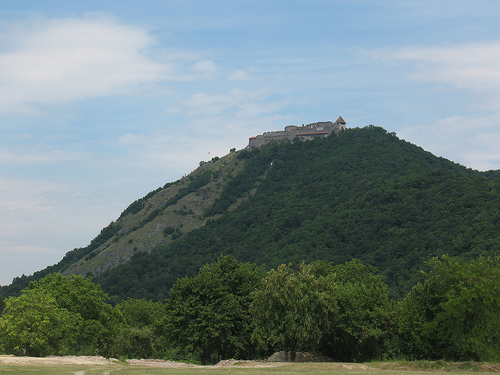
Visegrád Castle, also known as the Citadel or Upper Castle
(Fellegvár in Hungarian), is a prominent medieval fortress located
in the town of Visegrád, Pest County, Hungary. Situated
approximately 40 kilometers north of Budapest on the right bank of
the Danube River in the scenic Danube Bend, the castle perches atop
a 328-meter-high hill, offering panoramic views of the river valley,
surrounding hills, and the Pilis Mountains. The name "Visegrád"
derives from Slavic origins, meaning "high castle" or "acropolis,"
reflecting its elevated and strategic position. The site encompasses
not just the Upper Castle but also the connected Lower Castle, the
Royal Palace at the base of the hill, and remnants of earlier
fortifications like those on nearby Sibrik Hill, forming a complex
fortification system that has evolved over centuries.
The
castle's location was chosen for its defensive advantages, guarding
the vital trade and military route between Esztergom and Buda along
the Danube. Today, it stands as one of Hungary's most visited
historical sites, attracting tourists for its architectural ruins,
museums, and breathtaking vistas.
The history of Visegrád Castle dates back to the early medieval
period, with roots in Roman times. The area around Sibrik Hill
featured a Roman fortification built in the 4th century as part of
the empire's limes (frontier defenses), including a triangular
military camp and a late-4th-century praetorium (commander's
building). By the 10th-11th centuries, a Hungarian fortification on
Sibrik Hill served as a regional center, first mentioned in 1009 as
"Visegrád." This early castle was destroyed during the Mongol
invasion of 1242.
Post-invasion reconstruction began under King
Béla IV in the 1240s-1250s, who rebuilt the fortifications to
protect against future threats. The site gained royal prominence in
1325 when King Charles I made Visegrád the royal seat of Hungary,
appointing Stephen Sáfár as castellan and constructing the initial
royal house. A pivotal moment came in 1335 when Charles hosted a
two-month congress with King John of Luxembourg of Bohemia and King
Casimir III of Poland, forging alliances against Habsburg Austria
and promoting peace among the kingdoms. Another congress followed in
1339.
Under the Angevin kings in the 14th century, Visegrád
flourished as a royal residence. King Louis I expanded the palace,
while King Sigismund (Holy Roman Emperor and King of Hungary)
shifted the royal seat to Buda around 1405-1408 but continued
enhancements. King Matthias Corvinus used it as a summer residence
in the late 15th century, introducing Renaissance elements. The
castle safeguarded the Hungarian royal insignia from the 14th
century until 1526.
The decline began after the 1526 Battle of
Mohács, which partitioned Hungary. Ottoman forces under Suleiman the
Magnificent captured it in 1529, followed by sieges and recaptures:
King John Zápolya took it in 1532, Habsburg general Leonhard Fels in
1540, and Ottoman Yahyapaşaoğlu Mehmed Paşa in 1544. It remained
under Ottoman control until 1685, with a brief exception from
1595-1605, suffering extensive damage. In modern history, Visegrád's
legacy inspired the 1991 formation of the Visegrád Group by leaders
of Hungary, Czechoslovakia, and Poland, echoing the 1335 alliance.
Visegrád Castle's architecture reflects multiple phases of
construction, blending Romanesque, Gothic, and Renaissance styles.
Upper Castle (Citadel): Built in the 1240s-1250s on a triangular
ground plan with three corner towers, it was expanded in the 14th
century with curtain walls and palace buildings under the Angevins.
Sigismund added a third curtain wall around 1400, and Matthias
Corvinus renovated interiors in the late 15th century. Features
include thick stone walls, bastions, and terraces with views of the
Danube Bend.
Lower Castle: Connects the Upper Castle to the
Danube, centered on the 13th-century Solomon Tower—a hexagonal
residential tower named after a legend involving King Solomon of
Hungary (though historically inaccurate). 14th-century curtain walls
surround it; the tower's southern part collapsed in 1544.
Royal
Palace: Begun by Charles I after 1325, expanded by Louis I in the
14th century, and rebuilt by Sigismund into a 123x123-meter square
complex with gardens and a Franciscan friary (founded 1424).
Matthias Corvinus reconstructed it (1477-1484) in late Gothic style
with Italian Renaissance decorations—the first such appearance
outside Italy—including ornate fountains and sculptures.
Sibrik
Hill: Triangular Roman-era fort with later Hungarian additions, now
ruins.
The overall complex emphasizes defense with
multi-layered walls, towers, and strategic positioning, while the
palace highlights luxurious royal living.
Visegrád Castle was central to Hungarian monarchy, serving as the royal seat (1325-1408) and a diplomatic hub for alliances that shaped Central Europe. It symbolized power, hosting the royal crown for over 200 years and introducing Renaissance art to the region. Militarily, it protected key routes during medieval and Ottoman eras. Culturally, it represents Hungary's golden age under kings like Matthias Corvinus, whose court life is depicted in exhibitions. Its 1991 namesake group underscores its enduring legacy in regional cooperation.
After Ottoman conquests, the castle fell into ruin by the 18th
century, with the palace buried under earth. Restorations began in
the 1870s for the Solomon Tower, completing in the 1960s. Palace
excavations started in 1934 and continue; comprehensive Upper Castle
restorations occurred from the 1950s onward.
Today, it's a
major tourist attraction and museum complex managed by the King
Matthias Museum. The Upper Castle houses exhibitions on medieval
history, hunting, and weaponry, with terraces for views. The Solomon
Tower displays reconstructed Gothic fountains, Renaissance
sculptures, and Visegrád's history. The Royal Palace features
restored interiors and historical exhibits. Visitors can access via
hiking trails, car, or bus from Budapest (about 1-hour trip). Entry
fees apply (around 1,500-2,500 HUF for adults, varying by section),
and it's open year-round, though weather affects outdoor areas.
Events like medieval festivals enhance the experience.