Location: Drimnagh Map
First mentioned in 1216 (owner is Sir Hugh de Bernival)
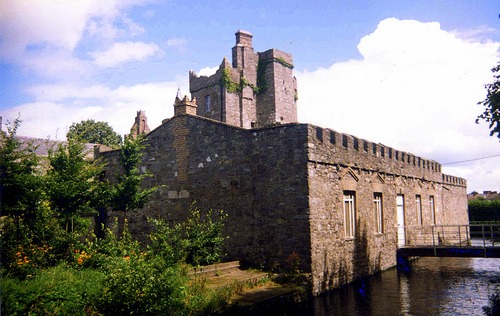
Drimnagh Castle (Caisleán Dhroimeanaigh), located in the suburb of Drimnagh in South Dublin, Ireland, is a remarkably preserved Norman castle and a unique historical site, distinguished as the only remaining castle in Ireland surrounded by a flooded moat. With a history spanning over 800 years, the castle is a testament to medieval architecture, Norman influence, and Ireland’s complex socio-political past.
Pre-Norman Context and Norman Grant (Pre-1215)
The area around
Drimnagh showed signs of human activity long before the castle.
Neolithic people created burial grounds about 5,000 years ago, with a
megalithic tomb nearby in Kilmashogue. The landscape was wild and
rugged, home to wild boar, wolves, and deer. Bronze Age settlers
followed, then Viking incursions, but the land remained largely
undeveloped until the Norman invasion of Ireland.
The castle’s
documented history begins in the early 13th century during the Norman
consolidation of power after Strongbow’s (Richard de Clare’s) invasion
in 1172. The de Berneval family (an ancient Breton lineage with ties to
William the Conqueror in 1066 and later Norman campaigns, including the
Holy Land) had early Irish connections. Some family members landed in
Berehaven, Co. Cork, before Strongbow but were largely wiped out by the
MacCarthy clan. One survivor, Hugo (Hugh) de Berneval (also spelled de
Bernival or Barnewall in Anglicised form), fled to England and returned.
For his family’s service—including support during the invasion—King John
granted him seisin of lands at Drimnagh (then Drymenagh or Drumenagh,
meaning “ridged land”) and Terenure in the vale of Dublin on 12 December
1216 (some sources cite 1215). Hugh first built a castle at Terenure
(site of modern Terenure College) and then Drimnagh Castle on high
ground at the head of the Lansdowne Valley as part of Dublin’s defensive
network against raids from the O’Byrne and O’Toole clans in the Wicklow
Mountains. The earliest recorded owner appears in state papers as Sir
Hugh de Bernival in 1216.
Barnewall (de Berneval) Family Era:
13th–Early 17th Century (~400 Years)
The de Berneval/Barnewall family
held Drimnagh for nearly four centuries, making it one of Ireland’s
longest-occupied castles. The first fortification was likely a wooden
structure built in the mid-13th century (around 1240 in some accounts),
but the O’Byrnes of Wicklow burned it during raids. A stone replacement
followed around 1280, with the oldest surviving basement/undercroft
dating to this period. Key family figures included:
Wolfran
(Ulphram) de Bernivale (late 13th century) — Constable of Dublin Castle,
Sheriff of County Dublin, defender of Saggart, and donor to the Leper
Hospital at Palmerstown.
Later descendants like Reginald (d. 1331)
and others who served in Parliament, military campaigns, and local
governance.
The family expanded landholdings (including between
Drimnagh and Balbriggan) and rose in influence as Anglo-Norman nobles.
They built or rebuilt the main surviving structures in the early 15th
century: a great hall (with undercroft below) featuring a vaulted
ceiling, embrasure windows, and later fireplaces. A 16th- or
17th-century square-plan tower/keep was added to the south, about 57
feet (17m) high, with turrets offering views over the countryside.
Defensive features included the moat (crossed originally by a
hand-operated drawbridge), murder holes, and left-turning spiral stairs
(a defensive design). The castle served as both residence and fortress,
protecting Dublin’s southern approaches.
The Barnewalls remained
staunch Catholics. Their power waned after the 1641 rebellion, when
Puritan forces targeted such families. The male line ended with heiress
Elizabeth Barnewall, who sold the castle on 1 February 1607 to Sir Adam
Loftus (Knight of Rathfarnham, nephew of Archbishop Adam Loftus). By
then, a 1604 census showed a small village around it (56 people in
Drimnagh).
Later Ownership and Decline as a Fortress: 17th–19th
Centuries
Post-1607, ownership fragmented amid turbulent times:
1607–1654: Loftus family (Sir Adam Loftus occupied it briefly; his
descendant Lettice married Lt. Col. Philip Fearnley/Ferneley/Cromwellian
officer).
1654 onward: Lt. Col. Philip Fearnley held it during the
Cromwellian period. Hearth Money rolls noted six taxable hearths;
inventories listed luxurious contents (feather beds, tapestries,
carpets, velvet saddle). He later sold it.
18th century:
Owners/tenants included Lt. Col. Nick Hart (1664), John Edwards, Godfrey
Boate (Justice of the King’s Bench, who felled 18,000 trees in the
woods), Walter Bagenal (sold to Henry, Earl of Shelburne in 1727),
Arthur Archer, and families like Ennis and O’Reilly. In 1780, Mr. Reilly
replaced the drawbridge with a stone bridge and added a walled garden,
signaling a shift to more peaceful, stately use.
By the 19th century:
Owned by the Marquess of Lansdowne (mid-1800s; leased to Mylott/Kavanagh
families, with residents like Edward Kavanagh in 1832 and Mrs. Elizabeth
Cavanagh until 1875). Samuel Lewis’s 1837 Topographical Dictionary
described it as an “irregular pile” occupied by Mr. E. Cavanagh.
The castle transitioned from a military outpost to a country residence,
with 18th-century additions like the entrance bridge reflecting
stability.
20th Century: Hatch Family, Christian Brothers, and
Ruination
In the early 1900s (around 1904), Dublin dairy farmer and
city councillor Joseph Hatch (1851–1918) bought the castle and lands for
cattle grazing. He restored it as a summer home, hosting family events
like his silver wedding anniversary and daughter Mary’s 1910 wedding.
After his death, it passed to sons Joseph Aloysius “Louis” Hatch (d.
1951) and Hugh (d. 1950), who ran the dairy business. Louis bequeathed
it to Dr. P. Dunne, Bishop of Nara, who sold it nominally to the Irish
Christian Brothers in the early/mid-1950s. The Brothers lived in the
castle and ran a school (using the stable block/coach house for classes
and Mass) until relocating to a new building in 1956 (some sources say
1958). It briefly served as a GAA clubhouse (An Caisleán/St James Gaels)
in 1978.
By the 1960s, it stood uninhabited and fell into severe
disrepair over 20–30 years, damaged by weather and pigeons. It housed
only fowl and risked demolition.
Restoration and Modern Era
(1980s–Present)
In 1985–1986, artist and conservationist Peter
Pearson (working with An Taisce, FÁS, CYTP, and local Drimnagh/Crumlin
community) discovered the castle’s plight and launched a major
hand-crafted restoration. Over 200 workers (stonemasons, carpenters,
etc.) rebuilt a 15th-century-style medieval oak roof (modeled on
Dunshoughly Castle), installed mullioned stone windows with leaded
glass, used traditional lime mortars, re-tiled floors (some from St
Andrews Church), and created a formal medieval-style garden with a
French parterre, herbs, and hornbeam alley. The great hall fireplace
bears the family motto Malo mori quam foedari (“I would rather die than
be defiled”). Restoration completed in 1991; President Mary Robinson
officially opened it to the public. Further work continued in the 1990s.
Today, Drimnagh Castle operates as a heritage site offering guided
tours, weddings, banquets, events, and workshops (e.g., dry stone
walling). It has appeared in films/TV like The Tudors (2007), The
Abduction Club (2002), and Ella Enchanted (2004). A small dedicated
group maintains it.
Overall Layout and Setting
The moat forms a roughly
rectangular enclosure around the castle proper, gardens, and
courtyard, providing a formidable water barrier. Access is via a
stone bridge constructed around 1780 (replacing an earlier
drawbridge). Inside the moat lies the bawn wall, an inner courtyard,
and the principal structures: a rectangular main block (the
15th-century great hall/chamber) with an attached square-plan
tower/keep on the south side. A separate early-20th-century stone
building (formerly stables, coach house, or ballroom) occupies part
of the site. Formal 17th-century-style parterre gardens with
symmetrical herb beds, gravel paths, clipped yew and laurel, and
hornbeam alleys enhance the setting, though these are more landscape
than structural.
The walls throughout are constructed of local
grey calp limestone (a dense, durable stone quarried nearby),
typically 3–4 feet (about 1 metre) thick, giving the structure its
characteristic robust, grey appearance.
The Main Rectangular
Block (c. 15th Century)
This freestanding, multiple-bay,
three-storey (over undercroft) structure forms the heart of the
castle. It originated as a great chamber (a late-medieval innovation
for audience, dining, and private household functions in extended
noble households), rather than a traditional open great hall—though
it is commonly referred to as the Great Hall today.
Undercroft (Ground/Basement Level): A vaulted storage and refuge
space with three wicker-centred (or reed/wattle) vaulted
ceilings—remnants of the centering technique are still visible,
typical of 15th-century Irish construction. The entrance is a
lowered pointed arch with limestone voussoirs and a replacement
timber door. Embrasure windows (splayed for defence/light) pierce
the thick walls. Features include a 16th-century hearth, smoker, and
bain-marie (a built-in water bath for keeping food warm). Stone
staircases at the south and north-east corners lead up to the hall
above. The floor is paved with sandstone flags, and the space now
includes a recreated 19th-century kitchen display.
Great Hall
/ Chamber (First Floor): The principal living and ceremonial space,
originally multifunctional (dining by day, sleeping on rush matting
by night). It was raised from two to three storeys in the 16th–17th
centuries, evidenced by a building line with corbels around the
upper walls. A modern mezzanine/gallery (replacing an 18th-century
staircase) overlooks the space. Key features include a reconstructed
15th-century-style medieval oak truss pitched slate roof (hipped to
the north), inspired by Dunshoughly Castle in Fingal and built
entirely by hand from durable Roscommon oak in the courtyard before
being hoisted into place. The roof incorporates a fumerelle (smoke
vent), a shaped stone parapet with billeted (notched) stone moulding
at its base, and a brick chimney on the north gable. A large
17th-century hearth dominates one wall, featuring a reproduced
Barnewall family crest. Windows are square-headed on the east and
west elevations, reconstructed with cut limestone surrounds, carved
tracery, and leaded glass (some incorporating heraldic motifs of the
Barnewall, Loftus, and Lansdowne families). Many east-side openings
have later brick pediments. Stone steps from the courtyard (via a
gabled porch added c. 1780) provide access.
The Tower / Keep
(Late 16th or Early 17th Century)
Attached to the south of the
main block, this square-plan tower rises approximately 57 feet (17.4
metres) and functions as both gatehouse and defensive/residential
addition. It commands views of the surrounding countryside.
Exterior: Hipped slate roof with a castellated parapet, stone
battlements, and a brick chimney on the south elevation. A cut-stone
string course runs horizontally. Lookout turrets project from the
south and west corners. Windows include paired round-headed lancet
openings on the east and west (some with brick pediments) and narrow
loop windows on the south for defence.
Gatehouse Function: The
integral archway provides the main entrance to the inner courtyard.
Directly above is a murder hole (a vertical opening for dropping
stones, boiling water, or other projectiles on attackers). A winding
spiral staircase (turning left—an unusual defensive feature in
Norman design to disadvantage right-handed swordsmen) ascends
through the tower.
Interior Integration: The tower and main block
form a cohesive 15th–16th-century chamber complex, with evidence of
hierarchical access (separate doorways for lordly household vs.
visitors) revealed by archaeological scars in the masonry.
Defensive and Functional Features
Defences: Thick limestone
walls, moat, battlements, turrets, loop windows, murder hole, and
embrasures. The original 13th-century phase may have included an
even earlier gate (segmental pointed arches with piers, similar to
Trim Castle), suggesting the moat’s defensive origins predate the
main 15th-century build.
Chimneys and Heating: Multiple
phases—stone chimneys (c. 16th century) later augmented with brick
(17th–18th centuries, some with blind arcades). The north and west
chimneys serve multiple floors.
Parapets and Roofs: Varied
styles, including curving sections (some reconstructed in the 1980s)
and rounded merlons capped in brick.
Architectural Evolution
and Restoration
The castle evolved from a possible 13th-century
motte-and-bailey or early stone fortification into a more domestic
15th-century chamber complex, then gained a taller defensive tower
in the late 16th/early 17th century. 18th-century changes included
larger sash windows and the porch for greater comfort and light.
Early 20th-century owners (the Hatches) added brick pediments and
other modifications.
A major restoration from 1986–1991 (led by
local historian Peter Pearson and involving over 200 craftspeople)
saved the ruin. All work was traditional and hand-executed: the oak
roof, mullioned windows, lime mortars and plasters, wood carving,
and re-tiling of the great hall floor with salvaged medieval-style
tiles from St. Andrew’s Church, Dublin. Wooden sculptures of
restorers now stand in the hall. Recent conservation (2023) has
addressed roofs, slates, leads, chimneys, and parapets while
preserving archaeological evidence.
Drimnagh Castle is a cherished heritage site, voted Ireland’s number
one hidden gem by Tripadvisor. It serves multiple roles today:
Tourist Attraction: Guided tours, which require pre-booking, offer
visitors a journey through the castle’s history, architecture, and
gardens. Tours last approximately 1 to 1.5 hours and cost €9 for adults,
€7 for students and seniors, and €5 for children (cash payments in Euros
only). Visitors praise the knowledgeable guides, who share stories of
the Barnewall family and the castle’s medieval past.
Event Venue: The
castle is available for hire for weddings, presentations, product
launches, photo shoots, and film productions. Its picturesque setting
and historical ambiance make it a popular choice.
Film Location:
Drimnagh Castle has been featured in several productions, including The
Tudors (2007), Ella Enchanted (2004), The Abduction Club (2002), The Old
Curiosity Shop (2007), and Moonfleet (2013). Its authentic medieval
aesthetic makes it a sought-after filming location.
Educational and
Community Role: The castle hosts events like dry stone walling courses
and single-day community activities. Drimnagh Castle Secondary School,
operated by the Christian Brothers, is located adjacent to the castle,
reinforcing its community ties.
Drimnagh Castle is steeped in folklore, particularly the tale of
Eleanora Barnewall, a young woman from the late 16th century. According
to legend, Eleanora was betrothed to her cousin Edmund Barnewall to
secure family wealth and land but was in love with Sean O’Byrne, a
member of the rival O’Byrne clan from Wicklow. On the day of her
wedding, the O’Byrne clan ambushed Edmund’s entourage, killing him. In
retaliation, Eleanora’s uncle imprisoned her in the castle and had Sean
murdered. Two versions of the story exist:
Devastated, Eleanora
leapt from the castle walls to her death.
She escaped to find Sean’s
grave in the Dublin mountains, where she froze to death.
Since then,
Eleanora’s ghost is said to haunt the castle, wandering silently in
search of her lost love. Visitors and staff have reported feeling
watched, hearing cries, or smelling lilies, though no scientific
evidence supports these claims. Another legend claims Oliver Cromwell
stabled his horses at Drimnagh during his 1649 campaign in Ireland, and
his ghostly presence has been reported in the halls.
Visitors to Drimnagh Castle describe it as a “hidden gem” that
transports them to another era. The guided tours, led by passionate
historians, cover the castle’s architecture (including the murder hole
and undercroft), its history, and its restoration. The formal gardens
are a highlight, offering a tranquil contrast to the castle’s martial
origins. The castle’s proximity to Dublin city center (accessible via
Cork Street, Crumlin Road, and Long Mile Road) makes it an easy day
trip, though it is not wheelchair-friendly due to its gravel courtyard
and steep stairs.
Tripadvisor reviews praise the castle’s
authenticity and the enthusiasm of guides like Amanda and Gerben, though
some note that self-guided tours offer less to see. The castle’s small
size is offset by its rich history and well-preserved features, making
it a must-visit for those interested in Irish history, medieval
architecture, or folklore.