Location: Newmarket-on-Fergus Map
Constructed: 19th century
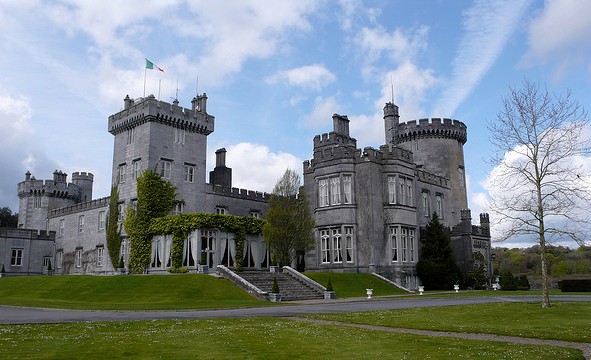
Dromoland Castle is located in Newmarket-on-Fergus in County Clare in Ireland. It was constructed in the 19th century and today it is converted to hotel. The current building of the castle Dromoland castle was completed in 1835. It was built on the site of an ancient castle Dating back to the XV century. This historic castle was built by Thomas is the son of Shane Mac Anergen. There are at least three locks, at different times called the castle the Dromoland castle. Dromoland castle was once the seat of eight generations of clan O'brien chiefs. In addition, members of the Irish clan Mac Inernay lived in this castle in the XVI century.
Early Origins and the O'Brien Dynasty (11th–16th
Centuries)
The site's deep history ties directly to the O'Brien clan.
Brian Boru (c. 941–1014), Ireland’s most famous High King, defeated
Viking forces at the Battle of Clontarf in 1014. His son Donough O’Brien
controlled the Dromoland area as a defensive stronghold around that
time. The O’Briens ruled the Kingdom of Thomond (roughly modern Clare
and parts of Limerick/Tipperary) for centuries, reasserting dominance in
the 1400s after Norman incursions.
By the 15th or early 16th century,
a tower house stood at Dromoland—typical of Gaelic Irish fortifications,
similar in style to nearby Bunratty or Leamaneh castles (also O’Brien
holdings). The first documentary mention appears in the 1551 will of
Murrough O’Brien (c. 1480s–1551), the 57th King of Thomond and chief of
the O’Brien clan. Under the Gaelic tanistry system, he bequeathed
Dromoland (along with Leamaneh) to his third son, Donough.
In 1543,
facing Henry VIII’s conquest, Murrough surrendered his Gaelic kingship.
He was created 1st Earl of Thomond and Baron Inchiquin, marking the
O’Briens’ shift from independent Gaelic royalty to titled Anglo-Irish
nobility. The castle was rebuilt or modified around this period as part
of this political realignment.
17th Century: Cromwellian Wars,
Máire Rua, and the Move to Dromoland (1650s)
The O’Briens faced major
upheaval during the Cromwellian conquest. Conor O’Brien of Leamaneh
Castle (husband of the legendary Máire Rua O’Brien, née MacMahon, c.
1615–1686) was killed in battle against Cromwellian forces in 1651.
Máire Rua (Red Mary), a formidable Gaelic aristocrat, famously married a
Cromwellian officer (Captain John Cooper) afterward to safeguard the
family estates for her son—a pragmatic, if controversial, act that
spawned folklore legends (including unproven tales of her later
murdering him).
Her son, Sir Donough (Donat) O’Brien (1642–1717), 1st
Baronet of Leamaneh and Dromoland, became one of Ireland’s wealthiest
commoners. In 1650 (just before his father’s death), he relocated the
most powerful branch of the O’Briens from Leamaneh to Dromoland,
consolidating their holdings. Sir Donough avoided direct involvement in
the Williamite Wars and died in 1717; his portrait by Mary Beale hangs
in the castle today. Dromoland was described in this era as a “handsome
Grecian Building.”
18th Century: The Classical House and Sir
Edward O’Brien, 2nd Baronet (1700s–1790s)
Sir Donough’s grandson, Sir
Edward O’Brien, 2nd Baronet (1705–1765), transformed the estate into a
more refined residence. A passionate racehorse breeder and gambler
(legend holds he once wagered and lost the castle on a horse race but
won it back), he oversaw construction of a second, larger
classical/Queen Anne-style house between c. 1700–1730. He added
landscaped gardens, follies (including the Gazebo or Temple of Mercury
on Turret Hill, designed c. 1736 by architect John Aheron for viewing
horse training), and decorative interiors with pictures and carvings.
His son, Sir Lucius O’Brien (1731–1795), continued estate improvements.
By the late 18th century, Dromoland was a grand country seat amid
political and economic changes, including the Act of Union era.
19th Century: The Gothic Revival Castle and William Smith O’Brien
(1800–1830s)
The present castle dates primarily to 1835. Sir Edward
O’Brien, 4th Baronet (d. 1837; grandson of the 2nd Baronet) commissioned
English architects James Pain (1779–1877) and his brother George Richard
Pain (c. 1793–1838), pupils of John Nash (architect of Buckingham Palace
and Regent’s Park). They had already worked on Irish Gothic projects
like Strancally Castle.
Work began around 1822 (or possibly earlier
proposals from 1813). The earlier classical house was largely demolished
c. 1826, and a new castellated Gothic Revival mansion rose in its place
using dark blue limestone quarried on the estate. Costs were
enormous—stone cutting and hauling alone exceeded £80,000 (a fortune in
Georgian times), with total expenditure around £50,000 or more. The
design featured four castellated turrets, machicolations, label-moulded
windows, rusticated elements, and a dramatic perron entrance.
Contemporary descriptions called it “a superb edifice in the castellated
style…surrounded by an extensive and richly wooded demesne” with “fine
chiseled workmanship.”
Sir Edward married Lady Charlotte Smith, whose
inherited wealth helped fund the project. The castle became the
birthplace and boyhood home of their son William Smith O’Brien
(1803–1864), who later became a prominent (and unlikely) Irish
nationalist. Despite his Protestant aristocratic background, he
championed tenant farmers’ rights, led the failed Young Irelanders
rebellion of 1848, and was transported to Tasmania (later pardoned). His
story added a layer of republican lore to the family seat.
The estate
included formal gardens (inspired by Versailles, with elements
attributed to André Le Nôtre), a yew-tree gallery (dating to c. 1740), a
lily pond, and follies.
20th Century: Land Wars, Survival, and
Conversion to Hotel (1880s–1960s)
The O’Briens’ wealth declined amid
the Irish Land Wars and agrarian reforms. Tenant farmlands were sold off
under the 1921 Land Act. During the Irish revolutionary period, IRA
leaders in Dublin marked Dromoland for destruction as a symbol of
Anglo-Irish landlordism, but local Clare IRA units intervened, citing
the family’s reputation as fair and benevolent landlords (including
famine relief efforts in the 1840s by Lucius O’Brien). The castle was
spared.
Lady Ethel Inchiquin (widow of Baron Lucius O’Brien)
personally funded its upkeep for over a decade post-1921. After her
death in 1940, her son Donough O’Brien, 16th Baron Inchiquin (and later
the 18th Baron, Conor O’Brien, who still farms part of the demesne from
nearby Thomond House) maintained it. Facing health and financial
pressures, Donough sold the castle and 400 acres (plus shooting/fishing
rights) in 1962 to American businessman Bernard McDonough (whose
grandparents hailed from nearby). McDonough converted it into a luxury
hotel, which opened in 1963. It joined Historic Hotels Worldwide and has
hosted luminaries including the Beatles, Muhammad Ali, Bono, Nelson
Mandela, Johnny Cash, and U.S. President George W. Bush (for the 2004
EU-U.S. Summit).
Irish-American investors acquired it in 1987 and
undertook further renovations (including a €20 million upgrade in later
years). The public rooms retain much of their original baronial
character—chandeliers, plasterwork, the O’Brien coat of arms, and
portraits of ancestors.
Architectural Legacy and Today
The
castle blends remnants of earlier structures (15th/16th-century
tower-house foundations, 18th-century elements) with the dominant 1835
Gothic Revival core. Interiors feature marble fireplaces, Tudor-arch
doorways, and preserved features like the octagonal study (now a
cocktail lounge) and library (now dining). The estate retains
18th-century follies, gardens, and a modern golf course added later.
Dromoland remains a living link to Ireland’s Gaelic royal past while
embodying the adaptability of the O’Brien lineage—from High Kings to
barons, rebels, and hoteliers. Guided “Living History Tours” by the
castle historian (often a Jane O’Brien) bring these stories to life for
guests. The O’Briens’ 36-foot pedigree scroll, tracing directly to Brian
Boru, underscores the unbroken thread.
The castle’s architecture reflects three distinct
eras:
15th/16th-century Tower House (original stronghold): The
earliest structure was a classic Irish tower house— a five-storey
rectangular limestone building designed for defense. It featured
vertical planning (one principal room per floor), narrow defensive slit
windows on lower levels (for archers), wider decorative windows above,
large stone fireplaces in gable walls, battlements with crenellations,
and basic machicolations (openings for dropping projectiles). Access was
via a solid wooden ground-floor door. It closely resembled Bunratty
Castle in style and function, serving as a fortified residence amid
turbulent times.
Early 18th-century Queen Anne House (c. 1736): Sir
Edward O’Brien and Lady Mary Hickman replaced or expanded the tower
house with a more residential Queen Anne-style structure. This phase
introduced a quadrilateral courtyard (the Queen Anne Court) with 29
rooms, emphasizing symmetry, comfort, and domestic scale over
fortification. Surviving elements include rows of painted sash windows,
a dominant front gable with porch, a sweep of steps to a carved stone
door frame, and an adjoining round tower rising from ground level. The
courtyard remains a charming, pre-dating feature of the hotel today.
1835 Gothic Revival Rebuild (current main building): In the 1820s, Sir
Edward O’Brien (4th Baronet) demolished the earlier house and
commissioned English architects James Pain (1779–1877) and George
Richard Pain (1793–1838)—pupils of John Nash (architect of Buckingham
Palace)—to create a grander castellated residence. The brothers
initially proposed classical designs but ultimately delivered a full
Gothic Revival scheme at enormous cost (around £50,000–80,000). Stone
was quarried on the estate (dark blue limestone, often described as
appearing grey), and the expense of cutting and hauling it was immense.
Construction ran from roughly 1819–1835, preserving four original
castellated turrets from prior structures. Contemporary accounts praised
it as “a superb edifice in the castellated style…surrounded by an
extensive and richly wooded demesne” and “built entirely of dark blue
limestone…in fine chiselled workmanship.”
Exterior Architecture:
Gothic Revival Castellated Style
The main building is a detached
six-bay, two-storey (with three-storey rear return) Gothic Revival
former country house, National Inventory of Architectural Heritage
(NIAH) rated and protected for its architectural, historical, and
technical significance. It is built entirely of finely dressed
cut-limestone blocks with a rusticated plinth at the base.
Key
features include:
Towers and turrets: Four linked castellated turrets
create a dramatic skyline—one circular three-stage tower, one
square-plan four-stage tower, and a polygonal turret on the rear porch.
These retain machicolations and carved bartizans (corner turrets).
Roof and parapets: Crenellated parapets with machicolations on towers;
cut-stone octagonal chimneystacks with domed cappings.
Windows and
openings: Single and paired timber sliding-sash windows with mullions,
transoms, and label mouldings (Gothic dripstones). A prominent
full-height canted bay window on the advanced left bay floods interiors
with light.
Porch and entrances: Projecting Gothic porch with
Tudor-arch doorways fitted with timber panelled double-leaf doors;
moulded string courses, finials, crests, and corbels throughout for
ornate detailing.
Rear elevation: Six-bay three-storey return with a
three-bay single-storey projecting porch and two-storey polygonal turret
above, reached by steps.
The overall effect is monumental and
romantic—high grand walls sweeping upward with pointed arches (a
hallmark of Gothic engineering for strength and light), evoking a
fairy-tale fortress while using advanced 19th-century craftsmanship. The
castle sits on a 450+ acre estate with a long curving drive past walled
gardens and a lake, enhancing its imposing yet picturesque presence.
Later additions maintain stylistic harmony: the 1998 Moriarty Wing
blends seamlessly, and the Brian Boru International Centre (a
purpose-built event space) echoes the Gothic style with high ceilings,
balconies, and heraldic details.
Interior Architecture and
Features
The interiors retain their original baronial grandeur, with
classic country-house opulence that feels lived-in and welcoming rather
than museum-like. Public spaces appear much as they did during the
O’Brien family’s residence.
Standout elements:
Entrance and
circulation: A great entrance hall opens onto panelled corridors lined
with ancestral portraits, coats of armour, and antique furniture. A
grand corridor leads to the main staircase, featuring a striking
stained-glass window and gracefully vaulted ceiling (Gothic pointed
arches for structural elegance and drama).
Public rooms: Sparkling
Waterford Crystal chandeliers, tasselled drapes, gold cornices, rich
fabrics, oil paintings, tapestries, fireplaces, and substantial antiques
define the drawing room, main lounge, and entrance gallery. The dramatic
high-ceilinged dining room incorporates part of the former library.
Signature spaces: The Lord’s octagonal-shaped study (beneath the round
tower) is now an intimate cocktail lounge. The Brian Boru Hall serves as
a Gothic banqueting hall with a minstrel gallery, mahogany arched
doorways, heraldic banners, and soaring ceilings (25–30 ft).
Guest
accommodations: All 97 rooms and suites are housed within original
castle walls, featuring unique layouts, original architectural details
(e.g., thick stone walls, arched windows), historically inspired
furnishings, and modern luxuries. Many overlook the lake and gardens;
staterooms include sitting areas and dining nooks. The Queen Anne Court
rooms retain 18th-century charm.
The Gothic influence is evident
throughout: vaulted ceilings distribute weight efficiently, pointed
arches add visual height and strength, and abundant windows (a Gothic
innovation) maximize natural light—addressing the damp, dark limitations
of earlier tower houses.
Queen Anne Court and Grounds
The
Queen Anne Court (c. 1736, renovated 1963) forms a separate quadrangle
of guestrooms, blending seamlessly with the main castle. It offers a
more intimate, residential scale with its courtyard layout and historic
sash windows.
Grounds include an early 18th-century Temple of Mercury
(classical folly encircled by yew trees), a walled garden incorporating
a 1600 gateway from Lemanagh Castle, a Doric-porticoed gate lodge, and
other landscape features that complement the castle’s romantic setting.
Modern Context and Legacy
Renovated in 1962–1963 (and again in
2018) for hotel use, the castle preserves its architectural integrity
while adding 21st-century comforts. The Pain brothers’ design—rooted in
Nash’s romanticism—successfully transformed a defensive site into a
luxurious baronial home that still feels authentic after nearly two
centuries. Its limestone craftsmanship, preserved turrets, and
harmonious blend of medieval fantasy with Georgian-era refinement make
Dromoland Castle one of Ireland’s finest examples of Gothic Revival
domestic architecture.