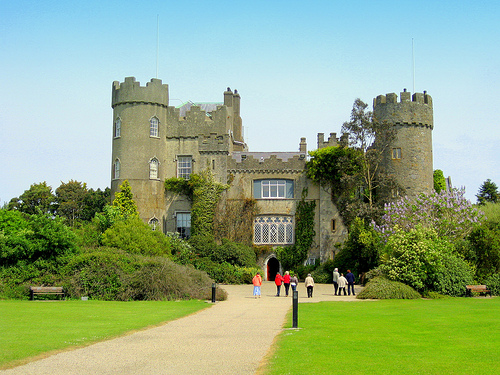
Location: 9 mi (14 km) North of Dublin Map
Constructed: 12th century
Malahide Castle, located in the coastal village of Malahide, about 14 kilometers north of Dublin, Ireland, is one of the country’s oldest and most historically significant castles. With over 800 years of history, it stands as a testament to Ireland’s medieval past, its evolving cultural landscape, and its complex socio-political history.
Origins and Founding (12th Century)
The story begins in the late
12th century during the Anglo-Norman invasion of Ireland. In 1185, King
Henry II of England granted the lands and harbour of Malahide to Sir
Richard Talbot, a Norman knight who had accompanied the king to Ireland
around 1174 (some accounts cite 1170 or 1171). Richard, whose family
also held titles like Lords of Shrewsbury in England, was the common
ancestor of the 29 subsequent Talbot lords of Malahide. His lordship was
later confirmed by Prince John (future King John).
Initially, the
Talbots built a wooden motte-and-bailey fortress (remains visible today
at nearby Wheatfield/Broomfield), with the estate spanning over 600
acres including stables, barns, and defenses. By around 1250, they
constructed the first stone structure on the current site—an
Anglo-Norman tower house/keep. This evolved into the core of the present
castle, with the earliest surviving parts (a three-storey rectangular
keep-like tower including the Great Hall) dating to circa 1400.
The
Talbots quickly rose in prominence: by the 14th–15th centuries, they
served as Members of Parliament, sheriffs, and defenders of English
interests in Leinster. In 1475, Thomas Talbot was granted the hereditary
title of Lord High Admiral of Malahide and the Adjacent Seas,
controlling the booming port and levying customs.
Medieval
Expansion and the Great Hall (15th–16th Centuries)
The castle was
significantly enlarged during the reign of Edward IV (1442–1483). Around
1475, the iconic Great Hall was built or completed as a grand feasting
and courtly space—a rare surviving example of a medieval Gaelic-style
banqueting room. Measuring about 42 by 22 feet with a minstrels’
gallery, it featured carved corbel heads (including one of Edward IV)
and served as the heart of Talbot hospitality and justice.
The Oak
Room (originally the principal chamber of the ancient tower house) dates
to the 16th century, with richly carved Flemish oak paneling depicting
Biblical scenes. Legend claims a Talbot dreamed of a votive chamber with
“ivory pillars” but used oak painted white instead (later blackened and
nicknamed “candles”). By the 16th century, Malahide Castle appeared in
manuscripts as one of County Dublin’s key garrisons, with fortifications
including walls, a moat (remnants visible today), drawbridge, and
portcullis.
17th Century: Cromwellian Interruption and
Restoration
The Talbots’ ownership faced its only major interruption
during the Cromwellian conquest. In 1641, John Talbot (a “Papist” per
contemporary records) remained neutral in the Irish Rebellion but was
indicted for treason; his lands were forfeited. The castle was
garrisoned by the Duke of Ormond and leased to Miles Corbet (Lord Chief
Baron and later a regicide who signed Charles I’s death warrant) for
£50/year during Dublin’s plague outbreak. Corbet called it “the
strongest Castle in the neighbourhood of Dublin.”
The family was
exiled to Connaught. After the Restoration of Charles II in 1660, Sir
John and Lady Catherine Talbot regained the estate. Lady Catherine
immediately ordered the demolition of outworks and defenses, declaring
it should “never again serve as a stronghold to invite the residence of
an usurper.” Repairs followed, and the castle regained prominence.
18th–19th Centuries: Architectural Flourishing and Survival Through
Turmoil
Major changes occurred in the Georgian era. A fire around
1760 damaged earlier structures; between 1765 and 1782, the west wing
was rebuilt in Georgian Gothic Revival style, adding two (later three)
slender circular towers at the front and creating the opulent Drawing
Rooms. These feature distinctive “Malahide Orange” walls, rococo
plasterwork (possibly by Robert West, with acanthus, chinoiserie
motifs), marble fireplaces, and decorative doorcases. The family
remained Roman Catholic until Richard Talbot’s conversion in 1774, yet
retained their estate through the Penal Laws thanks to diplomacy.
The
castle survived the 1690 Battle of the Boyne dramatically: 14 Talbot
family members breakfasted in the Great Hall before fighting for James
II; by evening, only one survived. In the 19th century, the 2nd Baron
(Richard Wogan Talbot) enlarged the Oak Room southward (adding a porch
and squared towers) around 1820–1825 and remodelled the Great Hall in
neo-Gothic style. The peerage “Baron Talbot of Malahide” was created in
1831 for Margaret O’Reilly Talbot. The castle hosted notables, including
the Marquess Wellesley (Lord Lieutenant) in 1825.
20th Century to
Present: Inheritance, Sale, and Public Access
The 20th century
brought modern twists. During WWI, the grounds hosted an airship mooring
base for anti-submarine patrols. In the 1920s, James Boswell’s private
papers (of the famous biographer) were discovered in the castle by his
great-great-grandson, the 6th Baron, and sold to Yale University.
The
7th and final Baron, Milo Talbot (a diplomat, WWII intelligence officer,
and botanist), died suddenly in 1973. His sister Rose inherited the
estate but faced heavy death duties; she sold the castle, contents, and
demesne to Dublin County Council (now Fingal County Council) in
1975–1976. Many furnishings were auctioned (some later recovered), but
the castle opened to the public in 1977. It is now operated by Shannon
Heritage, with guided tours of the state rooms, the Talbot Botanic
Gardens (Milo’s southern-hemisphere plant collection), and the demesne
park. Major conservation continues, including the Great Hall’s 2022
reopening after €500,000+ in works.
Today, Malahide Castle preserves
Talbot family history through its interiors (including Jacobite
portraits on loan from the National Gallery of Ireland in the Great
Hall), collections, and grounds. It hosts events, concerts, and
visitors, embodying over 800 years of Irish history—from Norman conquest
to modern heritage tourism.
The castle began as a simple Anglo-Norman stone tower house (or
keep-like rectangular tower) in the late 12th–14th/early 15th century,
replacing an earlier wooden fortress on the site granted to Richard
Talbot by King Henry II in 1174/1185. This core structure was three
storeys high, with a ground-floor kitchen/servants’ quarters and a
first-floor family area that incorporated the Great Hall.
Major
enlargements occurred in the 15th century during the reign of Edward IV
(1461–1483), when the Great Hall was constructed around 1475 as the
medieval feasting hub. Further renovations and extensions happened
c.1650.
A fire in the 1760s (around 1760) prompted reconstruction of
the west wing between 1765 and 1782, introducing Georgian interiors and
Georgian Gothic-style circular towers (single-bay, three-storey) added
at each end of the front elevation c.1770. These towers gave the façade
its distinctive symmetrical, castellated profile.
In the early 19th
century (c.1825), the 2nd Baron Talbot (Colonel Richard Wogan Talbot)
extensively remodelled the castle in neo-Gothic Revival style, adding a
central single-bay three-storey flat-roofed entrance block with
single-bay full-height square turrets at the corners, Gothic windows,
and further embellishments to the Great Hall. This phase enhanced the
romantic, picturesque medieval appearance while modernizing interiors.
Later 20th-century works (extensive renovation c.1990 and sensitive
conservation in 2022, especially of the Great Hall) preserved the fabric
without major stylistic changes. The result is a square, battlemented
building with circular corner towers flanking the front, random coursed
rubble stone walls (nap-rendered in places), slate roofs hidden behind
crenellated parapets, and ivy often clinging to the stonework.
Exterior highlights include:
Battlemented parapets and crenellations
for a fortified look.
Two prominent circular towers (Georgian Gothic,
c.1770) with ogee-headed openings, stone sills, and Gothic timber sash
windows.
Central pointed-arch entrance door with cut-stone surround.
Diamond-leaded and mullioned windows (some with hood mouldings).
A
tall central tower section with battlements and large arched windows.
Overall four-storey appearance in parts (including basement), though
primarily three storeys over basement in the main range.
Key
Interior Architectural Features
The interiors showcase a
chronological layering of styles, from medieval to early modern,
Georgian, and 19th/20th-century elements. Guided tours highlight how
each space evolved.
Great Hall (c.1475, remodelled 1825): This is
the architectural and historical heart — one of Ireland’s rare surviving
medieval Gaelic feasting rooms in its original domestic use. Measuring
approximately 42 ft by 22 ft, it features a high timber-beamed ceiling,
a minstrel’s gallery (for musicians), diamond-patterned leaded windows,
and carved corbel heads depicting Edward IV. The 1825 neo-Gothic Revival
work added wooden beams and historicist detailing; it was conserved in
2022 (roof, rafters, windows, fireplaces). Walls display a renowned
collection of Jacobite portraits in their original setting. It remains
imposing yet intimate, with chandeliers, dark wood panelling accents,
and a fireplace.
Oak Room (oldest section, early modern interior):
Located in the original tower/keep, this evocative early-modern space is
famed for its richly ornate Flemish-influenced 17th-century timber
carvings and panelling (some sourced from older furniture). The dark oak
covers walls and includes intricate motifs reflecting the Talbots’
continental tastes, devotions, and exoticism. Features include small
defensive windows, a hidden priest-hole escape route (used during penal
times), and a later Egyptian-style fireplace surround. It is one of
Ireland’s most atmospheric surviving early interiors.
Drawing Rooms
(west wing, rebuilt c.1770 after the 1760 fire): These opulent Georgian
entertaining spaces exemplify 18th-century Irish design. They feature
rococo plasterwork in the Dublin school style (associated with Robert
West), decorative doorcases, marble fireplaces, and walls famously
painted in the idiosyncratic “Malahide orange” (redecorated 1833).
Ornate furniture, chandeliers, and classical detailing create a light,
elegant contrast to the darker medieval rooms.
Library: A serene
18th-century space with original bookcases that once held the Talbots’
rare manuscripts. Gilt-leather wallpaper (calfskin with gold and silver
leaf, centuries old) adds a luxurious, atmospheric gleam.
Other
interiors: Include turret rooms with stucco ceilings, Edwardian bedrooms
reflecting 20th-century private life (e.g., references to diplomat Lord
Milo Talbot), a vaulted undercroft, and an entrance hall added in the
1820s. A flushing toilet was an early modern addition (1870), and gas
lighting came via a 1856 on-site plant.
The Malahide Castle demesne spans 260 acres and includes
beautifully landscaped gardens, parklands, and woodlands. The
gardens are a major attraction, offering a serene contrast to the
castle’s imposing stone structure.
Walled Garden: The 20-acre
walled garden, originally designed in the 18th century, is a
highlight. It features seven glasshouses, including a Victorian
conservatory, and a diverse collection of plants. The garden is
particularly noted for its collection of over 5,000 plant species,
with a focus on Southern Hemisphere varieties, such as those from
Australia and Chile, introduced by Milo Talbot, a keen botanist.
Butterfly House: Within the walled garden, the Butterfly House is
Ireland’s only permanent butterfly exhibit, housing exotic species
in a tropical environment. It adds a modern, family-friendly element
to the estate.
Formal Gardens: The formal gardens include
manicured lawns, ornamental flowerbeds, and tree-lined avenues. The
Talbots took great pride in their horticultural efforts, and the
gardens reflect their legacy of landscaping expertise.
Parklands:
Beyond the gardens, the demesne features open parklands with walking
trails, a cricket pitch, and a golf course. The grounds are home to
native wildlife, including deer, foxes, and a variety of bird
species.
Malahide Castle is more than a historic residence; it is a cultural
landmark that encapsulates Ireland’s layered history.
Talbot Family
Legacy: The Talbots’ long association with the castle makes it a unique
case study in Anglo-Irish history. Their ability to retain control
through centuries of upheaval reflects their political acumen and
adaptability. The family’s Catholic faith, combined with their loyalty
to the Crown, positioned them as mediators between English and Irish
interests.
Ghost Stories: The castle is famously associated with
supernatural tales, adding to its mystique. Among the reported ghosts
are:
Puck, a jester who fell in love with a lady of the castle and
was found dead under mysterious circumstances. His spirit is said to
haunt the castle’s turrets.
The White Lady, a spectral figure linked
to a painting in the Great Hall, who is said to wander the castle at
night.
Miles Corbet, the Cromwellian occupant, whose ghost is
believed to linger as a reminder of his grim fate. These stories, while
likely embellished, draw visitors and enhance the castle’s allure.
Art and Furnishings: The castle houses a significant collection of
period furniture, portraits, and artifacts, many of which were part of
the Talbot family’s collection. The National Portrait Gallery of Ireland
once stored part of its collection here, though most paintings have
since been relocated. The remaining furnishings provide insight into the
lifestyle of the Anglo-Irish gentry.
Today, Malahide Castle is a major tourist attraction, managed by
Shannon Heritage and Fingal County Council. It serves multiple roles:
Tourism and Education: Guided tours offer visitors access to key
rooms, including the Great Hall, Oak Room, and drawing rooms, providing
insights into the castle’s history and the Talbot family. The tours
emphasize the castle’s architectural evolution and its place in Irish
history.
Events and Weddings: The castle and its grounds are a
popular venue for weddings, corporate events, and cultural festivals.
The Great Hall and walled garden provide picturesque settings for
private functions.
Avoca Café and Shop: The castle’s visitor center
includes an Avoca café and retail shop, offering locally sourced food
and Irish crafts. This adds a contemporary commercial element to the
estate.
Community Hub: The demesne is a cherished public space for
locals, who use the parklands for recreation, sports, and community
events. The castle’s accessibility reflects its role as a shared
cultural asset.
Visiting Malahide Castle offers a multifaceted experience:
Castle Tours: Tours are available daily, with knowledgeable guides
providing historical context. Visitors can explore the castle’s
interiors and hear stories of its inhabitants, from medieval knights to
Georgian aristocrats.
Gardens and Grounds: The walled garden and
parklands are open to the public, with seasonal events like plant fairs
and outdoor concerts. The Butterfly House is a hit with families.
Accessibility: The castle is easily accessible from Dublin via the DART
train (Malahide Station is a short walk away) or by car. The village of
Malahide, with its charming pubs, restaurants, and marina, complements a
visit to the castle.
Seasonal Highlights: The castle hosts Christmas
markets, Halloween ghost tours, and summer festivals, making it a
year-round destination.