Location: Enniskerry, County Wicklow Map
Constructed: 1731- 41
Tel. 01 204 6000
Bus: 185 from Bart DART
station
Open: 9:30am- 5:30pm (dusk Oct- Mar) daily
Closed: 25th &
26th December
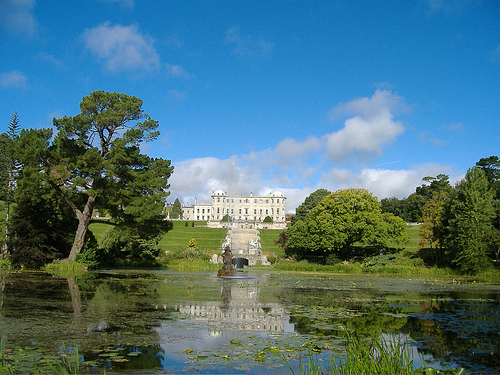
Powerscourt Estate, located in Enniskerry, County Wicklow, Ireland, is one of the country’s most renowned historic estates, celebrated for its stunning gardens, grand Palladian mansion, and rich cultural heritage. Nestled at the foot of the Wicklow Mountains, approximately 20 kilometers south of Dublin, the estate spans over 1,000 acres, with 47 acres dedicated to meticulously designed gardens. Its combination of natural beauty, architectural elegance, and historical significance makes it a premier destination for visitors.
Medieval Origins: The La Poer (Power) Castle and Gaelic Takeover
(13th–16th Centuries)
The site’s name derives from the Anglo-Norman
de La Poer (or Le Poer/Power) family, who built a 13th-century castle
here shortly after the Norman invasion of Ireland in the late 12th
century. “Powerscourt” is an anglicisation of “Paor’s Court.” Positioned
on a commanding hilltop, the castle controlled key river valleys
(Dargle, Glencree, and Glencullen), serving as a vital outpost
protecting the English Pale (the area around Dublin under Crown control)
from raids by Gaelic Irish clans, particularly the O’Byrnes and O’Tooles
from the Wicklow Mountains.
By the late 14th century, the O’Toole
family had seized the castle and lands. They navigated a complex
existence—sometimes aligning with the English Crown while maintaining
Irish loyalties. A notable moment came in 1540 when Turlough O’Toole
submitted to Henry VIII, pledging to adopt English customs, maintain the
castle, clear forests for farming, and not harbor enemies in exchange
for retaining extensive lands. However, ongoing rebellions (including
involvement after the 1601 Battle of Kinsale) led to confiscation of
O’Toole holdings.
Wingfield Acquisition and 17th-Century Turmoil
(Early 1600s–Late 1600s)
A pivotal and controversial shift occurred
in 1603. The Wingfield family, ambitious English settlers, had long
coveted the O’Toole lands. Historical accounts describe the murder of
Phelim O’Toole (a key Gaelic lord) in the “Killing Hollow” near
Powerscourt on 14 May 1603, which helped provoke forfeiture of the
estate. King James I then granted a 21-year lease (later full ownership)
of the manor and roughly 40,000 acres to Sir Richard Wingfield, a
military commander, Marshal of Ireland, and favorite of Elizabeth I and
James I. In 1618, at age 68, he was created the 1st Viscount Powerscourt
(first creation), though the title became extinct upon his death in 1634
without direct male heirs; the estate passed to a cousin, Edward.
The
mid-17th century brought destruction during Oliver Cromwell’s invasion
of Ireland: the castle was burned and partially leveled to prevent its
use as a base by opposing forces. The Wingfields retained control,
however. Later in the century, Folliott Wingfield (created 1st Viscount
of the second creation in 1665) married Elizabeth Boyle, daughter of the
wealthy “Great Earl” of Cork (Robert Boyle). They partially rebuilt the
structure, but this title also became extinct without heirs. The estate
and title eventually passed through cousins to another Richard
Wingfield.
18th-Century Transformation: The Palladian Mansion
(1731–1741)
The estate’s most enduring architectural legacy began in
the early 18th century under Richard Wingfield (1697–1751), later
created 1st Viscount Powerscourt of the third creation. In 1730–1731, he
commissioned the German-born architect Richard Cassels (also spelled
Castle), renowned for Dublin landmarks like Leinster House, Russborough
House, and Carton House. Cassels extensively remodeled the medieval
castle remnants into a magnificent 68-room Palladian mansion, completed
around 1741. The design took advantage of the hilltop site,
incorporating a severe but imposing facade flanked by two circular domed
towers—giving it what Sir John Vanbrugh might have called a “castle
air.” The interior featured a grand entrance hall (18m long),
first-floor reception rooms, and the opulent Saloon (often called the
grandest room in any Irish house). A mile-long avenue of beech trees led
to the house.
19th-Century Golden Age: Gardens, Renovations, and
Royal Connections
Major landscaping and further house work occurred
in the 19th century, primarily under the 6th and especially the 7th
Viscounts Powerscourt. Mervyn Wingfield, 7th Viscount (who inherited at
age 8 in 1844 and took full control at 21), oversaw extensive
renovations and the creation of the famous gardens. Architect Daniel
Robertson (working 1841–1843 onward, despite battling gout and directing
from a wheelbarrow while sipping sherry) designed Italianate terraces
cascading down to Triton Lake. Up to 100 laborers worked on the project;
the terraces, parterres, fountains, statues (including winged horses),
Japanese gardens, walled gardens, Bamberg Gate, Dolphin Pond, and other
features were largely completed by around 1880 after nearly 40 years of
development. The 7th Viscount drew inspiration from Versailles,
Schönbrunn Palace, and Schwetzingen. Additional features included the
Pepperpot Tower (a whimsical 1900 playhouse for children, modeled on a
3-inch pepperpot) and a pet cemetery with personal epitaphs.
Notable
events included King George IV’s visit in August 1821 (just after his
coronation). The 5th Viscount dammed the nearby Powerscourt Waterfall
(121m/397ft high, Ireland’s tallest) to create a dramatic torrent for
the king, but the monarch overindulged at lunch and never made it to the
falls; the dam was later blown up anyway. In the 1830s, the house hosted
conferences on unfulfilled Bible prophecies under the Dowager
Viscountess, attended by figures like John Nelson Darby and Edward
Irving.
The estate also included a deer park (established 1858 with
Japanese Sika deer) and spanned about 200 km² at its peak.
20th
Century: Scouts, Sale, Fire, and Restoration (1900s–1990s)
The early
20th century saw ties to the Scout movement; the 8th Viscount provided
camping grounds, and Robert Baden-Powell visited a camp in 1928. The
estate remained with the Wingfields for over 350 years until 1961, when
the 9th Viscount, Mervyn Patrick Wingfield, sold it to the Slazenger
family (of sporting goods fame, known for Wimbledon tennis balls). The
families later intertwined when the 10th Viscount married Wendy
Slazenger in 1962; their son Mervyn Anthony Wingfield (11th Viscount)
has served as a director of the estate company.
Disaster struck on 4
November 1974 when a fire—accidental and worsened by high winds and
delayed firefighting response—gutted the central block of the house,
destroying the Saloon and many interiors while leaving the wings intact.
The property lay as a roofless shell for over 20 years. Major
restoration began in 1996 under the Slazengers: the house was re-roofed,
windows restored, and interiors rebuilt using traditional methods
alongside modern techniques. Only two rooms are preserved in their
historic state; much of the ground and first floors now house retail
shops, a visitor centre, exhibition on estate history, café, and
function spaces.
Powerscourt Today: A Thriving Visitor
Destination
The Slazenger family still owns and operates the estate.
The 47-acre formal gardens remain the highlight—ranked among the world’s
top by National Geographic—and include ongoing horticultural work.
Additional attractions comprise two 18-hole golf courses, a garden
centre, Avoca restaurant, and the separate Powerscourt Waterfall and
Valley (with its own entrance). A five-star Powerscourt Hotel (opened
2007) sits nearby on the former estate. The site attracts hundreds of
thousands of visitors annually and has appeared in films like Excalibur
(waterfall scenes) and others.
The site originated as a 13th-century Anglo-Norman castle built by
the Le Poer (anglicized to “Power”) family, strategically positioned on
a hilltop to control river access in the Wicklow Mountains. In the 18th
century, Richard Wingfield, 1st Viscount Powerscourt (1697–1751),
commissioned German-born architect Richard Cassels (also spelled Castle,
c. 1690–1751) to remodel the castle into a modern country house.
Cassels, a leading figure in Irish Palladianism who also designed Carton
House, Russborough House, and parts of Leinster House, began work in
1731 and completed it in 1741. He incorporated the medieval structure
while creating a symmetrical Palladian composition that capitalized on
the dramatic hilltop setting, imparting a subtle “castle air” (as Sir
John Vanbrugh might have described it) through its robust scale and
domed towers.
The house originally contained at least 68 rooms. A
mile-long beech avenue once approached it, underscoring its grandeur as
a Palladian villa inspired by Italian Renaissance models.
Exterior Architecture
Powerscourt House is a multi-part Palladian
composition: a three-storey central block linked by single-storey
corridors to two-storey wings, forming a U-shaped plan overall. The
primary material is local granite, giving the facades a solid,
monumental quality with rusticated (textured with recessed joints) lower
levels for contrast.
North (Entrance) Front: This nine-bay
granite facade features a prominent five-bay central breakfront. The
ground storey is treated as a rusticated basement, topped by a pediment
supported by six Ionic pilasters. The pediment displays the Wingfield
family arms. Rondels between the pilasters hold busts of Roman emperors
(including a central female bust known as “Empress Julia”). Balustraded
parapets run along the central block and links. The wings each have four
bays, and the facade extends via curved quadrant walls pierced by
pedimented Doric arches, terminating in obelisks crowned with eagles—the
Wingfield crest.
South (Garden) Front: This seven-bay elevation sits
between two rounded corner towers (or bows) surmounted by distinctive
ogee-shaped copper domes, giving the house its baroque flair and “castle
air.” One side includes an additional two-storey wing. The design frames
sweeping views down terraced gardens to Triton Lake. Window embrasures
vary in depth: central rooms (incorporating the old castle) have deep
8-foot reveals, while outer rooms are shallower (2.5–3 feet), confirming
the medieval core’s integration.
Interior Architecture (Pre-Fire
and Current State)
Before the devastating fire of 4 November 1974,
the interiors were opulent and eclectic. The ground-floor Entrance Hall
(60 ft long by 40 ft wide) featured elaborate shell-decorated ceilings,
family armor, guns, deer heads, antler trophies, and a famous Austrian
antler chandelier (some elements in papier-mâché). Main reception rooms
were on the piano nobile (first floor), typical of Palladian planning.
The Saloon (above the hall) was grander still, measuring about 60 x 40
feet and executed in a Roman Renaissance style rather than pure
Palladian. It included decorative columns, arches, mirrors, statues,
chandeliers, and a mosaic lunette by Salviati. Some central rooms
retained vaulted medieval elements, including a 15th-century
cross-shaped angle-loop.
The 1974 fire gutted the main block (likely
starting in a chimney), destroying most original interiors, though the
Slazenger family (owners since 1961) preserved a wing. A 1996
restoration added a new roof and windows; today, the ground and first
floors largely house retail units, a café, and an estate exhibition.
Only two rooms are preserved in their historic appearance for visitors.
Powerscourt’s gardens are the estate’s crown jewel, consistently
ranked among the world’s finest. Developed over two centuries, they
reflect a blend of Italian Renaissance, French formal, and English
landscape styles, shaped by the vision of the Wingfield family and
landscape architects like Daniel Robertson. The gardens were
primarily laid out in the 19th century, with significant
contributions from the 6th and 7th Viscounts Powerscourt. Below are
the key features of the 47-acre gardens:
Italian Gardens
The Italian Gardens, located directly below the mansion, are a
formal masterpiece inspired by the Renaissance gardens of Italy,
particularly the Villa d’Este and Boboli Gardens. Designed by Daniel
Robertson in the 1840s, they descend in a series of terraces to
Triton Lake. Notable elements include:
Terraced Lawns: Five
descending terraces adorned with ornamental urns, statues, and
intricate stonework, including a grand double staircase leading to
the lake.
Triton Lake: A central feature, this lake is named
after its dramatic fountain, modeled on Bernini’s Fountain of Triton
in Rome. The fountain, powered by gravity, shoots water up to 30
meters high, creating a striking focal point.
Statuary: The
gardens are adorned with classical sculptures, including winged
horses (symbolizing the Wingfield crest) and figures from Greek
mythology, sourced from Italy and Germany.
Mosaic Pathways:
Intricate pebble mosaics, crafted by local artisans, line the
terraces, depicting floral and geometric patterns.
Japanese
Gardens
Created in 1908 by the 8th Viscount Powerscourt and his
mother, Lady Londonderry, the Japanese Gardens offer a tranquil
contrast to the formal Italian Gardens. Tucked into a sheltered
valley, they feature:
Pagoda and Lanterns: Authentic Japanese
structures and stone lanterns, imported to enhance the garden’s
Eastern aesthetic.
Plantings: A collection of azaleas,
rhododendrons, and Japanese maples, chosen for their vibrant colors
and seasonal beauty.
Grotto and Bridges: A circular grotto made
of petrified sphagnum moss and small arched bridges add a whimsical,
fairy-tale quality to the space.
Walled Gardens
The Walled
Gardens, among the oldest features of the estate, date back to the
1730s and were originally used for kitchen gardening. Today, they
are a horticultural showcase, featuring:
Rose Garden: A
formal layout with over 200 varieties of roses, blooming vibrantly
in summer.
Herbaceous Borders: Long beds filled with perennials,
including delphiniums, lupins, and peonies, designed to provide
year-round color.
The Bamberg Gate: An ornate wrought-iron gate,
crafted in 1770 for Bamberg Cathedral in Germany, was acquired by
the 7th Viscount and installed as a striking entrance to the
gardens.
Dolphin Pond
Located near the Walled Gardens,
this serene pond is surrounded by yew trees and named for a dolphin
sculpture that once adorned it. It serves as a peaceful spot for
reflection, with views toward the mansion.
Pepperpot Tower
Inspired by a pepperpot from Lord Powerscourt’s dining table, this
folly tower was built in the 19th century as a lookout point. It
offers views over the estate and houses a small cannon, adding a
playful historical touch.
Pets’ Cemetery
A unique feature,
the Pets’ Cemetery is one of the largest of its kind in Ireland,
containing the graves of beloved animals belonging to the Wingfield
family, including dogs, horses, and even a cow named “Daisy.”
Inscribed headstones add a poignant, personal element to the
estate’s history.
Beyond the formal gardens, Powerscourt Estate encompasses woodlands,
deer parks, and walking trails that highlight the natural beauty of
County Wicklow. The estate’s location in the “Garden of Ireland”
provides a dramatic backdrop of rolling hills and forested valleys. Key
natural features include:
River Walk: A scenic trail along the
River Dargle, offering shaded paths and views of native flora and fauna.
Deer Park: A historic parkland where red deer roam, reflecting the
estate’s medieval origins as a hunting ground.
Sugarloaf Mountain:
The conical peak, visible from much of the estate, adds a distinctive
silhouette to the landscape.
Powerscourt Waterfall
Located 6
kilometers from the main estate, Powerscourt Waterfall is Ireland’s
highest waterfall, cascading 121 meters down a granite cliff. Though
technically separate, it is part of the Powerscourt demesne and a
popular attraction. Surrounded by ancient woodlands, the waterfall is
fed by the River Dargle and offers picnic areas, walking trails, and
breathtaking views, particularly after heavy rain. It’s a seasonal
highlight, with autumn foliage and spring wildflowers enhancing its
beauty.
Today, Powerscourt Estate is a multifaceted destination, blending
heritage tourism with modern amenities. It attracts over 300,000
visitors annually, drawn by its gardens, historical significance, and
proximity to Dublin. Key modern features include:
Tourism and
Events: The estate hosts guided tours, garden workshops, and seasonal
events like Christmas markets and outdoor concerts. The mansion’s
ballroom is a sought-after venue for weddings and corporate functions.
Powerscourt Golf Club: The estate includes two championship golf
courses, designed by David McLay Kidd and Peter McEvoy, ranked among
Ireland’s finest. The courses integrate with the landscape, offering
stunning views of the Wicklow Mountains.
Retail and Dining: The Avoca
Terrace Café and boutique shops provide high-quality Irish crafts, food,
and souvenirs. The Powerscourt Distillery, opened in 2018, produces
award-winning whiskeys, with tours and tastings available.
Conservation Efforts: The estate is committed to preserving its
biodiversity, with ongoing maintenance of its gardens and woodlands. It
participates in global horticultural networks, ensuring the gardens
remain a living legacy.
Powerscourt has inspired artists, writers, and filmmakers for centuries. Its gardens and mansion have appeared in films like Barry Lyndon (1975) by Stanley Kubrick and TV series such as The Tudors. The estate’s beauty has also been captured in countless paintings and photographs, cementing its status as an icon of Irish heritage.
Location: Enniskerry, Co. Wicklow, Ireland (20 km from Dublin).
Opening Hours: The gardens are open year-round, typically from 9:30 AM
to 5:30 PM (shorter hours in winter). The waterfall has separate hours,
usually 10:30 AM to dusk.
Admission: Tickets for the gardens cost
approximately €11.50 for adults, with discounts for children, seniors,
and families. The waterfall has a separate fee of around €6.50.
Accessibility: The gardens and mansion are partially accessible for
wheelchair users, with some uneven terrain in the Japanese Gardens and
woodland areas.
Getting There: Easily accessible by car (free parking
available) or public transport from Dublin (bus routes 44 or 185 to
Enniskerry, followed by a short walk).