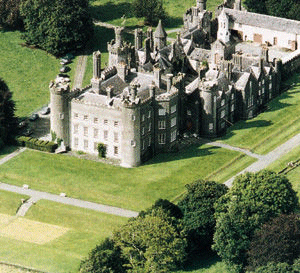
Location: 2 km (1.5 mi) from Castlepollard, County Westmeath Map
Constructed: early 19th century
Tullynally Castle, also known as Pakenham Hall, is one of Ireland’s most remarkable historic estates, located near Castlepollard in County Westmeath, approximately 80 kilometers from Dublin. This sprawling Gothic Revival castle, the largest still used as a private family home in Ireland, has been the seat of the Pakenham family, later the Earls of Longford, for over 370 years. Encompassing over 120 rooms, nearly an acre of roof, and 26 acres of enchanting gardens, Tullynally is a testament to architectural evolution, historical significance, and horticultural splendor.
Tullynally’s history begins in the mid-17th century, with its name
derived from the Irish Tulaigh an Eallaigh, meaning “Hill of the Swan,”
possibly linked to the nearby Lough Derravaragh and the legend of the
Children of Lir, who were transformed into swans. The estate’s origins
trace back to 1655, when Henry Pakenham, a captain in the Parliamentary
Dragoons, was granted the land in lieu of pay arrears during the
Cromwellian settlement. He built a square, semi-fortified “plantation
house,” which forms the core of the present castle.
The Pakenham
family, later ennobled as the Earls of Longford, expanded the estate
over generations. By 1740, Thomas Pakenham married an heiress from
Longford, elevating the family’s status. The 2nd Earl of Longford,
another Thomas, initiated major transformations in the early 19th
century, turning the Georgian house into a Gothic Revival castle with
towers, battlements, and a moat, partly as a defensive response to
tensions following the 1798 rebellion. The castle has remained in the
Pakenham family for ten generations, with the current owner, Thomas
Pakenham, the 8th Earl of Longford, continuing to live there and
maintain its legacy.
Notable family members include General Sir
Edward Pakenham, a senior British Army commander killed in 1815 at the
Battle of New Orleans, and Kitty Pakenham, who married Arthur Wellesley,
the 1st Duke of Wellington, in 1806. The family’s history is intertwined
with Ireland’s political and social evolution, and their commitment to
preserving Tullynally as a living home has made it a unique cultural
landmark.
Tullynally Castle is a magnificent example of Gothic Revival architecture, with elements of Georgian and Tudoresque styles, reflecting its gradual expansion from a 17th-century house to a sprawling castle. Stretching nearly a quarter of a mile, it features a picturesque skyline of turrets, pinnacles, battlements, and tall chimneystacks, earning it a fairy-tale appearance. The castle’s evolution involved some of Ireland’s most prominent architects, including Francis Johnston, James Shiel, and Sir Richard Morrison, who worked on various phases of its transformation.
1655–1730: The original structure, built by Henry Pakenham, was a
modest plantation house, possibly incorporating an earlier tower house
owned by the Fitzsimons family.
1780: A third floor was added to the
Georgian-style house, along with one of the earliest recorded central
heating systems in the British Isles, designed by inventor Richard
Lovell Edgeworth, a neighbor from Edgeworthstown. Heat was distributed
through floor grilles to warm the Great Hall.
1803–1806: Francis
Johnston remodeled the house for the 2nd Earl, introducing Gothic
elements such as battlements, label moldings, round corner turrets, and
a portcullis entrance, transforming Pakenham Hall into Pakenham Hall
Castle. These additions were both aesthetic and defensive, reflecting
post-1798 security concerns.
1820s: James Shiel designed further
Gothic “improvements,” including an octagonal dining room and the
spectacular Great Hall, known for its acoustics and used for concerts.
1840s: Sir Richard Morrison added two enormous wings and a central
tower, making Tullynally the largest castellated house in Ireland at the
time.
The castle’s exterior is a harmonious blend of Georgian restraint and
Gothic romanticism. Key features include:
Crenellations and
Battlements: Added in the 19th century to give a medieval castle-like
silhouette.
Towers and Turrets: Multiple three- and four-storey
towers, some with crow-stepped parapets, create a dramatic profile.
Castellated Gate Lodge: Designed by James Shiel around 1820, this
single-bay, two-storey gatehouse with a Tudor-pointed carriage arch and
polygonal tower marks the entrance to the outer courtyard.
Courtyard
and Clock Tower: An inner courtyard is accessed through a two-storey
block with a segmental-headed carriage arch, topped by an open
belfry/clock tower on a hexagonal plan, featuring a slate roof and
cast-iron weathervane.
The castle’s 120 rooms include grand public spaces and functional
areas, many of which are accessible on guided tours. Notable interiors
include:
Great Hall: A vast, vaulted space with clerestory
windows, oak paneling, and Gothic niches displaying family crests and
arms. Designed by James Shiel in the 1820s, it boasts excellent
acoustics and hosts concerts. Swords belonging to Edward Pakenham adorn
the walls.
Dining Room: An elongated octagon with a three-sided bow
window, lit dramatically and furnished with period pieces.
Library:
Begun by Elizabeth Cuffe, wife of the 1st Baron Longford, and expanded
by Georgiana, wife of the 2nd Earl, this room houses thousands of rare
books, some dating to the 17th century, and features a hidden door.
Drawing Room: An elegant Gothick-style room with fine furniture and
family portraits.
Victorian Kitchens and Laundries: These “below
stairs” areas offer insight into servant life, featuring a massive
mangle, scullery equipment, and period utensils. The interiors blend
Georgian elegance with Gothic Revival detailing, housing a fine
collection of furniture, paintings, and historical artifacts that
reflect the Pakenham family’s legacy.
Tullynally’s 26-acre gardens are among Ireland’s most celebrated,
laid out in the late 18th century in a romantic style and enhanced by
successive generations. Georgiana, wife of the 2nd Earl, was
instrumental in developing the formal gardens and planting trees that
are now mature. The current owners, Thomas and the late Valerie
Pakenham, have enriched the gardens with rare plants and modern
additions. The gardens are open to the public from April to September,
Thursday to Sunday.
Key Garden Features
Walled Gardens: Dating
to the early 19th century, these include herbaceous borders, a
magnificent avenue of 200-year-old Irish yews, and a kitchen garden—one
of Ireland’s largest—with two hothouses for peaches and grapes. The
walled garden is home to a family of llamas, adding a whimsical touch.
Woodland Gardens: Enhanced by Thomas Pakenham, a noted tree enthusiast,
these feature rare plants from China and Tibet, including magnolias and
giant lilies. Winding paths lead to a limestone grotto sourced from
Lough Derravaragh.
Ornamental Lakes: Two lakes, including the Swan
Pool, provide serene focal points, with views of the castle in the
distance.
Chinese Garden: A 21st-century addition with a pagoda,
reflecting Thomas Pakenham’s travels.
Tibetan Garden: Features
waterfalls and streams, adding an exotic dimension.
Follies and
Sculptures: The gardens include a Gingerbread House, summerhouses
designed by Valerie Pakenham, and fantastic woodcarvings in tree roots
by a local sculptor.
Grotto Path: A romantic path leading to the
limestone grotto, enhancing the garden’s fairy-tale quality.
The
parkland, with its terraced lawns and mature trees, overlooks the castle
and Lough Derravaragh, creating a breathtaking landscape. A children’s
discovery trail and tree trail make the gardens family-friendly.
Tullynally Castle is a living historical document, embodying
Ireland’s architectural and social history from the 17th to the 21st
century. Its continuous ownership by the Pakenham family distinguishes
it from many Irish estates that changed hands or fell into ruin. The
castle’s transformation from a plantation house to a Gothic Revival
masterpiece reflects changing tastes and the romanticization of
Ireland’s medieval past.
The Pakenhams have contributed to Irish
culture through literature and history. Valerie Pakenham wrote acclaimed
books, including The Big House in Ireland and Exploring Ireland’s Middle
Kingdom, while Thomas Pakenham is a renowned historian and author of
works like The Year of Liberty. Their daughter, Eliza Pakenham, penned a
family history about the 2nd Earl and his siblings.
The castle is
also reputedly haunted, with stories of a butler who took his own life
in the 18th century, a woman in black seen in the west tower, and the
tragic ghost of a child in the basement, adding a layer of mystique.
Tullynally Castle offers a rich experience for visitors, balancing
its role as a private home with public access. The castle and gardens
are a major tourist attraction in Westmeath, drawing history buffs,
garden enthusiasts, and families.
Castle Tours
Availability:
Guided tours of the main rooms and Victorian servants’ quarters run
Thursday to Saturday at 11:00 AM, 12:30 PM, and 2:00 PM from May to
September (no Sunday tours except during Heritage Week). Tours last 45
minutes and are not suitable for children under 10.
Highlights:
Visitors explore the Great Hall, library, dining room, drawing room, and
“below stairs” areas, with guides sharing stories of the Pakenham family
and Irish society.
Booking: Pre-booking is recommended due to limited
numbers. Tickets cost €16.50 for adults and €8.50 for children (includes
garden entry).
Reviews: Visitors praise the knowledgeable guides,
such as Octavia and Bartle D’Arcy, and the contrast between the grand
rooms and servant quarters.
Gardens and Tearoom
Access: The
gardens are open Thursday to Sunday, 9:00 AM to 5:00 PM, April to
September, with admission at €8.50 for adults, €4 for children, and €23
for a family (2+2). Season tickets are available.
Stables Tearoom:
Located in the stable courtyard designed by Francis Johnston, it serves
coffee, teas, and homemade refreshments from 9:00 AM to 5:00 PM.
Activities: Self-guided garden tours, children’s trails, and
dog-friendly paths (dogs must be on leads). The gardens are praised for
their beauty, though some visitors note maintenance issues like muddy
paths or sparse flowers compared to other estates.
Events
Tullynally hosts concerts in the Great Hall, craft fairs at Christmas,
and special events like haunted castle tours and Heritage Week
activities.
Location: Pakenham Hall Road, Castlepollard, Co. Westmeath, N91 HV58,
2 km from Castlepollard, 20 km from Mullingar, and 80 km from Dublin via
the N4 or N3.
Transport: Accessible by car (parking available) or bus
to Castlepollard, followed by a 30-minute walk or taxi. A pathway
connects Castlepollard to the demesne for pedestrians.
Thomas Pakenham and his late wife Valerie have modernized Tullynally while preserving its heritage. They restored derelict sections, created self-contained flats, and opened the estate to the public in the 1960s. Thomas, a tree enthusiast, has planted thousands of trees, while Valerie redesigned the flower gardens and summerhouses. The castle’s maintenance, with nearly an acre of roof, is a significant challenge, but the Pakenhams’ dedication ensures its survival as a “thriving community.”