Location: Jurbarkas district Map
Constructed: 1604- 1610
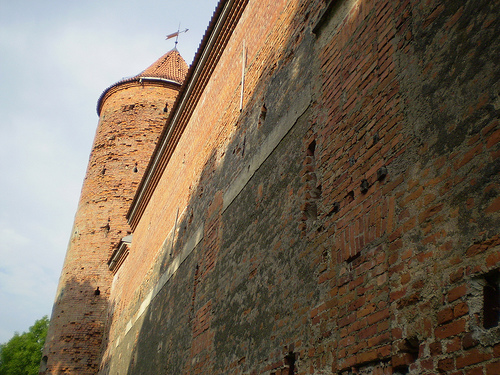
Panemunė Castle, also known as Panemunės pilis, stands on the right bank of the Nemunas River in Vytėnai, Jurbarkas district, Lithuania. It is widely regarded as one of the most authentic and best-preserved Renaissance residential castles in the country, blending defensive and residential functions in a picturesque riverside setting. The castle's origins trace back to the 14th century during the Lithuanian Crusade, when the Teutonic Order built a wooden fortress named Christmemel in 1313, which was captured by Grand Duke Vytenis in 1314 and repurposed as a residence. Over centuries, it evolved from a medieval defensive structure to a luxurious noble estate, reflecting shifts in ownership, military needs, and architectural trends. The current brick structure primarily dates to a major reconstruction between 1604 and 1610, commissioned by Hungarian nobleman János Eperjes (Janusz Eperyasz) and designed by Dutch architect Peter Nonhart, who also worked on the Vilnius Lower Castle Palace. Surrounded by parkland and lush forests, the castle harmonizes with its natural environment, emphasizing Renaissance principles of proportion and integration with the landscape.
Medieval Origins and Legends
The site's history traces back to the
medieval period, when the area along the Nemunas River served as a
strategic defensive zone for the Grand Duchy of Lithuania against
invading Teutonic Knights. Panemunė was part of a chain of early
fortresses built in the early 13th century to protect the duchy from
Prussian incursions. Local legends tie the location to Grand Duke
Vytenis of Lithuania (reigned 1295–1316), suggesting that his manor may
have stood on the castle grounds. According to folklore, Vytenis and his
wife Vikinda are buried in two mounds within the castle's park, which
were identified as such during the interwar period in the 20th century.
Another theory links the area to Vietotus (Vytenis), an early Grand
Duke, highlighting its role in the formation of Lithuanian statehood.
While archaeological evidence is limited, these stories underscore the
site's ancient significance as a Baltic tribal settlement and defensive
outpost.
Construction and the Eperjesz Era (17th Century)
The
modern castle's foundations were laid in the early 17th century, marking
a shift from medieval fortifications to a more residential structure. In
1597, the Panemunė Manor was sold by Samogitian nobleman Stanislovas
Stankevičius-Bilevičius to Hungarian nobleman and wood merchant Jonuš
Eperjesz (also spelled Eperješ or Eperyasz), who acquired the lands from
local Lithuanian inhabitants. Construction began around 1604, based on
designs by the renowned Dutch architect Peter Nonhardt (or Nonhart), who
incorporated Renaissance principles with defensive features like
surrounding walls and towers. The castle was built as a feudal residence
with military elements, including a territory enclosed by defensive
structures along the Nemunas. It featured a rectangular layout with four
corner towers, a central courtyard, and lavish interiors, making it a
masterpiece of Renaissance architecture in Lithuania.
The Eperjesz
family owned the castle for 158 years, from its construction until 1759,
during which it served as a symbol of noble prestige. This period saw
the castle evolve into a cultural and economic hub, benefiting from the
family's trade interests and the strategic location along the Panemunė
road, a vital trade route connecting Lithuania to East Prussia.
18th-19th Century: Reconstructions and Ownership Changes
In 1759, the
castle was sold to Antanas Gedgaudas (also Gelgaudas), the head of
Akmenė and a standard-bearer in the Grand Duchy, marking a new chapter
of enhancements. Under the Gelgaudas family, the castle underwent
significant reconstruction around 1759, transforming it into a more
opulent manor house with Baroque and Classicist interiors, including
intricate frescoes, stucco decorations, and a landscaped park with
cascading ponds. These changes reflected the shifting tastes of the
nobility, blending residential luxury with remnants of its defensive
past.
The 19th century brought turmoil. Antanas Gelgaudas, the last
private owner and a commander in the 1831 November Uprising against
Russian rule, was killed in battle, leading to the castle's confiscation
and gradual decline into ruins. Abandoned and neglected, it suffered
from lack of maintenance, though its architectural integrity remained
partially intact as one of the most authentic 17th-18th century
residential castles in Lithuania.
20th Century: Decline,
Expropriation, and Restoration
By the early 20th century, Panemunė
Castle had fallen into disrepair. In 1925, following Lithuania's
independence, it was expropriated by the state. Conservation efforts
began in 1939, with further restorations post-World War II. The castle
survived partial destruction during the war and was included in
Lithuania's register of cultural monuments in 1961. Official restoration
started in 1952 but progressed slowly, often jokingly compared to a
Guinness World Record for longevity due to bureaucratic delays and
funding issues. Scientific research on its history, including studies
from the 19th century onward, informed these efforts, focusing on its
role in the Nemunas River's brick castle network.
Modern Day:
Preservation and Cultural Significance
Today, Panemunė Castle is
fully restored and operates as a luxurious hotel, artist residence, and
cultural venue, attracting visitors for its historical exhibits, events,
and scenic park. It remains a key stop on the Panemunė Scenic Road, a
100km route dotted with castles and mansions that highlights Lithuania's
heritage and its role in preserving the Lithuanian language during the
19th-century Russian ban on printed Lithuanian texts. Environmental
studies emphasize its synergy with the surrounding landscape in Panemunė
Regional Park, viewing it as an entirety of cultural, historical, and
natural values. As a symbol of Lithuania's resilience, the castle
continues to evolve, hosting tours that delve into its layered past from
medieval defenses to Renaissance splendor.
Architectural Styles
The castle exemplifies Renaissance
architecture with prominent late Gothic elements, such as monumental
towers and facade proportions inherited from earlier defensive designs.
Its red brick construction, thick walls, and brick bonding techniques
are characteristic of Renaissance styles prevalent in the Dutch,
Flemish, and Polish influences of the era, creating a laconic yet
elegant aesthetic. Later renovations introduced Baroque and
Neo-Classical features, including dominant volumetric compositions and
decorative elements like console cornices, toothed gusts, and ornate
window surrounds. Interior wall paintings in the southern wing reflect
Classicism, Empire, and Biedermeier trends, adding layers of stylistic
evolution. Overall, the architecture mixes Gothic inheritance for
defense with Renaissance harmony, Baroque grandeur, and Classical
refinement, making it a transitional masterpiece that shifted from a
fortified dungeon to a representational palace.
Layout and
Structure
Panemunė Castle features a rectangular plan, originally
enclosed but later opened into a U-shaped configuration, a common
evolution in Lithuanian noble castles during the 16th-17th centuries to
prioritize residential comfort over pure defense. The core structure
consists of two main two-storey wings: the eastern residential wing for
the noble family and the northern utility wing (originally for outhouses
and services), connected by defensive walls on the southern and western
sides. Four-storey corner towers anchor the layout, providing both
defensive capabilities and visual symmetry—typical of Renaissance
palaces with corner towers inspired by European models. The ground floor
plans often included segmented housing, with arcades, embrasures in
defensive walls, and enclosures forming inner yards.
A significant
transformation occurred in the mid-18th century under Antanas Gelgaudas,
who demolished the northern wing to create a French-style cour
d’honneur—an open honor courtyard that transformed the closed defensive
enclosure into an inviting representational space. This courtyard,
framed by the remaining wings and towers, emphasizes grandeur and
accessibility, aligning with Baroque and Neo-Classical ideals.
The
southern wing was reconfigured for luxurious apartments, arranged in an
enfilade sequence: a dining room, antechamber, salons, ballroom, and
gallery, following French palatial examples. Defensive elements, such as
moats and high walls with shooting holes, were retained from earlier
phases but diminished in prominence as the castle's role shifted to
residential use.
Key Features
Towers and Defensive Elements:
The four corner towers are cylindrical or polygonal, with the main ones
serving observational and residential roles; for instance, a cylindrical
tower in the south facade and defensive towers in the northeast and
northwest. These towers feature crenellations added in later
restorations, and oak doors coated in metal plates for security. One
northeast tower was demolished in 1919 due to instability. The exterior
showcases robust red brick facades with Gothic proportions, Renaissance
decorative motifs, and Baroque volumetric emphasis.
Interiors and
Residential Spaces: Rooms feature natural ventilation through cracks,
windows, and channels, with historical heating via stoves or fireplaces
evolving to modern systems in restorations. The southern wing's
apartments include ornate wall paintings and enfilade layouts for flow
and representation. Surviving fragments from the 15th-century wooden and
brick manor indicate early luxury, with archaeological finds supporting
this.
Surroundings and Integration: The castle is set within a
landscaped park, with pathways and views of the Nemunas River, enhancing
its Renaissance harmony with nature. Historical baileys and foreworks
extended up to 1 km, though much has been lost.
Historical
Changes and Renovations
The castle's architecture has undergone
multiple phases of regeneration influenced by political, economic, and
social factors. Medieval wooden structures gave way to stone in the
15th-16th centuries, with a wooden manor amid ruins by the mid-1500s.
The 1604-1610 rebuild established the Renaissance core, preserved
through Eperjes family renovations. In 1759, Gelgaudas's changes
introduced French influences, widening eastern blocks and adding
Neo-Classical elements. 19th-century decline followed the 1831 uprising,
with seizures, fires, and partial collapses; Stanislovas Puslovskis
began restorations in 1867, halted by wars and land reforms.
20th-century efforts included minor conservation in 1939, interrupted by
WWII and Soviet occupation, leading to vandalism. Post-1950s,
adaptations for educational use occurred, with major restorations in
1958 (based on 1955 projects by historian Stasys Pinkus and architect
Žibartas Simonavičius) and 2012-2015, focusing on roofs, walls, facades,
and microclimate control using innovative methods like 3D modeling and
energy-efficient HVAC. These efforts preserved authenticity while
adapting for tourism.
Current State
Today, Panemunė Castle
functions as a museum under the Vilnius Academy of Arts, exhibiting
student works and offering accommodations in restored rooms. Two of the
four wings are fully restored, allowing visitors to explore its
historical layers. It remains a cultural landmark, balancing heritage
preservation with modern uses like events and tourism.