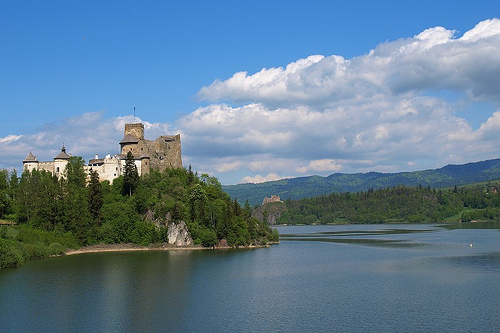
Location: Niedzica, Nowy Targ County Map
Constructed: 1320- 26
Castle Museum:
May- Sept: 9am- 7pm
Oct- Apr: 9am- 5pm Tue- Sun
Entrance Fee: 10 zl
Niedzica Castle, also historically known as Dunajec Castle, is a medieval fortress situated in the village of Niedzica-Zamek in southern Poland, within the Pieniny mountains. Perched at an elevation of 566 meters on a limestone hill overlooking the Dunajec River valley, it now stands about 30 meters above the artificial Lake Czorsztyn, created in 1994 by damming the river. Originally built as a border stronghold between the Kingdom of Hungary and Poland, the castle has served as a key defensive structure, customs post, and administrative center for centuries. Its strategic location guarded vital trade routes connecting Kraków and Budapest through the Dunajec valley, branching toward Lubovla and other regions. The castle's architecture evolved from a modest Gothic watchtower to a Renaissance residence, reflecting the influences of its successive Hungarian and Polish owners. Today, it functions as a museum and hotel, showcasing artifacts, historical rooms, and ethnographic exhibits from the Spiš region, attracting tourists with its picturesque views and rich lore.
Early Construction and 14th-Century Origins
The foundations of
Niedzica Castle trace back to the late 13th or early 14th century, when
it was established as a Hungarian border watchtower to protect against
Polish incursions and control commerce. The first documented mention
appears in 1325, listing it as the property of brothers Jan and Kokosz
(also spelled Rykolf) Berzevicz (or Berzevichy), descendants of Spiš
comes Rudyger from Tirol, who had colonized the surrounding lands in the
13th century. Kokosz of Brezovica is credited with erecting the initial
stone structure between 1320 and 1326 on the site of an ancient
earthen-walled stronghold. Some sources date the construction slightly
earlier, to 1308–1313 during the reign of King Charles Robert of
Hungary, emphasizing its role in safeguarding the northern Hungarian
frontier.
The early castle was modest: a promontory fortified with
timber buildings, a rock-cut rectangular water tank (about 3.4 by 7.9
meters), and possibly a stone residential tower or tower-like building
shielded by an earth rampart on the western side. An outer bailey,
enclosed by an earth rampart or palisade, housed stables, warehouses, a
smithy, and other economic facilities. This setup functioned as a
customs chamber and seat for the Spiš zupan (regional governor).
Around 1327, ownership shifted to Wilhelm Drugeth, a loyal court
official of King Charles, who initiated the first major expansion. He
replaced timber elements with stone, adding a perimeter wall (1.1–1.2
meters thick and 6 meters high with rounded corners and possible
battlements), a multi-level residential building (four floors, including
a rock-cut basement with three rooms and upper residential spaces heated
by fireplaces), and two gate portals (southern and southwestern, the
latter with drawbridge traces). A guard porch enhanced defenses. Drugeth
held the castle until his death in 1342, after which it reverted to the
king and was managed by castellans, such as Nicholas Berzethe in 1344.
In 1347, King Louis I of Hungary returned it to the Berzevicz family,
specifically to Henry, son of John (Kokosz's brother). Under their
stewardship in the second half of the 14th century, the castle saw
further enhancements: a two-storey residential wing in the southeast
(incorporating a chapel over the water tank with a rib-vaulted
presbytery, wooden-ceiling nave, and polychromes), a Gothic Hall above a
hypocaust stove, porches with semicircular arcades, and defensive wall
repairs (thickened to 80 cm in the northeast and raised to 12 meters).
Additional features included a northern latrine, an enlarged water tank
(repurposed as a crypt), a 60-meter-deep well, and an expanded outer
bailey with stone walls, a battlement, a quadrilateral gatehouse, a
half-round tower, and a timber bridge.
Medieval Period: Conflicts
and Ownership Transitions (Late 14th–15th Centuries)
Ownership passed
to Peter's son, Peter Berzeviczy, a prominent courtier under King
Sigismund of Luxembourg. He served as Spiš zupan and royal treasurer
from 1411 to 1432, and the castle became a hub for military activities.
In 1385 and 1410, it was a staging point for Hungarian expeditions
against Poland. Following the Hungarian defeat at Grunwald in 1410,
Polish King Władysław Jagiełło's forces pursued retreating Hungarians
from nearby Stary Sącz. A pivotal event occurred in 1412 at Niedzica,
where Polish emissaries received repayment of a 37,000 kop Prague
groschen loan from Emperor Sigismund, secured by 13 (later 16) Spiš
settlements as collateral—territories that remained under Polish control
until 1770 due to Hungary's failure to fully repay.
During the
1420s–1430s, Hussite raiders plundered nearby villages but spared the
castle. Peter died in 1425, and the castle went to his son Jan Schwarz.
By the 1460s, it became a pledge to the powerful Zápolya family, turning
hereditary after Jan's childless death in 1470. Emeric Zápolya
(grandfather of Polish Queen Barbara) and his brother Stefan (Hungarian
palatine) financed late Gothic expansions until 1487: the outer bailey
extended westward with a new oblique-entrance gatehouse, walls raised to
10–14 meters and thickened to 2 meters with a guard porch, a middle ward
courtyard with loopholes, a lower ward with a stone residential house
(10 x 22 meters, four floors), economic buildings, a 23-meter-deep well,
and a pebble courtyard. The upper ward gained a two-storey tower
superstructure, and an unfinished tunnel for a postern was attempted.
16th–19th Centuries: Renaissance Rebuilding, Wars, and Changing
Hands
The Zápolyas' era ended amid the Hungarian succession crisis
after King Louis II's death at Mohács in 1526. Jan Zápolya, vying
against Ferdinand Habsburg, granted Niedzica nominally to Hieronim Łaski
in 1528 for support, but Łaski besieged and captured it from defender
Stephen Potturniański. Habsburg forces retook it in 1529, but
raubritters (knight-robbers) seized it in 1533, leading to prolonged
skirmishes until 1535. After Hieronim's death in 1541, his son Olbracht
Łaski inherited it but pledged and sold it to the Horváth family in
1584–1589 due to debts.
Under Jan Horváth (1589–1611), the castle
underwent significant Renaissance modernization: dismantling lower ward
northwest walls for a new curtain and corner bastion with flanking fire
and loopholes, replacing the gatehouse with a horseshoe tower, adding a
small northern tower, and converting the Gothic Hall into a utility
space with a cellar and prison. During the Turkish invasions in the 16th
century, it briefly became a Polish protectorate. In the mid-17th
century, it was leased to the Italian-Hungarian Giovanelli family
(1670–1776), who allowed it to fall into disrepair. It was occupied by
anti-Habsburg Kuruc insurgents in 1683–1684 before imperial recapture.
After the Giovanellis' extinction in 1776, Andrew Horváth rebuilt the
residential sections.
In the 18th century, ownership returned to the
Berzeviczy family, including Sebastián Berzeviczy, whose adventures
inspired legends (detailed below). Renovations continued in the 15th,
16th, 18th, and early 19th centuries. By 1858, the Hungarian Salamon
family acquired it, holding it until 1945.
20th Century and
Modern Era
After World War I, Niedzica Castle became part of Poland.
The Salamon family, the last Hungarian inhabitants, abandoned it in 1943
as World War II fronts approached, with the last countess fleeing with
her children before the Red Army's arrival in 1945. Post-war, the Polish
state seized the estate, stripping the Salamons of rights.
Since the
1950s, the Association of Art Historians has managed it. A final
reconstruction, supervised by the Polish Ministry of Culture, was
completed in 1963, transforming it into a historical museum. The museum
features archaeological finds, masonry remnants, historical prints and
engravings, Spiš ethnographic exhibits, antique clocks,
18th–19th-century firearms, taxidermy, and a vast collection of
Hungarian-related materials (added in 1996 by former ambassador Ákos
Engelmayer, including maps and engravings of Hungarian kings and sites).
In 1994, the creation of Lake Czorsztyn altered the landscape,
submerging parts of the valley and requiring hill stabilization through
concrete reinforcements, substratum replacement, and surface protections
on the limestone-over-shale foundation. Ongoing monitoring ensures
stability. The castle has appeared in films and TV, and its lower ward
now includes guest rooms, while the upper ward offers preserved features
like the rock-carved well, Gothic Hall remnants, and Lord's Chambers
with period furnishings.
Niedzica Castle, also known as Dunajec Castle, is a medieval fortress
located in the village of Niedzica-Zamek in southern Poland, within the
Pieniny Mountains. Perched on a limestone promontory at an elevation of
566-572 meters above sea level, it overlooks the Czorsztyn Lake (formed
by the damming of the Dunajec River in 1994) and was strategically
positioned on the historical border between Poland and Hungary. The
castle was originally constructed between 1320 and 1326 by Kokos of
Brezovica (from the Hungarian Berzevicz family) on the site of an
earlier ancient stronghold fortified with earthen walls. Its
architecture reflects a blend of Gothic defensive elements with later
Renaissance modifications, evolving from a simple watchtower to a
complex residential and fortified structure. The site’s natural
defenses—a steep northern cliff originally dropping 80 meters to the
river valley and a gentler southwestern slope—played a crucial role in
its design, making it nearly impregnable.
The castle's hill
foundation consists of weather-resistant limestone rock layered over
shale and marl, which has required modern reinforcements, including
concrete injections, substratum replacements, and surface protections,
to stabilize it against erosion from the adjacent lake. Over centuries,
it served as a border outpost, customs point, and noble residence,
guarding key trade routes from Buda through the Poprad Valley to Kraków.
Ownership shifted among Hungarian nobles like the Drugeth, Berzevicz,
Zapolya, Łaski, Horváth, Giovanelli, and Salamon families, with periods
of neglect, sieges, and reconstructions shaping its form. The final
major restoration occurred post-World War II, starting in 1948, with
completion in 1963 under Poland's Ministry of Culture, transforming it
into a museum while preserving its historical integrity.
Historical Development and Phases of Construction
The architecture of
Niedzica Castle developed in distinct phases, adapting to defensive
needs, residential expansions, and changing ownership. Each stage
incorporated new materials and features while building upon the previous
layout, constrained by the narrow promontory site.
Initial Phase
(Late 13th to Early 14th Century)
Construction began at the end of
the 13th or start of the 14th century as a modest Hungarian watchtower.
The earliest structures were primarily timber-based, including
residential and economic buildings clustered at the hilltop. A key
feature was a rectangular rock-cut water tank (approximately 3.4 m by
7.9 m) hewn into the southeastern edge of the promontory for water
storage. Defensive elements included an earth rampart on the western
side and possibly a stone residential tower or tower-like house for
basic habitation. An outer bailey, likely encircled by an earth rampart
or wooden palisade, housed ancillary facilities like stables,
warehouses, and a smithy. The natural northern cliff provided inherent
protection, eliminating the need for extensive walls there.
Drugeth Expansion (Around 1330)
Under Wilhelm Drugeth, the castle was
significantly enlarged with stone fortifications. A perimeter wall,
1.1–1.2 meters thick and about 6 meters high with rounded corners and
possibly battlement crenellations, enclosed the upper ward. A
multi-story residential building (four floors) was added along the
western side: the rock-cut basement divided into three rooms for storage
(covered by a wooden ceiling), a ground floor for economic use with
three chambers, and two upper floors for living quarters, heated by
fireplaces or stoves. Access to the upper levels included a guard porch
along the defensive wall. Two gate portals pierced the walls—one
southern and one southwestern—with evidence of a drawbridge (rope marks
and timber blocks). A rock-cut shaft near the southern gate may have
served as a pit or emergency exit. The inner courtyard was established,
and the outer ward retained its earth rampart defenses.
Berzevicz
and Zapolya Period (1347–1470)
This era saw brick additions and
repairs, reflecting Gothic influences. The defensive wall was reinforced
(northeastern section 80 cm thick, others raised to about 12 meters) and
repaired after potential damage. The old water tank was enlarged, and a
deep well (approximately 60 meters) was carved into the northern wall
from solid limestone. A two-story southeastern residential wing was
built over the former tank, incorporating a chapel with a rib-vaulted
presbytery, flat wooden ceiling in the nave, and wall polychromes
(painted decorations). Above the basement, a "Gothic Hall" featured
possible hypocaust heating via wall channels. Facades included stone and
wooden porches with semicircular arcades. An entrance hall with a barrel
vault led to the upper ward courtyard via wooden stairs in a narrow
passage. A latrine was added in the northern section. The outer bailey's
earth defenses were upgraded to stone walls with battlements, and a
quadrilateral western gatehouse with a half-round open tower and timber
bridge connected to the upper ward.
Late Gothic Extensions (After
1470)
Under the Zapolya family, defenses were heightened amid
regional conflicts. Walls reached 10–14 meters high and 2 meters thick,
with loopholes (2 meters high, 80 cm wide) fitted with wooden covers for
archers. A new residential house (10 m x 22 m, four floors divided into
three rooms) enhanced living spaces. In the lower ward (formerly outer
bailey), a 23-meter-deep well was added. The upper ward saw limited
expansion due to space constraints, including a two-story tower
superstructure over the northern residential building, splitting the
former hall. An unfinished postern tunnel in the basement hinted at
escape routes. The lower ward expanded westward: the old western wall
and gatehouse were demolished, replaced by a new southern gatehouse with
an oblique entrance and long hall to the courtyard. A middle ward
emerged by connecting the half-tower to the old perimeter with a
perpendicular wall. The lower courtyard was pebble-lined, with a stone
residential house along the western curtain, timber outbuildings, and
enhanced bastions for flanking fire.
Horváth Reconstruction
(1589–1611)
The last major rebuild under Jerzy Horváth introduced
Renaissance elements, transforming it into a more palatial residence.
Northwest lower ward walls were dismantled and replaced with a new
curtain wall extending the Gothic residential house, plus a corner
bastion for improved flanking defense (leveled to perimeter height, with
ground-floor loopholes). The old gatehouse became a horseshoe tower, and
a small northern tower (with oven remnants, possibly a smokehouse) was
added at the upper-lower ward junction. A southwestern cannon tower
bolstered artillery capabilities. The entrance gate was relocated with a
reused Gothic portal, and the former entry hall converted to utility
space with a cellar and prison. A new defensive porch lined the inner
perimeter wall. This phase emphasized comfort alongside defense, with
arcaded residential wings around courtyards.
Subsequent periods saw
decline under the Giovanelli lease (17th century), partial rebuilds by
Andrew Horváth (late 18th century, including a ballroom), and ownership
by the Salamon family until 1945. Post-1945 Polish restorations focused
on preservation, adding museum spaces without altering the core
architecture.
Detailed Layout and Key Structural Elements
Niedzica Castle's layout is divided into upper, middle, and lower wards,
forming a densely packed complex on the irregular promontory. The
overall design features fortified stone and brick walls, towers,
bastions, and internal courtyards, with residential wings incorporating
arcades for circulation.
Upper Ward: The highest and oldest
section, accessible via a gate from the middle ward. It includes the
main residential buildings, such as the southeastern wing with the
Gothic chapel (featuring rib vaults and polychromes) and the "Lord's
Chambers" (hunting room, chamberlain's chamber, and guard's chamber,
furnished in 16th–19th-century styles). The courtyard here is edged by a
60-meter-deep limestone well. Dungeons beneath serve as cellars and
prisons, including a torture chamber. Towers include the northern
superstructure and small junction tower.
Middle Ward: Formed by
perpendicular walls connecting older structures, it acts as a
transitional defensive zone with flanking capabilities. It includes
parts of the perimeter wall and access to the upper ward via stairs and
halls.
Lower Ward: The largest area, entered via the main
southwestern gate and hallway. It features guest rooms around the
courtyard, a viewing terrace reached by wooden stairs, and economic
buildings like the western residential house and timber outbuildings.
Defensive elements include the horseshoe tower, cannon tower, corner
bastion, and loopholes for artillery. The courtyard is pebble-paved,
with a 23-meter well.
Key features across the castle include:
Walls and Fortifications: Thick stone and brick perimeter walls (up to 2
meters thick, 10–14 meters high) with battlements, loopholes, and
bastions for crossfire. Materials shifted from initial timber and earth
to durable stone and brick.
Towers and Bastions: Multiple towers
(e.g., horseshoe, cannon, northern) for observation and defense, often
with loopholes or ovens.
Courtyards and Arcades: Central courtyards
in each ward, surrounded by arcaded wings for sheltered movement; upper
courtyard with the deep well as a focal point.
Interiors: Surviving
rooms include heated halls, chapels with vaults, and museums displaying
original paintings (e.g., Crucifixion from the chapel) and furnishings.
Basements and dungeons are rock-cut for storage and imprisonment.
Gates and Entrances: Oblique and fortified gates with drawbridges,
portals (some Gothic-reused), and halls for controlled access.
Materials, Dimensions, and Evolution
Primary materials include local
limestone for foundations, wells, and rock-cut elements; stone for early
walls and buildings; and brick for later reinforcements and residential
additions. Dimensions vary: residential buildings like the western house
measure 10 m x 22 m; walls range from 80 cm to 2 m thick; wells reach
23–60 m deep. The architecture evolved from basic timber defenses
focused on border surveillance to sophisticated Gothic fortifications
with residential comforts, then Renaissance elegance emphasizing
aesthetics and artillery. This progression reflects adapting to warfare
changes (e.g., from arrows to cannons) while maximizing the site's
natural advantages. Today, much of the castle is in ruins, but preserved
sections like dungeons, rooms, and walls offer a glimpse into its
layered history, with ongoing stability measures ensuring its endurance.