Location: 5 miles (8 km) from Kętrzyn, Warmian- Masurian Voivodeship Map
The Wolf's Lair, known in German as Wolfsschanze and in Polish as
Wilczy Szaniec, was Adolf Hitler's primary military headquarters on
the Eastern Front during World War II. Located in the dense Masurian
forests near the village of Gierłoż (formerly Görlitz),
approximately 8 kilometers east of Kętrzyn (formerly Rastenburg) in
what was then East Prussia—now part of Poland's Warmian-Masurian
Voivodeship—this sprawling complex served as a central command hub
for Nazi operations, particularly the invasion of the Soviet Union
under Operation Barbarossa. The name "Wolfsschanze" derives from
Hitler's self-adopted nickname "Wolf," a reference to the Old High
German "Athalwolf" meaning "noble wolf," combined with "Schanze,"
which refers to a fortified redoubt or fieldwork rather than a
literal animal den. Hidden amid lakes, marshes, and thick woodland,
the site was chosen for its remoteness, natural defenses, and
proximity to the Soviet border, making it ideal for secretive
wartime planning.
At its peak, the Wolf's Lair housed between
2,000 and 3,000 personnel, including high-ranking Nazi officials,
military staff, secretaries, bodyguards, and support workers such as
food tasters to prevent poisoning attempts. Hitler spent more time
here than at any other command post—over 800 days from June 1941 to
November 1944—overseeing critical decisions that shaped the war,
including the Holocaust and the fate of occupied territories. The
complex symbolized the Nazi regime's paranoia and isolation, with
its massive bunkers reflecting a "dig-in" mentality as the war
turned against Germany.
Planning and Construction (1940–1941)
The origins of the
Wolf's Lair trace back to the preparations for Nazi Germany's
invasion of the Soviet Union, codenamed Operation Barbarossa. In
late 1940, following the successful Blitzkrieg campaigns in Western
Europe, Hitler and his high command recognized the need for a secure
eastern headquarters similar to the Felsennest (Rock Nest) used
during the invasion of France. Reconnaissance began in August 1940,
with the site selected for its strategic advantages: isolation amid
the Masurian woods, surrounded by lakes and marshes that provided
natural defenses, and proximity to the Soviet border while being far
from major roads, urban centers, and potential Allied bombing
routes. Accessibility was limited to a single railway line and a
small airstrip, enhancing security.
Construction commenced in the
fall of 1940 under the direction of the Organisation Todt, the Nazi
engineering group led by Fritz Todt (and later Albert Speer after
Todt's death in 1942). To maintain secrecy, the project was
disguised as a chemical factory named "Askania North," and
workers—primarily forced laborers from Poland and elsewhere—were
housed in nearby barracks under strict guard. The complex grew
rapidly between 1940 and 1944, eventually comprising over 200
structures: approximately 50 massive concrete bunkers, 70 barracks,
shelters, power plants, two airfields, a railroad station, and even
a tea house. Bunkers were engineered with walls up to 7 meters (23
feet) thick, reinforced with steel and concrete to withstand aerial
bombings, and camouflaged with vegetation and netting to blend into
the forest. Security was paramount, featuring three concentric
exclusion zones, countless guard posts, minefields spanning 10
kilometers, anti-aircraft guns, and a garrison of up to 2,000
personnel, including SS guards and military staff. The total cost
exceeded 36 million Reichsmarks (equivalent to hundreds of millions
in today's currency).
Use During World War II (1941–1944)
Hitler arrived at the Wolf's Lair on June 24, 1941, just two days
after the launch of Operation Barbarossa, marking the beginning of
the brutal Eastern Front campaign that would claim millions of
lives. The complex became his de facto residence and command center,
where he directed military operations, met with high-ranking
officials, and oversaw the war's progression. Key figures with
dedicated quarters included Luftwaffe chief Hermann Göring, SS
leader Heinrich Himmler, Propaganda Minister Joseph Goebbels, Party
Chancellery head Martin Bormann, Armaments Minister Albert Speer,
Chief of the OKW Wilhelm Keitel, Foreign Minister Joachim von
Ribbentrop, and others. Daily routines involved strategy meetings in
reinforced conference rooms, with Hitler often holding twice-daily
briefings on the front lines.
Beyond military planning, the
Wolf's Lair was a hub for genocidal policies. Discussions here
contributed to the escalation of the Holocaust, including the
coordination of death camps and mass executions. The site's
isolation allowed for unchecked decision-making, reflecting Hitler's
growing paranoia as the war turned against Germany. By 1943–1944,
with Allied advances in the West and Soviet gains in the East, the
complex was expanded further, but Hitler's health deteriorated—he
suffered from chronic illnesses and rarely left the bunkers. The
Wolf's Lair also hosted foreign dignitaries, such as Italian
dictator Benito Mussolini, who visited in 1941 and again in 1944
shortly after the assassination attempt.
The Assassination
Attempt: Operation Valkyrie (July 20, 1944)
The most infamous
event at the Wolf's Lair was the failed assassination attempt on
Hitler on July 20, 1944, part of Operation Valkyrie—a plot by
disillusioned German officers to overthrow the Nazi regime and sue
for peace. Led by Colonel Claus von Stauffenberg, a one-armed,
one-eyed veteran who had turned against Hitler due to the war's
atrocities and failures, the conspirators smuggled a bomb hidden in
a briefcase into a morning conference in Barrack 4 (a wooden
structure used due to ongoing reinforcements on Hitler's main
bunker). Stauffenberg placed the briefcase near Hitler and excused
himself before the detonation at 12:42 PM.
The explosion
destroyed the room, killing four people (including stenographer
Heinrich Berger and generals Rudolf Schmundt, Günther Korten, and
Heinz Brandt) and injuring over 20 others. Hitler survived with
minor injuries—eardrum damage, burns, and splinters—largely because
the bomb was moved away from him and the blast was dissipated by the
open windows and wooden construction. He emerged triumphant, viewing
his survival as divine providence, and broadcast a radio address
that evening to quash rumors of his death. In retaliation, over
5,000 suspected conspirators were arrested, and many executed,
including Stauffenberg, who was shot that night in Berlin. The site
of the blast, now marked by ruins with only the concrete floor
remaining, symbolizes the closest the internal resistance came to
ending Hitler's rule.
Abandonment, Destruction, and Post-War
Fate (1944–Present)
As the Soviet Red Army advanced westward in
late 1944, Hitler reluctantly abandoned the Wolf's Lair on November
20, 1944, retreating to Berlin and later his Alpine residence at the
Berghof. With the front lines collapsing, the Germans evacuated the
complex, and on January 24–25, 1945, SS units detonated massive
explosives—estimated at 200 tons of TNT—to demolish the structures
and prevent their use by the Soviets. The blasts cracked the immense
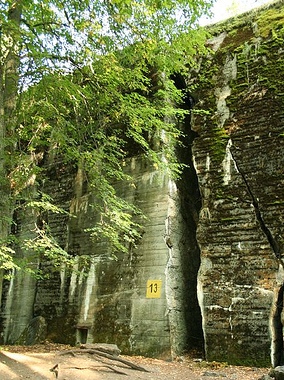
bunkers but did not fully destroy them, leaving behind a landscape
of shattered concrete monoliths overgrown with moss and trees. The
Red Army captured the ruins on January 27, 1945, finding them
largely intact but booby-trapped with mines, which claimed lives
during demining efforts.
After World War II, the area fell under
Polish administration as part of the post-war border shifts.
Initially neglected and dangerous due to unexploded ordnance, the
site was cleared in the 1950s and opened to the public in 1959 as a
historical monument. Today, the Wolf's Lair is a popular dark
tourism destination, managed as a museum by the Polish Forestry
Service. Visitors can explore the ruins via guided tours, view
exhibits on the site's history, and see remnants like Hitler's
bunker (Bunker No. 13), Göring's residence, and the assassination
site. It attracts over 300,000 tourists annually, serving as a
somber reminder of Nazi hubris, wartime atrocities, and the failed
resistance. Recent developments include educational programs and
debates over preservation versus allowing nature to reclaim the
ruins, emphasizing its role in Holocaust and WWII education.
Spanning about 6.5 square kilometers (approximately 1,600 acres), the
Wolf's Lair was a labyrinth of over 80 structures, including 50 bunkers,
70 barracks, shelters, two airfields, a railroad station, and support
facilities like a cinema, sauna, and firefighting pond. The bunkers were
constructed from steel-reinforced concrete up to 2 meters thick (with
some walls reaching 5-7 meters in high-security areas), designed to
withstand aerial bombings. Camouflage was extensive: roofs were covered
with grass, bushes, and artificial trees, while netting and painted
patterns blended buildings into the forest to evade Allied
reconnaissance. Construction costs for the bunkers alone exceeded 36
million Reichsmarks (equivalent to hundreds of millions in today's
euros). Expansions in mid-1944 added further reinforcements, but these
were left incomplete.
The layout was divided into three concentric
security zones for layered defense:
Sperrkreis 1 (Inner Zone):
The most secure area, fenced with steel and guarded by the SS
Reichssicherheitsdienst (RSD) and Hitler's personal bodyguard unit
(Führerbegleitkommando, or FBK). Only armed guards here were Hitler's
inner detail, who weren't searched. It included Hitler's massive
Führerbunker—a fortress-like structure with mazelike passages, living
quarters, and a conference room—as well as bunkers for key figures like
Martin Bormann, Hermann Göring, Wilhelm Keitel, Alfred Jodl, and Joseph
Goebbels. Other features: emergency generators, radio/telex centers,
garages, staff quarters (for physicians like Theodor Morell and
secretaries), a guest bunker, and a small cemetery.
Sperrkreis 2
(Middle Zone): Surrounding the inner zone, it housed barracks for Reich
ministers like Albert Speer, Fritz Todt, and Joachim von Ribbentrop,
along with additional personnel quarters.
Sperrkreis 3 (Outer Zone):
A fortified perimeter with minefields (over 54,000 mines laid),
watchtowers, checkpoints, anti-aircraft guns, tanks, and heavy weapons
manned by the Wehrmacht's Führerbegleitbrigade (FBB). Aircraft detection
radars covered up to 100 km, with additional troops stationed 75 km
away.
Security was obsessive: multiple guard posts, 10 kilometers
of minefields, and constant patrols. Despite this, the site was never
bombed by the Allies, who didn't discover it until 1945, and the Soviets
were unaware until early that year.
Life at the Wolf's Lair followed a rigid routine centered on Hitler.
Mornings involved dog walks (with his Alsatian, Blondi) around 10 a.m.,
mail review at 10:30 a.m., and midday military briefings (up to two
hours) in Keitel's or Jodl's bunkers. Afternoons included lunch,
non-military discussions, coffee, evening updates, dinner, and
late-night films or Hitler's monologues until 2-3 a.m. The humid,
mosquito-infested environment was uncomfortable, with Hitler rarely
venturing outside due to security fears.
Permanent residents included
Hitler's inner circle: Bormann (his private secretary), Göring
(Luftwaffe chief), Keitel and Jodl (military chiefs), and staff like
diplomats Walther Hewel and Hans-Erich Voss. Visitors ranged from Axis
leaders to collaborators, emphasizing its role in wartime diplomacy.
The Assassination Attempt: The 20 July Plot
The Wolf's Lair is
infamous for the failed assassination attempt on July 20, 1944, led by
Colonel Claus Schenk Graf von Stauffenberg as part of Operation
Valkyrie, a resistance plot to overthrow the Nazi regime. Stauffenberg,
citing hearing damage from Africa, placed a briefcase bomb near Hitler
during a briefing in a lightweight barrack (moved from a bunker due to
heat). The explosion at 12:42 p.m. killed four (including a
stenographer) and injured others, but Hitler survived with minor
wounds—shielded by an oak table leg and the barrack's thin walls
dispersing the blast. Stauffenberg and aide Werner von Haeften fled by
plane to Berlin to initiate a coup, but it failed when Hitler's survival
was confirmed. Conspirators were executed that night; survivors received
the Wound Badge of 20 July 1944. This event highlighted internal dissent
within the Wehrmacht.
Destruction and Post-War Fate
As the Red
Army advanced in the Vistula-Oder Offensive, Hitler departed on November
20, 1944, with Soviets just 15 km away. On the night of January 24-25,
1945, German forces demolished the site using tons of explosives (e.g.,
8,000 kg of TNT per major bunker) to prevent capture. The massive
structures were only partially destroyed due to their durability. The
Soviets occupied the ruins on January 27, 1945—the same day Auschwitz
was liberated—finding no resistance.
Post-war, Polish sappers cleared
over 54,000 mines and unexploded ordnance from 1945 to 1955. Under
communist rule, the site decayed, but since the 1990s, it has been
preserved as a historical monument.
Today, the Wolf's Lair is a popular tourist attraction managed by the Polish government, attracting nearly 300,000 visitors annually as of 2019. The ruins—crumbling concrete monoliths overgrown with moss and trees—offer guided tours highlighting the bunkers, assassination site, and historical context. Facilities include a hotel, restaurant, and conference room. Renovations started in February 2023 aim to enhance exhibitions, add an observation deck, and emphasize the site's role as a warning against totalitarianism, with completion expected by late 2024. Recent archaeological finds in 2024, such as skeletons under Göring's house (possibly from post-war burials), underscore ongoing discoveries. While educational, concerns persist about neo-Nazi visits, prompting efforts to contextualize the history responsibly.