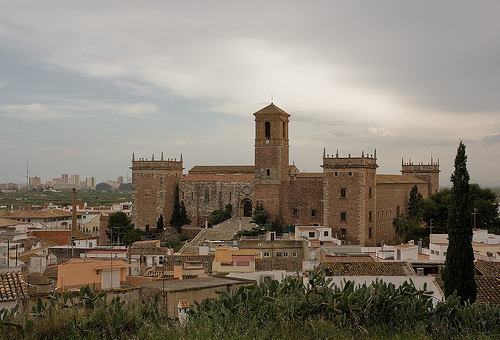
Location: El Puig, Valencia
Tel. 96 147 02 00
Open: Tue- Sat
The Monastery of Santa Maria, also known as the Royal Monastery of El Puig de Santa Maria, is a historic religious complex located in the town of El Puig, Valencia Province, Spain, at coordinates approximately 39°35′24″N 0°18′00″W. Founded in 1237 following the discovery of a revered Byzantine icon of Our Lady of the Angels (Nuestra Señora de los Ángeles), it serves as the sanctuary for the patron saint of the ancient Kingdom of Valencia and the residence of the Mercedarian monks. This imposing rectangular structure, flanked by four defensive towers, blends Gothic and Renaissance architecture, reflecting its evolution from a medieval church to a fortified convent. Declared a National Historic-Artistic Monument in 1969 and now a Bien de Interés Cultural (Property of Cultural Interest), it symbolizes Valencia's religious and historical heritage, attracting visitors for its art, architecture, and ties to figures like King James I and Saint Peter Nolasco. The monastery encompasses a Gothic sanctuary, Renaissance cloisters, museums, and royal chambers, offering a glimpse into centuries of devotion and artistry.
The origins of the Monastery of Santa Maria trace back to the
Reconquista period. In 1237, during the Christian conquest of Valencia,
Saint Peter Nolasco—founder of the Mercedarian Order—discovered a
7th-century Byzantine icon of the Virgin Mary hidden under a bell on the
hill of El Puig, which had survived the Muslim occupation since the 8th
century. This miraculous find prompted King James I of Aragon (Jaume I)
to order the construction of a church on the site in 1238, completed by
1240, to house the image and serve as a symbol of victory over the
Moors. The church was affiliated with the Mercedarian Order, established
in 1218 for the redemption of Christian captives. As pilgrimages grew
due to the Virgin's reputed favors, the original single-nave church
proved insufficient, leading to the construction of the current Gothic
church starting in 1300 and completed by the mid-14th century.
In
1588, under the design of architect Antón Dexado de la Cossa,
construction began on the Renaissance-style convent, completed in 1670,
to accommodate the Mercedarian community. The monastery played a role in
regional history, hosting royal visits and serving various purposes in
the 19th century, including military uses. It endured damage during the
Spanish Civil War (1936-1939), including the destruction of the original
Romanesque doorway and the Virgin's image, both of which were restored
post-war. Notable figures include King James I, who associated the site
with his conquests; Saint Peter Nolasco; and Father Jofré, founder of
the world's first psychiatric hospital, whose tomb is in the church.
Today, it remains an active Mercedarian monastery and a key cultural
site, preserved as a Bien de Interés Cultural since 1969.
The Monastery of Santa Maria exemplifies a fusion of Gothic and
Renaissance styles, forming a grandiose rectangular complex with a
defensive appearance, including four sturdy towers in Herrerian
style—the oldest being the southeast tower with a rectangular base. The
exterior features a large eastern door for access to the monastery and
Printing Museum, a 1666 lattice gate in the northeast, a barbican, and
an eastern ramp. The north wing includes a ladder to the restored
Romanesque church doorway, and the bell tower, with bells that chime
hours and summon for masses, is attached to the church.
The Gothic
church, built on the foundations of a Visigothic temple, has a
rectangular plan with three naves, ribbed vaults supported by pilasters,
and a square apse in the presbytery. The choir, started in 1669, is
enclosed by a 1514 forged grating. Chapels feature neoclassical coatings
from 1739-1745 on the Epistle side, with elements from Renaissance,
Neoclassicism, and Romanesque styles integrated throughout.
The
Renaissance convent, completed in 1670, centers around the Patio
Castrense—a sober, majestic courtyard of exposed ochre and reddish
brick, sloping to collect rainwater in a rock-hewn cistern. Two
cloisters provide serene spaces: the lower with 17th-century pictorial
works, accessing the Gothic hall, refectory, and community chapel; the
upper adorned with 17th-, 18th-, and 20th-century canvases, furniture,
liturgical vestments, and religious images, leading to royal rooms and
the church.
The monastery boasts numerous highlights, blending art, history, and
spirituality.
Church and Alta Mayor y Camarín: The church houses
exquisite Gothic tombs, such as those of Bernat Guillem d’Entença and
Father Jofré, along with religious images, altarpieces, and canvases.
The neo-Gothic altarpiece in the main chapel centers on the 7th-century
Byzantine icon of Our Lady of the Angels (rebuilt post-Civil War,
weighing 200 kg), surrounded by scenes from Jesus' life, Mercedarian
figures, and reconquest motifs. The Camarín de la Virgen features a dome
with frescoes by José Vergara (1726-1799), depicting the icon's legend
of concealment during Muslim invasion and discovery.
Gothic Hall:
Built on rodeno rock foundations, it displays facsimiles of historical
books, one of King James I's swords, statue sketches, a commemorative
medal, and one of the world's smallest books.
Refectory: Completed in
1670, it retains original furniture with sgraffito decorations of
enigmatic Latin initials and windows bearing Valencian nobility shields.
The pulpit incorporates a 14th-century cistern curb from Margarita de
Lauria's house.
Community Chapel: Originally the "Sala de profundis,"
this 18th-century Baroque space features Valencian school canvases
(e.g., "Christ" from Francisco de Vergara's school, "Virgen de la
Merced" by Vicente López), a Russian icon tabernacle door, a 3-meter
lamp with nobility shields, and 1774 Manises ceramic paintings of Saint
Joseph's life.
Museums and Halls: The Printing Museum showcases
historical printing artifacts. The Salón Real (Royal Hall), used by
monarchs, and the Hall of the Order of the Knights of El Puig feature
paintings by Vergara and Espinosa.
January 1 (Closed)
January 6: Visit at 12 noon (If it is Monday:
closed)
March 19: Visit at 12 noon (If it is Monday: closed)
Maundy Thursday (Morning visits only)
Good Friday (Closed)
June
24: Visit at 12 noon (If it is Monday: closed)
August 15 and 16:
Visit at 12 noon (If it is Monday: closed)
October 9 and 12: Visit at
12 noon (If it is Monday: closed)
November 1: Visit at 12 noon (If it
is Monday: closed)
December 6 and 9: Visit at 12 noon (If it is
Monday: closed)
December 24 (Morning visits only)
December 25
(Closed)
December 31 (Morning visits only)
Every holiday Monday
(Closed)
The Monastery of Santa Maria is open to visitors year-round, with guided tours recommended to fully appreciate its history and art. Located at C/ lo Rat Penat, 1A, 46540 Puig, it is accessible by car (near Valencia, about 15 km north) or public transport. Admission fees are modest (around €5-€7 for adults), including access to cloisters, church, museums, and halls; check the official website (www.monasteriodelpuig.org) for current hours, which typically include mornings and afternoons, closed Mondays. Tours last about 1-2 hours and are available in multiple languages. Tips: Wear comfortable shoes for uneven surfaces; photography is allowed without flash; visit early to avoid crowds, especially during religious festivals honoring the Virgin. Combine with nearby attractions like El Puig's beaches or Valencia's historic center for a full day. The site is partially accessible for those with mobility issues, but some areas involve stairs.