Location: Leon
Info: Carrasco 4
Tel. 987 42 42 36
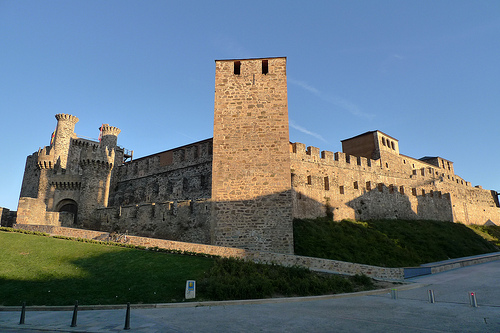
Ponferrada Castle is located in the Spanish city of Ponferrada, El Bierzo region, province of León. It stands on a hill at the confluence of the Boeza and Sil rivers.
Ancient Origins and Early Settlement
The site of Ponferrada
Castle in northwestern Spain has roots stretching back to
pre-Roman times. Originally a Celtic hill-fort or castro, it
later served as a Roman citadel, strategically positioned on a
hill overlooking the confluence of the Sil and Boeza rivers in
the El Bierzo region. This location provided natural defenses
and control over the surrounding valley, which was rich in
vineyards and resources like iron, as evidenced by a 928 AD
document gifting a nearby villa with iron deposits to the
Monastery of San Pedro de Montes. The area's name, Ponferrada,
derives from "pons ferrata" (iron bridge), referring to an
iron-reinforced bridge built in 1082 by Bishop Osmundo of
Astorga to aid pilgrims on the Camino de Santiago pilgrimage
route to Santiago de Compostela. This bridge facilitated safe
crossings over the Sil River, marking Ponferrada as a key stop
on the French Way of the Camino. By the late 11th century, the
site was refounded as a pilgrim station, evolving from its Roman
predecessor into a medieval settlement.
The Arrival of
the Knights Templar (12th Century)
The castle's medieval
history truly begins in 1178 when King Ferdinand II of León
granted the site to the Knights Templar, a powerful military
order founded during the Crusades to protect Christian pilgrims.
The Templars occupied an existing small fortress, expanding and
fortifying it to safeguard pilgrims from Muslim incursions and
local noble conflicts between León and Galicia. In 1187, they
began major fortifications, transforming the structure into a
formidable stronghold. By 1196, King Alfonso VIII had settled
the area for strategic attacks on nearby El Bierzo, and in 1211,
his successor Alfonso IX officially donated the town to the
Templars, making it their regional headquarters. By 1226, the
Templars had fortified the village and castle, completing key
expansions by 1282. The castle grew into one of the largest
fortresses in northwestern Spain, covering over 16,000 square
meters with a polygonal enclosure, double and triple
battlements, turrets, and a large courtyard. This period marked
the height of Templar influence, with the castle serving as a
defensive bastion on the Camino.
Decline of the Templars
and Transition (13th-14th Centuries)
The Templars' control
was short-lived. By the early 14th century, their immense wealth
and power aroused suspicion among European leaders, including
King Philip IV of France. In 1311, amid accusations of heresy
and corruption, Pope Clement V disbanded the order, leading to
the confiscation of their properties in 1312. The Templars had
enjoyed the castle for only about 20-30 years before losing it.
Legends persist from this era, including tales of the lost sword
of Jacques de Molay, the last Grand Master of the Templars,
supposedly hidden in the castle. In 1340, the lordship passed to
the Count of Lemos, marking a shift to secular ownership. The
castle continued to evolve, with expansions reflecting Gothic
military architecture.
Incorporation into the Crown and
Later Modifications (15th-19th Centuries)
In 1486, the
Catholic Monarchs, Ferdinand and Isabella, incorporated
Ponferrada and its castle into the Spanish Crown, consolidating
royal control amid the Reconquista's final phases. This ended a
period of noble disputes and integrated the site into broader
Spanish governance. The castle underwent further transformations
in the late 15th and early 16th centuries, including additions
to its square-plan enclosure and defensive features. By the 19th
century, it saw practical updates, such as the addition of
stables in 1848. Throughout this time, the structure remained a
symbol of medieval might, though its military role diminished as
Spain modernized.
Modern Era and Preservation (20th
Century to Present)
The 20th century brought numerous reforms
to preserve the castle's complex architecture, which blends
Romanesque, Gothic, and later elements from centuries of
modifications. Today, it is owned by the King of Spain and
serves as a major cultural site, housing a museum with Templar
artifacts, medieval exhibits, and a library. Recognized for its
historical significance, the castle attracts visitors interested
in Templar lore, the Camino de Santiago, and Spanish medieval
history. Its enduring legacy includes associations with mystery,
such as hidden Templar treasures, and it stands as a testament
to the order's brief but impactful presence in Spain.
In the castle enclosure, shaped like an irregular polygon, two
different parts can be distinguished: the northern part, from
the 12th century, and the rest, built throughout the 15th
century, with some works carried out in the 19th and 20th
centuries. In ancient times the castle was surrounded by a moat,
except in the northwestern part, where the river fulfilled the
same function.
Inside there is a group of 12th century
fortifications of Templar origin: the remains of a barbican at
the access to a patio, to which the elliptical tower opens, part
of the promenade, a tower that had three floors, the tower of
the Malvecino and another tower in which a pointed arch door
stands out, of great artistic value.
The northwest façade
constitutes a continuous parapet that ends in the Moclín tower,
with an irregular hexagonal plan. Below it a new ring opened
that defended the underground that linked the castle with a
cistern, located in a tower.
The main masonry façade is
made up of two towers that flank a wide semicircular arch.
Behind this arch stood the access doors to the patio where, to
the left, is the keep, from which you can access the parade
ground.
Before entering the patio there is a defensive
enclosure that leads to the Cabrera tower, located to the south
and connected to the first defensive line on the east side, at
the midpoint of which stands a semicircular tower, intended for
dungeons and communication with the second. defense line. The
facing continues towards the north, finding another square
tower, before accessing the Malvecino tower, from the 15th
century.
In the parade ground, attached to another
defensive line, there are several rooms, such as the Gallery of
Tiles, demolished and covered in rubble because in 1811 an order
from the Regency of the Kingdom ordered that the interior rooms
be blown up (the damage was not It must have been very large
because in 1815 a society ball was offered in its halls) and
since in 1848 the Ponferrada City Council, with the direct
opposition of the Ponferrada Monuments Commission, began to use
it as a local quarry and a thousand other felonies that
culminated in 1923 when its walls were blown up for the
construction of a sports field.