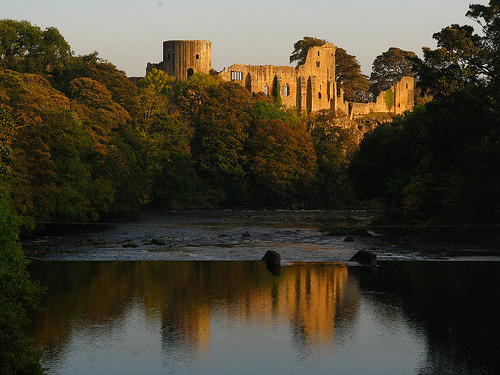
Location: Teesdale, County Durham Map
Constructed: 11th century
Barnard Castle is a ruined medieval fortress located in the market town of the same name in County Durham, northern England. Perched dramatically on a clifftop overlooking the River Tees, it commands a strategic position that has been significant since Roman times, guarding a key ford and ancient road crossing the Pennines. The castle spans about 2.5 hectares (6 acres) and represents one of the largest and most impressive medieval fortifications in northern England, evolving from a simple ringwork to a complex shell keep with multiple wards. Today, it stands as a picturesque ruin, managed by English Heritage, attracting visitors for its historical associations, architectural remnants, and scenic views. The surrounding town, also named Barnard Castle (often called "Barney" locally), developed in the castle's shadow and features Georgian architecture, antique shops, and a vibrant market tradition.
Origins and Construction
The site's history traces back to
the late 11th century, following the Norman Conquest. Prior to
1066, the upper Teesdale area was part of an Anglo-Norse estate
centered on Gainford. In 1095, after the breakup of the Earldom
of Northumberland by King William II (William Rufus), the
Lordship of Gainford was granted to Guy de Balliol, a Norman
knight from Picardy. Guy constructed initial earthwork and
wooden fortifications between 1095 and 1125 to guard a strategic
river crossing against potential Scottish incursions.
The
castle was rebuilt in stone during the early 12th century by
Bernard de Balliol (Guy's nephew or son, sources vary slightly),
who expanded it into a more formidable structure between 1112
and 1132. This reconstruction included a stone keep, curtain
walls, and multiple baileys (wards), creating a complex with
four baileys in total. Architectural highlights from this period
include the Balliol keep, a round tower, and later additions
like the Mortham Tower. The castle's design emphasized defense,
with its cliffside location providing natural protection on
three sides.
Medieval Ownership and Expansion
The
Balliol family held the castle for several generations,
cementing its importance in Anglo-Scottish affairs. Bernard's
successors, including Hugh de Balliol, maintained and expanded
it. In the 13th century, John de Balliol (son of Hugh) married
the wealthy Devorguilla of Galloway in 1268, boosting the
family's fortunes; Devorguilla was later buried with John's
embalmed heart at Sweetheart Abbey in Scotland. Their son,
another John de Balliol, became King of Scotland in 1292,
appointed by Edward I of England, marking the peak of Balliol
influence.
However, John Balliol's defiance of Edward I led
to his overthrow in 1296 during the Scottish Wars of
Independence. The castle was confiscated by the English crown
and granted to Guy de Beauchamp, 10th Earl of Warwick. The
Beauchamps held it for over a century, adding buildings and
strengthening defenses, including two notable constructions.
In the 15th century, the castle passed to Richard Neville, Earl
of Warwick (known as "Warwick the Kingmaker"), through marriage
to a Beauchamp heiress. After Neville's death at the Battle of
Barnet in 1471 during the Wars of the Roses, it was granted to
Richard, Duke of Gloucester (later King Richard III), via his
marriage to Anne Neville. Richard III added personal touches,
such as an oriel window in the great chamber carved with his
boar emblem.
Key Events and Conflicts
Barnard Castle
saw several sieges and rebellions, underscoring its strategic
value:
1216 Siege: During the First Barons' War following
Magna Carta, the castle was held by Hugh de Balliol for King
John. It was besieged by rebels led by Eustace de Vesci and
Scottish King Alexander II, but the siege ended when de Vesci
was fatally shot by a crossbow near the walls.
1536
Pilgrimage of Grace: In this northern uprising against Henry
VIII's religious reforms, rebels targeted the castle's keeper,
Robert Bowes (an ancestor of Queen Elizabeth II). Bowes
surrendered without resistance but later aided in suppressing
the revolt.
1569 Rising of the North: Catholic earls rebelled
to place Mary, Queen of Scots, on the throne. Protestant Sir
George Bowes fortified the castle with about 700 men and held
out for 11 days against a large force, despite desertions. His
surrender bought time for Elizabeth I's forces to crush the
rebellion, marking the castle's last military action.
These events highlight the castle's role as a border fortress
amid tensions between England and Scotland, as well as internal
English conflicts.
Decline, Ruin, and Modern Legacy
After Richard III's death at Bosworth in 1485, the castle
reverted to the crown and gradually fell into disrepair over the
next century, though it remained defensible into the 16th
century. In the early 17th century, the Vane family acquired it
and used its stone to enhance nearby Raby Castle, accelerating
its ruin—damage came more from dismantling than warfare.
By the 19th century, the romantic ruins became a tourist draw,
featured in Sir Walter Scott's 1813 poem Rokeby and visited by
literary figures like Charles Dickens (who researched Nicholas
Nickleby there in 1837–1838). The surrounding town developed
industries like wool weaving and thread manufacturing, and
cultural sites like the Bowes Museum (opened 1892) added to its
appeal, housing art collections and the famous Silver Swan
automaton.
In modern times, the castle gained unexpected
notoriety in 2020 when UK government advisor Dominic Cummings
claimed a trip there during COVID-19 lockdown was to "test his
eyesight." It remains a symbol of medieval power in the north,
with ongoing preservation efforts ensuring its historical
significance endures.
Barnard Castle's design reflects its evolution from a defensive
stronghold to a luxurious residence. It comprises four wards, enclosed
by curtain walls, rock-cut ditches, and natural cliffs, with access via
bridges and gates.
Inner Ward: The core, originally the ringwork,
now a shell keep on the clifftop. It features a stone hall (rebuilt
circa 1170–1185), great chamber (three stories, with Richard III's oriel
window overlooking the river and carved boar lintel), kitchens,
bakehouse, and the iconic Round Tower (circa 1200, three stories,
military and domestic use with fireplaces and garderobes). Other towers
include Mortham (14th century, with turret), Postern, Prison, and
Headlam (incorporating the original stone gatehouse).
Middle
Ward: South of the Inner Ward, functioning as a barbican with the
Constable Tower (three-story gate-tower) and a wet moat. It includes the
North Gate and Brackenbury Tower (rectangular, domestic with amenities,
named after Richard III's supporter Sir Robert Brackenbury).
Town
Ward: Northeast, with a courtyard, pond, well, postern gate, and towers
like Dovecote Tower (square, with nesting boxes for pigeons). It housed
a chapel dedicated to St. Margaret (mid-12th century, later a stable).
Outer Ward: The largest (about 1.5 hectares), south and east, enclosed
by walls and ditches; it fell out of use by the 14th century.
Defenses include the Great Ditch (rock-cut arc), outer ditches, arrow
loops in recessed arches, portcullises, and a demi-bastion. Materials
are primarily local stone, with barrel-vaulted basements and wall walks.
As a Grade I listed building and scheduled ancient monument, Barnard
Castle is preserved by English Heritage since 1984 (under state care
from 1952). The ruins are open to the public, offering insights into
medieval life through interpretive signs and events. Excavations
(1974–1982) revealed buried features like timber structures and farm
buildings. Its significance lies in its role as a northern stronghold
during turbulent periods like the Scottish wars and Wars of the Roses,
plus associations with figures like Richard III and the Balliols. The
adjacent town enhances its appeal, with landmarks like the octagonal
Market Cross (1747, used as a butter market and courthouse) and the
Bowes Museum (opened 1892, housing European art and the clockwork Silver
Swan automaton).
In modern culture, the site gained ironic fame
in 2020 when UK political advisor Dominic Cummings cited a drive to
Barnard Castle (the town) to "test his eyesight" during COVID-19
lockdown controversies, though this refers more to the locale than the
castle itself. Overall, it remains a testament to medieval engineering
and history, blending natural defenses with human ingenuity.