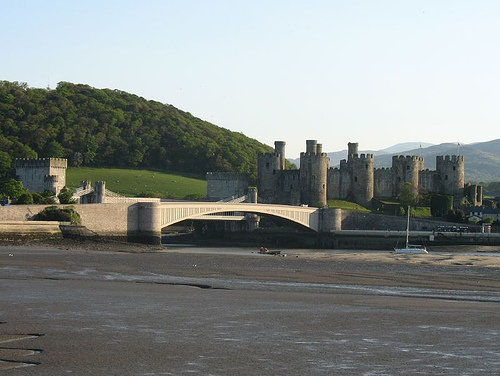
Location: Conwy, Wales Map
Tel. +44 1492 592358
Admissions: £4.70- Adult
£14.00- family
Open: 1st Apr.- 31st Oct. 9 am- 5pm daily
1st Nov.- 31st Mar. 9:30 am-4 pm Mon- Sat.
11 am- 4 pm Sun
Conwy Castle (Castell Conwy), situated on a rocky coastal ridge overlooking the River Conwy estuary in Conwy, North Wales, is one of the most magnificent and best-preserved medieval fortresses in Europe. Built between 1283 and 1289 by King Edward I of England as part of his campaign to conquer and subjugate Wales, it forms a key component of his "iron ring" of castles designed to encircle and control the region. The castle, along with its integrated town walls, was constructed at a staggering cost of around £15,000 (equivalent to millions today) and exemplifies late 13th-century military architecture. Recognized as a UNESCO World Heritage Site since 1986 as part of the "Castles and Town Walls of King Edward in Gwynedd," it includes Beaumaris, Harlech, and Caernarfon. Today, managed by Cadw (the Welsh government's historic environment service), the castle attracts over 180,000 visitors annually, offering restored battlements, royal apartments, and panoramic views of the estuary and Snowdonia mountains.
Foundation (Late 13th Century)
The site of Conwy Castle was
strategically significant long before its construction. It overlooked a
vital crossing point over the River Conwy between the coastal route and
the mountainous interior of Snowdonia (Eryri), previously defended by
the Welsh hillfort of Deganwy Castle. From the 12th century, it housed
Aberconwy Abbey, a Cistercian monastery founded by Llywelyn the Great
(Llywelyn ap Iorwerth) in 1198 and favored by Welsh princes as a symbol
of their authority.
Edward I's invasion of Wales in 1282–1283 marked
a turning point. After defeating Llywelyn ap Gruffudd (the last
independent Prince of Wales) in 1282, Edward captured Aberconwy in March
1283. To assert English dominance, he relocated the abbey and its monks
8 miles upstream to Maenan (at a cost of £666) and repurposed the site
for a new castle and bastide town. This move symbolized the transfer of
power from Welsh ecclesiastical and princely authority to English royal
control. Work on the castle began almost immediately, with Edward
personally overseeing initial plans during his stay in the area from
April to June 1283. The foundation was part of Edward's broader strategy
to create a network of fortifications and English-settled towns to
pacify North Wales following the Treaty of Aberconwy in 1277 and the
subsequent rebellions.
Construction (1283–1289)
Construction
was remarkably swift, completed in just four to six years (1283–1287 for
the main works, with final details by 1289), under the direction of
Master James of St George, Edward's chief architect from Savoy
(modern-day France/Switzerland). James, who had worked on Savoyard
castles, brought innovative designs to Conwy. The project was overseen
by Sir John Bonvillars initially, with a massive workforce of up to
1,500 laborers, masons, and craftsmen recruited from across England and
assembled at Chester each summer. Materials included local grey
sandstone and limestone, with colorful sandstone accents from Creuddyn,
Chester, and the Wirral.
The first phase (1283–1284) focused on the
outer curtain walls and towers for defensibility. The second phase
(1284–1286) added interior buildings and the 1.3 km (0.8 miles) town
walls with 21 towers and three gates. By 1287, the great hall's north
wall was heightened for a lead roof. The total cost of £15,000 made it
one of Edward's most expensive Welsh projects. A royal charter in 1284
established the English borough of Conwy, granting privileges to
settlers while excluding Welsh inhabitants.
Architectural
Developments
Conwy Castle is a masterpiece of medieval military
architecture, blending defensive prowess with residential luxury. Its
rectangular layout (approximately 350 by 150 feet) is divided into an
Outer Ward (for garrison and services) and an Inner Ward (for royal
apartments), separated by a cross-wall with a gate. Eight massive
towers, each about 70 feet (21 meters) high, flank the curtain walls,
originally whitewashed for visibility. The walls feature Britain's
earliest surviving stone machicolations (overhanging defenses) and arrow
slits for crossbowmen.
The main entrance is via a western barbican
with a drawbridge over a rock-cut ditch, protected by a portcullis and
murder holes. The Outer Ward includes the great hall (with a later
stone-arched roof), chapel, kitchens, and service buildings like the
bakehouse and brewhouse. The Inner Ward houses the best-preserved set of
medieval royal apartments in Wales, including Edward I's chambers, a
great chamber, and a private chapel with stained glass. An eastern
barbican encloses a garden with a postern gate to a river dock for sea
supplies. Savoyard influences are evident in window designs,
crenellations, and putlog holes. The integrated town walls, with 21
semicircular towers, form a complete defensive circuit.
Economic
Activities and Daily Life
Conwy served as an administrative center,
with the constable doubling as mayor of the English borough. The
garrison initially comprised 30 men, including 15 crossbowmen, plus
specialists like a chaplain, blacksmith, and engineer. It functioned as
a supply depot, prison, and occasional royal residence. The town walls
enclosed a planned settlement for English colonists, promoting trade and
excluding Welsh locals. By the 14th century, maintenance issues arose
due to rot and leaks, reflecting the challenges of remote
administration.
Decline and Challenges (14th–17th Centuries)
In 1294–1295, during Madog ap Llywelyn's rebellion, Edward I was
besieged at Conwy but resupplied by sea until relief forces arrived.
Edward II visited in 1301. By 1321, the castle was in disrepair; Edward
the Black Prince ordered repairs in 1343, including stone arches for the
great hall. In 1399, Richard II sought refuge there before his capture
by Henry Bolingbroke's forces.
During Owain Glyndŵr's revolt, the
castle was captured in 1401 by Rhys and Gwilym ap Tudur (ancestors of
the Tudor dynasty) in a surprise attack; they held it for three months
before surrendering on terms. It saw little action in the Wars of the
Roses but was reinforced. Under Henry VIII, it served as a prison and
depot, with repairs in the 1520s–1530s.
In the English Civil War
(1642–1651), Conwy was a Royalist stronghold under Archbishop John
Williams. It was besieged by Parliamentary forces under General Thomas
Mytton and surrendered in November 1646. In 1655, it was slighted to
prevent reuse, and in 1665, remaining valuables were stripped, leading
to ruin.
Post-Medieval History (18th–20th Centuries)
In the
18th and 19th centuries, the romantic ruins attracted artists like
Thomas Girtin and J.M.W. Turner. Infrastructure developments, including
Thomas Telford's 1826 suspension bridge and Robert Stephenson's 1848
tubular railway bridge, boosted tourism. Civic leaders took ownership in
1865, reconstructing the Bakehouse Tower. In 1953, it was leased to the
Ministry of Works; historian Arnold Taylor's research in the 1950s–1960s
confirmed James of St George's role. UNESCO designation in 1986
highlighted its global significance.
Current Status
Conwy
Castle is managed by Cadw and remains exceptionally well-preserved, with
restored spiral staircases allowing access to battlements for a circuit
walk. A new visitor center opened in 2012, and ongoing maintenance
(e.g., £30,000 repairs in 2002–2003) addresses erosion. It is a Grade I
listed building and Scheduled Monument, hosting exhibitions, events, and
art installations. Visitor numbers peaked at 186,897 in 2010, and it
remains a symbol of Welsh heritage and English conquest.
Overall Layout and Site Planning
The castle's layout exploits the
natural topography of a narrow, elongated rocky ridge, forming a roughly
rectangular plan approximately 125 meters (410 feet) long east-west and
35 meters (115 feet) wide north-south, aligned with the coastline. It is
divided into two main enclosures: the larger western Outer Ward (about
50 x 30 meters/164 x 98 feet) for administrative, service, and garrison
functions, and the smaller eastern Inner Ward (25 x 22 meters/82 x 72
feet) as a secure royal enclave. A thick cross-wall with a gatehouse and
drawbridge over a rock-cut dry moat separates the wards, allowing the
Inner Ward to function independently during sieges. Natural defenses
include steep cliffs dropping to the River Conwy on the east and the
Gyffin stream on the south, supplemented by a rock-cut ditch on the
north and west sides.
Access is controlled via two barbicans: the
western (main) entrance from the town, approached by a ramp and
drawbridge, and the eastern barbican leading to a garden and water gate
for river access. The castle integrates with Conwy's 1.3 km (0.8 mile)
circuit of town walls, connected at the southwest and northwest towers,
creating a fortified complex enclosing the settlement. This concentric
design, with towers projecting outward for flanking fire, emphasizes
defense while incorporating domestic spaces. The site's elevation
provides commanding views, and a 27.7-meter-deep (91-foot) well in the
Outer Ward ensured water supply.
Key Structures: Towers, Halls,
and Barbicans
Conwy's architecture centers on eight massive round
towers, each about 21 meters (70 feet) high with walls up to 4.6 meters
(15 feet) thick, arranged four per ward for symmetry and defense. These
towers, slightly battered at the base for stability, include spiral
staircases, multiple levels of arrow slits (at staggered heights for
cross-fire), and upper turrets for watchmen. Named towers reflect
functions: Northwest Tower (porter's lodge and stores), Southwest Tower
(bakehouse and constable's quarters), Kitchen Tower (pantry and
latrines), Prison Tower (with a 3.1-meter-deep/10-foot dungeon),
Stockhouse Tower (storage), Bakehouse Tower (kitchen and ovens), King's
Tower (servants' rooms), and Chapel Tower (private royal chapel with
rib-vaulted presbytery and tracery window).
The Outer Ward features
the Great Hall, an L-shaped structure along the south wall with a high
timber roof (replaced by stone arches in the 1340s), fireplaces, and
Gothic windows for feasts and assemblies. Adjacent is a chapel with a
niche altar and blind arcades. Service ranges include kitchens,
brewhouses, and stables (now foundations). The Inner Ward houses royal
apartments on the first floor: a great chamber, outer chamber, and inner
chamber with fireplaces, connected passages, and latrines. A
half-timbered granary and well occupy the courtyard.
Barbicans
provide layered defense: the western barbican has twin semi-circular
towers flanking a gate with portcullis, murder holes, and Britain's
earliest surviving stone machicolations (projecting galleries on corbels
for dropping missiles). The eastern barbican, with semi-circular towers
and machicolations, protects the garden and water gate stairs to a small
dock for resupply.
Architectural Styles and Evolution
Conwy
exemplifies late 13th-century military architecture with Savoyard
influences from James of St George's background, seen in crenellated
battlements with triple-pinnacled merlons, window designs, and putlog
hole placements (inspired by sites like San Giorio di Susa). Gothic
elements include pointed arches, ogival windows, tracery (e.g., St.
Andrew's cross motifs), and rib vaults in chapels. The design
prioritizes functionality: narrow slits for defense, larger mullioned
windows in private areas for light, and corbelled latrines.
Evolution
began with rapid construction in phases: exterior walls and towers
(1283-1284), interiors and town walls (1284-1286), completed by 1287.
The 1340s saw repairs under Edward the Black Prince, adding stone arches
to the Great Hall. Neglect in the late 14th century led to decay, but
Henry VIII restored it in the 1520s-1530s as a prison and depot. Civil
War adaptations in 1646 included slighting (demolishing roofs and
interiors), with full ruination in 1665 when materials were stripped.
19th-century romantic interest prompted Bakehouse Tower reconstruction;
20th-century conservation by the Ministry of Works (from 1953)
stabilized structures and added access features like restored spiral
stairs.
Materials and Construction Techniques
Built from local
grey sandstone and limestone quarried from the ridge during site
leveling, with colorful imported sandstone from Creuddyn, Chester, and
Wirral for decorative elements like portals and windows. Walls feature
rubble cores with ashlar facing, originally lime-rendered white for
weatherproofing. Construction involved 1,500 workers annually, using
scaffolding (evidenced by putlog holes) and ramps for stone transport.
Brick secured latrine outlets; iron bars and wooden shutters protected
windows. Roofs were lead-covered timber; vaults used stone ribs. The
rapid build (four years) reflects efficient organization, with defenses
like machicolations on multi-tiered corbels.
Notable Features and
Historical Modifications
Standout features include the machicolations
(earliest in Britain), the best-preserved medieval royal apartments in
England and Wales (designed as a sealable palace with sea access), and
the integrated 1.3 km town walls with 21 towers and three gates. The
garden evolved from a 14th-century lawn to 16th-century orchards.
Modifications include 1340s hall arches, 15th-century strengthening
during the Wars of the Roses, and Civil War damage (Bakehouse Tower
partially destroyed). Post-1665 ruination stripped valuables, but
19th-20th-century restorations preserved the fabric without major
alterations.
Current State as a Preserved Site
Conwy Castle
remains exceptionally intact, with curtain walls, towers, and
battlements standing nearly full height, though roofless in most areas.
Restored spiral staircases allow a complete battlement circuit, offering
views of Snowdonia and the estuary. Managed by Cadw as a Grade I listed
monument and World Heritage Site, it includes an exhibition, gift shop,
and venue hire. Accessibility features address uneven terrain, with
ongoing conservation combating erosion. It draws over 200,000 visitors
annually, symbolizing Edwardian military prowess.