Location: Bodelva, St. Austell Map
Tel. 01726 811911
Open: Apr- Oct: 10am- 6pm daily
Nov- Mar: 10am- 4:30pm daily
Closed: 24, 25 Dec
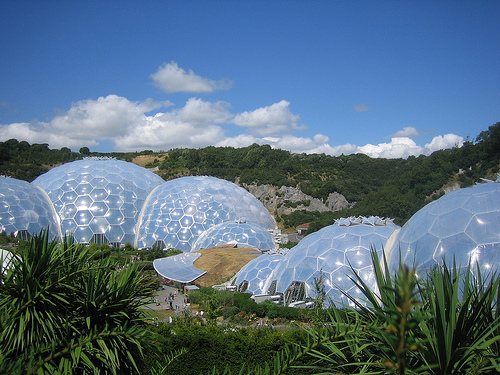
The Eden Project is one of Britain’s most striking regeneration stories: a 160-year-old exhausted china clay pit turned into a living theatre of plants, people and ideas. It sits at Bodelva, near St Austell in mid-Cornwall, in a crater about 60 metres deep and the size of roughly 35 football pitches. The pit sits 15 metres below the water table. In 2026 it marked 25 years since the full site opened.
The clay pit before Eden
China clay (kaolin) extraction around St
Austell began in the early nineteenth century. Bodelva Pit opened around
1825; the neighbouring Carvear workings were recorded as active by 1827.
The two pits later merged. The clay here was often pink-stained, which
limited some ceramic markets but suited newsprint; the Financial Times
famously printed on pink paper. Work continued for more than 160 years.
By the mid-1990s the pit was economically exhausted, a sterile lunar
landscape of white spoil, unstable slopes and no soil. In 1981 the BBC
even used it as the surface of Magrathea in The Hitchhiker’s Guide to
the Galaxy.
Cornwall’s last working tin mine closed in 1998. The
county was among the poorest parts of Western Europe. That economic
vacuum is part of why Eden’s later impact on jobs and tourism mattered
so much.
Conception: Heligan, a napkin and a “lost world”
Tim
Smit, an archaeologist and former music producer, had already helped
restore the Lost Gardens of Heligan in the early 1990s. While doing that
work he became fascinated by stories that linked plants to human lives.
He wanted a much larger stage: a place that would show the plants people
depend on every day but rarely see growing. Architect Jonathan Ball
became co-founder.
Smit has said the crater itself was the spark.
Driving the A30 he saw the ochre clay heaps in sunset light and thought
of Arthur Conan Doyle’s The Lost World: a lost civilisation in a
volcanic crater. The first biome sketches were drawn on a napkin in a
pub in October 1996. Nicholas Grimshaw’s practice took the idea on,
initially thinking in terms of their Waterloo International terminal,
then shifting to interlocking geodesic “bubbles” that could settle on
the irregular floor and walls of a quarry. Bubbles, they realised, do
not need a flat site.
The project was framed as one of the UK’s
Landmark Millennium Projects. The mission, still used today, is to
promote understanding of the relationship between plants, people and
resources and to inspire positive action.
Funding and design
The Millennium Commission awarded a major grant (figures cited in
contemporary sources range around £37.5–£56 million depending on how
match funding is counted). The rest came from the EU, the South West
Regional Development Agency, banks, sponsors and private support. Total
creation cost is commonly given around £80–140 million depending on what
is included. Construction started at risk before all money was locked
in. Finance director Gaynor Coley (later managing director) was central
to securing the match funding that released the lottery grant in 2000.
Key design and build team:
Architects: Grimshaw
Structural
engineers: Anthony Hunt Associates
Services: Arup
Construction:
Sir Robert McAlpine / Alfred McAlpine joint venture
Biome steel and
geometry: MERO
ETFE cushions: Vector Foiltec
Landscape masterplan:
Land Use Consultants (Dominic Cole’s outdoor gardens remain a major part
of the site)
The two covered biomes are geodesic steel frames
clad in inflated ETFE foil cushions (hexagons and pentagons). ETFE is
far lighter than glass, transmits more light, and the cushions act as
insulation. There are no internal columns. The Rainforest Biome is about
240 m long, 110 m wide and 55 m high (large enough to contain the Tower
of London). The Mediterranean Biome is smaller. A planned desert biome
was never funded.
Construction: rain, soil and “sky monkeys”
Work on site began in late 1998. The first months were among the wettest
on record. Some 43 million litres (or gallons, depending on the source)
of rain poured into the pit. Engineers built a large subterranean
drainage system that still harvests rainwater for the site. The pit had
to be reshaped, slopes stabilised and structural embankments built to
carry the biomes. About 230 miles of scaffolding went up, a Guinness
World Record “birdcage.” Abseilers nicknamed the Sky Monkeys fitted the
ETFE pillows.
They refused to import topsoil. With Reading University
they manufactured more than 83,000 tonnes of soil from local mine waste
(sand and clay) plus composted bark inside the biomes and green waste
outdoors. That decision became part of the story: regeneration from
waste.
The visitor centre opened in May 2000 so the public could
watch the “big build.” About half a million people paid to see
construction. First plants arrived in September 2000. Many were grown
from seed in Eden’s own nursery.
Opening, 17 March 2001
The
full site opened on 17 March 2001 in Cornish mist that cleared at dawn.
The Times called it the eighth wonder of the world. It drew 1.8 million
visitors in the first year and more than a million in the first four
months. The outdoor gardens, biomes and the idea of a “living theatre of
plants and people” were in place from the start.
The site later
appeared as Gustav Graves’ ice palace in the James Bond film Die Another
Day (2002).
Growing into an institution
2001 onward – Eden
Sessions. Pulp played the first concert. Later line-ups included Oasis,
Amy Winehouse, Kylie, Elton John, Björk and many others. The setting
(half Glastonbury, half Glyndebourne, as one paper put it) became a
fixture of the British summer.
2005 – The Core. The education centre
opened, its timber roof derived from phyllotaxis (the spiral geometry of
sunflowers and pine cones). Queen Elizabeth II formally opened it the
following year. The copper roof came from a Rio Tinto mine chosen for
higher social and environmental standards.
July 2005 – Live 8, Africa
Calling. Angelina Jolie, Youssou N’Dour, Peter Gabriel and a live link
to Nelson Mandela. About 30,000 people attended.
June 2007 – Seed.
Peter Randall-Page’s 70-tonne granite sculpture, carved from a single
block of Cornish granite from Bodmin Moor and based on the same growth
geometry as the Core roof, was craned into the building.
2009 – The
Big Lunch. Eden launched a nationwide community meal that became an
annual UK tradition.
Other landmarks: first titan arum bloom (2005),
rainforest lookout and later canopy walkway (2010–2017), Invisible
Worlds exhibition in the Core (2018), Nature’s Playground (2023). A
desert biome bid failed in a 2007 lottery public vote.
The site has
weathered floods (notably 2010 and landslips in 2020 during Covid
closures) and financial tight years, but visitor numbers and economic
impact kept growing.
Energy, education and a wider movement
Eden always presented itself as more than a garden. It runs school
programmes (hundreds of thousands of children over the years), degree
courses with Cornwall College and Plymouth University, apprenticeships
and research. A primary school and nursery opened on the outer estate in
2022.
In May 2021 drilling started for a deep geothermal well into
the granite. In June 2023 the UK’s first new operational deep geothermal
heating plant since 1986 came online. The well is about 5 km measured
depth. Heat at around 85°C now supplies the biomes, offices and the
Growing Point nursery, cutting gas use sharply and saving hundreds of
tonnes of CO2 a year. A second well for electricity remains a
longer-term ambition.
Eden Project International, launched in 2017,
has pursued sister projects on damaged land elsewhere (Morecambe in
Lancashire is the best-known UK proposal; other sites have been
discussed in China and beyond). In 2021 Eden hosted G7 leaders, the
Queen and the then Prince of Wales.
Impact after 25 years
By
2026 Eden had welcomed more than 25 million visitors, the large majority
from outside Cornwall. Impact studies for the anniversary put net
additional economic benefit to Cornwall at about £5.7 billion and a
larger figure for the South West, with hundreds of jobs supported each
year and more than a million people reached through schools programmes.
It is an educational charity and social enterprise, not a conventional
commercial theme park.
The outdoor gardens (around 28 acres of
designed landscape plus a much larger estate) now hold thousands of
species and cultivars and joined the RHS Partner Garden scheme in 2026.
Horticulture director Peter Jones has argued those outdoor landscapes
deserve as much attention as the famous bubbles.
The core idea has
not changed: take a place written off as finished, make soil from waste,
grow the plants that feed, clothe, heal and house us, and use spectacle
so people remember the story. The biomes are the postcard. The history
is the conversion of a dead industrial hole into a working argument that
regeneration is possible.
How to get there
Address: Eden Project, Bodelva, St Austell,
Cornwall PL24 2SG.
By car: well signposted from the A30 (Exeter
direction) and the A390/A391 from Plymouth. Free on-site parking. EV
chargers (22 kW AC, Mer Connect app) sit in Banana Car Park;
peak-season stay is limited to 4.5 hours. No overnight parking. From
the upper car parks you walk down into the pit or use the
park-and-ride bus when it is running (it is not always in service).
By public transport: St Austell station is on the London
Paddington–Penzance main line. Buses 28 and 31 (Transport for
Cornwall / Go Cornwall Bus) link the station and surrounding towns
to Eden. Arrive by train, bus, bike or on foot and you can claim a
free Eden guidebook (and a children’s guide if you have
5–16-year-olds) as a green-travel incentive. Cycle racks are
available.
Tickets and opening hours (as of early September
2026)
Pre-book a timed-entry ticket online. Arrive within 30
minutes of your slot; you can then stay until closing. School
holidays fill quickly.
Typical 2026 day prices (online / on the
door):
Adult 16+: £35.50 / £39.50
Student with ID: £32 /
£35.50
Child 5–15: £12.50 / £15
Under-5s: free (up to four per
adult)
Carers / personal assistants: free
A general ticket
is also treated as an annual pass, so a second visit within 12
months is included. Cornwall and Devon residents can buy a cheaper
Locals’ Pass. Discounts exist for Universal Credit / Pension Credit
holders (bring proof). Gift Aid on a full-price ticket can be
worthwhile if you are a UK taxpayer.
Early September 2026 hours:
site gates 9.45 am, ticket desks 10 am, last entry 3.30 pm, close 5
pm (hours shorten further in late September–October and lengthen
again for Christmas Lights evenings). Biomes open 30 minutes after
ticket desks and last entry is 30 minutes before site close. Closed
25 December and for short maintenance windows in January–February.
Check the live calendar.
What to see
Rainforest Biome
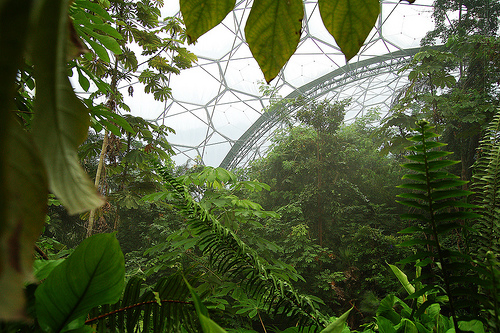
The larger dome (about 50 m high, 16,000 m²) holds one of the
world’s biggest indoor rainforests: more than 1,000 species from SE
Asia, West Africa and tropical South America. Expect heat and
humidity (often 21–35 °C). Highlights include the canopy walkway and
lookout (sometimes closed if the biome is too hot), a waterfall,
rubber and cacao groves, bananas, spice-market displays, and
occasional titan arum blooms that last only 48 hours and smell of
rotting flesh. Wear layers you can shed and bring a refillable
bottle. UV still reaches you through the ETFE, so use sun cream even
indoors.
Mediterranean Biome
Cooler and drier (usually
under 25 °C). Terraces of olives, vines, citrus, cork oaks,
lavender, herbs, succulents and seasonal flowers representing the
Mediterranean, California, South Africa and Western Australia. Look
for Tim Shaw’s Rites of Dionysus sculptures among the vines and
Heather Jansch’s life-size cork pigs. Photographers often linger
here.
Outdoor Gardens (roughly 28–30 acres)
Easy to rush
past, but they are the site’s quiet strength: Wild Cornwall, Global
Gardens, Myth & Folklore garden, prairie and Chilean plantings,
seasonal meadows, contemporary borders and more than 3,000 temperate
species. Nature’s Playground (opened 2023) is a large natural-play
area with a 9 m Tree of Life tower, water play, slides and a
miniature clay pit – children will get wet. The Core, a
sunflower-inspired education building, houses the Invisible Worlds
exhibition and is usually cooler and quieter. Free daily biome tours
run; private tours can be booked.
Hangloose Adventure
(separate company, extra ticket)
SkyWire zip line (about 660 m,
up to 60 mph over the biomes), Giant Swing, aerial course and other
high-adrenaline rides on the pit rim. Book ahead in summer at
hangloose.co.uk. Not included in Eden admission.
Seasonal extras
in 2026 have included Dinosaurs Return (late July–early September),
art exhibitions, Mediterranean Biome evening suppers on selected
Tuesdays, and Christmas Lights plus ice rink later in the year. Eden
Sessions summer concerts sell separately.
Practical visiting
tips
Timing
Arrive at opening (9.45–10 am) and go straight
into the Rainforest Biome while it is cooler and less crowded, then
lunch, Mediterranean Biome and outdoor gardens. Alternatively arrive
after 2.30 pm on a long summer day once coaches have left. Avoid 11
am–12.30 pm if you can. Weekdays outside school holidays are
quieter. Spring and autumn often give the best balance of plants and
crowds; winter contrast (cold Cornwall to hot rainforest) is
memorable.
Weather and clothing
Cornwall weather changes
fast. The biomes are indoor but the site is a steep pit with lots of
outdoor walking. Waterproofs or a compact umbrella, comfortable
shoes with grip, and layers are essential. On hot days leave heavy
coats in the Link building cloakroom before the rainforest. Sun
cream is needed even inside the biomes. Bring a refillable water
bottle; taps are free. Reusable cups give 30p off hot drinks (or
borrow a returnable cup for a £2.50 deposit).
Food
Cafés
use seasonal, local and fairly traded ingredients and cater for
vegetarian, vegan and gluten-free diets. Peak lunch queues are long;
eat early or late, or bring a packed lunch (you can eat it on site).
Coffee is generally better at the barista-style café on the
Mediterranean side than at the main biome kitchen. Evening
Mediterranean Biome suppers need advance booking.
Families
Buggy-friendly paths, free manual wheelchairs, Nature’s Playground
water play, under-5s free. Layers for babies (the rainforest can be
very hot). Scooters and skateboards are not allowed. Allow extra
time for the walk from the car park.
Accessibility
Steep
gradients exist because it is an old quarry, but there are
accessible routes including to the rainforest canopy. Free manual
wheelchairs (first-come), bookable powered scooters and an
all-terrain Tramper. Changing Places toilet. Personal assistants
enter free. Assistance dogs are welcome everywhere; pet dogs are
allowed on leads in the outdoor gardens only (not biomes, play areas
or most buildings). Book mobility equipment in advance via
guestservices@edenproject.com or 01726 811911.
Other notes
Photography for personal use is fine; no drones. Last biome entry is
30 minutes before close. The site composts food waste and recycles
rainwater. Gift shops sell plants and ethical goods.
How long
and what else nearby
A focused visit can be done in 3–4 hours; a
relaxed one with gardens, play area and lunch needs 5–7 hours.
Combine with the Lost Gardens of Heligan (also Smit-related, about
20 minutes away), the Clay Trails cycle paths, or the beaches and
harbour towns of the south Cornish coast. St Austell itself is a
practical base with rail connections.