Location: County Fermanagh Map
Tel. 028 6632 5000
Official site
Open:
July & Aug: 10am- 5pm Tue- Fri
2pm- 5pm Sat- Mon
May- June & Sept: 10am- 5pm Tue- Fri
2pm- 5pm Sat Mon
Oct-
Apr: 10am- 5pm Tue- Fri
2pm- 5pm Mon
Closed: Jan 1, Dec
25, 26
Enniskillen Castle, located in County Fermanagh, Northern Ireland, is a historic fortress with a rich and layered history, strategically positioned on the banks of the River Erne. Its origins date back to the early 15th century, and it has served as a military stronghold, a plantation castle, a barracks, and now a museum complex.
Maguire Foundation and Early Stronghold (1420s–1590s)
The Maguires
(Mág Uidhir) had ruled Fermanagh since the late 13th century, first from
Lisnaskea in the south. In the early 15th century a junior branch
established a second power centre at Enniskillen. Hugh “the Hospitable”
Maguire is credited with building the original tower house sometime in
the 1420s. He died in 1428 while returning from pilgrimage in Spain, so
the castle predates that year. The earliest written reference appears in
the Annals of Ulster for 1439, when Tomás Óg Maguire was held prisoner
in his own castle at Enniskillen by Domnall Maguire “the Freckled.”
The original structure was a typical Irish tower house: a tall,
rectangular keep with battered (sloping) lower walls for defence,
vaulted ground-floor storage rooms, and living quarters above. Only the
battered base of the present Keep survives from this Maguire phase. The
castle stood on its own small island, separated from the rest of
Enniskillen island by a water-filled ditch and drawbridge. It controlled
the river crossing and the surrounding manorial lands that the Maguires
farmed directly. By 1484, when Seán Maguire became clan chief,
Enniskillen had become the principal Maguire seat. Court life there
included patronage of poets, churchmen, and hospitality, as suggested by
a 15th-century poem describing the lord’s house beside the lake, with
herb gardens, ships, and reflected purple outlines in the water.
The
castle was repeatedly attacked by rival Gaelic lords and by English
forces:
1508: Hugh O’Donnell took it by boat from Rory Maguire, then
returned later the same year and burned it.
1538: Conn O’Neill, with
English artillery, destroyed it again.
These raids were typical of
the fluid, violent politics of late-medieval Ulster. The Maguires
rebuilt each time.
Nine Years’ War and the End of Gaelic Control
(1593–1607)
Enniskillen Castle became a key objective in the Nine
Years’ War (1594–1603). Hugh Maguire of Fermanagh, allied with Hugh
O’Neill of Tyrone and Red Hugh O’Donnell of Tyrconnell, was among the
first to rebel. In January 1594 Captain John Dowdall brought an English
force up the Erne. After a nine-day siege that included cannon fire from
land and boats, the English stormed the castle on 2 February. The
garrison surrendered and was massacred. A contemporary bird’s-eye
watercolour by soldier John Thomas (now in the British Library) records
the assault.
Maguire recaptured the castle in May 1595 after
ambushing an English supply column at the Battle of the Ford of the
Biscuits on the Arney River. English forces under Lord Deputy Sir
William Russell took it again later that year; Maguire recovered it in
1596. Hugh Maguire himself was killed in single combat near Cork in
March 1600. After the Irish defeat at Kinsale in 1601, Cúchonnacht
Maguire slighted (deliberately demolished) the castle in 1602 to deny it
to the English. Niall Garbh O’Donnell, then allied with the Crown,
finished the destruction the same year. Only the lower Keep survived.
Cúchonnacht Óg Maguire left Ireland in the Flight of the Earls in 1607
and died in Spain the following year. Gaelic lordship at Enniskillen
ended.
Plantation Castle and the Founding of the Town (1607–1641)
In 1607 Captain William Cole, a Devon-born officer who had served in
Ireland, was appointed Constable. He received a Crown grant of £200 in
1611 to refortify the ruined site. Cole raised the curtain walls, added
flankers (projecting defensive towers), built a wall-walk, and
constructed a “fair house” on the old Keep foundations. By 1614 he had
completed the distinctive twin-turreted Watergate on the riverside.
Despite its name it was never a water entrance; it is a
Scottish-influenced defensive tower with corbelled circular tourelles.
Cole purchased the castle outright in 1623 and lived there with his
family.
Cole also founded the Plantation town of Enniskillen on the
island. King James I granted it a royal charter in 1613, making it one
of the new Ulster boroughs. Cole served as first sovereign (mayor). By
1630 about 180 English and Scottish settlers lived in the new town
outside the castle walls. The castle remained the Cole family residence
until a fire in 1710 prompted them to move first to Portora Castle and
later to Florence Court.
During the Irish Rebellion of 1641 the
castle sheltered Protestant settlers. Sir William Cole escaped an
assassination attempt and warned Dublin. Rory Maguire (brother of Connor
Maguire, Baron of Enniskillen) unsuccessfully besieged it. The castle
held.
Williamite War and the Inniskilling Regiments (1688–1691)
In 1688–89 Enniskillen’s Protestant inhabitants declared for William of
Orange against James II. They raised their own horse and foot units, the
“Inniskillingers,” under Gustavus Hamilton. These local forces relieved
Crom Castle, defeated Jacobite troops at Newtownbutler in 1689, and
helped keep the town supplied while Derry was under siege. The units
were later regularised as the 27th (Inniskilling) Regiment of Foot and
the Inniskilling Dragoons. The Watergate became the cap-badge emblem of
the Inniskilling Fusiliers. The castle and town thus gave their name to
two of the British Army’s most storied Irish regiments.
Barracks
Period and Modern Museums (1796–present)
Fear of French invasion in
1796 led to a major conversion of the castle into Castle Barracks. New
ranges, including the curved barrack block of 1822, were built inside
the old walls. The 27th Regiment of Foot was stationed there from 1853
until it moved to Omagh in 1875. Other units, including the North Irish
Horse from 1939, used the barracks until decommissioning in 1950. The
site then served as a council depot before being opened as a heritage
centre.
A £3.5 million restoration completed in 2016 created a new
visitor centre. Today the complex houses the Fermanagh County Museum
(prehistory, Maguire history, rural life, Belleek pottery) and the
Inniskillings Museum (regimental history from 1689 through two world
wars). Six historic buildings and the castle gardens remain open to the
public, preserving the layered sequence from medieval Maguire keep
through Plantation Watergate to Georgian barracks.
Site and defensive logic
The castle sits at the western tip of
Enniskillen’s island, commanding the waterway and one of the few land
routes into Ulster. The river itself served as moat on most sides. A
1594 siege drawing and contemporary notes show a compact island fort:
outer wall, barbican/gate toward the landward approach, a ditch about 36
feet wide at the bridge, and a four-storey keep in the centre. Stakes
were planted in the water approaches. The keep’s height allowed plunging
fire onto anyone attacking the land gate.
That water-and-isthmus
logic never disappeared. Even after the town grew around it, the south
and west walls still drop almost to the river.
Phase 1: Maguire
tower house (c. 1420s)
Hugh “the Hospitable” Maguire is credited with
founding a stone tower house here in the 1420s; the Annals of Ulster
first name the castle in 1439. It belongs to the small group of
late-medieval tower houses in Fermanagh, built as status and wartime
refuge rather than everyday domestic halls.
What survives of that
building is mainly the lower fabric of the present keep:
Rectangular
plan, originally four storeys.
A 1593/94 measured survey (taken after
the English capture) records: height 56 feet; east and west sides 56
feet; north and south sides 38 feet; wall thickness 8 feet. No proper
windows, only “spieikt holies” (loops). A barbican wall 14 feet high
stood about 45 feet from the keep.
Pronounced batter (outward flare)
at the base, still visible on the east and north sides. This is the most
widely accepted Maguire remnant. The batter thickens the wall against
mining and ramming and throws dropped stones outward.
Early views
show a crenellated wall-walk with loops, a gabled roof (shingles or
slates), and a single chimney on the north side.
An early
17th-century plan (Speed, c. 1611) still shows this rectangular tower
just before Cole’s remodelling. Only the lower courses of the east and
north walls are generally accepted as Maguire masonry; the rest was
rebuilt.
Phase 2: Cole’s Plantation castle (c. 1607–1614)
After the Nine Years’ War the site was “a broken castle.” Captain (later
Sir) William Cole took command in 1607. With a £200 Crown grant in 1611
he built an 8-metre-high “fair and strong wall” with flankers around the
old tower, and began “a fair house on the foundation of the old castle.”
He completed the riverside flanker known as the Watergate by about 1614.
He later bought the castle outright (1623).
The Keep (Cole
rebuild)
Cole rebuilt the upper parts of the Maguire tower into a
more domestic “fair house.” The rectangular mass you see in the
courtyard is largely his, sitting on the battered medieval base. Large
sash windows on the upper floors are later (late 18th century), cut when
the building was no longer a fighting keep. Ground-floor walls remain
thick; interiors have been adapted many times for barracks and museums.
The Watergate
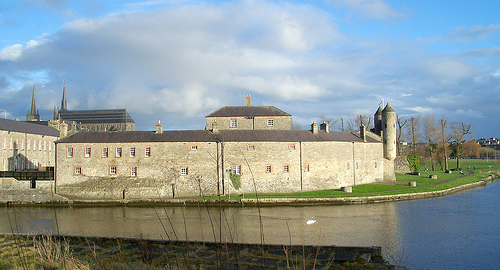
This is the building that defines Enniskillen. It
is the surviving south flanker of Cole’s bawn, not a functioning water
gate. The name is later. It never opened onto the river; it contained a
well about 4 metres deep and later served as a barracks latrine.
Architectural character:
Three-storey stone façade facing the river.
Pair of circular, corbelled tourelles (small round turrets) with conical
roofs, rising from the outer corners.
Stepped Irish battlements on
the parapet.
Strong Scottish Baronial / Jacobean influence: tall
corbelled circular turrets of this type are a late-16th /
early-17th-century Scottish motif, brought by Plantation masons and
settlers. Some older writers speculated the Maguires had already used
Scottish masons in the 1580s; the consensus now dates the Watergate to
Cole’s campaign, c. 1609–1614.
The original bawn had two circular and
two rectangular flankers. Only this south circular pair survives as a
complete composition. Curtain walls were strengthened with bartizans
(projecting corner turrets). The whole ensemble is one of the most
distinctive pieces of Plantation architecture in Ulster and became the
emblem of the town and of the Inniskilling regiments.
Phase 3:
Castle Barracks (from 1796)
Fear of French invasion prompted a major
rebuild in 1796 at a cost of about £7,000. The medieval/Plantation core
was wrapped in a working military barracks. Most ranges now visible
around the courtyard date from this period or the 19th century.
Key
later buildings:
Curved Range (in place by 1822): a long, slightly
bowed barracks block built on top of the old curtain wall along the
river. Regular sash windows, slate roofs, dressed stone dressings. It
follows the line of the waterfront rather than a medieval plan.
Other
barracks blocks, magazine, and service buildings filling the former
bawn.
Coach House (1881).
Large windows punched through the keep’s
upper walls.
The courtyard became a parade/drill space. The keep
lost its last purely medieval silhouette and became a solid, almost
Georgian-looking block in the middle of the square. An 1710 fire had
already damaged the Cole house; the barracks phase completed the
transformation from lordly residence to garrison.
Materials and
construction
The visible masonry is local limestone and related
Fermanagh stone: grey, weathered, with later brick or sandstone
dressings around barracks windows. Walls are typical Irish tower-house
construction - two faces of masonry with a rubble core, lime-mortared.
The keep’s recorded 8-foot thickness at the time of the 1594 survey
matches that tradition. The Watergate’s turrets are corbelled (each
course projecting slightly beyond the one below), a technique that needs
good stone and skilled masons.
The 2016 visitor centre uses Irish
blue limestone in a textured ashlar that deliberately echoes the
historic masonry without copying it.
What you read on the ground
today
Walk the site in layers:
River front - Watergate turrets +
curved barracks wall sitting on the old curtain line. This is the
postcard view and the most “Scottish” part of the design.
Courtyard -
rectangular keep in the centre (medieval base, Cole body, Georgian
windows), surrounded by 19th-century ranges.
Keep interior - ground
floor still reads as a thick-walled tower; upper floors are museum
galleries in later openings.
East side - modern visitor centre (2016)
and garden/walkway looking back over the complex and the town.
Since the 20th century, Enniskillen Castle has been repurposed as a
heritage site and museum complex, managed by the Northern Ireland
Environment Agency and Fermanagh and Omagh District Council. The castle
houses two main museums:
Fermanagh County Museum:
This museum
explores the history of Fermanagh from prehistoric times to the present.
Exhibits include artifacts from the castle’s Gaelic and plantation
periods, such as weapons, pottery, and manuscripts. It also covers local
folklore, archaeology, and the region’s natural history, with displays
on the Erne’s ecological significance.
Temporary exhibitions often
highlight local artists, crafts, or historical events, making the museum
a cultural hub.
Inniskillings Museum:
Dedicated to the Royal
Inniskilling Fusiliers and Dragoons, this museum traces the regiments’
history from their formation in the 1680s to their amalgamation in the
20th century. Displays include uniforms, medals, weapons, and personal
accounts from soldiers, with a focus on battles like Waterloo, the
Somme, and D-Day.
The museum also explores the social history of the
regiments, including their impact on Enniskillen’s community.
The
castle’s grounds are open to visitors, with guided tours available to
explore the keep, barracks, and exhibitions. Its riverside setting and
well-preserved structures make it a popular tourist destination,
offering panoramic views and a tangible connection to Fermanagh’s past.
Visitor Experience
Access: The castle is easily accessible in Enniskillen town, with
parking and nearby amenities. It’s open year-round, though hours vary by
season.
Events: The castle hosts cultural events, such as historical
reenactments, craft fairs, and lectures, particularly during summer
months.
Conservation: Ongoing restoration ensures the castle remains
in good condition, with efforts to balance historical authenticity with
modern accessibility.