Location: Forfar, Angus Map
Tel. 01307 840393
Open:
Mar- Oct: 10:30am- 4:30pm daily
Nov& Dec: 10am- 6pm daily
Last tour at 4pm
Official site
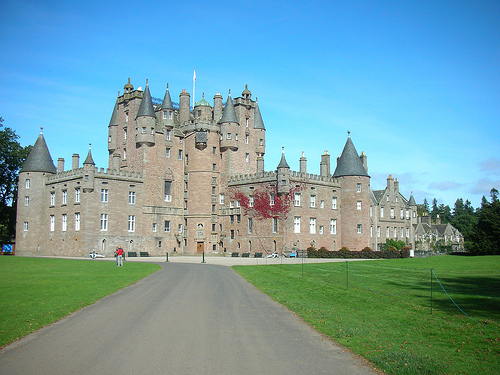
Glamis Castle, nestled in the fertile Strathmore Valley of Angus, Scotland, is a majestic baronial stronghold that blends medieval grit with fairy-tale elegance. Renowned as the family seat of the Earls of Strathmore and Kinghorne, it has stood for over 600 years, evolving from a defensive tower into a grand residence steeped in history, legend, and royal connections. Its striking turrets and lush grounds, set against the rolling Angus countryside, make it one of Scotland’s most picturesque castles, while its ties to Shakespeare’s Macbeth and the late Queen Mother add layers of mystique. Managed by the Strathmore family, Glamis remains a living estate, open to visitors for its architecture, gardens, and tales of intrigue.
Origins and the Lyon Family (14th–15th Century)
Glamis Castle’s
documented history as a family seat begins in 1372, when King Robert II
granted the thanage of Glamis to Sir John Lyon of Forteviot as a reward
for service to the crown. The site had already served as a royal hunting
lodge on the open Angus plain; tradition also links it to the death of
King Malcolm II in 1034, though that association belongs more to legend
than firm record. Four years after the grant, Sir John married the
king’s daughter Princess Johanna (Joanna) Stewart, bringing royal
Stewart blood into the Lyon line. He began converting the lodge into a
more defensible tower house around 1376. Appointed Chamberlain of
Scotland, he was killed in 1382 after a quarrel with Sir James Lindsay
of Crawford.
His son, Sir John Lyon II, continued the work. By the
early 1400s the family was building the “Palace House,” the core that
later became the east wing. The result was a sturdy L-plan tower house
suited to clan feuds and the lingering insecurity of the late medieval
Lowlands. In 1404 the widow Elizabeth Graham obtained a royal charter
confirming Glamis as a barony. Patrick Lyon, grandson of the first Sir
John, was created 1st Lord Glamis in 1445. The castle saw little direct
fighting in the Wars of Independence, but it served as a regional
refuge, including around the 1452 Battle of Brechin nearby.
Renaissance Expansion and Royal Ties (16th–17th Century)
The Lyons
expanded the house in stages. By the early 16th century John, 6th Lord
Glamis (d. 1528), had added wings and a chapel that reflected growing
Renaissance taste. After his death his widow Janet Douglas, sister of
the Earl of Angus, became the target of James V’s long vendetta against
the Douglas family. She was accused of treason and of plotting to poison
the king; servants and relatives were tortured for evidence. On 17 July
1537 she was burned at the stake on Edinburgh Castle Hill. James V
seized Glamis, occupied it with his court from about 1537 to 1542, and
left the estate stripped. Her son John, 7th Lord Glamis, recovered the
property in 1543 and began restoration. Mary, Queen of Scots later
stayed at the castle in 1562.
In 1606 Patrick, 9th Lord Glamis, a
favourite of James VI, was created Earl of Kinghorne. He launched a
major rebuilding that gave the castle much of its present silhouette:
extra storeys, a grand staircase tower, turrets, and a more palatial
roofline. An inscription on the central tower records the work of
Patrick and his wife Dame Anna Murray. During the Civil Wars of the
1640s Glamis sheltered Royalists, among them James Graham, Marquis of
Montrose, in 1645 before his defeat at Philiphaugh. Cromwellian troops
occupied the castle briefly in 1651, damaging interiors but leaving the
fabric standing.
The Strathmore Era and Modern History (18th
Century–Present)
In 1677 Patrick, 3rd Earl of Kinghorne, obtained a
new charter from Charles II that extended the title to Earl of
Strathmore and Kinghorne. The family stayed largely neutral in the
Jacobite risings of 1715 and 1745 and so avoided the destruction that
overtook houses such as Eilean Donan. Eighteenth-century taste turned
the grounds into a romantic landscaped estate; Patrick, 7th Earl (d.
1789), employed Thomas White, a follower of Capability Brown. In 1767
John, 9th Earl, married the English heiress Mary Eleanor Bowes; the
family name gradually became Bowes-Lyon.
Nineteenth-century
prosperity brought Victorian interiors, including elaborate plasterwork
in the Dining Room under Thomas, 11th Earl (d. 1865). Claude, 13th Earl
(d. 1904), was the father of Lady Elizabeth Bowes-Lyon, born 4 August
1900 (the exact place is uncertain and is often given as London or
Hertfordshire rather than Glamis). After her grandfather’s death in 1904
the family used Glamis as a principal home. Elizabeth spent much of her
childhood there, later marrying the Duke of York (the future George VI)
in 1923. Princess Margaret was born at the castle in 1930. During the
First World War Glamis served as a convalescent hospital; in the Second
World War it again housed wounded soldiers and remained a royal family
retreat.
The 14th Earl, Timothy Bowes-Lyon (d. 1972), opened the
castle to the public in the 1950s to help meet maintenance costs. That
arrangement continued under Michael, 18th Earl (d. 2016), and his son
Simon, 19th Earl (b. 1986), who succeeded in 2016. The Queen Mother’s
100th birthday was marked at Glamis on 4 August 2000; it was her last
visit before her death in 2002. The castle remains both a private family
residence (the Earl occupies a private wing) and a major visitor
attraction managed by Strathmore Estates, still in the same
Lyon/Bowes-Lyon line that received the thanage in 1372.
Glamis Castle stands in the Strathmore valley of Angus as the
ancestral seat of the Lyon, later Bowes-Lyon, family and as one of
Scotland’s most complete baronial houses. What began as a royal hunting
ground became, after 1372, a private stronghold when King Robert II
granted the thanage of Glamis to Sir John Lyon. Four years later Lyon
married the king’s daughter, Princess Johanna Stewart, binding the
family to the Stewart line. The pinkish local sandstone pile that
visitors see today is still L-shaped at heart: a late-medieval tower
house raised and dressed in the early 1600s into a turreted mansion,
then given Victorian rooms and twentieth-century comfort without losing
its defensive silhouette of crow-stepped gables, pepper-pot turrets and
conical roofs.
The family still lives here. Elizabeth Bowes-Lyon,
later Queen Elizabeth the Queen Mother, spent much of her childhood at
Glamis. Princess Margaret was born in the castle on 21 August 1930.
Public tours usually take in about ten of more than a hundred rooms,
while private wings remain in family use.
The central tower
The oldest standing mass is the great tower, begun in the fifteenth
century under Patrick, 1st Lord Glamis, and completed over several
decades. Its walls, in places around 2.5 to 3 metres thick, still show
narrow slits that once served archers. The ground storey is a vaulted
cellar that stored provisions; a well once opened beneath it and is now
sealed. Above this rose the principal apartments.
The former Great
Hall, later remodelled as the Drawing Room, is the castle’s finest
interior: a barrel-vaulted chamber roughly 18 metres long and 6 to 7
metres wide, with walls about 2.5 metres thick and deep window
embrasures. Plasterwork dated 1621 carries the monograms of John, 2nd
Earl of Kinghorne, and Margaret Erskine. A vast carved fireplace
displays Lyon heraldry and, in later colouring, royal arms that mark the
Union of the Crowns. Oak panelling, a minstrels’ gallery and
seventeenth-century furniture turn a medieval hall into a Renaissance
salon still used by the family on high days.
Upper floors include
rooms long associated with legend. The so-called King Malcolm Room is
tied to the story that Malcolm II died at Glamis in 1034 after being
wounded nearby. The tale is older than the present tower and is not
supported by firm evidence, yet the chamber keeps seventeenth-century
plasterwork and a four-poster bed that give the legend a physical
setting. The tower’s conical cap was rebuilt in 1606, when Patrick, 9th
Lord Glamis and 1st Earl of Kinghorne, raised the keep and added the
skyline of turrets that still dominates the park. An inscription on the
tower records the work of Patrick and Dame Anna Murray. Tradition once
credited Inigo Jones; Historic Environment Scotland more plausibly
points to the King’s Master Mason, William Schaw, and to the
Scottish-French baronial manner of the period.
A newel stair of about
1600, some 143 steps in the full ascent, links the floors. Clockwork
once sat in the hollow newel. Secret mural chambers and passages run
inside the thick walls, a reminder that Glamis was built as much for
concealment as for display.
Wings, chapel and later rooms
Flanking wings grew from the fifteenth century onward and enclose an
irregular courtyard. The north-east chapel wing was added in 1679-83 by
Patrick, 3rd Earl of Strathmore and Kinghorne, not in 1500 as older
guide notes sometimes claimed. In 1688 the earl commissioned the Dutch
painter Jacob de Wet to cover walls and ceiling with biblical scenes.
One celebrated panel shows Christ as a gardener wearing a hat, a rare
iconography. Stained glass by Charles Eamer Kempe was inserted in the
nineteenth century. Family pews remain; one seat is customarily left
empty for the Grey or White Lady, the ghost identified with Janet
Douglas, Lady Glamis, who was executed for alleged witchcraft in 1537
during the forfeiture of the estate to James V. The chapel still serves
family rites.
The west range was rebuilt after fire and changing
taste. The Drawing Room described above occupies the old hall. Victorian
work added a bay looking toward the Italian Garden. The Dining Room of
1850-53, fitted by Hon. Thomas Liddell in Scotch Baronial revival style,
has oak panelling charged with heraldry, an ornate plaster ceiling of
thistles, roses and lions, stained glass and a long oak table that can
seat around forty when fully extended. A chandelier and carved
overmantel complete the nineteenth-century show.
Royal apartments
were arranged after Lady Elizabeth Bowes-Lyon married the Duke of York
in 1923. They include the Queen Mother’s sitting room (once a tapestry
room), with a carved oak fireplace lined in Dutch tiles, and related
bedrooms. Mary, Queen of Scots stayed at Glamis in August 1562 after the
estate had been restored to the Lyons; James V had earlier occupied the
house during the family’s forfeiture.
Entrance and remnants of
defence
The main approach sits under a clock tower. A sundial dated
1678 marks the seventeenth-century front. A carved stair of lions, the
Lyon emblem, leads toward the principal rooms. A dry moat was filled in
the eighteenth century. The gatehouse is now ornamental, though a
portcullis slot survives. More than a hundred rooms, servants’ quarters,
kitchens formed from sixteenth-century vaults, and ten towers produce
the labyrinthine plan that feeds both tourism and ghost stories.
Among those stories: Earl Beardie (often identified with a Lindsay of
Crawford) is said to have played cards with the Devil on the Sabbath and
to haunt a sealed chamber. The “Monster of Glamis” is a Victorian legend
of a deformed heir hidden in a bricked-up suite; no such room has been
proven, and the tale may echo older clan violence, including the story
of Ogilvy refugees locked in a chamber until most starved. Shakespeare
set Macbeth at Glamis, but the historical Macbeth had no known link to
the house. These narratives are part of the visit; they are not
architectural fact.
Condition and upkeep
The sandstone
weathers to rose-pink but remains sound. Seventeenth-century reroofing
saved the interiors. Victorian plumbing, nineteenth-century heating and
later electrical work (gas arrived in 1865, electricity in 1929) made
the house livable. Public rooms are highly finished; private floors are
less restored. Tourism, events and estate income support maintenance of
a building that still functions as a family home rather than a museum
shell.
Grounds and gardens
Immediate gardens and parkland
around the castle run to roughly 65 hectares, set within a much larger
designed landscape and working estate. A mile-long lime avenue, planted
in the late eighteenth century (and sometimes dated 1775), frames the
first view from Glamis village and is famous in spring for daffodils.
The Italian Garden was laid out in 1910 for Cecilia, Countess of
Strathmore, mother of the future Queen Mother, to designs associated
with Arthur Castings. Yew hedges, parterres, fountains, roses and a
sundial linked to George VI give a formal foreground to the castle
silhouette. It is used for outdoor ceremonies.
The Kitchen Garden
(formerly called the Walled Garden) dates in its present four-acre form
from 1866-68 under the 13th Earl. Red-brick walls shelter heritage
vegetables, espaliered apples, cut flowers and a Victorian greenhouse
tradition. Produce supplies the Castle Kitchen restaurant. Recent
restoration has added double perennial borders, a long rose border, a
central fountain, pond gardens and a Monet-inspired bridge.
The
Pinetum, planted about 1870 by the 13th Earl, holds sequoias, Douglas
firs and other North American conifers, some among the tallest of their
kind in Britain, together with older yews. Paths continue into East
Woodland and the Macbeth Loop, a set of wooden sculptures of scenes from
the play, carved from estate timber. A nature trail of about
three-quarters of a mile to two miles, depending on the loop, crosses
parkland toward the River Dean (Dean Water), the Earl Michael Bridge of
1890 (reopened by the Queen Mother in 1996) and habitats for roe deer,
red squirrels and woodland birds, with views to the Sidlaw Hills.
Events such as the Glamis Proms have drawn crowds of around 10,000 to
hear music against the castle backdrop. Paved routes help wheelchair
users in the formal gardens; wet grass on the longer trails can be
harder going. Dogs are usually welcome on leads in the grounds.
Glamis is still a working Scottish seat: medieval keep, Renaissance
palace, Victorian dining room and twentieth-century royal nursery under
one roofline, set in gardens that run from Italian formality to
productive walls and a Victorian pinetum. The legends cling to the thick
walls. The documented story is six and a half centuries of one family,
two queens in living memory, and a house that never quite stopped being
both fortress and home.
Glamis Castle is a cultural icon, rich with history and myth:
Royal Connection: As the Queen Mother’s childhood home and Princess
Margaret’s birthplace (1930), Glamis links to Britain’s monarchy. Its
royal guestbook includes Queen Victoria (1875) and Elizabeth II
(multiple visits).
Shakespeare’s Macbeth: Glamis is tied to the
fictional Thane of Glamis in Macbeth, though the historical Macbeth (d.
1057) had no connection. The legend stems from Malcolm II’s supposed
murder there, fueling tales of a “Macbeth Room” with ghostly bloodstains
(a romantic embellishment).
Ghost Stories: Glamis is Scotland’s “most
haunted” castle, with tales of the Grey Lady (Janet Douglas’ spirit), a
Monster of Glamis (a deformed heir allegedly hidden in a secret room),
and card-playing ghosts in the crypt. These legends, amplified by
19th-century gothic fascination, draw paranormal enthusiasts.
Clan
Legacy: The Strathmore family’s 600-year tenure, unbroken despite wars
and taxes, embodies Scottish nobility. The castle’s Lyon and Bowes-Lyon
artifacts—swords, tapestries, a 14th-century charter—preserve clan
pride.
Cultural Events: The Glamis Extravaganza (July) features
vintage cars and Highland games, while Christmas markets fill the
grounds with lights, tying the castle to Angus’ community.
Its
turrets grace postcards, and its interiors inspired Rebecca (1940) sets,
cementing Glamis as a romantic archetype.
Located 5 miles southwest of Forfar off the A94, Glamis is 12 miles
north of Dundee (20-minute drive) or 1 hour from Aberdeen. Forfar’s bus
(20C) stops at Glamis village, a 1-mile walk to the castle. Free parking
fits 300 cars, with overflow for events.
Opening hours (2025):
March 29–October 26: Daily, 10:00 AM–5:00 PM (last entry 4:30 PM).
November 1–December 14: Weekends only, 10:00 AM–4:00 PM (grounds only
weekdays).
Closed December 15–March 28, except for private bookings.
Admission: £16.50 adults, £10 children (5–16), £13 concessions, £45
family (2 adults, 3 children). Guided tours (50 minutes), included in
the ticket, explore 10 public rooms, with self-guided garden access.
Pre-booking is advised, especially for summer.
The castle offers:
Accessibility: Ground-floor rooms (Dining Room, Crypt) suit wheelchairs
via ramps, but upper floors (70 steps) are stairs-only. A virtual tour
aids those with mobility issues.
Family Appeal: Kids enjoy ghost
tales and a nature trail treasure hunt, though narrow passages need
supervision. Dogs are welcome in gardens (leashed, not indoors).
Facilities: The Pavilion Café serves scones and haggis, while the shop
stocks Strathmore tartan and Queen Mother memorabilia.
Highlights
include the Chapel’s ceiling, the Drawing Room’s grandeur, and garden
strolls with Sidlaw vistas. Nearby, Dundee’s V&A Museum or Angus Glens
hikes complement a visit.
Glamis faces preservation hurdles:
Upkeep Costs: Maintaining 100+
rooms and 65 hectares costs £1 million yearly, met by tourism, weddings
(50 annually), and farming revenue from Strathmore Estates’ 2,000
hectares.
Weather Damage: 2023 storms cracked turrets, with repairs
ongoing into 2025. Climate-driven rain threatens sandstone, prompting
gutter upgrades.
Tourism Balance: 70,000 visitors yearly strain
floors and paths, managed by timed entries and restricted private
access.
Legends vs. History: Ghost stories boost appeal but
overshadow factual narratives, a tension the family navigates in tours.
The Strathmore Trust, formed 1990, ensures longevity, with solar panels
(2022) cutting energy costs. The castle’s private ownership keeps it a
home, not a museum, preserving its soul.
Glamis Castle in Angus, Scotland, ancestral home of the Earls of
Strathmore and Kinghorne and childhood residence of Queen Elizabeth The
Queen Mother, is as famous for its legends as for its architecture and
royal connections. The present building grew from a royal hunting lodge
on a site already old when King Malcolm II was mortally wounded in a
nearby clash in 1034 and brought here to die. The official castle
account still points to that hunting lodge as the origin of the later
fortress granted to Sir John Lyon in 1372. Thick walls, hidden passages,
and a long record of clan violence supplied the raw material for the
stories that visitors still hear on guided tours.
The best-known tale
is that of the Monster of Glamis. Legend says a hideously deformed child
was born into the Bowes-Lyon family, most often identified with the
first son of Thomas, Lord Glamis, recorded as born and dying on 21
October 1821. In the story the infant did not die. He was hidden in a
secret suite of rooms, fed through a grate, and never acknowledged as
heir. After his death the chambers were bricked up. Descriptions
collected in the nineteenth and twentieth centuries speak of an
egg-shaped figure with a massive hairy chest, almost no neck, and tiny,
almost useless limbs. Some versions claim every generation produced a
similar “vampire child” who was walled away. An old anecdote tells how
guests once hung towels from every accessible window so they could walk
outside and spot the sealed rooms. Several windows remained empty.
Relatives later suggested the family had simply removed the towels so
the rooms would stay hidden. The family itself has never confirmed the
story; some later Earls were said to have been initiated into “the
secret” on their twenty-first birthday and thereafter grew withdrawn.
A more historical explanation for a sealed chamber points to the Ogilvy
clan. In the late fifteenth century, during a feud with the Lindsays, a
group of Ogilvies sought sanctuary at Glamis. Lord Glamis, secretly
allied with their enemies, locked them in a room whose walls are nearly
five metres thick. They were left to starve. When the chamber was later
opened, skeletons were found in positions that suggested cannibalism.
The room, sometimes called the Bone Room or the Hangman’s Chamber, was
walled up again. That earlier atrocity almost certainly helped give the
later monster legend its shape.
The castle’s small family chapel,
completed and dedicated in 1688 and decorated with biblical panels by
the Dutch painter Jacob de Wet, seats only forty-six people. Guides
still tell visitors that one pew is permanently reserved for the Grey
Lady. She is identified as Janet Douglas, Lady Glamis, widow of the
sixth Lord. In 1537 she was convicted on politically motivated charges
of witchcraft and treason against James V and burned at the stake on
Edinburgh’s Castle Hill. Her ghost is said to kneel at the altar or sit
quietly in the back row. The chapel remains in regular use by the
Bowes-Lyon family; no one is permitted to occupy her seat.
Sir David
Bowes-Lyon, brother of the Queen Mother, is reported to have seen
another female figure while walking the lawn late at night. A young
woman stood at a barred window, clutching the bars and staring into the
dark. As he prepared to speak she vanished as if pulled away from
inside.
Earl Beardie, usually identified as Alexander Lindsay, 4th
Earl of Crawford (died 1453), or sometimes as Alexander Lyon, 2nd Lord
Glamis, supplies the castle’s most theatrical haunting. One Saturday
night he demanded a game of cards. Because the Sabbath was approaching,
his hosts refused. Enraged and drunk, he declared he would play with the
Devil himself. A tall stranger appeared and the two sat down in a locked
room. Servants heard shouts and curses; one who peered through the
keyhole was blinded by a sudden flash of light. The stranger vanished
and Beardie’s soul was forfeit. Visitors still report the rattle of dice
and bursts of swearing on Saturday nights. Some say the Earl is
condemned to play until Judgement Day.
Other figures complete the
roster. A tongueless woman, said to have learned a family secret and
been mutilated for it, runs across the grounds pointing at her mouth. A
thin “Jack the Runner” races up the drive. A small Black page boy sits
on a stone bench outside the Queen Mother’s sitting room. A woman with
mournful eyes clutches the bars of an upper window. These stories,
whether rooted in real clan feuds, political executions, or Victorian
gossip, have turned Glamis into one of Scotland’s most storied houses.
The family still lives in the private apartments; the public rooms,
chapel, crypt, and King Malcolm’s Room are shown on guided tours that
keep the legends alive without ever quite confirming them.
The castle
stands in the broad Vale of Strathmore, about 20 km north of Dundee. It
is open seasonally; tickets include a guided interior tour that visits
the chapel, the crypt, Duncan’s Hall, and the royal apartments
associated with the Queen Mother and Princess Margaret, who was born
here in 1930. The surrounding gardens, Dutch Garden, and Italian Garden
reward a longer visit. Whether the secret room still exists, and what,
if anything, it once contained, remains the property of the Earl, his
heir, and one trusted adviser, exactly as the old custom required.