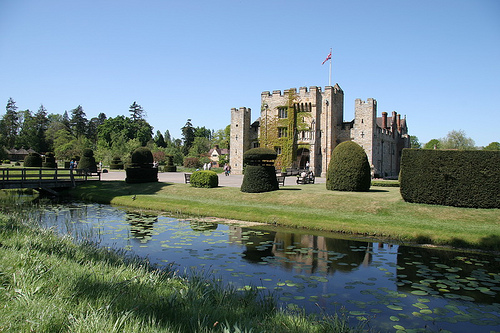
Location: Edenbridge, Kent Map
Constructed: started in 1270
Tel. 01732 865 224
Open:
Apr- Oct: daily
Nov, Dec, Mar: Thu- Sun
Gardens Open:
11am- 6pm
Castle Open: noon- 6pm
Official site
Hever Castle, located in the village of Hever, Kent, about 30
miles southeast of London, is a moated medieval fortress turned
Tudor manor house that has witnessed over 600 years of English
history.
Its story spans from a simple 13th-century country house
to a fortified defensive structure, the childhood home of Anne
Boleyn (second wife of Henry VIII and mother of Elizabeth I), a
royal gift to Anne of Cleves, centuries of gradual decline, and a
lavish 20th-century restoration that transformed it into the
romantic, visitor-friendly site it is today. Much of its current
appearance—crenellated walls, double moat, and gardens—reflects both
its Tudor roots and the ambitious vision of its early 20th-century
American owner.
Medieval Origins: From Country House to Fortified Castle
(13th–14th Centuries)
The site’s earliest structure dates to
around 1270, when it began as a modest country house (possibly
owned by figures like William de Hever, a local sheriff in 1272,
or later associated with James Fiennes, 1st Baron Saye and
Sele). It consisted of a large hall and outbuildings, with the
oldest surviving elements being the gatehouse and a walled
bailey.
Evidence of an even earlier motte-and-bailey castle
(timber hall with surrounding buildings for kitchens, stables,
etc.) exists but has largely been lost. By 1308, a building
known as Hever Cobham was inherited by Stephen de Cobham, Baron
Rundale.
The pivotal moment came in 1383, when John de Cobham
(a government official and tax collector, reportedly alarmed by
the Peasants’ Revolt of 1381) was granted a royal licence to
crenellate (fortify) the manor. He transformed it into a
defensive castle: sandstone gatehouse, moat, curtain walls,
towers, Great Hall, and an inner bailey with timber-framed
domestic buildings (kitchen, stores, stables). The exterior was
whitewashed for dramatic effect and weatherproofing, with
colorful decorations on the front. Features from this era
include the oldest working original portcullis in England and
remnants of original country-house timbers encased in stone.
The layout shifted from a circular motte-and-bailey to a more
rectangular inner bailey. Wings housed family chambers (solar,
great chamber), administrative offices, and guest quarters. This
medieval core remains the castle’s defensive heart today.
The Boleyn Era: Tudor Modernization and Royal Connections
(15th–16th Centuries)
In 1462, the castle was purchased by
Geoffrey Boleyn (sometimes spelled Bullen), a wealthy London
merchant and Lord Mayor of London. He and his descendants
converted the outdated medieval dwelling into a comfortable
Tudor manor house within the protective walls, marking the start
of its most famous period.
Geoffrey died in 1463; it passed
to his son William, then to grandson Thomas Boleyn in 1505.
Thomas (later 1st Earl of Wiltshire) lived there with his wife,
Lady Elizabeth Howard, and their children: George, Mary, and
Anne Boleyn. Hever became the childhood home of the Boleyn
siblings. Anne (born c. 1501, likely at Blickling Hall but
raised here from around age 4–12) spent her early years at the
castle until sent abroad in 1513 for education at the court of
Archduchess Margaret of Austria in the Habsburg Netherlands.
Thomas continued improvements: large windows in the Great Hall,
a parlour partition, spiral staircase, new fireplaces, and
ceilings over exposed roofs. The castle was a hub for the rising
Boleyn family, whose ambitions intertwined with the Tudor court.
Henry VIII’s courtship of Anne is famously linked to the area
(he reportedly stayed nearby at Bolebroke Castle, though Hever
features in the romantic narrative). After Anne’s execution in
1536 and Thomas’s death in 1539, the castle reverted to the
Crown. Henry VIII gave it to his fourth wife, Anne of Cleves, in
1540 as part of their amicable annulment settlement; she held it
for about 17 years and made additions, including the present
Entrance Hall and a grand staircase leading to a Long Gallery
over the Great Hall. One of Henry VIII’s private locks from his
visits remains.
Later Owners and Gradual Decline
(16th–19th Centuries)
In 1557, the castle passed from Anne of
Cleves’s estate to the Waldegrave family, who owned it until
around 1715–1718. Subsequent owners included the Humfreys family
(until 1749, including Sir William Humfreys, 1st Baronet) and
the Meade-Waldo family (1749–1903).
During these centuries,
the castle saw minor changes: a 1644 fireplace in the Morning
Room, bricking up of Long Gallery windows to avoid the 1696
window tax (reopened 1898), replacement of the wooden drawbridge
with stone, and a moat terrace for damp-proofing. By the 19th
century, it fell into serious disrepair—part of the northeast
corner collapsed under a heavy chimney, the kitchen was
relocated, and the estate (expanded to 1,300 acres by 1786) was
often leased to tenants. The Meade-Waldos held it until 1903,
when it was rundown and in need of rescue.
The Astor
Restoration: A 20th-Century Renaissance (1903 Onward)
On 27
July 1903, American multimillionaire William Waldorf Astor (the
“richest man in America”) purchased the castle for use as a
family home. He invested a fortune (equivalent to tens of
millions today) and employed architects like Frank Loughborough
Pearson, engineers, and hundreds of craftsmen (748 on the castle
alone, plus 800 to excavate the 38-acre lake).
Restoration
(completed 1906 for the castle, 1908 for grounds) preserved
every original fragment using only period-appropriate tools
(adze and chisel, no modern planes). Interiors were returned to
Tudor splendor with carved wood, plastered ceilings, and antique
furnishings. Astor added the Astor Wing (a “Tudor Village” of
guest cottages across the moat, now offering B&B rooms) and
transformed marshland into award-winning gardens: the Italian
Garden (with his collection of statues, fountains, and
colonnades), rose garden, yew maze, and more.
Modern Era
and Current Ownership (1983–Present)
In 1983, the Astor
family sold Hever to John Guthrie (1906–1992), chairman of
Broadland Properties Limited (the Guthrie family’s company),
which still owns and operates it as a museum, event venue, and
heritage attraction. Investments continue in conservation,
sustainability (e.g., biomass boiler since 2009, ecological
sewage systems), and visitor facilities like restaurants and a
Japanese teahouse folly (rebuilt 2013).
Today, Hever
celebrates milestones like 640 years since the 1383 crenellation
and 60+ years open to the public. It features exhibitions on the
Boleyns and Reformation, Tudor artifacts (including Anne’s
prayer books), period rooms, and extensive gardens open
year-round. It hosts events from jousting to exhibitions,
blending its layered history with family-friendly appeal.
Hever Castle’s history is not just about stones and moats—it
embodies the rise and fall of powerful families, Tudor intrigue
that reshaped religion and monarchy, and one man’s Edwardian
dream of historical revival. Its enduring charm lies in how each
era left its mark, from medieval defenses to Tudor elegance to
Astor opulence.
Construction Phases and Overall Layout
The castle developed in
three main phases, reflected in its hybrid medieval-Tudor-Edwardian
architecture:
Medieval Origins (c. 1270–1384): It began as a simple
country house (timber-framed) on the site of an earlier manor. Around
1383–1384, Sir John de Cobham received a licence to crenellate,
fortifying it into a defensive structure with a gatehouse, curtain walls
enclosing a bailey (courtyard), and a broad rectangular moat. The
gatehouse and outer bailey are the oldest surviving elements; original
country-house timbers remain visible within the stone walls. This phase
established the compact, motte-and-bailey-inspired layout: a central
inner courtyard surrounded by walls and domestic buildings.
Tudor
Domestic Expansion (1462–mid-16th century): The Boleyn family (from
1462) modernized the interior into a manor house while retaining the
outer fortifications. Geoffrey Boleyn converted and repaired the
existing structures, adding timber-framed Tudor dwellings within the
bailey. His grandson Thomas Boleyn (Anne Boleyn’s father) enhanced it
further around 1505–1506 with private chambers and the Long Gallery.
After the Boleyns, Anne of Cleves (Henry VIII’s fourth wife, who
received the castle in 1540) added key linking elements: the Entrance
Hall, Staircase Gallery, and Long Gallery (extending across the full
width of the house). These introduced more light, comfort, and
connectivity.
20th-Century Restoration and Extension (1903–1908):
American millionaire William Waldorf Astor purchased the dilapidated
castle and invested heavily in restoration under architect Frank
Loughborough Pearson (with sculptors William Silver Frith and Nathaniel
Hitch). They repaired original features using period techniques, added
ornate panelling/ceilings, and constructed the “Astor Wing” (a
picturesque cluster of half-timbered “Tudor village” guest cottages, now
luxury B&B accommodation). Astor also landscaped the grounds
extensively. The result is a Grade I listed building blending authentic
medieval/Tudor elements with Edwardian craftsmanship.
The castle
is small (roughly three storeys around a central courtyard) with a
visitor-friendly floor plan: ground-floor public rooms (Entrance Hall →
Inner Hall → Drawing Room → Great Hall → Library), upper floors (private
chambers, Long Gallery), and the separate gatehouse tower. A spiral
stone staircase and galleried connections link the wings.
Exterior Architecture and Defensive Features
The exterior is
dominated by the moat (still water-filled, one of the few working
historic moats in England) and the imposing three-storey sandstone
gatehouse—the only fully original 14th-century structure. A wooden
drawbridge (reinstated by Astor and still operable) crosses the moat to
the arched entrance, defended by two rectangular towers (slightly
shorter than the gatehouse) with buttresses and crenellated battlements.
The gatehouse features:
Two surviving original wooden
portcullises (the front one is among the oldest working examples in
England; originally three).
Machicolations (openings for dropping
missiles) and murder holes.
A garderobe (medieval toilet) emptying
directly into the moat.
Stone blocks that feel cold and rugged; the
inner passage has a bumpy stone floor leading into the courtyard.
The curtain walls enclose the inner bailey, creating a secure
courtyard where the contrast is striking: heavy medieval sandstone on
one side versus lighter timber-framed Tudor buildings (white-painted
wood with prominent black beams and diamond-paned windows) on the
others. Crenellations and small defensive towers reinforce the fortified
appearance, while ivy and climbing plants soften the stonework today.
Interior Architecture and Key Rooms
Interiors blend sturdy
medieval stone with rich Tudor woodwork and Astor-era refinements. Most
rooms feature oak or walnut panelling, carved fireplaces, beamed or
plastered ceilings, and rush matting or wooden floors in Tudor areas.
Entrance Hall (mid-16th century, Anne of Cleves addition): A grand
linking space with a large staircase; original 14th-century timbers
visible in an earlier doorway. Soft red carpet and darker tones set a
transitional medieval-to-Tudor feel.
Inner Hall (former Tudor Great
Kitchen): High ceiling with Elizabethan-style plasterwork (Tudor rose
emblem), Italian walnut panelling, and carved columns by Frith (1905). A
gallery above echoes King’s College Chapel, Cambridge. Wooden columns
and springy flooring enhance the grand yet intimate scale.
Drawing
Room (1905, Pearson redesign): Formerly domestic offices; now long,
bright, and elegant with oak panelling inlaid with bog oak and holly
(inspired by Sizergh Castle). Patterned ceiling and large windows
reflect Astor’s luxurious Tudor revival.
Great Hall (15th-century
origins): Originally open to the roof rafters; now with linenfold
panelling, a Boleyn-coat-of-arms fireplace (by Frith), and a carved
minstrels’ gallery (by Hitch, 1905). Wooden floors, tapestries, and long
tables evoke Tudor banqueting.
Long Gallery (16th century, Anne of
Cleves/Thomas Boleyn): The architectural highlight—approximately 100 ft
long, spanning the house width. Original 16th-century panelling, tall
windows (some with stained glass showing family arms), and a
reconstructed Tudor-style ceiling (by Hitch). Used for exercise,
entertaining, and displaying art; it exemplifies Tudor “processional”
architecture.
Private Chambers (Nursery, Great Chamber, Best
Bedchamber, Henry VIII’s Bedchamber): Intimate Tudor spaces with rush
matting, fabric wall hangings, four-poster beds, painted ceilings, and
fireplaces. Some retain 16th-century panelling; others gained
19th/20th-century windows or detailing. Spiral stone stairs (narrow,
with varying steps) connect them, preserving medieval vertical
circulation.
Library and Parlour: Richly carved (sabicu wood in
Grinling Gibbons style) with bookcases copied from Samuel Pepys’
originals; the Parlour shows the Tudor shift toward private family
spaces.
Gatehouse Interior: Functional and defensive—portcullis winch
chamber, counterweights, and Council Chamber (with stone walls and a
medieval garderobe).
The Astor Wing (separate but visible from
the castle) extends the Tudor aesthetic with half-timbered gables,
multiple chimneys, and clustered cottages, creating a “village” effect
around the original core.
Materials and Craftsmanship
Medieval: Local sandstone blocks (rough, load-bearing) over timber
framing.
Tudor: Oak beams, half-timbering (black-and-white),
linenfold and inlaid panelling, stained glass.
Astor Restoration:
Sympathetic use of period tools/materials—plaster ceilings, intricate
carvings, bog oak inlays—plus Italian walnut and sabicu woods for a
luxurious finish.
Hever Castle sits in peaceful rural Kent on the Kent/Surrey/Sussex
border, about 30 miles southeast of central London and 3 miles southeast
of Edenbridge. It’s signposted from the M25 (junctions 5 or 6) and the
A21. Use postcode TN8 7NG or what3words ///wedge.secret.loves for
sat-nav.
By car: Free parking is plentiful in two main car parks
(one near the ticket office and King Henry VIII Inn; another lakeside).
Coaches have dedicated space. Arrival is easy and stress-free.
By
train + walk/taxi: Nearest stations are Edenbridge Town (3 miles away,
taxis available) or Hever station (unmanned, ~1-mile pleasant rural walk
signposted with red-and-white posts). No regular buses run directly to
the castle.
You’ll arrive at a ticket office beside the road,
then cross into the grounds. Grab your free map on entry — it shows all
opening times for attractions and amenities. The castle looms ahead
across the moat, flags flying, with the Yew Maze already tempting you
from the forecourt.
Practical Essentials (2026 Season)
Opening
times (daily from 28 March – 25 October, the peak visitor period):
Grounds open 10:30
Castle opens 12:00
Final entry: Grounds 16:30,
Castle 17:00
Final exit: Grounds 18:00, Castle 17:45
Shorter
hours apply outside this window (check the website closer to your date).
The site is busiest mornings/early afternoons; arrive early for quieter
photos.
Tickets (11 Feb – 19 Nov 2026):
Buy online to save £2–3
per adult and skip queues.
Castle & Gardens: Adult £25.50 /
Senior-Student £22.60 / Child (5–17) £14.05 / Under-5 free / Family (2
adults + up to 3 children) £66.60
Gardens Only: Adult £19.95 / etc.
(similar discounts)
Audio guides (English + 5 other languages,
plus children’s version) are included with castle admission. Annual
membership is great value if you live nearby. Picnics are welcome in the
grounds.
Inside the Castle: Tudor History Comes Alive
Hever’s
core is a 14th-century defensive gatehouse and walled bailey built in
1383. The Boleyn family lived here from the 1460s; Anne spent her early
years here before becoming Henry VIII’s second wife. The castle later
passed to Anne of Cleves and fell into disrepair until American
millionaire William Waldorf Astor bought it in 1903 and lavishly
restored it.
Spend at least one hour inside (allow 90 minutes if you
linger). Wood-panelled rooms, huge fireplaces, four-poster beds,
tapestries, and antiques create an intimate, lived-in feel. Highlights
include:
The Long Gallery with one of the finest private
collections of Tudor portraits outside the National Portrait Gallery.
Anne Boleyn’s two Books of Hours (prayer books) — one 15th-century
manuscript and one printed, both bearing her handwritten inscriptions
and signature — displayed in her childhood bedroom.
The Astor Suite
showing Edwardian family life with photos and memorabilia.
The
castle feels “haunted” and storybook-perfect: crenellated towers, narrow
spiral stairs, and the sense that history happened here. No photography
inside most rooms, but the atmosphere is unforgettable.
The
Gardens: 125 Acres of Pure Magic
Laid out 1904–1908 by Joseph Cheal &
Son (over 1,000 men, including 800 who dug a 38-acre lake), the gardens
turned marshland into classical Italianate splendour and natural
woodland. They’re award-winning and beautiful year-round, but spring
(daffodils, rhododendrons) and summer (roses) are spectacular.
Must-see areas:
Italian Garden: Formal terraces, classical
statues, fountains, cascades, grottoes, and a Loggia overlooking the
lake — inspired by Italian Renaissance gardens. Astor’s sculpture
collection shines here.
Rose Garden: Over 5,000 bushes, giant topiary
chess pieces, and fragrant blooms.
Tudor Garden, Rhododendron Walk,
Anne Boleyn’s Walk (century-old trees), and peaceful woodland paths
(Sunday Walk, Church Gill Walk along a stream).
38-acre lake with
views from the Loggia; rowing boats sometimes available seasonally.
The Mazes (huge family hits):
Yew Maze (Edwardian, 1906): 80 ft ×
80 ft traditional English hedge maze (1,000+ yew trees, 8-ft hedges,
quarter-mile of paths). One of Britain’s few historic designs. Takes ~30
minutes; open all year (weather permitting).
Water Maze (on Sixteen
Acre Island): Concentric stepping-stone circles over water; stones tilt
and hidden jets spray you! Aim for the central grotto — few succeed dry.
Super fun (bring a towel). Open 28 March – 1 Nov 2026; kids under 5 must
be accompanied; shoes required.
Food, Facilities & Extra Fun
Cafés serve hot lunches, sandwiches, cakes, and teas (indoor/outdoor
seating). Picnics are popular.
Seasonal events: Easter family fun,
jousting tournaments, archery taster sessions, behind-the-scenes tours,
and special exhibitions (e.g., Anne Boleyn imagery through 2027).
Toilets, shops, and a small visitor centre are well-placed.
Visitor Tips from Real Experiences
Full day recommended: Many
visitors say 4–6 hours flies by. Gardens-only tickets work if time is
short, but the castle is unmissable.
Best time: Weekdays or early
arrival for fewer crowds. Spring for flowers; summer for lake and water
maze.
Families: Kids love the mazes, playgrounds, and “castle” vibe.
Pushchairs are manageable in most areas.
Accessibility: Some gravel
paths and steps; the Access Guide (downloadable) details facilities. Car
parks are close to key areas.
What people rave about: “Stunning,
well-maintained, peaceful corners everywhere” and “perfect blend of
history and beauty.” Some note food can be pricey, so picnic if you
like.