Location: 15 miles (24 km) North of York Map
Tel. 01653 648444
House: Open: Mar- Oct: 11am- 4pm daily
Grounds: 10am- 4:30pm daily
Entrance Fee: House: adults
£9.50, senior/ student £8.50, children £6.50
Grounds: adult
£6.50, children £4.50
Castle Howard is a magnificent Baroque country house located in the village of Henderskelfe, North Yorkshire, England, approximately 15 miles (24 km) north of York. Built between 1699 and 1712, it serves as the ancestral seat of the Carlisle branch of the Howard family and spans over 1,000 acres of parkland, including lakes, woodlands, and follies. Renowned for its grand architecture, opulent interiors, and sweeping landscapes, it is a Grade I listed building and a key example of early 18th-century English Baroque design. Owned by Castle Howard Estate Limited and managed by the Hon. Nicholas Howard and his wife Victoria, the estate has been in the family for over 300 years and attracts visitors for its historical depth, artistic treasures, and role in popular culture, including as a filming location for Brideshead Revisited and Bridgerton.
Origins of the Site and the Howard Family Connection
The land on
which Castle Howard stands was part of the Henderskelfe estate in
Yorkshire, which included an earlier manor house known as the Old Castle
of Henderskelfe. This predecessor building burned down, clearing the way
for the new structure. The Howard family’s link to the estate dates to
1577, when Lord William Howard (1563–1640), known as “Belted Will” and
the third son of Thomas Howard, 4th Duke of Norfolk, married his
step-sister Elizabeth Dacre. She was the youngest daughter of the 4th
Baron Dacre, and through this marriage, the family acquired the
Henderskelfe estates (along with Naworth Castle in Cumbria). Lord
William lived primarily at Naworth but established the Yorkshire
connection that would later define the Carlisle branch of the Howards.
The title of Earl of Carlisle was created in 1661 for Charles Howard
(1629–1685), great-grandson of Lord William and a skilled politician,
soldier, and opportunist who became the 1st Earl. His son Edward became
the 2nd Earl, but it was Edward’s son—Charles Howard (1679–1738), the
3rd Earl of Carlisle—who decided to build a magnificent new house
befitting his elevated status as a prominent Whig and member of London’s
influential Kit-Cat Club.
Commission and Construction: A
Century-Long Project (1699–1811)
In 1699, the 3rd Earl commissioned
his friend, the dramatist and playwright Sir John Vanbrugh (who had
never designed a building before), to create the house. Vanbrugh wisely
partnered with the experienced architect Nicholas Hawksmoor for
practical execution. Design work evolved between 1699 and 1702, and
construction began at the east end, progressing westward—an unusual
approach that allowed the family to occupy parts of the house as it
grew.
Key phases: The East Wing and east end of the Garden Front
were built 1701–1706; the Central Block (including the iconic dome,
added late in the design) 1703–1706; and the west end of the Garden
Front 1707–1709. By 1725, an engraving in Vitruvius Britannicus showed
the exterior largely complete with opulent Baroque interiors finished.
Style and features: The house was conceived in exuberant English
Baroque—richly decorated with pilasters, urns, cherubs, coronets, and
cyphers. The central dome (one of the first on a British country house)
was a bold, dramatic feature. Interiors included work by Italian artist
Giovanni Antonio Pellegrini.
Vanbrugh died in 1726 and the 3rd
Earl in 1738, both before completion. The 4th Earl (son-in-law to the
3rd via marriage to Isabella Howard) commissioned Sir Thomas Robinson to
add the West Wing in a contrasting, more restrained Palladian style.
This created an asymmetrical appearance that has drawn comment ever
since. The wing was roofed but undecorated at Robinson’s death in 1777;
interiors were finished gradually, with the Long Gallery finally
decorated by Charles Heathcote Tatham in 1811. Later 19th-century tweaks
(e.g., removing attic pavilions on the West Wing in the 1870s) helped
harmonize the wings somewhat.
The 4th and 5th Earls enhanced the
house through Grand Tour acquisitions—antique sculptures, paintings, and
treasures from Italy and beyond—turning it into a showcase of classical
art. The 5th Earl completed the building and filled it with an extensive
painting collection.
18th–19th Centuries: Family Life, Politics,
and Refinements
Successive Earls used Castle Howard as a family seat
while pursuing public service, politics, and the arts. Notable figures
include:
The 6th Earl, who married Georgiana Cavendish (daughter
of the famous 5th Duchess of Devonshire).
The 7th Earl, a
distinguished Victorian politician who traveled widely.
The 9th Earl
(George Howard), a talented painter and National Gallery trustee, and
his wife Rosalind (the “Radical Countess”), a campaigner for women’s
suffrage and temperance who actively managed the estate.
By the
time of the 7th Earl, the estate exceeded 13,000 acres and included
several villages; it even had its own railway station (1845–1950s). The
house and collections grew impressively, though diarist Henry “Chips”
Channon noted signs of “decaying magnificence” during a 1923 visit.
20th Century: Fire, War, and Revival
After the 9th Earl’s death
in 1911, the house passed to his fifth son, Geoffrey Howard (grandfather
of the current generation). During World War II, it served as a girls’
school (Queen Margaret’s School from Scarborough). Tragedy struck on 9
November 1940 when a chimney fire, fanned by strong winds, devastated
about a third of the house. The dome collapsed into the Great Hall,
destroying the central hall, dining room, east staterooms, Pellegrini’s
ceiling painting The Fall of Phaeton, 20 paintings (including two
Tintorettos), and valuable mirrors. The Malton and York fire brigades
contained it after eight hours; the schoolgirls helped salvage items.
Post-war restoration was led by George Howard (who unexpectedly
inherited after his brothers’ wartime deaths) and his wife Lady Cecilia.
They reopened the house to the public in 1952, making it one of the
first great houses to do so commercially. The dome was rebuilt and
redecorated 1960–1962 (with The Fall of Phaeton recreated by Canadian
artist Scott Medd). The Garden Hall was rebuilt in 1981 during filming
of Brideshead Revisited. Further work included re-roofing the Central
Block (1994–1995) and ongoing conservation of the East Wing (still
partially a shell).
Modern Era and Cultural Significance
Today, Castle Howard is owned by a family company (Castle Howard Estate
Limited) and managed by the Hon. Nicholas (Nick) Howard and his wife
Victoria (who holds an OBE). It remains a working family home while
welcoming hundreds of thousands of visitors annually. Ongoing
restorations address fire damage, masonry, roofs, gardens, and
collections.
The 1,000-acre parkland (with Grade I-listed gardens)
features the Temple of the Four Winds, the Mausoleum, lakes, the Pyramid
(restored 2015), obelisks, follies, and the separate Yorkshire
Arboretum. Modern additions include sustainable heating from an
underwater lake system (2009).
Culturally, it has starred in
Brideshead Revisited (1981 TV and 2008 film), Bridgerton, and other
productions. Its collections (though reduced by sales and the 1940 fire)
still include sculptures, paintings, tapestries, and furniture evoking a
“Grand Tour” experience.
Castle Howard (frequently referred to in shorthand as “Howard
Castle”) is one of Britain’s most iconic English Baroque country houses,
located in the Howardian Hills of North Yorkshire, about 15 miles (24
km) north of York. Although its name includes “Castle,” it is not a
medieval fortress but a grand 18th-century stately home commissioned in
1699 by Charles Howard, 3rd Earl of Carlisle, as a statement of power,
ambition, and taste. It has remained the seat of the Carlisle branch of
the Howard family for over 300 years and is still privately owned.
The house was designed primarily by the dramatist-turned-architect Sir
John Vanbrugh (his first architectural commission) in collaboration with
the highly experienced Nicholas Hawksmoor. Construction began around
1701 and took over a century to reach its present form (completed 1811),
spanning three earls and multiple phases of design evolution.
Overall Plan and Massing
Vanbrugh’s original concept was a bold,
theatrical Baroque composition arranged on a north–south axis with a
distinctive T-shaped plan. The central “corps de logis” (main block)
focused on arrival and reception, while service and family apartments
extended into symmetrical wings and courtyards. The design emphasized
external grandeur and dramatic spatial sequencing rather than strict
symmetry of later Palladian houses.
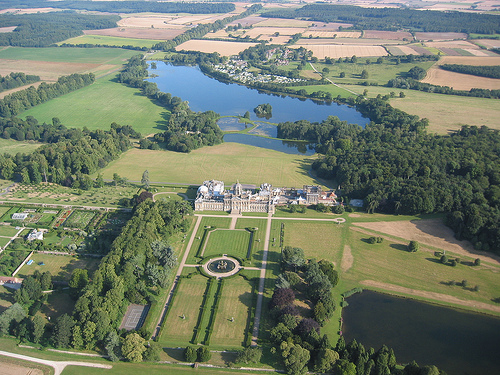
An aerial view reveals how the
house stretches dramatically across the landscape, with the central dome
as the focal point and projecting wings creating a sense of monumental
scale.
Exterior Architecture: Baroque Drama on a Grand Scale
The house is built of local limestone and sandstone in a richly
sculptural English Baroque style. Key features include:
Central
Dome: The most iconic element—a 70-foot-high (21 m) dome added
relatively late in the design (after construction had begun). It crowns
the Great Hall and gives the house its palace-like silhouette. The dome
was destroyed in a 1940 fire and faithfully rebuilt in 1960–61.
South
(Garden) Front: The showpiece façade, nine bays wide with giant
Corinthian pilasters framing the central three bays. A projecting
pediment carries the Carlisle coat of arms, while the frieze below
features exuberant Baroque carvings of putti, winged horses, urns,
cherubs, coronets, and cyphers. Exaggerated keystones on arched windows
and balustraded parapets with classical statuary add movement and
theatricality. Flanking nine-bay wings originally created perfect
symmetry (though later altered).
North (Entrance) Front: More
restrained but still Baroque, with Roman Doric pilasters. It faces the
arrival courtyard and emphasizes solidity and grandeur.
Asymmetry and
Later Additions: The east wing and central block are pure
Vanbrugh/Hawksmoor Baroque. The west wing, added in the 1750s by Sir
Thomas Robinson for the 4th Earl, is in a more conservative Palladian
style—flat, symmetrical, and lacking the original Baroque ornament. This
creates a striking visual mismatch visible in the garden front. Attic
pavilions on the west wing were later removed (1870s) to improve
harmony.
The façades use a palette of stone with decorative
plaster, creating strong contrasts of light and shadow—the essence of
Baroque “movement.”
Interior Architecture: Theatrical Spaces and
Integrated Decoration
Vanbrugh and Hawksmoor treated the interior as
an extension of the exterior drama. The design prioritizes circulation,
verticality, and spatial surprise using arcuated forms (arches, vaults,
domes), marble floors, stone walls, and painted decoration.
French-inspired practices (marble, stone, and painting in harmony) were
unusual in England at the time.
Great Hall: The heart of the
house—a square, soaring space rising through all storeys beneath the
dome. The dome’s colossal substructure acts like a giant baldacchino,
supported by massive piers and transverse arches that also create hidden
passageways to the wings. Four cardinal arches frame ceremonial routes.
The original ceiling painting by Giovanni Antonio Pellegrini (1709–12)
depicted the Fall of Phaeton (recreated post-fire by Scott Medd). Walls
and soffits feature imaginary garlands, zodiac signs, continents, and
muses—an Ovidian theme tying architecture to mythology.
Circulation and Sequencing: From the hall, doorways beckon forward;
stairs and galleries lead to upper rooms; hidden servant passages
(including spiral back-stairs) maintain service flow without disrupting
grandeur. The south enfilade (aligned suite of rooms) creates long
vistas and dramatic light effects.
Key Rooms and Decoration:
Garden Hall / Saloon (south enfilade): Derbyshire marble door frames,
parquet floors, and painted ceilings continuing Ovidian themes.
State
Apartments (east and west wings): Wood panelling by William Thornton of
York (low basement, tall panels, carved friezes), elaborate joinery,
marble fireplaces, and rich textiles (velvet, tapestry, silk damask in
blue, crimson, green). Later generations added paintings (Canaletto,
Reynolds, Venetian views).
High Saloon (first floor): Coved ceiling
with Pellegrini paintings of Aeneas and Minerva/Venus scenes.
Chapel
(1875–78): Redesigned by William Morris and Edward Burne-Jones with
Pre-Raphaelite stained glass and decoration.
Materials blend
stone, marble (including Derbyshire), carved wood, stucco, and textiles.
Decoration is architectural first—paintings and objects respond to the
geometry rather than dominating it.
Architectural Significance
and Evolution
Castle Howard was revolutionary: Vanbrugh’s
dome-crowned, T-plan Baroque house was unprecedented in Britain for its
scale, theatricality, and integration of house and landscape. The
Palladian west wing and 19th-century refinements show shifting tastes,
yet the core remains a pure expression of early 18th-century Baroque
ambition. A devastating 1940 fire destroyed the dome and many interiors;
sympathetic restorations (including recent work on the Crimson Drawing
Room) have preserved its spirit while adapting it for modern use.
The 1,000-acre estate is a masterpiece of landscape design, evolving
from formal Baroque gardens to an English landscape park. South of the
house, terraced formal gardens exploit the ridge's topography, with
lakes on either side and vistas framed by follies. Key features include
the Temple of the Four Winds (1728–1731, by Vanbrugh), a domed pavilion
symbolizing the winds; the Mausoleum (1728–1730, by Hawksmoor), a
neoclassical tomb for the Howards; and the Obelisk (1714), a 72-foot (22
m) Egyptian-style monument. Ray Wood, an ancient woodland east of the
house, features restored 18th-century walls and diverse plantings, while
the Walled Garden hosts ornamental roses and borders.
Other follies
dot the grounds: The Pyramid (restored 2015), Carrmire Gate, and
monuments in Pretty Wood like Hawksmoor's Four Faces. The 127-acre
Yorkshire Arboretum, managed by a charitable trust, showcases global
tree collections. The estate's scale historically supported
self-sufficiency, with villages and farms, and today emphasizes
conservation, including dog-friendly trails and biodiversity projects.
Castle Howard holds immense cultural value as Britain's finest
Baroque stately home, influencing landscape architecture and
aristocratic patronage. Its Grade I listing extends to gardens and
structures, though some, like follies, appear on the Heritage at Risk
Register. Filming has amplified its fame: as Brideshead in the 1981 ITV
series and 2008 film of Brideshead Revisited; Clyvedon Castle in
Bridgerton (2020–); and in Barry Lyndon (1975), The Buccaneers (1995),
and Lady L (1965). These portrayals highlight its timeless allure,
blending opulence with melancholy.
Preservation is family-led through
Castle Howard Estate Limited, with National Heritage Lottery funding
aiding restorations. The 2025 renovations enhance accessibility to
hidden gems, reinforcing its role in education and tourism while
addressing climate challenges via rewilding.
Castle Howard sits in the Howardian Hills of North Yorkshire, about
15 miles north of York. It is not a medieval fortress. It is a Baroque
country house begun in 1699 for Charles Howard, 3rd Earl of Carlisle,
and still lived in by the Howard family more than three centuries later.
Playwright-turned-architect Sir John Vanbrugh designed it with practical
help from Nicholas Hawksmoor. Building stretched across three
generations and was only finished in 1811, when a later Palladian west
wing by Sir Thomas Robinson completed the composition. The result is one
of England’s most theatrical houses: a central dome over a 70-foot Great
Hall, long galleries, and a landscape of lakes, temples, statues and
woodland covering roughly 1,000 acres.
A chimney fire on 9 November
1940 gutted the dome and nearly twenty rooms while the house was used as
a girls’ school. George Howard later rebuilt the dome (1960-62) and
reopened the house to the public. A major “21st Century Renaissance”
project, revealed in April 2025, restored the lost Tapestry Drawing Room
to its early-18th-century appearance, rehung the collection and
refreshed the Long Gallery and Grand Staircase. Ticket income still pays
for conservation.
Planning a visit
Gardens, grounds and the
award-winning Skelf Island Adventure Playground are open daily. Typical
hours are 10am to 5pm (last entry 4pm), with members admitted from 9am.
The house usually opens 10am to 4pm (last entry 3pm) from spring through
October, then closes or changes programme for private events and
Christmas dressing from November into early January. Hours shift for
special dates; the house is closed on 29 September 2026, for example.
Always check castlehoward.co.uk before travel. Online tickets cost less
than those bought at the gate. Gardens tickets include the playground,
shops and cafés. House-and-gardens tickets add the interiors.
Highlights inside include fire-restored state rooms, the soaring Great
Hall and collections that range from Reynolds and Gainsborough to Grand
Tour sculpture. Outside, autumn walks take in the Temple of the Four
Winds, the Great Lake, Ray Wood, the family Mausoleum and long avenues
of statues. A land train (the Kelly Car) links the courtyard ticket
office with the house and Boathouse Café; it takes wheelchairs and dogs.
Across the road, the Castle Howard Arboretum holds more than 7,000 trees
and has its own café and an 11-acre off-lead dog area.
The estate won
the 2025 Accessible and Inclusive Tourism Award (Visit York) and is a
VisitEngland Quality Assured attraction. Manual wheelchairs can be
borrowed, sensory guides and calm sessions are offered, and assistance
dogs are welcome throughout the house. Ordinary dogs on short leads are
welcome in the grounds, outdoor café seating and several indoor cafés
and shops, but not in the house or the playground.
Luxury holiday
cottages sit on the estate. Nearby Castle Howard Lakeside Holiday Park
offers camping and lodges with discounted grounds entry. Halloween
events and a full seasonal calendar appear on the official website. From
mid-November the house is dressed for Christmas; recent themes have
included The Wonderful Wizard of Oz and a Dickensian “Victorian
extravaganza.”
Castle Howard on screen
Filmmakers treat the
house and park as ready-made sets.
Stanley Kubrick used the exterior
as Lady Lyndon’s estate in Barry Lyndon (1975).
Both the 1981 Granada
television series and the 2008 feature film of Evelyn Waugh’s Brideshead
Revisited cast Castle Howard as Brideshead, the Marchmain family home.
The 1981 production helped fund reconstruction of the Garden Hall.
In
Garfield: A Tail of Two Kitties (2006) the estate became the fictional
Carlyle Castle.
Netflix’s Bridgerton filmed Clyvedon Castle, home of
the Duke of Hastings, here in 2019. Key spots include the Great Hall,
the Walled Garden and the Temple of the Four Winds.
Interiors doubled
as Kensington Palace in ITV’s Victoria, including the Long Gallery used
for the young queen’s first address to her lords.
Displays inside
the house often show production stills. The same rooms that once stood
in for Brideshead or Clyvedon now welcome visitors who come for
architecture, landscape and family history rather than cameras.
Castle Howard remains a working private residence as well as a public
attraction. That dual role is why opening hours and ticket types change
with the season. Check the official site for current prices, timed house
slots and event dates before you set out.