Location: Sutherland Map
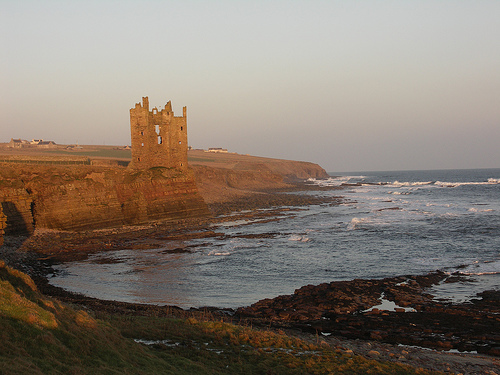
Keiss Castle, perched precariously on sheer cliffs overlooking Sinclair’s Bay in Caithness, Scotland, is a partially ruined yet strikingly picturesque tower house that embodies the rugged charm of the northern Highlands. Located less than a mile north of Keiss village, near the northern tip of mainland Scotland, it stands as a testament to the Sinclair family’s historical dominance in the region. Built in the late 16th or early 17th century, this Z-plan fortress reflects the architectural ingenuity and defensive needs of its time, though its crumbling state today—due to coastal erosion and centuries of neglect—adds a haunting allure to its story.
Origins and Sinclair Construction (Late 16th–Early 17th Century)
Keiss Castle’s origins are tied to George Sinclair, 5th Earl of
Caithness (1582–1643), a powerful figure in northern Scotland whose
family controlled vast lands, including the earldoms of Caithness and
Orkney. Likely constructed between 1590 and 1620—possibly on the site of
an earlier fort known as “Raddar” (though no firm evidence survives)—the
castle served as a secondary stronghold to assert Sinclair authority
over Sinclair’s Bay. Its first recorded mention comes in 1623, when
James VI commissioned Sir Robert Gordon to lead an armed force into
Caithness to quell Sinclair unrest, suggesting the castle was already a
significant presence.
George, known for his ambition, built Keiss
as a Z-plan tower house, a design favored in Scotland for blending
defense with residence. Unlike the nearby Castle Sinclair Girnigoe,
Keiss was smaller and less militarized, hinting it was more a status
symbol than a frontline fortress. The Sinclairs’ control over Caithness
was often contested by clans like the Gunns and Sutherlands, but Keiss
saw little direct conflict, its cliffside perch deterring land-based
assaults.
Later Sinclair Tenure and Decline (17th–18th Century)
The castle passed through generations of Sinclairs, with George, 6th
Earl (d. 1676), shifting focus to Thurso Castle as his primary
residence, allowing Keiss to decay. By 1698, John, 7th Earl, died there,
but records from 1700 describe it as “ruinous,” suggesting rapid
deterioration. A 1726 report notes repairs and a “convenient house
lately built” nearby, possibly a lean-to for tenants, but the tower
itself was abandoned.
In 1710, Sir William Sinclair of Dunbeath,
a branch of the family, acquired Keiss and its lands. Facing financial
strain, he sold Dunbeath in 1752 and began constructing a new mansion,
Keiss House (later called “New Keiss Castle”), about 200 meters inland,
completed around 1755. The old castle, obsolete amid changing military
technology and architectural tastes, was left to the elements, its
cliff-edge location accelerating its ruin as storms battered its
foundations.
Modern Era and Preservation Efforts (19th
Century–Present)
By the 19th century, Keiss Castle was a romantic
ruin, its skeletal towers inspiring antiquarian interest. In 1860,
Colonel K. Macleay, then owner of Keiss House, hired architect David
Bryce to remodel the new castle into a Scottish Baronial mansion,
incorporating stone possibly quarried from the old ruins. Sold to the
Duke of Portland in 1866, the estate remained private, with the old
castle fenced off within its grounds.
Coastal erosion has since
claimed parts of the structure, with a significant collapse in the 20th
century narrowing its footprint. Unlike Castle Sinclair Girnigoe, Keiss
lacks a formal preservation trust, but its status as a Scheduled Ancient
Monument (designated by Historic Environment Scotland) protects it from
development. As of April 11, 2025, it remains a fragile relic, its
future uncertain as the North Sea encroaches, yet its haunting
silhouette endures along the North Coast 500 route.
Keiss Castle is a classic Scottish Z-plan tower house: a tall, narrow
rectangular block with two round towers set at diagonally opposite
corners. Built of dark, layered Caithness flagstone, it was packed onto
a tight clifftop site so that the same compact footprint could serve as
both a noble residence and a lookout over Sinclair’s Bay.
The tower
rose four storeys plus an attic above a vaulted basement. George
Sinclair, 5th Earl of Caithness, raised it in the late 16th or early
17th century, possibly on the site of an earlier fort known as Raddar.
The castle was already standing by 1623, when James VI sent Sir Robert
Gordon into Caithness with an armed force. The 7th Earl died here in
1698. By 1700 the building was described as ruinous, though a 1726
account still found it in repair, with “a convenient house lately built”
beside it. Around 1755 the Sinclairs of Dunbeath abandoned the
cliff-edge tower for a new inland mansion, later remodelled in 1860 by
David Bryce into the Scottish Baronial house now called New Keiss
Castle.
Tower house structure
The main block is unusually
slender for its height, about 8.4 m by 7.2 m over walls a little more
than 1 metre (just over 3 feet) thick. Tall chimneystacks once stretched
that vertical line even further.
Basement. The vaulted cellar is
partly rock-cut into the sloping cliff. It held a kitchen with a wide
fireplace and a small side chamber, probably a storeroom. A spiral stair
in one round tower rose from this level; the lowest treads have been
lost to collapse.
First floor. The hall measured roughly 8 by 4
metres and was the principal living room. An external stair (now gone)
led up to it. Thin walls are pierced by small windows and shot-holes
rather than the heavy gun-loops of later artillery forts.
Upper
floors. Private chambers occupied the second and third floors; the attic
likely housed servants or stores. A square caphouse with a conical roof
crowned the stair tower. A bartizan (overhanging corner turret) on the
north angle added a decorative, slightly martial flourish.
Towers.
One round tower contained the main newel stair. The other was largely
solid mass, stiffening the Z-plan. A smaller turret stair, corbelled out
of the north-west wall, served the highest rooms. One chamber per floor
made the house efficient but cramped, unlike the long ranges of Glamis
or Eilean Donan.
Defence and daily life
The site did most of
the defensive work. The castle stands on a sheer 30-metre (100-foot)
cliff and was almost impregnable from the sea. Landward works were
modest: a simple ditch, now largely eroded. Walls this thin, and the
scarcity of gun loops, suggest the builders expected seaborne raids more
than a siege with cannon. Small windows let in light without opening
large targets.
Timber floors and plastered walls once gave the
interior modest comfort. All of that has gone. What remains is a hollow
shell. Coastal erosion later tore away the north-east angle, taking the
original ground-floor entrance with it. The ruin is now a scheduled
monument, fenced off because the cliff continues to fail.
Setting
and later story
Old Keiss Castle sits less than a mile north of Keiss
village, at the northern end of Sinclair’s Bay, about 7 miles north of
Wick and 10 miles south of John o’ Groats. New Keiss Castle stands
inland on the same estate and remains a private house. Nearby Iron Age
brochs, Keiss Harbour (built c. 1820 for the herring fleet), Castle
Sinclair Girnigoe a few miles south, and the Castle of Mey to the north
place the ruin in a dense belt of Caithness strongholds.
From a
distance the tower looks imposing. Close up it is small and vertical, a
cliff-edge silhouette rather than a sprawling fortress, still one of the
most photogenic ruins on the North Coast 500.
Today, Keiss is a precarious ruin. The eastern tower teeters on the cliff edge, parts of the southern wall have fallen into the sea, and the western tower’s base is fractured. The basement vault remains intact, but upper floors are open to the sky, their timbers rotted away. Erosion has narrowed the promontory, and a retaining wall, added in the 20th century, prevents closer access, preserving what remains while highlighting its fragility.
Keiss Castle’s setting is as compelling as its structure:
Cliffside Promontory: The castle occupies a narrow headland jutting into
Sinclair’s Bay, surrounded on three sides by crashing waves. A small
cove below, reachable by a steep path, offers a rocky beach where
visitors stack cairns amid seaweed and driftwood.
Sinclair’s Bay:
Stretching south to Keiss village and Reiss Beach, this sandy arc
contrasts the cliffs’ starkness. Seals bask on offshore rocks, and
seabirds—puffins, guillemots—nest in the crags.
Approach: A ¾-mile
coastal path from Keiss harbour winds along the cliffs, passing Iron Age
brochs (Nybster and Whitegate) and offering sweeping views to Noss Head
Lighthouse and the Orkney horizon. Heather and gorse dot the hinterland,
with sheep grazing inland fields.
New Keiss Castle: The 18th-century
mansion, a harled Scottish Baronial pile with turrets and crow-stepped
gables, looms 200 meters west, its private grounds enclosing the old
ruins. The juxtaposition of old and new underscores Keiss’ layered
history.
No formal gardens survive, but the wild coastal
landscape—windswept, salt-sprayed—suits the castle’s raw aesthetic, its
isolation amplifying its romance.
Cultural and Social
Significance
Keiss Castle, though less storied than Glamis or Eilean
Donan, carries a quiet weight:
Sinclair Legacy: As a Sinclair
outpost, it reflects their northern empire, linking to Castle Sinclair
Girnigoe and Thurso Castle. While lacking Girnigoe’s infamy (e.g.,
“Wicked George’s” dungeons), Keiss shares their tale of feudal power and
decline.
Architectural Insight: Its Z-plan design offers a window
into late medieval Scotland, a practical blend of defense and
domesticity before artillery reshaped fortresses. Its thin walls and
cliff reliance highlight a shift toward symbolic rather than functional
strength.
Romantic Ruin: The castle’s decay, hastened by nature,
evokes the Romanticism of Sir Walter Scott’s era, its silhouette a muse
for artists and photographers along the North Coast 500.
Local
Identity: For Keiss village (pop. ~500), the castle is a landmark, its
ruins tied to fishing heritage and coastal resilience. Unlike
film-starred Doune or Eilean Donan, Keiss’ obscurity adds authenticity,
a hidden gem for explorers.
Its lack of ghost tales or royal visits
keeps it grounded, a relic of everyday nobility rather than grand drama,
though its cliff-edge peril stirs the imagination.
Located at ND 355 615, Keiss Castle is 8 miles north of Wick via the
A99, part of the North Coast 500. From Inverness (110 miles, 2.5 hours),
take the A9; Wick’s train station (4 hours from Inverness) is a
20-minute drive or taxi ride away. Park at Keiss harbour (KW1 4XD),
where a signed coastal path begins.
Access: Open year-round,
free, with no formal hours—visit during daylight, avoiding stormy days
when winds gust to 80 mph. The ¾-mile walk (15 minutes) from the harbour
is flat and easy, passing brochs and offering bay views, though muddy
after rain. Sturdy shoes are advised; the path suits most but lacks
wheelchair access beyond the cliff edge.
Experience:
Viewing:
A fence, due to cliff slippage, keeps visitors 10 meters from the ruins,
but the castle’s towers and chimneys are vivid against the sea.
Binoculars enhance details like weathered stonework or nesting birds.
Surroundings: Explore the cove below (steep descent, tide-dependent) or
linger at the harbour, where fishing boats bob. Nybster Broch, 0.5 miles
north, adds archaeological depth.
Amenities: No on-site facilities
exist; Wick offers cafés (e.g., Mackays Hotel) and shops. The harbour
has parking for 10–15 cars, free but busy in summer.
Highlights
include the castle’s leaning silhouette, the crash of waves below, and
Orkney’s faint outline on clear days. Nearby, Castle Sinclair Girnigoe
(3 miles north) and John o’ Groats (10 miles) complement a Caithness
tour.
Keiss Castle stands on borrowed time. The late-16th or
early-17th-century Z-plan tower house of George Sinclair, 5th Earl of
Caithness, still clings to the sandstone and flagstone cliffs at the
northern tip of Sinclair’s Bay, but the North Sea is taking the ground
from under it.
Coastal erosion is the most immediate danger. The
northeast angle of the tower, which once held the original ground-floor
entrance, has already sheared away with the cliff. What remains sits on
a narrowing headland, its walls only about a metre thick and never built
with landward defence in mind. Storms, salt spray and a slowly rising
North Sea continue to undercut the Devonian flagstones that form this
stretch of Caithness coast. Without large-scale engineering that no one
is funding, further collapse is expected rather than possible.
Structural decay has been underway for centuries. The castle was already
called ruinous by 1700, two years after the 7th Earl of Caithness died
inside it. A brief mention of repair in 1726, with “a convenient house
lately built” beside it, did not last. Around 1755 the Sinclairs of
Dunbeath abandoned the clifftop stronghold for a new house further
inland, later remodelled in 1860 by David Bryce into the Scottish
Baronial mansion still known as Keiss Castle or Keiss House. The old
tower has stood unroofed ever since. Rain and salt work through the
masonry; upper floors are gone; the interior is now visible from outside
like an opened doll’s house, with traces of the wheel stair and former
floor levels still readable in the stone.
Unlike Castle Sinclair
Girnigoe a few miles south, which has had a dedicated trust since 1999,
Old Keiss has no active conservation body. It is a Scheduled Monument
(SM623, first designated in 1920), which protects it from unauthorised
work but also limits what can be done without consent. There is no
public budget for stabilisation. Safety fencing, recently improved along
the John o’ Groats Trail approach with gates, stiles and a viewing lane,
keeps visitors back from the edge. The ruin itself must not be entered.
Recent collapses in the ground around the walls make that warning more
than official caution.
The same ruinous state that makes the castle
dangerous is what gives it its hold on photographers and walkers. From
Keiss Harbour or the beach the silhouette still reads as a tall, narrow
Z-plan against sky and water, two round towers at opposite corners of a
slim central block. It was built to watch the sea rather than the land.
Today it watches its own foundations disappear. The fencing, the
scheduled status and the absence of a rescue fund all point the same
way: Keiss is being left to the weather, a coastal monument whose charm
and peril are now the same thing.