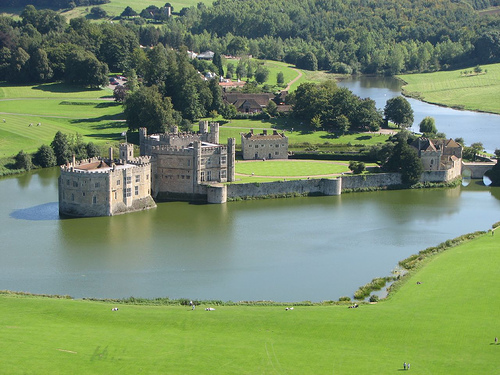
Location: 4 miles (6.5 km) Southeast of Maidstone, Kent Map
Constructed: 1119
Tel. 01622 765400
Open: 10am- 5pm daily
Closed: for concerts, 25 December
Leeds Castle, located in Kent, England (about 7 miles southeast of Maidstone, near the village of Leeds), is often called the "loveliest castle in the world" and the "Castle of Queens." It sits dramatically on two small islands in a man-made lake formed by the River Len, surrounded by over 500 acres of parkland, gardens, a maze, and woodlands. While its current appearance blends medieval, Tudor, and 19th–20th-century elements, its history spans over 1,100 years—from a Saxon manor to a Norman stronghold, a favored royal residence for medieval queens and kings, a Tudor palace, a private country house, a wartime hospital, and today a major heritage attraction and event venue.
Early Origins: Saxon Manor to Norman Stronghold (857–12th
Century)
The site's earliest recorded history dates to around AD
857, when a Saxon chief named Led (or Leed) is said to have built a
wooden structure on the two islands in the River Len. The Domesday
Survey of 1086 (commissioned by William the Conqueror) first
mentions the "Manor of Esledes" (an Old English term possibly
meaning "slope" or "hillside"), owned by Odo, Bishop of Bayeux and
half-brother to William I. Soon after, King William II ("Rufus")
granted the estate to Hamo de Crevecoeur, whose family held it for
about 175 years.
In 1119, Hamo's grandson, Robert de Crevecoeur,
constructed the first stone castle on the natural rocky outcrops of
the islands. The main fortification—a keep (now the site of the
Gloriette)—stood on the smaller island, while domestic buildings
occupied the larger "Bailey" island, connected by a raisable
drawbridge for defense. It likely began as a simple motte-and-bailey
or island fortress. Surviving 12th-century remnants include a
two-light window in the Salon and a vaulted cellar beneath the
Servants' Room.
The castle's first major trial came in 1139
during the Anarchy (the civil war between King Stephen and Empress
Matilda). The de Crevecoeur family supported Matilda, prompting King
Stephen to besiege Leeds Castle; the family survived, but it marked
its early entanglement in royal politics.
Royal Palace and
the "Castle of Queens" (13th–15th Centuries)
Leeds Castle entered
its golden royal era in 1278 when Queen Eleanor of Castile (wife of
Edward I) purchased it by acquiring a debt bond from Jewish
moneylenders (discounted due to Edward's heavy taxation). It became
one of Edward I's favorite residences. Eleanor oversaw major
upgrades: a revetment wall (up to 10 meters high) around the larger
island with D-shaped bastion towers, and enhancements to the smaller
island's buildings, which evolved into the Gloriette (a Spanish term
for a garden pavilion, reflecting Eleanor's heritage). The
surrounding lake and a unique three-part barbican (with multiple
drawbridges, gateways, and portcullises spanning three islands) were
likely added, creating formidable defenses.
After Eleanor's death
in 1290, Edward I continued improvements (including a bathhouse
inspired by his Crusades experiences) and granted the castle as
dower property to his second wife, Queen Margaret of France (1299).
It passed through several queens as a royal dower or residence:
Queen Isabella of France (wife of Edward II): In 1321, her husband’s
steward, Bartholomew de Badlesmere, refused her entry; archers fired
on her party, killing six. Edward II besieged and captured the
castle; Badlesmere was later executed. Isabella retained it after
Edward II’s 1327 deposition and murder, using it until her death in
1358.
Queen Anne of Bohemia (wife of Richard II): Granted in
1382; the couple visited often. Chronicler Jean Froissart described
it in 1395 as a “beautiful Palace in Kent called Leeds Castle.”
Queen Joan of Navarre (wife of Henry IV): Received it in 1403;
briefly imprisoned here in 1419–1422 on witchcraft accusations by
her stepson Henry V (later released). Her wardrobe accounts detail
daily life.
Queen Catherine de Valois (wife of Henry V):
Inherited it in 1422.
(Some accounts also link it to Philippa
of Hainault, wife of Edward III, and note its use by other royals.)
This era earned it the nickname “Castle of Queens.” Edward III added
outer gates, portcullises, and refurbished apartments. A 1414
inventory by Archbishop Thomas Arundel describes the layout: great
hall and chapel on the larger island, kitchens, moat, and floodable
defenses.
Tudor Palace (16th Century)
Henry VIII
transformed the fortress into a luxurious palace, investing heavily
from 1517–1523 (and later) for his first wife, Catherine of Aragon.
He added an upper floor to the Gloriette, fireplaces with royal arms
and lovers’ knots, mullioned windows, and the Maidens’ Tower (with
flattened Tudor arches). A 1532 inventory details the opulent
apartments. Catherine stayed here en route to the 1520 Field of the
Cloth of Gold (supplies like venison came from Leeds); the famous
painting of that event still hangs in the castle. Glazier Galyon
Hone repaired windows in 1536 and 1544 (for Catherine Parr’s visit).
Royal ownership ended in 1552 when Edward VI granted it to Sir
Anthony St. Leger.
Private Ownership: Jacobean to Georgian
Era (17th–18th Centuries)
The St. Leger family held it until
1618, when Warham St. Leger sold it to Sir Richard Smythe (who built
a large Jacobean house on the larger island, foundations later
excavated). It passed to the Culpeper family in 1632. During the
English Civil War, owner Sir Cheney Culpeper supported Parliament,
sparing the castle (though used as an arsenal and prison). In 1665,
it housed Dutch prisoners, who accidentally burned part of the
Gloriette (damage unrepaired for centuries).
By the late 17th
century, it passed via marriage to the Fairfax family (linked to
Virginia estates in America). The 6th Lord Fairfax was born here
(1693) and later settled permanently in colonial America. His
brother Robert laid out the parkland in the mid-18th century. George
III and Queen Charlotte visited in 1778, prompting refurbishments.
The Georgian era saw Strawberry Hill Gothic additions to the
Jacobean house.
19th-Century Remodelling: The "New Castle"
(Early 1800s)
Inherited by the Wykeham Martin family in the 19th
century, the castle was in poor repair (ruined Gloriette, collapsing
towers). Fiennes Wykeham Martin demolished the Jacobean house and
built the current Tudor-style "New Castle" (completed ~1823) by
architect William Baskett, clearing the moat and repairing the
Gloriette. Costs led to auctions of contents, but the family later
prospered. By the late 19th century, it was one of Kent’s largest
estates.
20th Century: Lady Baillie’s Glamorous Restoration
and Public Era
In 1926, the Hon. Olive, Lady Baillie
(Anglo-American heiress) bought the rundown castle for £180,000
(equivalent to millions today) as a Kent retreat. She spent lavishly
(over $2 million in the era) restoring it with French designers like
Armand-Albert Rateau and Stéphane Boudin: recreating Tudor
interiors, adding a grand oak staircase, modern plumbing, a music
room from the former chapel, and luxurious 1930s fittings. It became
a glamorous venue for weekend house parties attended by royalty
(e.g., Prince of Wales and Wallis Simpson), politicians, film stars
(Charlie Chaplin, Errol Flynn), and celebrities.
During WWII, it
served as a hospital, treating wounded soldiers from Dunkirk and
injured airmen. Post-war, Lady Baillie continued hosting on a
smaller scale (including Queen Elizabeth the Queen Mother). On her
death in 1974, she bequeathed it to the Leeds Castle Foundation (a
private charitable trust) to preserve it for the nation. Gardens
opened to the public in 1975, the castle in 1976; major investments
funded conferences and visitor facilities. It hosted the 1978 Middle
East peace talks (preceding Camp David Accords) and 2004 Northern
Ireland talks.
Today, the castle welcomes hundreds of thousands
of visitors annually. While much of the visible structure reflects
19th–20th-century restorations, the medieval core (Gloriette base,
moat defenses) remains. Features include the unique barbican,
Maidens’ Tower, a yew maze with grotto, aviaries (formerly), and
exhibitions on its queens.
Norman Origins (1119) – The First Stone Fortress
In 1119, Robert
de Crevecoeur erected the first stone castle on the site, taking
advantage of two natural rocky islands in the River Len. The smaller
island housed the main fortification—a Keep—while the larger island (the
Bailey) contained domestic buildings, including a great hall, chapel,
buttery, bake-house, pantry, and kitchens. The islands were linked by a
drawbridge that could be raised for defence. The whole complex was
surrounded by a wide moat, with an inner ditch between outer and inner
walls for added protection.
Surviving Norman elements are rare but
telling:
A two-light window at the end of the present-day Salon.
The vaulted cellar beneath the Servant’s Room, featuring a
characteristic round Norman arch leading to a now-blocked staircase.
The castle was built primarily of local ragstone, a hard Kentish
limestone that has weathered into the characteristic pale-grey, textured
walls still visible today.
13th-Century Royal Upgrades under
Edward I and Eleanor of Castile (1278–1290s)
When the castle passed
to King Edward I in 1278, it became a royal palace. Major defensive and
residential improvements transformed it:
The Gloriette (named in
honour of Queen Eleanor, evoking a Spanish-style garden pavilion)
replaced or incorporated the original Keep. It housed the king’s and
queen’s private apartments, a great hall, and a chapel. The structure
rises directly from the water on the smaller island and was reinforced
with thick stone walls.
The Barbican—one of the most distinctive
features in British castle architecture—was constructed as a three-part
defensive sequence spanning additional islands in the moat. Each section
had its own entrance, drawbridge, gateway, and portcullis, creating
successive barriers that made a direct assault extremely difficult.
A
revetment wall with D-shaped bastion towers (originally rising about 10
metres straight from the water) encircled the islands; only one tower
retains its full original height.
Edward I reportedly added a
bath-house beneath the Bailey walls (near the future Maiden’s Tower),
inspired by his Crusades experiences.
These works created the
classic “castle on water” silhouette that still defines Leeds Castle.
Tudor Transformations (Henry VIII, 1517–1523)
Henry VIII spent
lavishly to convert the fortress into a luxurious royal palace for his
first wife, Catherine of Aragon. Key changes included:
An upper
floor added to the Gloriette for more private apartments.
Fireplaces
in the Queen’s Gallery bearing the arms of Castile and pomegranates of
Aragon.
A large Tudor bay window in the Henry VIII Banqueting Hall.
The Maiden’s Tower (late Tudor), originally built to house the queen’s
maids of honour; it features mullioned windows and Tudor arches and was
later converted into brewhouse, bachelor apartments, and even a cinema.
Some 16th-century busts of Henry VIII, Mary I, Elizabeth I, and
Edward VI survive in the interiors.
17th–18th Centuries: Jacobean
Mansion and Georgian Gothic
After the royal period, the castle became
a private residence. Sir Richard Smythe built a large Jacobean mansion
on the main island (demolished later). A 1665 fire (started by Dutch
prisoners housed in the Gloriette) damaged interiors. In the Georgian
era, the Jacobean house received fashionable “Strawberry Hill Gothic”
window embellishments.
19th-Century Tudor-Revival Rebuild
(1822–1823)
The Wykeham Martin family inherited the estate and used
proceeds from American land sales to undertake a comprehensive
restoration. They demolished the decaying Jacobean/Georgian house and
erected the present “New Castle” in a romantic Tudor style. The
Gloriette was repaired after earlier fire damage, and the moat was
cleared. This phase largely defines the castle’s external appearance
today—turrets, battlements, mullioned windows, and ragstone walls that
blend seamlessly with the medieval fabric.
20th-Century Luxury
Restoration under Lady Olive Baillie (1926–1974)
In 1926, the Hon.
Olive, Lady Baillie purchased the castle (then in poor condition) and
spent millions transforming it into a glamorous 20th-century country
house while preserving its medieval character. Working first with French
architect Armand-Albert Rateau and later with decorator Stéphane Boudin,
she:
Added a 16th-century-style carved-oak spiral staircase in
the Fountain Court.
Restored the Banqueting Hall to its full size (it
had been subdivided).
Converted the Chapel into a music room.
Installed modern plumbing and service quarters.
Created sumptuous
interiors: the Library (formerly the great hall), Thorpe Hall Drawing
Room (imported 1653 pine panelling from a Lincolnshire mansion),
Boudoir, and dining room in refined French Regence and Louis XVI styles.
Reconfigured the Maiden’s Tower into family apartments.
The
result is a harmonious blend of medieval shell, Tudor revival, and
elegant 1930s luxury.
Key Architectural Elements Today
Setting
and Defences: The castle is entirely water-bound, with the moat and lake
providing natural fortification. The approach crosses the three-stage
barbican, gatehouse, and bridges—still impressive despite later
landscaping.
Gloriette: The oldest core; now contains the Banqueting
Hall (with Tudor bay window and royal fireplaces), Queen’s apartments,
and a restored chapel area. Its position on the smaller island, reached
by a bridge, gives it the feel of a self-contained royal pavilion.
Main Bailey / New Castle: Houses the Library, drawing rooms, dining
areas, and service quarters—largely 19th- and 20th-century interiors
within medieval walls.
Maiden’s Tower: Distinctive Tudor structure
with its own courtyard; now elegant guest accommodation.
Materials:
Primarily Kentish ragstone with some brick insertions (Tudor period);
timber roofs, oak panelling, and imported French stonework in the
20th-century work.
Leeds Castle’s architecture is not a frozen
medieval relic but a living record of adaptation—from Norman military
stronghold to royal palace, Jacobean mansion, Victorian romantic
fantasy, and 20th-century aristocratic retreat. Its genius lies in how
later owners respected the water-girt silhouette while layering
luxurious interiors that make it feel both ancient and inviting. Today
it remains one of Britain’s most photogenic and architecturally
fascinating castles, open to the public and carefully maintained by the
Leeds Castle Foundation.
A typical visit starts at the Visitor Centre, where you can pick up a
map, multimedia guide, and tickets. The estate is large, so plan 4–7+
hours (or a full day) to explore without rushing. Free parking is
included, and internal transport like Elsie the Castle Train (small
charge in season) and the Black Swan Ferry (seasonal) help you get
around.
The Castle Itself
The highlight for many is touring
the castle interiors, which blend medieval roots with later layers.
Self-guided with a multimedia guide (included), you’ll see:
Grand
rooms reflecting Lady Baillie’s 20th-century country house era (e.g.,
elegant drawing rooms, dining areas with Art Deco touches).
Tudor
remnants from Henry VIII’s time, including heraldic symbols and
fireplaces.
Exhibits on the queens who lived here and "Queens with
Means."
The Dog Collar Museum (a quirky collection of historic dog
collars from medieval to Victorian times).
Special temporary
displays, such as "Pilgrimage of Love: Eleanor of Castile" (running
March–November 2026) or castle talks (January–March 2026).
The
castle feels lived-in rather than sterile, with armor, furnishings, and
views over the moat. Allow 1–2 hours. Note that parts may occasionally
close for events or maintenance.
Gardens and Parkland
The
500-acre grounds are stunning year-round and change dramatically with
seasons:
Culpeper Garden: A charming formal garden with herbaceous
borders, herbs, and roses—perfect for strolling.
Lady Baillie
Mediterranean Garden Terraces: Sun-drenched terraces with Mediterranean
planting and views of the castle.
Princess Alexandra Gardens: More
formal landscaping.
In spring (e.g., Darling Daffodil Walks,
March–April 2026), vibrant blooms light up the paths.
Wider parkland
offers circular walking routes, wildlife spotting (birds, swans, deer),
streams, and peaceful viewpoints. Deckchairs are available in summer for
relaxation.
The setting—castle rising from the moat—is
postcard-perfect, especially at golden hour.
Family and Adventure
Attractions
Leeds Castle excels as a family day out:
Maze and
Underground Grotto: A large yew hedge maze (planted 1988) leading to a
mysterious, mythical underground grotto—fun and atmospheric for all
ages.
Bird of Prey Centre and Falconry Displays: One of the most
popular features. Watch majestic birds (owls, eagles, falcons) in
free-flying demonstrations. You can sometimes book close encounters (may
have extra fees).
Playgrounds: Knights’ Stronghold (for older kids)
and Squires’ Courtyard (for younger ones), plus a Castle Kids Obstacle
Course—medieval-themed and energetic.
Adventure Golf: A challenging
12–18 hole course (small additional charge).
Seasonal extras like
Easter activities (April 2026), jousting, or beach areas in warmer
months.
Other Highlights
Black Swan Ferry and Train Rides:
Scenic ways to cross the water or tour the estate (small charges,
seasonal).
Go Ape or Segway Tours: Added adventure options (likely
extra cost).
Wildlife and nature: Moat, lake, and parkland teem with
birds and animals.
Many attractions are included in standard
admission. Events throughout the year (jousting in May, concerts in
July, etc.) add variety but can increase crowds.
Practical
Information for Visiting (as of 2026)
Opening Hours (subject to minor
changes; check the official site):
Grounds & Gardens: 10am–5pm
(Jan–Mar, last entry 3pm); 10am–6pm (Apr–Sep, last entry 4pm).
Castle: 10:30am–3:30pm (Jan–Mar, last entry 3pm); 10:30am–5pm (Apr–Sep,
last entry 4:30pm).
Other facilities (golf, playgrounds, etc.) align
with grounds but close earlier. Closed Christmas Day (fireworks event
only that weekend).
Open nearly every day (364 days a year).
Tickets (pay once, return free for 12 months—great value for multiple
visits):
Explorer Ticket (core access): Adult £34.50 online / £38.50
onsite; Child (3–15) £24.50 / £28; Family options from ~£87.
Ultimate
Explorer Ticket (adds extras like more experiences): Higher prices (~£11
more per adult).
Discounts: Online booking saves money; 20% off for
green travel (train/bus/bike, redeem at Visitor Centre); concessions for
disabled visitors + carers.
Book ahead via leeds-castle.com,
especially for peak times or events.
Getting There:
By Car:
Junction 8 off M20 (1 hour from London, 30 min from Channel Tunnel).
Free parking.
By Public Transport: Train to Bearsted (from London ~1
hour via Southeastern) then shuttle bus or taxi (~10–15 min). Or to
Maidstone and bus. Green travel discount available. Taxis from Maidstone
~£40–55.
Address: Broomfield, Maidstone, Kent ME17 1PL.
Facilities: Castle View Restaurant (lunch-focused), cafés, shops,
pre-loved bookshop. Picnics allowed in grounds. Mobility bus for
accessibility. Toilets and baby-changing available. The site is mostly
accessible, but some castle areas (steps, uneven paths) may challenge
those with limited mobility—contact ahead.
Best Time to Visit:
Weekdays or early morning to avoid crowds. Spring for daffodils and
blooms; summer for longer days and full facilities; autumn for foliage;
winter for quieter, atmospheric visits (shorter hours). Weather in Kent
can be variable—bring layers and comfortable walking shoes.
Tips from
Visitors:
Allocate a full day; many say 3–6 hours minimum.
Combine
with nearby Kent attractions (Canterbury, Dover) for a longer trip.
Overnighters can stay in on-site accommodations (e.g., Stable Courtyard
rooms, lakeside lodges, or holiday cottages) for after-hours ground
access and a magical experience.
Food can be pricey; some bring
picnics.
Crowds build during school holidays and events—book online
and arrive early.
Photography is excellent around the moat and from
the terraces.
The Black Dogs (or Ghostly Retrievers)
The most famous legend
involves two spectral black curly-haired retriever dogs, one bringing
good fortune and the other ill fortune or death. Sightings describe them
appearing and vanishing suddenly—often passing through walls or closed
doors—in corridors, rooms, and grounds. These have been reported for
generations by staff, visitors, and locals.
The Bad Luck Dog: Its
appearances often precede tragedy, misfortune, or death for occupants or
visitors. It is linked to Eleanor Cobham, Duchess of Gloucester (wife of
Humphrey, Duke of Gloucester, and aunt to Henry VI). In the 1430s–1440s,
she was imprisoned at the castle on charges of necromancy, witchcraft,
heresy, and treason (involving plots against the king using wax effigies
and sorcery). The dog is sometimes described as her demonic familiar or
the result of a curse she placed during her confinement.
The Good
Luck Dog: This one is protective. In one recounted story, it barked
frantically at a person sitting in a bay window (in what is now the
Henry VIII Banqueting Hall) until they moved—moments before the window
collapsed into the moat, potentially saving their life.
These black
dog legends fit into broader British folklore of phantom hounds as
omens.
Female Ghosts and Apparitions
Several female spirits
are reported:
Duchess of Gloucester (Eleanor Cobham): A gliding woman
in the corridors, believed to be her restless spirit from her
imprisonment.
Woman in the Queen's Room: A figure in a long flowing
dress, seen brushing her hair.
Grey/White Lady: A sorrowful
apparition in grey or white, sometimes linked to Joan of Navarre
(imprisoned earlier on witchcraft charges) or other tragic royal women.
She roams halls and areas like the Maiden's Tower and moat.
Lady
Olive Baillie: A more modern, benevolent ghost. The Anglo-American
heiress who owned and restored the castle in the 20th century (dying in
1974) is reportedly seen in 1930s attire, continuing to "oversee" her
beloved home as a caring hostess.
Other reports include
unexplained footsteps (e.g., running down spiral staircases with no one
visible), cold spots, and a woman in white observed in Henry VIII's
rooms during a psychic experiment—possibly tied to Joan of Navarre's
imprisonment.
Other Legends and Prophecies
Alice Wykeham
Martin's Predictions (19th century): Daughter of owners Charles and
Jemima Wykeham Martin, Alice had reputed psychic abilities or
superstitions. One warned that bringing a hawk into the castle foretold
the owner's death. In 1878, a gamekeeper did so; her uncle Philip soon
fell ill and died. Portraits of her parents hang in the castle.
Broader context includes witchcraft tales (Joan of Navarre and Eleanor
Cobham were both accused and held there) and the castle's layers of
conflict, sieges, and royal drama, which fuel its haunted reputation.