Location: North Yorkshire Map
Constructed: 1398 by Thomas de Holand, Earl of Kent and Duke
of Surrey
Dissolved: 1539
Tel. 01609 883494
Open: Apr-
Sep: Thu- Mon
Oct- Mar: Thu- Sun
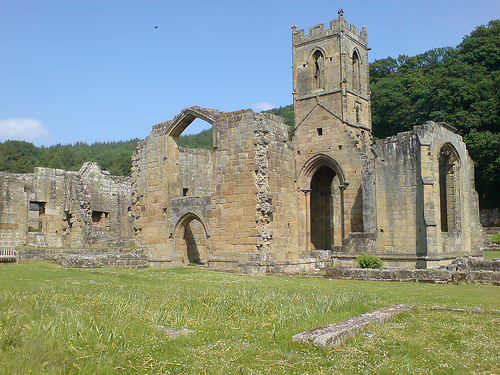
Mount Grace Priory, also known as the Charterhouse of the Assumption of the Blessed Virgin and St Nicholas, is the best-preserved Carthusian monastery (charterhouse) in England and one of the finest surviving examples in Europe. Located in the parish of East Harlsey, North Yorkshire, at the foot of the Cleveland Hills within the North York Moors National Park, it was founded in 1398 and dissolved in 1539. Its exceptional preservation allows a clear view of its unique layout: a small church, two cloisters surrounded by individual monks’ cells with private gardens, an inner court with guest facilities, and advanced water systems—all reflecting the Carthusian emphasis on solitary, contemplative life rather than communal monasticism.
Founding in 1398: A Product of Late Medieval Piety and Royal
Connections
The priory was established in or shortly after April 1398
by Thomas de Holland (c. 1374–1400), 6th Earl of Kent and 1st Duke of
Surrey, nephew of King Richard II. Holland founded it at his manor of
Bordelby in partnership with his tenants John and Eleanor de Ingleby,
driven by his “special devotion” to the Carthusian order. This
French-founded order (originating at the Grande Chartreuse in the 11th
century) emphasized extreme austerity, silence, and eremitic
(hermit-like) living—unlike the more communal Benedictines or
Cistercians.
It was one of the last monasteries founded in medieval
Yorkshire and among the few new houses established in Britain between
the Black Death (1348–50) and the Reformation. Holland, a courtier
enriched by the Hundred Years’ War, endowed it with estates confiscated
from “alien” priories (English dependencies of French monasteries seized
during the war). Richard II granted liberties, including lead-mining
rights, and alien priories such as Hinckley, Carisbrooke, and Wareham.
The foundation charter required prayers for the royal family, Holland’s
heirs, and the Inglebys.
Initially, the community was small—space for
a prior and about 23 monks (choir monks and lay brothers)—with Robert
Tredwye as the first rector (later prior).
Early Instability and
Revival (1400–1420s)
Holland’s promising foundation collapsed
quickly. After Richard II’s deposition in 1399, Holland joined a failed
coup against Henry IV and was executed in 1400. His body was later
reburied at the priory in 1412. The loss of patronage and insecure
endowments (many alien priory grants were temporary) left the monks
vulnerable. Henry IV and Henry V reclaimed some lands to support other
projects, including Henry V’s own charterhouse at Sheen.
Salvation
came from Thomas Beaufort, Duke of Exeter and half-brother to Henry IV.
Around 1415, he became the priory’s “second founder,” persuading Henry V
to restore endowments in stages. Beaufort added five extra monks to pray
for him and was buried there in 1429 after the church was extended
eastward with new stalls and a tower over the cross-passage. This marked
the first major building phase (c. 1400–1410, followed by 1420s
expansions).
Four distinct building phases are identifiable
archaeologically (c. 1400–1523), tied to these events.
Growth,
Stability, and Carthusian Daily Life (Mid-15th to Early 16th Century)
By the mid-15th century, the priory stabilized through additional royal
and noble grants. Edward IV gave the manor of Atherstone (1462) and
estates from the French priory of Bégard (1471) for a chantry. Later
benefactors included Henry, Lord Clifford (who funded more cells in the
1520s) and Sir John Rawson (who built a travelers’ hostel, “le Inne,”
before fighting at Rhodes in 1522). A waiting list of aspiring monks
existed by 1523.
The Valor Ecclesiasticus (1535) valued its net
income at about £323 annually, making it reasonably wealthy despite
earlier uncertainties.
Carthusian life was highly distinctive. Monks
lived as near-hermits in one of up to 25 individual cells around the
Great Cloister (north of the church; 15–17 cells for choir monks) and
Lesser Cloister (six cells for lay brothers). Each cell included a
living hall with fireplace, study, bedroom/oratory, upper workroom,
garden (for horticulture and meditation), and latrine. A service hatch
prevented visual contact with servers; water was piped from hillside
springs via an octagonal conduit house. Carthusians ate mostly
vegetarian meals in solitude (except Sundays and feast days), observed
near-constant silence, and gathered only for limited services in the
small, plain church. They practiced trades and produced devotional
literature.
Notable intellectual output included works by priors like
Nicholas Love (early 15th century, first prior after formal
incorporation in 1410), whose Mirror of the Blessed Life of Jesus Christ
was a hugely popular Middle English devotional text. The house preserved
the only surviving manuscript of The Book of Margery Kempe and
translations by Richard Methley.
The church was rectangular and
modest (expanded with burial chapels in the 1470s and 1520s). An outer
court housed service buildings, a gatehouse (c. 1400), guesthouse, mill,
fishponds, and a moat-like system. Three well-houses supplied fresh
spring water—crucial since Carthusians drank water several days a week.
Dissolution in 1539
Mount Grace avoided early involvement in the
Pilgrimage of Grace (1536) but was suppressed in December 1539 during
Henry VIII’s Dissolution of the Monasteries—one of the last in
Yorkshire. Prior John Wilson surrendered after initial resistance to the
Oath of Supremacy (some monks were briefly imprisoned). The community
received generous pensions (totaling £195); Wilson got the nearby
hermitage at The Mount in Osmotherley, and a few later joined the
refounded Sheen charterhouse under Mary I (1555).
Post-Dissolution: From Ruins to Mansion and Arts & Crafts Revival
The
site was leased to John Cheney (1540) then bought by Sir James
Strangways (1541). It passed through families (Rokeby, then via marriage
to Conyers Darcy, Lord Darcy of Knayth in 1616). In the mid-17th
century, Thomas Lascelles (1653/4) converted the medieval guesthouse
into a private mansion (Mount Grace House), adding a dated porch. The
southern half of the guesthouse survived intact.
In 1898,
industrialist Sir Isaac Lowthian Bell (ironmaster and MP) purchased the
ruins. Architect Ambrose Poynter extended and remodelled the house in
the Arts and Crafts style, inspired by William Morris and John
Ruskin—exposing medieval features while preserving 17th-century
interiors. Bell rebuilt one monk’s cell (later reconstructed by English
Heritage in the 1980s based on excavations).
The ruins were among
the first conserved under Society for the Protection of Ancient
Buildings principles. The site passed to the National Trust in 1953
(with the house) and English Heritage guardianship for the monastic
remains (from 1955). It is a scheduled monument and Grade I listed
building.
Historical and Archaeological Significance
Mount
Grace stands out as the pre-eminent “type-site” for late medieval
Carthusian houses due to its preservation (no major post-medieval
alterations to the core monastic plan), extensive excavations (about 35%
of central buildings, plus food waste, garden evidence, and plumbing),
and architectural analysis. It is the only publicly accessible
Carthusian monastery in England and has international importance
alongside a few Dutch sites. Excavations have yielded unparalleled
evidence of monastic diet, daily life, and horticulture.
Today,
visitors can explore the ruins, reconstructed cell, and restored
house—offering a vivid window into medieval solitary monasticism,
political patronage, and later aristocratic adaptation. The priory
remains a powerful symbol of late medieval piety, the upheavals of the
Reformation, and 20th-century heritage conservation.
Mount Grace Priory, in the parish of East Harlsey, North Yorkshire,
England (within the North York Moors National Park), is the
best-preserved Carthusian charterhouse (monastery) in Britain and one of
the finest surviving examples in Europe. Founded in 1398 by Thomas de
Holland, 1st Duke of Surrey, and dedicated to the Assumption of the
Blessed Virgin Mary and St Nicholas, it was designed specifically for
the Carthusian Order’s semi-eremitic (hermit-like) lifestyle. Unlike
Benedictine or Cistercian monks who lived communally, Carthusians spent
most of their time in solitary prayer, study, and manual labour within
individual cells, gathering only rarely for services.
The
architecture emphasises privacy, self-sufficiency, and contemplation,
with four main construction phases identifiable between c.1400 and 1523.
The priory is built primarily of local stone, with ashlar (finely
dressed) masonry for higher-status elements such as the church and guest
house. The overall precinct is enclosed by a wall (mostly 1420s), with
an outer court beyond for farming and industry. The surviving
layout—including the church, two cloisters, cells, inner court, and
water systems—is remarkably clear on the ground.
Overall Layout
and Phased Development
The monastery is compact and centred on a
small church. To its north lies the Great Cloister (the largest
feature), surrounded on three sides (east, west, and north) by 15
individual monks’ cells, with the prior’s and sacrist’s cells in the
south range—accommodating up to 17 choir monks plus the prior. To the
south of the church is the smaller Lesser Cloister with six cells for
lay brothers (who handled domestic work). Further south is the Inner
Court, containing service buildings (kitchens, brewery, bakery, stables)
entered through a c.1400 gatehouse. The medieval guest house occupies
the west side of the Inner Court.
Construction unfolded in clear
phases:
c.1400 (initial build): Church, gatehouse, basic cloisters,
and first cells.
1420s (under Thomas Beaufort, “second founder”):
Major expansion of the church (tower, eastward extension), more cells,
and precinct wall.
1470s: Addition of burial chapels.
1520s (under
Henry, Lord Clifford): Further cells and a third chapel; the priory
reached near-full capacity with a waiting list.
A sophisticated
piped water system—unusual for the period—served the entire site from
hillside springs via conduit houses and an octagonal water tower in the
Great Cloister.
The Church
The church is characteristically
small for Carthusians (who performed most offices privately in their
cells) and built in Perpendicular Gothic style, with pointed arches and
remnants of tracery. It began c.1400 as a simple rectangular structure
of four bays with a central cross-passage dividing the western section
(for lay brothers, entered via the west door) from the eastern monks’
choir and chancel.
In the 1420s it was enlarged: a square tower was
added over the cross-passage, the choir extended eastward by two bays,
and new stalls installed. Three burial chapels were later added (two
flanking the nave in the 1470s, one south of the choir in the 1520s) to
accommodate wealthy patrons’ tombs and chantry masses. There are no
aisles or transepts—the plan remains a simple rectangle focused on the
high altar and choir. Monks accessed the church via steps from the Great
Cloister. The ruins today show the tower base, pointed windows, and
chapel foundations clearly.
The Great Cloister and Monks’ Cells
This is the architectural highlight and the defining feature of
Carthusian design. The Great Cloister is a large square walk (much
bigger than typical monastic cloisters) enclosing a central garth. Each
of the 15+ cells is a self-contained two-storey stone house with its own
walled garden and a tiny private cloister (covered walkway) for
meditation—essentially a private miniature monastery.
A typical cell
(one of which has been fully reconstructed and furnished by English
Heritage) included:
Ground floor: Living room (with fireplace),
bedroom (with oratory for private prayer), and latrine connected to a
flushed sewage system.
Upper floor: Workroom (for copying
manuscripts, spinning, or other manual labour).
Garden:
Vegetable/herb plot for self-sufficiency; covered walkways
(reconstructed from excavation evidence).
Serving hatch: An L-shaped
opening beside the door through which food was passed without visual
contact.
Each cell had its own piped fresh-water supply (for
drinking and latrine flushing) and was built against the cloister wall.
The reconstructed cell demonstrates the surprisingly spacious yet
austere comfort: stone walls, leaded windows, wooden furniture, and
direct access to the garden.
Lesser Cloister, Inner Court, and
Service Buildings
The Lesser Cloister (south of the church) housed
six smaller cells for lay brothers, who managed cooking, brewing,
baking, and other communal tasks. The Inner Court contained the main
service ranges (kitchens, stores, stables) and was the hub of practical
activity. These areas are now largely earthworks or low ruins but show
the functional, utilitarian design contrasting with the contemplative
Great Cloister.
Guest House and Later Manor House (Mount Grace
House)
The medieval guest house (west side of the Inner Court)
survives almost intact within the later house. It originally featured
four ground-floor guest cells, upper suites for important visitors, a
guest hall open to the roof, and a north-end kitchen with procurator’s
accommodation above. The southern half retained its medieval roof
timbers.
After the priory’s suppression in 1539, the guest range was
converted in the early 17th century into a Jacobean manor house (porch
dated 1654) by Thomas Lascelles. Features include
mullioned-and-transomed windows with hood moulds, gables, and a
full-height porch with a Tudor-arched doorway. Medieval buttressing was
retained on the left bays.
In 1898–1901, industrialist Sir Lowthian
Bell commissioned architect Ambrose Poynter for an Arts & Crafts
restoration and extension. This sensitively exposed medieval fabric,
preserved 17th-century interiors (oak panelling, inglenook fireplaces),
and added rooms with Morris & Co. wallpapers, hand-blocked designs, and
naturalistic motifs—embodying the movement’s reverence for
pre-industrial craftsmanship. The house today retains this layered
character: 15th-century stone core, 17th-century Jacobean façade, and
early 20th-century Arts & Crafts interiors and gardens.
Water
Supply and Engineering
A standout technical feature is the advanced
hydraulic system. Three hillside springs fed well houses (conduit
houses) that distributed water via lead pipes to every cell, the
cloisters, and the Inner Court. An octagonal tower in the Great Cloister
acted as a central distribution point. Carthusians drank water (rather
than beer) at least three days a week, making this system essential.
Drainage and latrine flushing were also integrated.
Summary of
Architectural Significance
Mount Grace Priory’s architecture is a
near-perfect expression of late-medieval Carthusian ideals: extreme
solitude balanced with high-quality, practical self-contained living
spaces. The small church, expansive Great Cloister with individual
cells, sophisticated water engineering, and the layered post-dissolution
manor house create a site that is both austere and remarkably humane.
English Heritage’s reconstruction of one cell and the on-site phased
plan allow visitors to visualise the original community vividly. It
stands as the premier surviving example of this rare monastic order in
England.
Opening times (as of spring 2026): Wednesday to Sunday, 10am–4pm
(last entry 3:30pm). Check the English Heritage website closer to your
date, as hours extend to 5pm in peak summer and may vary seasonally or
for events. Closed Mondays and Tuesdays (except bank holidays).
Tickets: Book in advance online for a 15% discount and to skip queues.
Typical prices (2025/26 season, before discount) are around £13 for
adults, £6–7 for children (5–17), with family tickets and concessions
available; under-5s free. English Heritage members enter free (bring
your card); National Trust members usually get free entry to the
house/gardens but may pay parking.
How to get there:
By car:
Easy from the A19 (follow brown English Heritage signs). SAT NAV: DL6
3JG. There’s a good-sized on-site car park (150m walk to the entrance;
pay & display for non-members, around £3–4). It fills up quickly between
11am–2pm in summer.
Public transport: No direct buses. Train to
Northallerton (6 miles away) then taxi/bus/walk, or bus to nearby
Osmotherley and a 4.5-mile walk. Cycling is pleasant; bike racks are
available.
Nearest major airports: Leeds Bradford or Newcastle.
Duration: Allow 1½–3 hours (or more if picnicking or lingering in
the gardens). It’s compact yet immersive—many visitors say it feels like
stepping out of time.
Facilities:
Modern Orchard Café in a
purpose-built wooden building amid trees: hot/cold drinks, pasties,
sausage rolls, cakes, ice creams, children’s lunch bags, alcoholic
drinks, homemade baguettes (Apr–Oct), and soups (Nov–Mar). Indoor and
covered outdoor seating.
Small gift shop and second-hand bookshop
inside the manor house.
Toilets, picnic areas, and family explorer
packs (magnifying glass, binoculars, spotter guides for kids).
Accessibility & dogs: The site has some uneven grass paths and steps
around the ruins (mobility can be tricky), but the manor house and café
are more accessible; assistance dogs welcome. Wheelchair-friendly routes
exist—call ahead for drop-off advice. Dogs on short leads are allowed in
grounds but check restrictions.
Arriving and First Impressions
You park and stroll a short, scenic path through woodland to the
entrance (in the manor house). Tickets are sold here, and friendly staff
hand out maps, seasonal garden leaflets, and family activity packs. The
whole site feels wonderfully secluded—wooded hills rise behind, birds
sing, and the ruins and house sit in a green bowl. It’s rarely crowded,
enhancing the contemplative vibe.
Exploring the Priory Ruins
Wander freely among the substantial stone ruins of the church (with its
striking surviving tower), chapter house, refectory, and the vast Great
Cloister—the heart of Carthusian life, where 25 individual cells once
stood around a huge square.
The layout is incredibly well-preserved:
you can trace the monks’ separate little “houses,” each with its own
tiny garden for growing food and flowers. The small church underscores
their austere focus—Carthusians prioritized silence and prayer over
grand communal spaces.
Step Inside the Reconstructed Monk’s Cell
Don’t miss this highlight: one cell has been meticulously rebuilt and
furnished as it would have appeared in the 15th century, based on
excavations and contemporary records. Enter through the L-shaped hatch
(for silent food delivery—no talking to the deliverer!), then explore
the living space, study, bedroom, and oratory. Outside is the monk’s
private garden, replanted with herbs, vegetables, and flowers the monks
would have used—pick up the planting guide to learn their medicinal and
culinary roles. It’s a surprisingly cozy, self-sufficient setup that
brings the solitary life vividly to life.
The Arts & Crafts Manor
House
The medieval guest house range was converted into a private
home in the 17th century and later extended in lavish Arts & Crafts
style by industrialist Sir Lowthian Bell at the end of the 19th century.
Wander the rooms, hallways, and attics filled with William Morris
wallpapers, textiles, and an original Morris carpet in the drawing room.
Medieval and 17th-century features blend seamlessly with the later
interiors. Upstairs, a small museum traces the site’s story from monks
to the Bell family. Some visitors find the house modest in scale
compared to grander stately homes, but its intimate, eclectic charm and
connection to the priory make it special.
The Gardens
These
13-acre Arts & Crafts gardens are a year-round delight, recently
revitalised with input from designer Chris Beardshaw. Terraced “rooms,”
a dell garden, meadows, an orchard of traditional Yorkshire apple
varieties, and mown paths lead to a lake where you can spot birds.
Seasonal highlights include snowdrops in winter, bluebells in spring,
fragrant eglantyne roses in summer, and fiery Japanese acers in autumn.
Pick up the free seasonal leaflet at admissions—it points out the best
spots. The gardens feel magical and relaxing; families love the Folktale
Creature Trail (spot mythical beasts for a certificate) and explorer
packs.
Café, Picnic, and Extra Touches
End (or start) with a
stop at the Orchard Café for a pasty or cake under the trees. Many
visitors bring picnics to enjoy on the grass near the ruins or by the
lake. Look out for events like bushcraft workshops, evening garden
tours, or family activities—check the website.
Visitor Experience
& Tips
Reviews consistently praise the site’s tranquility, beauty,
and educational value—“one of my favourite places to wander,” say many.
The reconstructed cell and gardens are standout hits; the ruins feel
haunting yet uplifting. It’s ideal for a half-day trip combined with
nearby North York Moors or other Yorkshire sites.
Pro tips:
Go
early or late in the day for maximum peace.
Wear sturdy shoes—the
ruins and some garden paths are grassy/uneven.
Bring binoculars for
birdwatching or the family packs.
Combine with a walk in the
surrounding hills or a visit to Rievaulx Abbey (another EH gem).
Download the free audio guide or buy the excellent £4.50 guidebook
on-site for deeper history.