Location: Pickering, North Yorkshire Map
Constructed: 1069–1070 by William the Conqueror
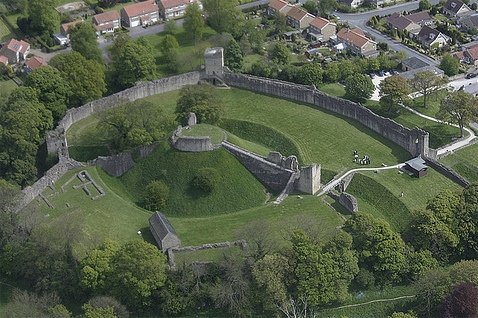
Pickering Castle is a well-preserved motte-and-bailey fortress in the North Yorkshire market town of Pickering, on the edge of the North York Moors National Park. It stands as a classic example of early Norman defensive architecture that evolved into a stone stronghold over centuries. Today, it is owned by the Duchy of Lancaster and managed by English Heritage as a Scheduled Monument, open to the public. Its ruins—including a prominent motte topped by a shell keep, curtain walls, towers, and inner and outer wards—offer one of the clearest illustrations in England of how a timber-and-earth castle was progressively upgraded into a more permanent medieval fortification.
Norman Origins (1069–1070)
The castle’s story begins in the
turbulent aftermath of the Norman Conquest. Following William the
Conqueror’s victory at the Battle of Hastings in 1066, resistance in
northern England prompted the brutal “Harrying of the North”
(1069–1070), during which Norman forces devastated the region to crush
rebellion. To secure control, William ordered the rapid construction of
motte-and-bailey castles along key routes. Pickering Castle was one of
these, built in 1069–1070 on a strategic hilltop overlooking Pickering
Beck and the route between Helmsley and Scarborough.
The original
structure was entirely of timber and earth: a large central motte (an
artificial mound about 20 metres high with a 60-metre base) crowned by a
wooden keep and palisade, surrounded by a bailey (enclosed courtyard)
with ditches and earthen banks. A pre-Conquest settlement already
existed here (held by Morcar, Earl of Northumbria before 1066), but the
castle itself was a new Norman imposition. Its dual-bailey layout (inner
and outer wards flanking the motte) was somewhat unusual and provided
layered defences. The motte’s steep sides and the natural cliff on the
western side added significant natural protection.
Transition to
Stone: 12th and 13th Centuries
Over the following two centuries, the
castle underwent phased upgrades as royal priorities shifted from
immediate conquest to long-term administration and defence. Under Henry
II (r. 1154–1189), around 1180–1187, the timber palisade of the inner
bailey (the original bailey) was replaced with a stone curtain wall, and
the Coleman Tower—a stone gatehouse with portcullis and drawbridge—was
added as the main entrance. The ground floor of Coleman Tower served as
a prison with windowless cells. A stone bridge to the inner bailey and
possibly an early stone keep on the motte were also constructed.
King
John (r. 1199–1216) visited in 1201 and commissioned further works
between 1207 and 1210, including bridges and a staircase up the motte to
strengthen access to the keep. During Henry III’s reign (r. 1216–1272),
the castle formed part of a defensive triangle with Scarborough and York
Castles against threats from France and rebellious northern barons.
Between 1218 and 1236, the keep was converted into a stone shell keep (a
circular or polygonal wall around the motte summit), a chapel was built
in the inner ward, and work began on the Old Hall (a timber-framed
garrison building with an arched “judgement seat” niche for holding
court). The castle was briefly damaged during baronial unrest but was
repaired and reinforced.
In 1267, Henry III granted the Honour of
Pickering (including the castle) to his son Edmund Crouchback, 1st Earl
of Lancaster. This transferred the castle into Lancastrian hands, where
it would remain for centuries as part of the Duchy of Lancaster estate.
Edmund’s son Thomas, 2nd Earl of Lancaster, further improved it around
1314, building the New Hall—a two-storey stone structure with private
chambers, a tiled roof, kitchens, and another judgement-seat
niche—linked by a private passage to the chapel. Thomas used the castle
as a residence and maintained a garrison, though he opposed Edward II
and was later executed.
14th-Century Fortifications and Royal Use
Fears of Scottish invasion under Edward II (r. 1307–1327) prompted major
upgrades. After narrowly escaping capture by the Scots in 1322, Edward
ordered the outer bailey’s timber defences replaced with a stone curtain
wall (completed 1323–1326). This included three new towers—the
gatehouse, Diate Hill Tower, and Mill Tower (later used as a
prison)—plus a second ditch, ovens, storehouses, and additional
buildings. A distinctive addition was Rosamund’s Tower, a three-storey
projection outside the wall with a hidden postern gate but no internal
staircase, designed for defensive surprise. Edward also established a
royal stud farm here, keeping over 50 horses, and spent three weeks at
the castle in August 1323.
Pickering served multiple royal purposes
throughout the Middle Ages: as a hunting lodge, holiday residence,
administrative centre, and stud farm. At least six medieval kings are
recorded as having stayed here between 1100 and 1400. It also functioned
as a courthouse and prison. In 1399, the deposed Richard II was briefly
held prisoner here after his abdication, before being moved to
Pontefract Castle (where he died). At the time, the castle was claimed
by Henry Bolingbroke (soon Henry IV), who used his Lancastrian
connection to rally support and seize the throne.
Late Medieval
to Post-Medieval Period
The castle saw little major action in the
Wars of the Roses (15th century), largely because of its strong
Lancastrian ties and distance from the main battlefields. Minor
maintenance continued, including new stables in the outer ward, but by
the late medieval period some stone was robbed for other building
projects (e.g., by the constable Sir Richard Cholmley for his house at
Roxby). The chapel later lost its religious role after the Dissolution
of the Monasteries under Henry VIII and was repurposed as a courtroom.
During the English Civil War (17th century), the castle was held for
King Charles I but was in poor defensive condition. Parliamentary forces
under Oliver Cromwell breached the west wall (cannon positions are
traditionally identified on three mounds to the west), though damage was
limited compared to many castles. After the war, Parliamentary troops
occupied it briefly; Sir Hugh Cholmeley stripped lead, timber, and iron
from the towers to strengthen Scarborough Castle. The castle was sold
during the Commonwealth but returned to the Crown under Charles II. It
remained in royal (and later Duchy of Lancaster) hands with minimal
intervention.
Modern Preservation and Today
In 1926 the
Ministry of Works (predecessor to English Heritage) took guardianship.
The ruins have been conserved as a romantic, flower-strewn site with
substantial surviving curtain walls, towers (including the relatively
intact Diate Hill and Rosamund’s Towers), the restored chapel (the only
fully intact medieval building), and foundations of the halls. The motte
and shell keep remain the visual centrepiece.
Its remarkable state of
preservation stems from its limited involvement in the Wars of the Roses
and Civil War, plus its continuous Crown ownership, which prevented
wholesale demolition or conversion.
Reconstructions help visualise
its medieval appearance: the original timber motte-and-bailey phase
showed wooden palisades, a keep, and bustling activity; by the 13th–14th
centuries it featured stone walls, multiple towers, halls, and a
thriving inner courtyard with royal and garrison life.
Today,
visitors can walk the full perimeter, climb the motte for panoramic
views over the Vale of Pickering, and explore the layers of nearly 1,000
years of English history—from Norman conquest to medieval royal retreat.
Folklore even adds a ghostly monk said to haunt Mill Tower, though the
castle’s real story is one of enduring royal power and architectural
evolution rather than dramatic sieges. It stands as a quiet but powerful
testament to the Norman legacy in northern England.
Pickering Castle, located in the market town of Pickering, North
Yorkshire, England (on a limestone bluff overlooking the Vale of
Pickering and Pickering Brook), is one of the best-preserved examples in
Britain of a Norman motte-and-bailey castle that evolved into a stone
shell-keep fortress. Its architecture is notable for its minimal
alteration since the late medieval period and for its unusual layout
featuring two baileys (inner and outer) with the motte positioned
centrally between them, rather than the more typical single bailey
adjacent to the motte.
The castle began as a timber-and-earth
structure built by William the Conqueror around 1069–1070 during the
“Harrying of the North” and was progressively rebuilt in stone from the
late 12th century onward. It served as a royal hunting lodge,
administrative centre, courthouse, prison, and stud farm, with later
phases driven by threats such as Scottish raids under Edward II. The
surviving ruins—managed by English Heritage—include substantial sections
of curtain walls standing to near full height, towers, earthworks, and
foundations, offering a clear record of medieval defensive and domestic
evolution.
Overall Layout and Design
The castle occupies a
single limestone outcrop site that provided both natural defences (steep
cliffs and slopes on the west and north) and building material (stone
was quarried directly from the ditches). The core design consists of:
A central motte (earthen mound) flanked by an inner bailey
(crescent-shaped, approximately 120 m × 35 m) to the north-west and an
outer bailey (approximately 185 m × 25 m) to the south-east.
Multiple
defensive ditches (some 15 m wide) and earthen banks, with the motte
encircled by its own ditch.
This double-bailey configuration is rare
and preserved the original Norman earthwork footprint unusually well
into the stone phases.
The layout created layered defences: the
outer bailey acted as the first line, the inner bailey housed key
domestic and administrative buildings, and the motte provided the
ultimate strongpoint.
Construction Phases
11th century (c.
1069–1070): Original timber-and-earth motte-and-bailey with palisades on
the motte and around both baileys, plus ditches and banks. The motte was
crowned with a timber keep/palisade.
Late 12th century (c. 1180–1187,
Henry II): Inner bailey palisade replaced by a stone curtain wall;
probable first shell keep on the motte; Coleman Tower added as the inner
gatehouse/prison. Walls were built across the motte ditch for access.
Early 13th century (c. 1216–1236, Henry III): Shell keep
rebuilt/reinforced in its present form; chantry chapel constructed (c.
1227). Old Hall and early service buildings added.
Early 14th century
(c. 1314): New Hall built as a high-status residence.
1323–1326
(Edward II): Major upgrading of the outer bailey with a full stone
curtain wall, three projecting towers, gatehouse, drawbridge, and
postern gate in response to Scottish threats. Stables and other service
buildings were added against the outer curtain for the royal stud.
No major new construction occurred after the mid-14th century; the
castle saw little alteration through the Wars of the Roses or Civil War,
and stone was later robbed for local building.
The Motte and
Shell Keep
The motte rises steeply to about 20 m high with a base
diameter of about 60 m. It was originally topped by a timber palisade
and later by a stone shell keep—a circular rubble wall enclosing a
roughly 20 m wide area. The keep is not a tall tower but a ring-wall
with an internal wall-walk above garrison buildings (foundations of
13th–14th-century structures survive inside). Access to the motte summit
was via late-12th-century walls and stairways crossing the encircling
ditch. The shell keep provided elevated command over the surrounding
countryside and served as the final refuge.
Inner Bailey and
Curtain Wall
The inner bailey’s late-12th-century stone curtain wall
(replacing the earlier timber palisade) survives best where later
buildings incorporated it. Entry was through the Coleman Tower (square
plan, integral with the wall): a first-floor entrance with portcullis
and drawbridge; the ground floor was a windowless prison (known
historically as the King’s Prison). A second gate and drawbridge
alongside it (added 1320s) fell out of use by the 16th century.
Key
internal structures (foundations and partial ruins):
Old Hall
(early/mid-12th century, possibly half-timbered): Free-standing, with a
judgement-seat niche; later used for servants/guests.
New Hall
(King’s Hall or Motte Hall) (c. 1314, two-storey stone with stone-tiled
roof): Lean-to against the curtain wall; ground floor had buttery,
kitchen, and pantry; upper floor included a private chamber (solar) with
decorated fireplace and plastered walls, plus another judgement niche. A
private passage linked it to the chapel. It served as a courthouse
later.
Chantry chapel (c. 1227): Still largely complete though
altered; originally religious, later used as a courtroom; partially
reconstructed on site today.
Service ranges including Constable’s
Lodging (half-timbered elements pre-dating the curtain wall), kitchens,
pantries, staff quarters, storehouses (one possibly a wool house),
ovens, and a well.
Outer Bailey and Curtain Wall
The outer
bailey’s stone curtain wall (1323–1326) replaced an earlier timber
palisade on a 5–8 m high earthen bank. It featured projecting square
towers, a gatehouse with drawbridge over the outer ditch, and a postern
(sally-port) gate. Substantial lengths survive to good height, with
wall-walks implied. A further earthwork bank east of the outer ditch may
have provided extra defence.
The three main towers (all square-plan
and projecting):
Rosamund’s Tower (north-east, most impressive):
Three storeys high; projects outward from the wall; ground-floor postern
gate (pointed chamfered arch) with no direct internal stair from the
ground floor for added security.
Diate Hill Tower (middle):
Projecting square tower.
Mill Tower (south-west): Used as a prison;
ground-floor entrance with two linked doors (first inward-opening,
second outward-opening).
Other features included stables against
the outer curtain and additional service buildings.
Defensive
Features
Ditches and banks: Motte ditch; 15 m-wide inner bailey
ditches linked to it; outer ditch beyond the south bank. Some were
rock-cut, with ongoing quarrying for building stone.
Natural slopes
and cliffs enhanced defences on the north and west.
Drawbridges,
portcullis, and postern gates allowed controlled access and sorties.
Tenant obligations for maintaining sections of the (earlier timber)
palisade reflect the feudal defensive system.
Materials and
Construction Techniques
Local limestone (quarried on-site from the
ditches) was used for rubble walls, with some dressed stone for
architectural details (e.g., fireplaces, arches). Early domestic
buildings often incorporated half-timber framing. The transition from
timber palisades to stone curtain walls and towers reflects the typical
Norman-to-medieval evolution, with thickening and adding projections for
better flanking fire.
Pickering Castle stands out as a rare,
relatively unaltered shell-keep conversion (one of only about 60
nationally) and a textbook illustration of how an early earth-and-timber
fortress was adapted into a sophisticated stone stronghold while
retaining its original footprint. The ruins, with their prominent motte,
intact towers, and reconstructed chapel, allow visitors to visualise the
layered defences and domestic life of a medieval royal castle.
Exhibitions and Surroundings
The chapel hosts a dedicated English Heritage exhibition exploring the castle's 1,000-year story, featuring artifacts like medieval arrowheads, a knife blade, spurs, and manacles unearthed during excavations. Interactive displays cover its roles in conquest, royal hunts, and Civil War sieges, with reconstructions illustrating daily life—from knights' quarters to the royal stud farm breeding warhorses. Surrounding the castle are wildflower meadows, picnic areas, and wildlife habitats, including birds and butterflies, set against the North York Moors' heather-clad hills. Nearby, the Pickering Forest remnants and the North Yorkshire Moors Railway add to the visitor experience, with steam trains visible from the motte on clear days.
The castle’s unusual layout—with the motte in the centre and baileys
on either side—makes exploration straightforward and rewarding. Start at
the entrance (the old gatehouse area) and follow the clear paths and
information panels.
The Motte and Shell Keep: Climb the steep but
manageable steps up the 20-metre-high (66 ft) motte for the best
panoramic views over Pickering town, the Vale of Pickering, and the
rolling North York Moors beyond. The shell keep on top is a rare
survival—originally timber-roofed, it would have housed the lord’s
private quarters.
Inner and Outer Baileys: Wander the grassy inner
ward (the original service area) and outer ward. Look for the
foundations of the Old Hall (with its decorative “judgement seat” niche
where the king or his steward held court) and the New Hall (added in the
14th century for more private royal apartments).
Curtain Walls and
Towers: The stone walls are largely intact and walkable in places. Don’t
miss Rosamund’s Tower—a three-storey projecting tower with a postern
gate (a sneaky side exit) and great defensive sightlines. The Coleman
Tower (gatehouse) and other towers like Diate Hill and Mill Tower (used
as a prison) give you a real feel for medieval siege defence.
The
Chapel Exhibition: A highlight is the restored chapel (built by Henry
III and later used as a courtroom). It now houses a modern exhibition
with artefacts like medieval arrowheads, a knife blade, spurs, manacles,
and interactive displays tracing the castle’s story through the ages.
It’s engaging for all ages and adds context to what you’re seeing.
The Dry Moat/Ditch: Descend into the wide, grassed-over ditch that once
formed part of the outer defences. Walking here gives an excellent sense
of scale—impressive how attackers would have been exposed while trying
to storm the walls.
There are also picnic benches scattered
around, wildflowers in spring/summer, and nesting kestrels that add to
the peaceful atmosphere.
Practical Information for Your Visit (as
of late March 2026)
Opening Hours: Open daily 10am–5pm (last entry
4:30pm). Hours can be slightly shorter in winter (November–Easter);
always double-check the English Heritage website closer to your date.
Tickets: Available on the day or online (advance booking recommended for
a 15% discount). Typical prices (subject to change): adults around £7–9,
children (5–17) £3.50–4.50, concessions £5.50–7, family tickets
available. English Heritage members and up to six children enter
free—great value if you’re visiting multiple sites.
How to Get There:
By Car: Castlegate, Pickering YO18 7AX (what3words:
applauded.slimming.punt). Small gravel parking area 75m from the
entrance (a few disabled bays closer in). Town car parks are also
nearby.
By Public Transport: Buses include Scarborough & District
128, Yorkshire Coastliner 840/X40. Summer MoorsBus service. Nearest
mainline train station is Malton (9 miles); the heritage North Yorkshire
Moors Railway (steam trains) stops in Pickering just ¼ mile away—perfect
for a combined day out.
Cycling/Walking: On the National Cycle
Network; easy walk from town centre or station.
Facilities: Small
shop selling gifts, books, toys, hot/cold drinks; male/female toilets;
picnic area. Well-behaved dogs on leads welcome. No full café on site,
but plenty of options in Pickering town.
Accessibility: Some level
paths and disabled parking, but the site has steps, uneven ground, steep
motte access, and grass/ditches—mobility scooters or wheelchairs may be
limited in places (a wheelchair is sometimes available to borrow; check
ahead). Not fully wheelchair-friendly but manageable for many with
assistance.
Visitor Experience and Tips
Reviewers consistently
describe it as “worth the visit,” “great views,” and “fun for kids”
despite being mostly ruins. It’s atmospheric rather than opulent—perfect
for picnics, photography, and letting children explore safely. On a
clear day the views from the walls are spectacular, stretching across
fields and moors.
Pro Tips:
Wear sturdy shoes—grass can be
slippery, especially after rain, and you’ll want to walk the ditch and
walls.
Visit in spring or summer for wildflowers and longer daylight;
it’s open year-round but cosier in milder weather.
Combine with a
ride on the North Yorkshire Moors Railway (Pickering station is minutes
away) and a visit to St Peter’s & St Paul’s Church in town (famous for
its medieval wall paintings).
Allow time to wander into Pickering
itself—market town with cafés, shops, and a relaxed vibe.