Location: Kent Map
Rochester is located within the area of the
unitary authority of Medway, on the banks of the homonymous river,
and about 50 km from London.
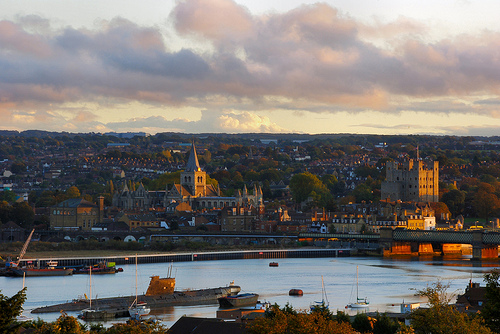
Rochester is known for its cathedral and its castle. Rochester
Castle was built between 1087 and 1089 for Bishop Gundulf, some
parts of the castle survive even though it has been greatly altered
by use and reuse in the following centuries. The latter, in 1215
being occupied by barons rebelled by the peace agreements reached by
King John I of England with France, was besieged for about 2 months
by the king himself. The siege was lifted when the defenders died of
starvation. The Church of the Christ and the Blessed Virgin is a
Norman building.
The Romano-British toponym for Rochester
has been a matter of debate for a long time. The name Durobrivae can
be translated as a "bastion on the bridge" or "stronghold of the
bridges". It was also known as Durobrovum and Durobrivis, which
could be a Latinization of the British word Dourbruf which means
"fast-flowing, river".
There is evidence of at least one
Neolithic settlement found in 1961 by R. E. Chaplin below the Roman
levels of the city. Rochester was one of the two centers of the
Cantiaci tribe (the other is the capital, Cantiacorum, today
Canterbury). It was the administrative west center of the Celtic
kingdom of Kent. The Romans arrived and called the settlement
Durobrivae, after being conquered by Aulus Plaucius. The later Roman
colony offers us the current Main Street and the hill Northgate /
Boley. Around the nineties of the second century: the Romans built
mud protections at key points for the domain of the territory. In
the early third century AD hese were replaced by others made of
stone, which are still preserved. In 427 the Romans decided to
abandon what for them was the province of Britania.
By plane
Rochester sits in the Medway towns of
north Kent, so London’s airports are the practical gateways rather than
a local commercial field. Rochester Airport (RCS) is a small
general-aviation airfield on the edge of town and is not useful for
scheduled passenger flights.
The closest commercial option is London
City Airport (IATA: LCY), about 30 miles / 48 km by road (roughly 40-50
minutes in light traffic). It is convenient for short-haul European
routes into the Docklands. From LCY you can travel by DLR to Stratford
International, then take a Southeastern high-speed or Thameslink train
to Rochester, typically around 1 hour 10 minutes door to door.
London
Gatwick (LGW) is the nearest major international hub, about 45 miles /
73 km by road (around 55 minutes). It offers a wide range of European
and long-haul flights. Rail is usually easier than driving: Gatwick
Express or Thameslink into London, then a Southeastern or Thameslink
service to Rochester.
London Southend (SEN) is about 40 miles / 65 km
by road (around 55 minutes). It has a smaller timetable, often used by
low-cost carriers. London Stansted (STN) is about 52 miles / 83 km by
road (around 1 hour) and is another low-cost base (Ryanair and others).
Heathrow (LHR) is farther, about 70 miles / 110 km via the M25, but it
has the densest long-haul network; allow 1.5-2 hours by car, or rail via
central London.
Allow extra time on all road transfers if you use the
Dartford Crossing or hit the M25 at peak hours.
By train
Rochester railway station (code RTR) is on Corporation Street, about 100
m north of the High Street (postcode ME1 1NH). The present station
opened in 2015 after the older 1892 building was relocated a short
distance north. It has step-free access, ticket machines, and a small
car park.
The station sits on the Chatham Main Line and the North
Kent Line. Services are run by Southeastern and Thameslink.
Typical
connections:
London St Pancras International on high-speed
Southeastern trains in about 35-40 minutes
London Victoria in around
45-55 minutes (several trains per hour)
London Charing Cross, Cannon
Street and Blackfriars on classic routes (often with a change, around 1
hour or a little more)
Eastbound trains to Chatham, Gillingham,
Rainham, Faversham, Canterbury East, Dover Priory and Ramsgate
Off-peak there are usually several trains an hour toward London and a
useful spread of Kent-coast services. Check National Rail or the
Southeastern app for engineering work, which is common on weekends.
Ebbsfleet International (Eurostar / HS1) is a short hop west if you are
arriving from the Continent by high-speed rail; from there you continue
by local Southeastern train into Rochester.
By road
Rochester
lies on the historic A2 (the old Watling Street) where it crosses the
River Medway at Rochester Bridge. Through traffic now uses the M2, which
runs just south of the town.
From the north and from much of Greater
London you approach on the M25. You must use the Dartford Crossing
(Queen Elizabeth II Bridge southbound, tunnels northbound). This is a
Dart Charge account or number-plate billing system, not a cash booth.
Charge the crossing in advance or by midnight the day after you travel
to avoid a penalty. After the crossing, leave the M25 for the A2 toward
Canterbury / Dover, then follow signs for Rochester / Medway.
From
the south and the Channel ports, use the M2. From the Channel Tunnel and
Folkestone, the M20 then A229 or A2/M2 is the usual route.
The A289
and Medway Tunnel link Rochester with Chatham and Gillingham on the
other side of the river. Saturday markets, Dickens festivals and summer
weekends can clog the High Street and riverside approaches, so allow
extra time.
By boat
The nearest major Channel port is Dover,
about 45-50 miles / 75 km by road via the A2/M2 (roughly 1 hour, more in
holiday traffic). Folkestone and the Eurotunnel terminal at Cheriton are
a similar distance via the M20.
Dover-Calais passenger and freight
ferries are operated by P&O Ferries, DFDS and Irish Ferries. Crossing
time is typically 90 minutes to 2 hours depending on the ship. From
Calais or Dunkirk you drive off the ferry, join the A2/M20 network and
head northwest toward Medway.
There is no regular passenger ferry
into Rochester itself. The Medway is used by leisure craft and
occasional excursion boats rather than scheduled Channel services.
Arriva Southern Counties is the main bus operator.
Frequent local routes link Rochester High Street with Chatham,
Gillingham, Strood, Maidstone and nearby villages. Chatham Waterfront
bus station is the main interchange for the Medway towns.
Taxis and
licensed minicabs wait at the railway station. For short hops between
Rochester, Strood and Chatham a bus or a 15-20 minute walk is often
enough.
On foot
The historic core is compact and best seen on
foot. From the station it is a few minutes south to the High Street,
then a short climb to Rochester Cathedral (founded 604) and Rochester
Castle on the ridge above the Medway. The old town, Dickens-related
buildings (Eastgate House, Restoration House, Six Poor Travellers
House), the castle precincts and the river esplanade sit within an easy
walking loop.
Medway Council publishes a town-trail leaflet. Copies
are usually available at the tourist information point and in the castle
shop. Upper High Street is partly pedestrianised or traffic-restricted,
which makes wandering simpler once you have parked or left the station.
Parking
Useful council car parks close to the centre:
Corporation Street (long stay), on the left as you come off the Medway
toward the station and High Street. Convenient for rail users; a short
free drop-off window is sometimes available for station pick-up. ANPR
operates here.
Blue Boar Lane (short stay, typically useful for
visits of a few hours), on the right as you come off the Medway. Also
ANPR. Postcode ME1 1PD. Around 130 spaces.
Other nearby options
include Boley Hill (by the castle), Furrell’s Road, Almon Place, King
Street and riverside / Esplanade spaces.
Charges generally apply
from early morning into the late evening. Pay by card, contactless, cash
at machines, or the council’s phone app (Go Mobon). Blue Badge holders
usually park free but must register for ANPR sites and display the
badge. Check Medway Council’s current tariffs before you travel,
especially on festival weekends when spaces fill early.
You can start a city tour at the Medway Bridge. From
here follow the High Street, turning right into Boley Hill (on the left
is the Cathedral, a short detour to the right is the Castle). Walking
along the facade of the Cathedral, you come through Minor Canon Row and
The Vines to Crow Lane, which leads back to the High Street. Turn right
to Eastgate House and back to Medway Bridge. The route passes all the
sights described.
Rochester Castle, Rochester, ME1 1SW,
accessible from Castle Hill, Esplanade and Baker's Walk. Tel: +44 (0)
1634 335882. Open: 1 October to 29 March 2015 daily 10am to 4pm. Price:
Adults £6.00 (only the keep, the courtyard is freely accessible).
At the site of the current castle there was probably a Roman sentry
post protecting the Watling Street trade route. At this strategically
important position, William the Conqueror ordered the construction of a
castle. Bishop Gundulf, who is also responsible for the construction of
Rochester Cathedral and the Tower of London, was chosen as the master
builder. Construction of the keep, which is one of the largest in
England, began around 1127. The walls reach a height of 34 m (113 ft)
and are up to 3.50 m (12 ft) thick. Although the main purpose of the
keep was defensive, there are some beautifully crafted archways and
windows. The sad highlight in the history of the castle was the 7-week
siege in 1215. Shortly before, the rebellious barons had forced King
John to sign the Magna Carta. The king engaged in a bitter war against
the barons who held the castle. John ordered a steady stream of arrows
and missiles. In addition, a tunnel was dug under the keep. Part of it
collapsed, but the defenders bravely fought on. Ultimately Rochester
fell and the defenders were captured. Between 1217 and 1237 the keep was
renovated. This is still clearly visible today, as the new corner tower
of the keep, in contrast to the other angular ones, has a cylindrical
shape. The last time the castle was involved in battle was during the
Peasants' Revolt in 1381. In 1423 Katharina von Valois received the
castle as her widow's property. After her death in 1437 the decline of
the castle began. Some of the stones were used in the construction of
Upnor Castle around 1600. Rochester Castle has been a visitor attraction
since the 19th century. Despite long neglect, Rochester Castle is
considered one of the best preserved Norman castles in England. Although
the roof and floors are missing, you can still use the passages and
stairs between the walls and climb all the way to the top. From here you
have an impressive view over the city, the Medway and the surrounding
area.
Rochester Cathedral, College Yard. Open: Daily 7:30 a.m. to
6:00 p.m., Sunday until 5:00 p.m. Price: Admission free.
There
was a cathedral in Rochester as far back as Anglo-Saxon times. It was
built around 604. Traces of the building survive, they are marked by
lines on the ground. The city is the second oldest bishopric in England
after Canterbury. The construction of today's church, which belonged to
a monastery, began in 1080. The architect was Archbishop Gundulf, who
also built Rochester Castle and the White Tower in the Tower of London.
The construction work dragged on for several centuries. The nave was
completed in the 12th century, and the Obergarden was built 300 years
later. The change in architectural style is also clearly visible in the
nave: the first, round arches with zigzag ornaments date back to Norman
times, while the taller pointed arches come from the early Gothic
period. The transepts were also built in the early Gothic style after a
fire in 1180. There is a modern (2004) fresco in the north transept. In
the south transept is an ornate portal (1343) in Gothic Decorated style.
The female figures are Ekklesia and Synagoga, they symbolize
Christianity and Judaism. The crossing is where the nave, transept and
chancel meet. The choir is separated from the nave by a rood screen.
So-called green men (carved in 1840, repainted in 1992) can be seen on
four bosses of the wooden ceiling. Faces are framed by foliage, leaves
spill out of mouths. The "Green Men" are of Celtic origin and symbolize
growth in spring. The early Christian church adopted them as a sign of
the resurrection.
The west facade
The west facade, which was
completed around 1160, rises up opposite the castle. Its portal is a
fine example of Norman architecture. In the center of the tympanum is
Christ surrounded by angels and symbols of the apostles. The large
window was added later.
In the choir
The murals originally
date from the 1340s but were repainted in the Victorian period. The
leopard of the royal coat of arms of England is seen together with the
French fleur-de-lis. This is meant to symbolize the English king's claim
to France. Above it are the coats of arms of the bishops. Wheel of
Fortune: wall painting from the 13th century. The surviving part was
hidden by a pulpit and the wall painting until the 19th century. You can
see Fortuna spinning the wheel of fortune. The men on the edge of the
wheel gain power and wealth only to become poor and weak again.
Restoration House, 17-19 Crow Street, Rochester, ME1 1RF. Tel: +44
(0)1634 848520 Email: robert.tucker@restorationhouse.co.uk. Open: May 28
to September 25, 2015 Thursday & Friday 10 a.m. to 5 p.m. Price: House &
Garden £7.50 (adults), Garden £4.00.
The property was created by
merging two medieval buildings that were transformed into a mansion in
the 17th century. Henry Clerke, the first owner, and his son Francis
were staunch supporters of the monarchy. When the Civil War (1642-1651)
broke out the house was confiscated by the Parliamentarians and Colonel
Gibbon made it his residence. After Cromwell died and the Commonwealth
could no longer be held, Francis Clerke tried very hard to bring Charles
II back to the throne. Restoration House owes its name to the fact that
King Charles II spent the eve of his coronation here in 1660. The house,
which suffered damage during the war, has been renovated to provide a
suitable place for the future king to spend the night. Charles Dickens
used the house as a model for his Satis House, the home of Miss Havisham
in the novel Great Expectations. The house now houses a collection of
17C and 18C period furniture, including paintings by Reynolds, Constable
and Gainsborough. A large, walled garden adjoins the house. It is
divided into two areas by a brick wall. There is a ground floor and
greenhouse on one side and a kitchen and cut flower garden on the other.
Part of a Tudor wall has been discovered at the edge of the property.
She was intrigued in the garden.
Rochester Bridge
The current road bridge over the
Medway dates from 1914, replacing two older predecessors. Three cast
iron arches are supported by granite pillars. At the point where the
arches meet, there are columns with heraldic ornaments and lamps on
plinths. Large lions lie on plinths to the right and left of the road.
The pedestrian walkway is entered through a portal that is also
decorated. From the bridge there is a beautiful view of Rochester Castle
and across the Medway. The old bridge is used for the northwest
direction. Another bridge was built in 1970 for traffic to the other.
The two bridges are part of the A 2.
Guildhall Museum, 17 High
St, Rochester, ME1 1PY. Tel: +44 (0) 1634 332680. The Guildhall was
built in 1687. The Staircase and Main Hall have beautiful stucco
ceilings added in 1695 at a donation from Sir Cloudesley Shovell. A
weathervane from 1780 in the shape of a contemporary warship is
enthroned on the dome. The adjacent building, which was built in 1909,
also belongs to the museum. It was once the River Medway Conservancy
Board Building. The museum was established in 1897 to commemorate Queen
Victoria's Diamond Jubilee. It has been housed in the two buildings
since 1979. Open: Tuesday to Sunday 10 a.m. to 5 p.m. Price: Admission
free.
The city's history is illustrated and the Dickens Discovery
Room pays tribute to the city's most famous resident. There is also the
hull of a prison ship used on the Medway during the Napoleonic Wars. The
inmates of these prisons used hair, wood and bone to create elaborate
artefacts, which are also on display. Also on display are local
paintings and prints, a Victorian drawing room and kitchen, as well as
portraits and the city's regalia.
Old Corn Exchange Admiral Sir
Cloudesley Shovell had the building built in 1706. It initially served
as a meat market, later as a court and most recently as a grain
exchange. The most distinctive feature is the clock towering far above
the street, which draws the eye to the elegant facade. The clock is
adorned with ornaments and the coat of arms of Admiral Sir Cloudesley
Shovell.
Chertseys Gate On the corner of High Street and Boley Hill,
Grade I listed. The gate was built of stone and flint in the early 15C.
In the 18th century the wooden upper floor was added to the gate. The
gate was part of the fortifications that once separated the Domfreiheit
from the city.
Poor Travelers' House, 97 High St, Rochester, ME1 1LX.
Tel: +44 (0) 1634 845609. Open: Wed to Sun 10am to 1pm & 2pm to 5pm. In
winter only on some weekends (as of 2014). Price: Admission free.
The Poor Travellers' House was built in 1579, the facade was added
in 1771. In his will, Richard Watts ordered the building to serve as a
poorhouse. The house provided overnight shelter for those who had
nowhere else to go. Above the door is an inscription from 1865 that
reads: "For six poor travelers who not being rogues or proctors may
receive gratis for one night lodging, entertainment and four pence
each". The money was given to the people because of the Poor Law Act of
1576. The law states that anyone who has less than that is a vagabond
will be flogged and sent back to their home parish. The simply furnished
rooms give an impression of the conditions under which people of the
lower class lived.
Eastgate House, High St. Open: Closed for
renovation until 2015.
Rochester’s compact historic centre is easy to eat
your way through. The High Street runs between the castle and cathedral,
with extra options a short walk into Upper Upnor beside the Elizabethan
fort on the Medway. Hours change, so check before you go, especially
around Dickens festivals and bank holidays.
Tiny Tim’s Tearooms
5 Northgate, Rochester ME1 1LS. Tel. +44 (0)1634 939031. Email:
tearooms@tinytimsrochester.co.uk. Website: tinytimsrochester.co.uk
Just off the High Street and a short stroll from Rochester Castle, this
long-running family tearoom is one of the most reliable spots in town
for tea, coffee and a full English. Dickens-themed breakfasts (Flying
Starter, Dickens Breakfast, Artful Dodger) sit alongside jacket
potatoes, sandwiches, baguettes, burgers and cream teas. Afternoon tea
is a set spread of finger sandwiches, scones with clotted cream and jam,
mini pastries and a pot of tea or coffee (vegetarian options on
request). Official site hours are every day except Christmas Day,
typically 9:00 a.m. to 6:00 p.m. (sometimes later). There is a large
pay-and-display car park almost next door on Northgate. Outdoor seating;
dogs often welcome. Good midway stop between the castle, cathedral and
the rest of the High Street.
Nancy’s Cafe (former Visitor
Information Centre)
95 High Street, Rochester ME1 1LX
The cafe
used to occupy the ground floor of the Medway Visitor Information
Centre, handy for maps, leaflets and a quick drink after arriving in
town. That centre closed permanently in April 2024 as a council
cost-cutting measure. The Huguenot Museum remains in the same building
above. For current visitor information use Visit Medway online or desks
at heritage sites. For coffee and light meals on this stretch of the
High Street, nearby independents such as The Deaf Cat (83 High Street,
opposite the cathedral) are the practical replacements.
The
Golden Lion
147-151 High Street, Rochester ME1 1EL. Tel. +44 (0)1634
880521
A large J D Wetherspoon pub-hotel occupying several floors of
historic High Street buildings. Number 147 was already The Golden Lion
from the early 19th century (the sign refers to the arms of Henry I);
149 was later a building society and savings bank before the premises
were combined. Expect value breakfasts from opening, a long food menu
through the day, real ales (typically Greene King Abbot, Ruddles Best
and Sharp’s Doom Bar plus changing guests), Wi-Fi, TVs, baby change,
step-free access and a licensed outside area. Rooms are available
upstairs. Usual hours: Monday-Thursday and Sunday 8:00 a.m. to midnight;
Friday and Saturday 8:00 a.m. to 1:00 a.m. Food is served for most of
the opening day. Families welcome. A straightforward, inexpensive base
if you want to stay on the High Street.
Eagle Tavern
124 High
Street, Rochester ME1 1JT. Tel. +44 (0)1634 409040. Website:
eagle-tavern.co.uk
Traditional single-room High Street pub opposite a
large car park, with a rear garden looking toward the old city wall. It
once billed itself as Rochester’s main music venue; it now leans toward
conversation, home-cooked food and Sunday roasts. Typical dishes include
baguettes with chips and salad, jacket potatoes, loaded chips and a
kids’ menu. Real ales on handpumps. Dog-friendly, gluten-free options
noted by diners, patio seating. Hours vary by source; a common pattern
is Monday-Wednesday about noon-11:00 p.m., Thursday-Friday
noon-midnight, Saturday 11:00 a.m.-midnight, Sunday noon-10:30 p.m.,
with kitchen service often ending earlier than last orders (frequently
around 6:00-8:00 p.m. on quieter days). Confirm kitchen times if you
plan dinner.
The Tudor Rose
29-31 High Street, Upper Upnor ME2
4XG. Tel. +44 (0)1634 714175. Website: tudorroseupnor.co.uk
Grade II
listed village pub a few minutes from Rochester, on the cobbled High
Street of Upper Upnor beside Upnor Castle and the Medway. The western
range is late 17th or early 18th century; the eastern part is early 19th
century with a later bar front. Previously the King’s Head. Shepherd
Neame house with Master Brew, Whitstable Bay and seasonal guests, plus a
large walled garden. Food is a step up from standard pub fare: lunch
roughly noon-3:00 p.m. and dinner 6:00-9:00 p.m. Monday-Saturday; Sunday
lunch often runs into the afternoon (around noon-5:30 p.m.). Bar hours
are typically noon-11:00 p.m. (some listings close earlier on Sunday).
Book at weekends, especially after a castle visit. Quiet historic
interior of noted interest.
Mamma Mia
4 High Street, Rochester
ME1 1PT. Tel. +44 (0)1634 827027. Email: info@mammamiarochester.co.uk.
Website: mammamiarochester.co.uk
Family-run Italian near the river
end of the High Street: wood-fired style pizzas, pasta, risotto, seafood
and classic mains such as chicken parmigiana and salmon with porcini
cream. Starters include calamari, whitebait, garlic bread and olives.
Pizzas start from the mid-£6 range on older lists and run higher for
loaded 12-inch pies; set menus (when offered) have been around two
courses for about £20 and three for about £25 with advance booking.
Typical hours: Sunday-Thursday noon-10:00 p.m.; Friday-Saturday
noon-11:00 p.m. (some midweek listings split lunch and evening service).
Friday and Saturday evenings often have a two-hour seating. Popular for
pizza, tiramisu and a relaxed family atmosphere. Booking is wise on
weekend nights.
Practical notes
Rochester High Street is
walkable from the railway station. Pay-and-display parking sits at
Northgate and other nearby lots. Upper Upnor is a short drive or a
longer riverside walk via the Medway path; combine The Tudor Rose with
Upnor Castle. Confirm opening times on the day, especially Mondays and
Sundays in winter.
Name and earliest settlement
The Romano-British name was
Durobrivae (also written Durobrivis, Durobrovum). It is usually taken as
“stronghold by the bridge,” though another reading links it to a British
phrase for a swift stream. Bede, writing around 730, misunderstood the
name as “Hrof’s fortified camp,” which produced Old English
Hrofesceaster and, eventually, Rochester. The Latin adjective Roffensis
still appears in documents of the cathedral.
Neolithic activity is
visible in the Medway megaliths nearby, including Kit’s Coty House.
Within the later town, Belgic remains and coin moulds found under Roman
levels suggest an Iron Age centre of some standing. Rochester was one of
two oppida of the Cantiaci, the western administrative counterpart to
Durovernum Cantiacorum (Canterbury). The track that became Watling
Street already aimed at this crossing.
Roman Durobrivae
The
Claudian invasion of AD 43 met resistance at the Medway. The Battle of
the Medway lasted two days, unusual for the period, before the Romans
pushed on. They turned the existing settlement into Durobrivae. The High
Street, Northgate and Boley Hill still follow that Roman layout.
Engineers building later bridges found the Roman footings: nine
composite piers of stone, timber and rubble, with a timber
superstructure and a 14-foot causeway across the marsh on the Strood
side.
In more peaceful decades the fertile valley filled with villas.
Earthen defences of the 190s were replaced in stone in the 220s;
stretches of those walls still survive. There is no evidence of a
classic legionary fortress. The town looks more like a walled vicus
along the road. After the last legions left in 407 and Honorius told the
cities of Britain to look to their own defence in 410, a sub-Roman
community lingered among the ruins.
Anglo-Saxon Rochester and the
second English see
Jutes under Hengist and Horsa landed in east Kent
around 449. After the Britons were defeated at Aylesford, Rochester
became the centre of the Cesterwara lathe. By the early seventh century
it had a market and a port reeve.
In 597 Augustine established the
see of Canterbury. In 604 he sent Justus to Rochester. King Æthelberht
of Kent granted land for a church dedicated to St Andrew. That first
cathedral was small - about 42 feet by 28 feet - and its apse is still
marked in the present floor. A school for clergy and a choir school
followed; The King’s School traces its origin to this foundation and is
among the oldest continuously existing schools in the world. Rochester
was the second bishopric in England after Canterbury.
Around 600
Æthelberht issued a law code of some ninety clauses, the earliest
surviving text in English and the earliest Germanic law code of its
kind. The only complete copy is in the Textus Roffensis, the “Book of
Rochester,” compiled in the early twelfth century and still held by the
cathedral. It also preserves foundation charters and early parish lists.
The town was sacked more than once. In 676 Æthelred of Mercia ravaged
Kent and destroyed Rochester; Bishop Putta left and his successor
Cwichelm resigned because the see was so poor. Danes sacked it in 842
and besieged it in 884 until Alfred relieved the town. Rochester minted
coins in the tenth century and still owed bridge-repair duties recorded
in late Saxon documents. A wooden bridge on the old Roman piers is
mentioned in 960.
Norman Rochester: Gundulf’s city
After 1066
William’s half-brother Odo, Bishop of Bayeux and Earl of Kent, took much
cathedral land. The Trial of Penenden Heath (1076) restored it. In 1077
Gundulf, a Benedictine from Bec and a gifted architect, became bishop.
He founded a hospital for the poor and leprous (St Bartholomew’s; only
the chapel of the original survives). He also began the present
cathedral in 1080, a little east of the Saxon church, as the heart of a
new Benedictine priory of St Andrew, the bishop’s seat, and the parish
altar of St Nicholas. The first Norman phase was complete by 1130. Henry
I attended the consecration. Fires in 1137 and 1179 damaged the east end
and monastic buildings.
Odo built an early castle, probably of
timber, soon after the Conquest. In 1088 he used Rochester as a
headquarters in the rebellion for Robert Curthose against William Rufus.
Rufus besieged city and castle. Disease, heat and flies forced a
surrender. The first castle was abandoned. Rufus then commissioned
Gundulf to build a stone castle on the present site in the south-west
corner of the Roman walls (1087–1089). Part of Gundulf’s west curtain
still stands. Gundulf also worked on the White Tower in London; the two
keeps share a family resemblance.
In 1127 Henry I granted the castle
to the Archbishop of Canterbury in perpetuity, on condition that a tower
be built. William de Corbeil raised the great keep, about 113 feet high
and 70 feet square, in Kentish ragstone with Caen dressings. It is one
of the tallest and best-preserved twelfth-century keeps in England or
France. It appeared on the town seal in the thirteenth century. Pipe
Rolls show later Angevin kings spending heavily on ditches and fabric as
a south-east defence after the loss of Normandy in 1204.
The
sieges of 1215 and 1264
In the First Barons’ War, rebel barons seized
the castle from Archbishop Stephen Langton. From October to 30 November
1215 King John besieged it. He broke the bridge, took the bailey, and
battered the keep with siege engines. Miners undermined the south-east
turret. Chroniclers record that they burned the fat of “40 pigs too fat
to eat” to fire the timber props. The corner collapsed. Defenders
retreated to the northern half of the keep and then surrendered to
starvation. A Barnwell chronicler wrote that the age had not known a
siege so hard pressed or so strongly resisted. John died the next year.
Prince Louis of France briefly held the castle in 1216. Henry III later
rebuilt the fallen corner as a round tower - still visible against the
original square turrets - and added royal apartments in the bailey.
In April 1264, during the Second Barons’ War, Simon de Montfort and
Gilbert de Clare attacked. They entered the city at night, looted the
cathedral (knights rode into the church and dragged out refugees), and
took the bailey. The keep held. Relief and the wider campaign ended the
siege after about a week, but fire gutted the royal hall. The damage was
not fully repaired for a century. Edward III and Richard II ordered work
in the 1360s–70s, including towers on the east curtain. In 1381 the
castle was captured and ransacked in the Peasants’ Revolt. After that it
drifted out of military use. Elizabeth I later licensed the stripping of
curtain stone for Upnor Castle, built to guard Chatham Dockyard.
Bridge, charters and later medieval town
The Roman bridge was
succeeded by a medieval stone bridge begun in 1387 and finished in 1391,
paid for largely by Sir John de Cobham and Sir Robert Knolles. It stood
about 100 yards upstream of the Roman line: 560 feet long, 14 feet wide,
ten piers on massive starlings of driven piles packed with chalk. A
Victorian cast-iron bridge of 1856 replaced it on a new alignment; the
Rochester Bridge Trust still maintains the crossing.
Henry III
granted a merchant guild and fee-farm in 1227. Later charters confirmed
liberties. Henry VI incorporated the city in 1446; Edward IV changed the
style to mayor and citizens in 1461. The street plan remained locked by
river, Watling Street, priory and castle. The city expanded beyond the
Roman walls in the thirteenth and fourteenth centuries.
The cathedral
continued to change: Early English quire consecrated 1227; Hamo de Hythe
vaulted transepts and raised the central tower around 1340; great west
window and nave clerestory in the fifteenth century; Lady Chapel
enlarged around 1490. Pilgrims to the shrine of William of Perth
(murdered nearby in 1201) helped pay for Gothic work. The priory was
dissolved in 1540. A new foundation of dean and canons was dedicated to
Christ and the Blessed Virgin Mary in 1542.
Reformation,
dockyards and decline of the fortress
Rochester produced two Tudor
martyrs. Bishop John Fisher refused to accept Henry VIII’s divorce from
Catherine of Aragon and was executed in 1535. Nicholas Ridley, bishop
1547–1550, was burned at Oxford in 1554 under Mary I as a Protestant.
Chatham Dockyard, just downstream, made the Medway a naval artery. Upnor
Castle (from 1559) guarded the yard. Rochester itself became a market
and coaching town on the London–Dover road. The castle played no part in
the Civil Wars and was never slighted, but a fire before the 1660s left
the keep a shell. Samuel Pepys climbed it and recorded the view. By the
later sixteenth century the bailey was let to tenants. Gardens later
occupied the old enclosure.
Dickens and the Victorian town
Charles Dickens spent part of his childhood in nearby Chatham. His
father pointed out Gad’s Hill Place and said that hard work might one
day let a boy live there. Dickens bought the house in 1856 and died
there in 1870 while writing The Mystery of Edwin Drood. Rochester
appears under its own name and as Cloisterham and Dullborough.
Restoration House is widely linked to Satis House in Great Expectations.
Eastgate House appears in The Pickwick Papers and Edwin Drood. The
castle ruins, cathedral close, High Street timber fronts and the
Guildhall of 1687 still read as the landscape he used. Two annual
Dickens festivals keep that association alive. Mid-nineteenth-century
barge traffic on the Medway was heavy; more than 2,400 barges were
registered in Rochester alone at one point.
City status lost
Rochester was treated as a city from the early thirteenth century. In
1998 local government reorganisation merged Rochester-upon-Medway with
Gillingham into the Medway unitary authority. The outgoing council did
not appoint charter trustees to carry the letters patent forward. City
status lapsed. The omission was noticed only in 2002. Later bids to make
the whole of Medway a city failed. Rochester remains a town with a
cathedral, a Norman keep and a High Street that still follows a Roman
road.
Location and administrative setting
Rochester lies on the east
bank of the Medway in north Kent. Strood sits directly opposite on the
west bank; the two have been linked by successive bridges since Roman
times. The town centre is in the ME1 postcode, with the wider built-up
area (including Strood) recorded at roughly 63,000 people in the 2011
census and later estimates around 67,000.
Coordinates of the centre
are approximately 51.39°N, 0.50°E (OS grid TQ739684). It is 8 miles from
Gravesend, 11 km north of Maidstone and 17.5 km west of Sittingbourne.
The M2 motorway and High Speed 1 railway cross the Medway a short
distance south of the historic bridges.
Topography and landform
The historic core occupies a relatively flat terrace of 5–7 m above
Ordnance Datum next to the river, with Rochester Castle standing on a
slight rise. South and south-west of the town the ground climbs the dip
slope of the North Downs; chalk hillsides reach about 50 m OD. Four main
routes leave the town southward: Star Hill, The Delce, the Maidstone
Road and the road through Borstal.
North of Rochester the landscape
drops into the low-lying Hoo Peninsula – London Clay and alluvial
marshes and flats along the Thames Estuary. The Isle of Grain, a
detached reclaimed area further north-east, now hosts a large oil
refinery. The town is thus squeezed between the river floodplain and the
rising chalk downs, with steep-sided dry valleys (bournes) typical of
the North Downs dip slope.
The Medway Gap itself is a water-cut notch
through the North Downs escarpment. This gap separates Rochester from
Maidstone and is designated part of an Area of Outstanding Natural
Beauty.
The River Medway
The Medway rises in the High Weald of
West Sussex and flows roughly 70 miles (113 km) to the Thames Estuary at
Sheerness. It turns north near Maidstone and cuts the Medway Gap at
Rochester. The river is tidal as far as Allington Lock (upstream of
Maidstone). At Rochester the tidal reaches are named Limehouse Reach,
Bridge Reach and Tower Reach.
The channel here is strongly tidal,
with a large range; at Rochester Bridge spring tides commonly reach
around 6 m. The bed is mainly soft mud and silt with scattered stone,
timber and artificial structures. Deep water close to the historic
crossing made the site attractive for a port and for defence. The Medway
remains navigable for substantial vessels up to Rochester Bridge.
Geology
Rochester sits on the southern margin of the London Basin
syncline. The North Downs are formed of Upper Cretaceous Chalk (White
Chalk Subgroup), which dips gently northward. Overlying the chalk on the
dip slope are Palaeogene deposits: Thanet Sand, the Lambeth Group and
London Clay. Superficial deposits include alluvium on the Medway
floodplain and Clay-with-Flints on the higher downs.
The Hoo
Peninsula to the north is dominated by London Clay and river-borne
alluvium. The chalk outcrop of the downs is the same formation that
produces the White Cliffs of Dover further east; the Medway Gap is one
of several river-cut gaps (Wey, Mole, Darent, Medway, Stour) that breach
the escarpment.
Climate
Rochester has a temperate oceanic
climate (Köppen Cfb) typical of south-east England, but slightly more
“continental” than western Britain because of its position near the
Thames Estuary and North Sea. It is drier, less cloudy and less windy
than the west, with warmer summers and colder winters.
Nearby
Gravesend recorded 38.1 °C in August 2003, one of the highest official
UK temperatures at the time. Annual rainfall is moderate (around 570 mm
at nearby stations). Mean daily maxima range from about 8 °C in January
to 22 °C in July–August; nights are typically 2–13 °C. Sunshine hours
peak in summer at around 200 per month.
Surrounding landscape and
urban geography
Rochester is the western historic core of a
continuous urban area that spreads east along the Medway to Chatham and
Gillingham and south toward Rainham. Industrial and dockland uses
historically lined both banks; much of the riverside north of the
railway has been redeveloped as Rochester Riverside housing.
Conservation areas protect the medieval street pattern, castle,
cathedral and 18th-century buildings around the High Street.